
ISO 27701 Certification in Uganda
Quick Answer
ISO 27701 certifies that a business has extended its information security management system with a dedicated privacy information management layer, a genuinely different thing from registration or compliance under Uganda’s Data Protection and Privacy Act, 2019, which is a legal obligation enforced by the Personal Data Protection Office rather than an ISO certification. The PDPO, housed within the National Information Technology Authority Uganda, oversees enforcement, receives breach reports, and issues compliance orders under the DPPA, but ISO 27701 certification itself comes through an accredited, independent certification body. The standard carries genuine relevance in Uganda given the DPPA’s data subject rights framework, access, correction, deletion, and objection rights that mirror international privacy regulation, combined with a digital economy where mobile money and fintech growth mean more businesses are processing sensitive personal data than ever before. Certification typically takes three to six months, and cost depends on real factors like your organization’s size, sector, and existing privacy maturity.
Understanding ISO 27701: What It Actually Is, and Why It Matters in Uganda
ISO 27701 is published by the International Organization for Standardization as a privacy extension to ISO 27001, adding requirements specific to how an organization manages personal data as either a data controller or a data processor. It covers everything from lawful basis for processing and data subject rights fulfillment, to data retention and deletion, to how the business demonstrates accountability for the personal data it handles. Certification means an accredited, independent auditor has formally verified this privacy management system is real and functioning, layered on top of a genuine ISO 27001 information security foundation.
Why this carries specific weight in Uganda comes down to the DPPA’s genuinely comprehensive data subject rights framework. Under the Act, individuals have the right to access personal data held about them, request corrections to inaccurate or incomplete data, request deletion where permissible, restrict processing, object to processing in certain situations, and receive their data in a commonly used format. Businesses that collect personal data, and given Uganda’s rapidly expanding mobile money and digital services economy, this now includes a very wide range of businesses, need genuine operational processes to fulfill these rights on request, not just a privacy policy published on a website that nobody internally knows how to action.
Benefits of ISO 27701 Certification for Ugandan Organizations
Here’s what certified Ugandan businesses actually gain from ISO 27701, explained in full rather than as a one-line summary:
Rather than scrambling to figure out how to respond when a customer formally requests access to or deletion of their data, a certified system means the process already exists, is documented, and has actually been tested.
Since the Personal Data Protection Office receives breach reports and investigates complaints, a certified privacy system gives a business documented processes for detecting, assessing, and reporting a privacy incident within expected timeframes, rather than an ad hoc response assembled after the fact.
Banks, telecoms, healthcare providers, and government agencies handling sensitive personal data increasingly require documented privacy management evidence as part of vendor evaluation, particularly for any contract involving customer or patient data.
Many businesses handle personal data on behalf of clients without ever formally clarifying whether they’re acting as a controller or a processor under the DPPA, and ISO 27701 forces this clarification, reducing genuine legal ambiguity about who’s accountable for what.
International partners increasingly expect documented privacy management evidence before transferring personal data to a Ugandan business, and ISO 27701 gives that assurance in a globally recognized format.
A certified system gives a business documented, auditable evidence of genuine compliance effort, reducing exposure to PDPO compliance orders or penalties that stem from undocumented or informal privacy practices.
Before certification, privacy compliance is often treated as an afterthought bundled into general IT security. ISO 27701 requires named roles, defined responsibilities, and leadership sign-off on privacy objectives, removing the ambiguity about who actually owns a privacy gap when one surfaces.
Informal privacy practices that work when a business handles a small amount of customer data break down as the business scales into larger data volumes and more third-party data sharing, a certified system is built to scale alongside genuine digital growth.
Businesses that already hold ISO 27001 certification find that ISO 27701 builds directly on that foundation, meaningfully shortening the path to privacy-specific certification compared to starting from scratch.
What are the steps to get ISO 27701 Certification in Uganda?
our services
- ISO Certification Uganda
- ISO 9001 Certification Uganda
- ISO 14001 Certification Uganda
- ISO 27001 Certification Uganda
- ISO 22000 Certification Uganda
- ISO 27701 Certification Uganda
- ISO 45001 Certification Uganda
- ISO 20000-1 Certification Uganda
- ISO 13485 Certification Uganda
- ISO 17025 Certification Uganda
- ISO 31000 Certification Uganda
- ISO 42001 Certification Uganda
- ISO 37001 Certification Uganda
- ISO 22301 Certification Uganda
- ISO 50001 Certification Uganda
- CE Mark Certification Uganda
- GDPR Certification Uganda
- GMP Certification Uganda
- Halal Certification Uganda
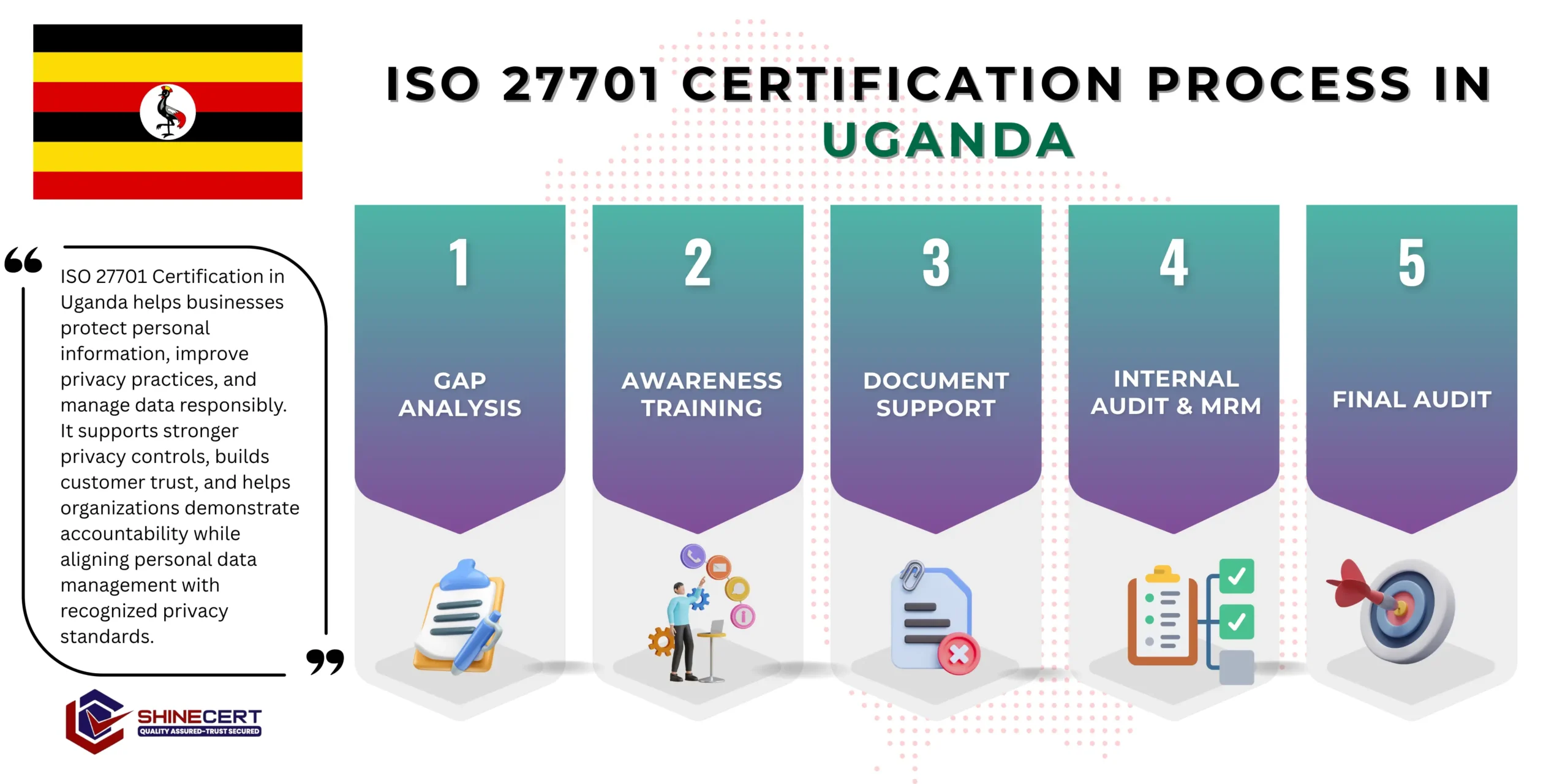
ISO 27701 Certification Process in Uganda
Getting certified is a five-stage journey, and understanding what actually happens at each stage makes the difference between a smooth certification and a stressful one.
Gap Assessment
We start by mapping, category by category, exactly what personal data flows through your business, customer records, employee files, transaction logs, anything else, and pinning down whether you’re acting as a controller, a processor, or genuinely both for different data sets.
That role determination shapes almost everything that follows, since a company processing data on behalf of a bank client carries different obligations than one collecting data directly from its own customers.
A clear picture of your actual data footprint and the specific PIMS gaps sitting between where you are now and where ISO 27701 needs you to be.
Documentation
With the data map and controller/processor split settled, we draft the privacy risk assessment, the data subject rights procedure, retention schedules, and every processor agreement or sub-processor record your specific data relationships require.
None of this gets borrowed from a generic privacy template, it’s built around the actual categories of data you actually hold.
A PIMS documentation layer sitting cleanly on top of your existing ISO 27001 system, ready to be tested rather than just filed.
Rollout
A privacy procedure that only exists in a document does nothing for a customer who actually emails asking what data you hold on them.
This stage is about making sure whoever answers that email actually knows the process, that the retention schedule is genuinely being followed rather than ignored, and that a breach response has been walked through at least once before it’s ever needed for real.
Staff who can genuinely execute a data subject request or breach notification without improvising on the spot.
Internal Review
Before any external assessor arrives, we run our own pass across every PIMS clause, actively hunting for exactly the kind of gap, an untested deletion process, a missing processor agreement, a retention schedule nobody’s checked in months, that a real auditor would flag first.
Those gaps closed out on our own timeline, not discovered under audit pressure.
Certification Audit
The external audit runs in two parts: first confirming your PIMS documentation genuinely extends your ISO 27001 system the way it’s supposed to, then testing whether the controls actually operate the way the documentation claims, pulling a real data subject request, checking a real retention record, reviewing how a real (or simulated) incident was handled.
Your ISO 27701 certificate, running alongside your ISO 27001 certificate for three years, with surveillance audits scheduled from there.
Staying Certified: Surveillance and Renewal
An ISO 27701 certificate runs for three years, alongside your underlying ISO 27001 certificate, with annual surveillance audits in years one and two reviewing whether your privacy management system is genuinely still functioning. A full recertification audit at the three-year mark determines whether the certificate continues. We recommend treating surveillance audits as a genuine checkpoint given how personal data processing tends to expand quietly over time as a business adds new digital services or data-sharing partnerships.
Realistic Timelines for Ugandan Businesses
| Business Profile | Typical Total Timeline | What Drives This |
|---|---|---|
| Small business, limited personal data processing | 2.5–3.5 months | Narrower scope and simpler documentation |
| Medium business, meaningful customer or employee data | 3.5–5 months | Broader privacy scope across data categories |
| Larger business processing sensitive or high-volume data | 5–7 months | Extensive privacy scope, multiple data categories, and processor relationships |
ISO 27701 Certification Cost in Uganda
- There’s no flat price for ISO 27701 certification in Uganda, because cost genuinely tracks a specific set of factors rather than a fixed fee schedule. Headcount matters less here than the genuine volume and sensitivity of personal data processed, a business handling financial or health data needs a considerably more detailed privacy risk assessment than one with a small, low-sensitivity customer database.
- The nature of the business is often the single biggest cost driver for this particular standard. Fintechs, healthcare providers, and telecoms processing large volumes of sensitive personal data face meaningfully deeper documentation needs than a business whose data processing is limited to basic employee and customer contact information. Whether the business acts as a controller, a processor, or both adds cost in a similar way, since processor relationships require additional documented agreements with each client whose data is being handled.
- How much privacy documentation already exists also shapes the timeline and therefore the cost, businesses that already hold ISO 27001 certification aren’t starting from a blank page, since ISO 27701 builds directly on that foundation. Certification body fees sit outside all of this: whichever accredited body actually conducts your audit sets and bills that fee directly, and it is never bundled into our quote. Finally, since ISO 27701 requires an existing or simultaneously implemented ISO 27001 certification, businesses pursuing both together see real cost efficiency compared to sequencing them with a gap in between.
Where Certification Matters Most Across Uganda’s Economy?
Healthcare and Telehealth Providers
Healthcare and telehealth providers arguably face the sharpest need for this specific standard, since patient records combine high sensitivity with genuinely difficult data subject rights questions, a patient asking to see or delete their own medical history triggers exactly the kind of tested procedure ISO 27701 requires, in a sector where getting it wrong causes real harm.
Read moreOutsourced HR and Payroll Processors
Outsourced HR and payroll processors sit right behind them, since their entire business model involves handling employee personal data on behalf of other companies, making the controller-versus-processor distinction the standard forces into the open a daily operational reality rather than a theoretical exercise.
Read moreInsurance Providers
Insurance providers collecting detailed personal and financial information during underwriting face genuine data subject rights complexity given how long policy records are typically retained.
Read moreEducation Institutions and EdTech Platforms
Education institutions and edtech platforms handling student and guardian data increasingly need documented consent and retention practices as digital learning tools spread beyond Kampala.
Read moreRecruitment, Staffing and Market Research Firms
Recruitment and staffing agencies processing candidate CVs and background information, and market research or survey firms collecting consumer data directly from the public, round out the businesses where a documented privacy layer answers a specific, recurring operational question rather than sitting as an abstract compliance exercise.
Read moreA Ugandan Business We’ve Worked With
- A Kampala-based telehealth platform processing patient health records approached us after a patient formally requested deletion of their data under the DPPA and the company realized it had no actual process for fulfilling that request.
- Our gap assessment found the company’s technical security was reasonably strong under its existing ISO 27001 certification, but there was no documented data subject rights procedure, no data retention schedule, and no clarity on whether the company was acting as a controller or processor for different categories of the health data it held.
- We built a privacy information management system covering a tested data subject rights procedure, a documented retention and deletion schedule, and clear controller-processor role definitions across its data categories. Certification took just under four months, and the company was able to fulfill the original deletion request, and every one since, within a documented and repeatable process.
- We see this pattern often enough to name it directly: businesses with genuinely strong security that had never formalized the specific privacy processes the DPPA and ISO 27701 both expect, this describes a recurring situation, not one specific client.
The Documentation PDPO-Conscious Auditors Expect, Clause by Clause
- Clause 5 — PIMS-Specific Requirements Related to ISO 27001 : Document: Scope of the PIMS Statement. A written boundary defining exactly which personal data processing activities your privacy information management system covers, and whether you act as controller, processor, or both.
- Clause 6 — Planning. Document: Privacy Risk Assessment : A record identifying every genuine privacy risk associated with your data processing, mapped against DPPA obligations specifically.
- Clause 7 — Controller-Specific Guidance : Document: Data Subject Rights Procedure. A working, tested process for actually fulfilling access, correction, deletion, and objection requests within a reasonable timeframe. Document: Privacy Notice. A clear, genuine statement to data subjects about what personal data is collected and why, not generic legal boilerplate nobody actually reads. Document: Consent Records. Evidence of genuine, informed consent where consent is the lawful basis for processing.
- Clause 8 — Processor-Specific Guidance : Document: Data Processing Agreements. Documented agreements with any client whose data you process on their behalf, clarifying respective privacy obligations. Document: Sub-Processor Records. Evidence any further sub-processors you use are genuinely vetted for privacy compliance.
- Shared Requirements : Document: Data Retention and Deletion Schedule. A documented policy for how long personal data is genuinely kept and how it’s securely deleted afterward. Document: Breach Response Procedure. A tested plan for detecting, assessing, and reporting a privacy incident, feeding directly into PDPO breach reporting obligations. Document: Internal Audit and Management Review Records. Evidence the privacy management system is genuinely reviewed and improved over time.
ISO 27701 Certification Across Uganda’s Business Hubs
ISO 27701 in Kampala
ISO 27701 in Jinja
ISO 27701 in Mbarara
ISO 27701 in Entebbe
ISO 27701 in Gulu
The Real Challenges Organizations Face While Implementing ISO 27701
Getting certified is rarely blocked by a lack of willingness, it’s the practical, day-to-day implementation work that trips organizations up. Here’s what we actually see Ugandan businesses struggle with:
- Controller versus processor status is often genuinely unclear : Many businesses process data on behalf of clients without ever formally determining which DPPA obligations fall on them versus their client, which ISO 27701 forces into the open during documentation.
- Data subject rights procedures exist on paper but have never actually been exercised : It’s common for a business to have a documented process for handling an access or deletion request that has genuinely never been tested against a real request, leaving real uncertainty about whether it would work.
- Data retention gets treated informally, with data kept indefinitely by default : Businesses often keep customer or employee data far longer than genuinely necessary simply because no one has defined a retention schedule, which is exactly the kind of gap an auditor will flag.
- Third-party data sharing happens without documented agreements : Businesses sharing data with vendors, partners, or sub-processors often do so on informal trust rather than documented data processing agreements clarifying each party’s privacy obligations.
- Privacy stays an IT security topic and never reaches broader business decision-making : ISO 27701 expects genuine organizational accountability for privacy, but in many businesses privacy is treated purely as a technical security matter rather than a business-wide responsibility.
Why Businesses Choose ShineCert in Uganda?
ShineCert brings 10 years of ISO consulting and certification experience to Uganda’s market, coordinated through our Riyadh and India offices with services delivered remotely or on-site depending on what your engagement genuinely needs. We’ve guided more than 10,000 organizations through ISO certification worldwide, and as the best ISO 22301 consultant in Uganda, ShineCert builds every continuity engagement around your actual critical activities and Uganda’s documented grid reliability realities.
Choosing a Certification Body in Uganda?
What to Check | Why It Matters |
Accreditation under a recognized international framework | Confirms the certificate carries genuine weight with regulators, partners, and international clients alike |
Genuine understanding of the DPPA and PDPO requirements versus accredited ISO certification | Ensures the auditor can clearly explain how legal compliance and ISO certification relate to your business |
Experience with your specific sector’s data sensitivity | Fintech, healthcare, and telecom carry genuinely different privacy considerations |
Ability to certify ISO 27701 alongside or building on ISO 27001 | Reduces duplication and cost when pursued together |
Ready to Get Started?
Whether you’re responding to a DPPA data subject request or building privacy management into a growing digital service from the start, we’ll walk through your specific data processing activities and cost factors before proposing a fixed-scope plan, delivered remotely, on-site, or however genuinely fits your project. Book a free consultation or contact us directly to get started.
Frequently Asked Questions
Look for genuine understanding of the DPPA and PDPO requirements versus accredited ISO certification, sector-specific privacy experience, and honest scoping before pricing. ShineCert scopes every Uganda engagement individually.
No. The Personal Data Protection Office enforces the DPPA and handles breach reports and compliance orders, but accredited ISO 27701 certification comes through an independent, accredited certification body.
Yes, ISO 27701 is a privacy extension to ISO 27001 and requires either an existing ISO 27001 certification or simultaneous implementation of both.
It depends on your data processing volume, sensitivity, and role as controller or processor, we scope every project individually.
Typically two and a half to seven months depending on organization size and data processing complexity.
Documentation work runs fine remotely, but process verification and staff training genuinely benefit from at least some in-person or live sessions.
Not a standalone one, we coordinate Uganda engagements from our Riyadh and India offices, with services delivered remotely or on-site as your project requires.