
ISO 9001 Certification in Uganda
Quick Answer
ISO 9001 certifies that a business has a structured, independently verified quality management system, not a UNBS registration, and not a certificate UNBS itself issues for this standard. The Uganda National Bureau of Standards coordinates the country’s standards landscape and is Uganda’s official ISO member body, but ISO 9001 certification comes through an accredited, independent certification body, the same way it works globally. For Ugandan businesses, the standard has genuinely direct relevance right now: Uganda’s trade deficits with Kenya, Tanzania, and Burundi are attributed largely to non-tariff barriers, and demonstrable quality management is one of the clearest, most addressable ways to clear that specific obstacle. Certification typically takes three to six months, and cost depends on real factors like your organization’s size and existing documentation.
Understanding ISO 9001: What It Actually Is, and Why It Matters in Uganda
ISO 9001 is published by the International Organization for Standardization and sets out requirements for a quality management system: a structured way of running an organization so that products or services consistently meet customer and regulatory requirements, and so that the business keeps improving how it does that over time. It covers everything from how leadership sets quality objectives, to how risks and opportunities get identified, to how nonconforming products get caught and corrected before they reach a customer. Certification means an accredited, independent auditor has formally verified this system is real and functioning, not a policy document sitting in a drawer.
Why this carries specific weight in Uganda comes down to the country’s regional trade position. Uganda sits inside the East African Community Customs Union, giving it duty-free access to a market of more than 200 million people, and yet Uganda runs trade deficits with several EAC neighbors that are attributed largely to non-tariff barriers rather than tariffs themselves. Quality and conformity gaps are exactly the kind of non-tariff barrier that keeps Ugandan goods out of markets they’d otherwise have free access to, a certified quality management system is a concrete, addressable way to close that gap, distinct from anything UNBS’s own domestic certification marks cover.
Benefits of ISO 9001 Certification for Ugandan Organizations
Here’s what certified Ugandan businesses actually gain, explained in full rather than as a one-line summary:
A growing number of government tenders processed through PPDA’s digitized procurement portal, along with private-sector supply agreements from larger institutional buyers, now list ISO 9001 as either a mandatory qualifying criterion or a significant scoring advantage during vendor evaluation. Without it, a business can find itself disqualified before its actual price or technical proposal is even reviewed, certification is often the ticket that gets you into the room, not just an advantage once you’re there.
Beyond addressing the non-tariff barriers affecting EAC trade specifically, ISO 9001 is widely recognized well outside East Africa, European, Gulf, and Asian buyers sourcing from Uganda routinely treat it as baseline evidence of a reliable trading partner. For a business with ambitions beyond the regional market, certification is frequently the first credential an international buyer’s procurement team asks about.
ISO 9001 is built around a genuine plan-do-check-act cycle, not a one-time setup. That means the system is designed to keep surfacing inefficiencies, a production step that wastes material, a bottleneck in order processing, a recurring cause of delay, and to force a documented response to each one. Businesses that take this seriously find the certification process itself uncovers real operational improvements, not just paperwork.
Catching a quality problem at the point it occurs costs far less than catching it after a product has shipped or a service has been delivered. Systematic nonconformity tracking and root-cause analysis directly reduce the material waste, wasted labor, and rework that eat into margins when problems are only caught informally.
When a Kenyan or Tanzanian buyer hesitates over a Ugandan supplier’s conformity standing, a certified quality management system gives that buyer independent, third-party evidence the business can actually stand behind, not a verbal assurance, but a certificate an auditor has tested.
As Uganda’s coffee, gold, and manufactured exports grow, buyers evaluating multiple suppliers increasingly use ISO 9001 as a fast filter, a supplier without it has to work harder to prove reliability case by case, while a certified supplier starts the conversation from a position of established trust.
ISO 9001 requires a genuine system for catching nonconforming products or services before they reach a customer, and for tracking why the failure happened so it doesn’t repeat. Businesses without this system tend to catch problems only after a customer complains, by which point the cost, lost trust, returned goods, a damaged relationship, is already spent.
Before certification, quality is often “everyone’s job,” which in practice often means nobody’s specific responsibility. ISO 9001 requires named roles, defined responsibilities, and leadership sign-off on quality objectives, which removes the ambiguity about who actually owns a quality problem when one surfaces.
Informal quality practices, a supervisor’s personal checks, tribal knowledge passed between staff, work fine at small scale but break down as a business adds shifts, sites, or product lines. A certified system is built to scale with the business rather than quietly eroding as complexity increases.
Businesses that later pursue ISO 14001, ISO 45001, or ISO 22000 find that document control discipline, internal audit habits, and management review cycles built for ISO 9001 carry over directly, meaningfully shortening the path to the next certification.
What are the steps to get ISO 9001 Certification in Uganda?
our services
- ISO Certification Uganda
- ISO 9001 Certification Uganda
- ISO 14001 Certification Uganda
- ISO 27001 Certification Uganda
- ISO 22000 Certification Uganda
- ISO 27701 Certification Uganda
- ISO 45001 Certification Uganda
- ISO 20000-1 Certification Uganda
- ISO 13485 Certification Uganda
- ISO 17025 Certification Uganda
- ISO 31000 Certification Uganda
- ISO 42001 Certification Uganda
- ISO 37001 Certification Uganda
- ISO 22301 Certification Uganda
- ISO 50001 Certification Uganda
- CE Mark Certification Uganda
- GDPR Certification Uganda
- GMP Certification Uganda
- Halal Certification Uganda
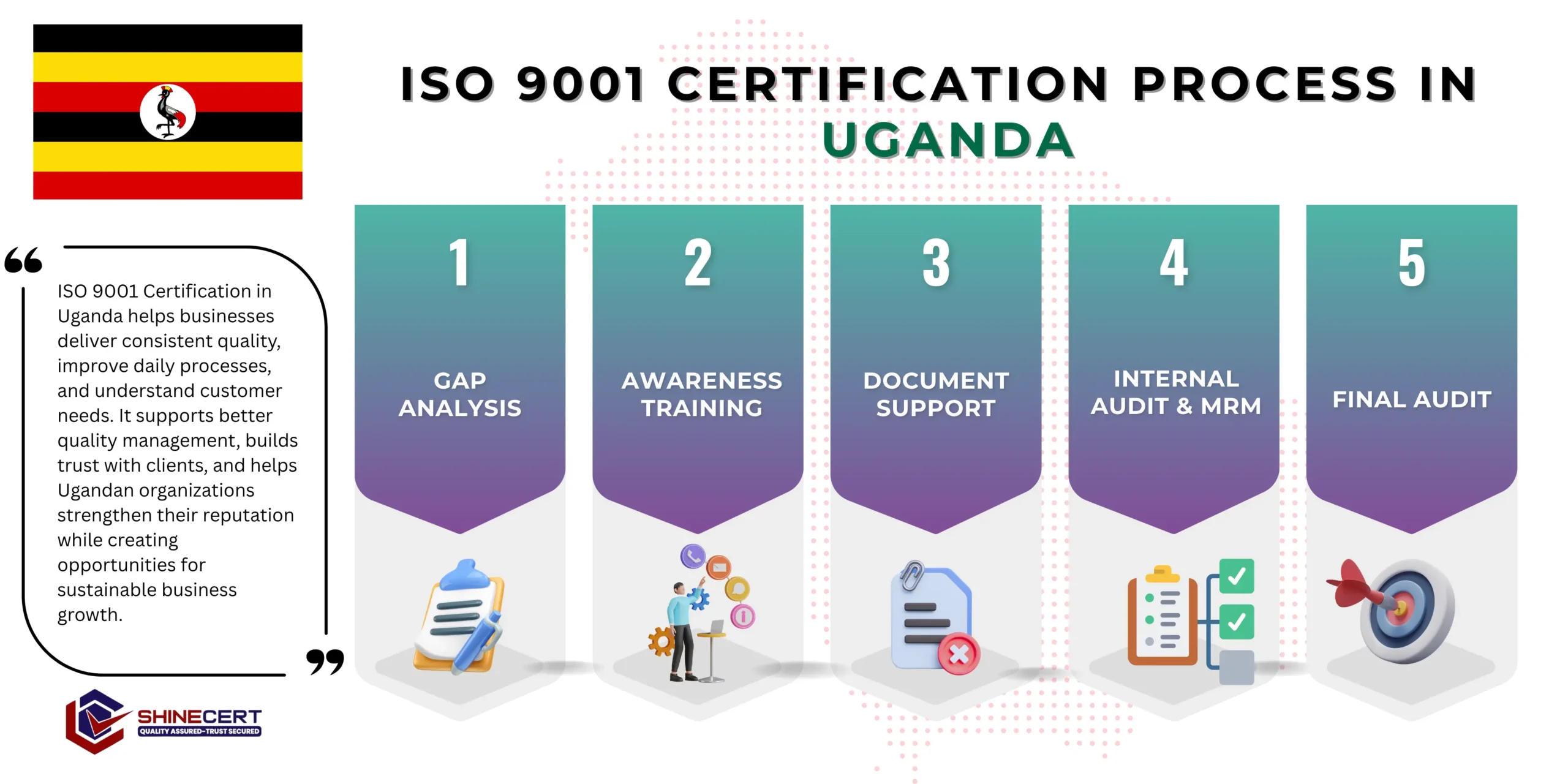
ISO 9001 Certification Process in Uganda
Getting certified is a five-stage journey, and understanding what actually happens at each stage, not just the stage names, makes the difference between a smooth certification and a stressful one.
Gap Assessment
This is where we actually walk through your business, your production line, your service delivery, your supplier relationships, and compare what we see against what ISO 9001 genuinely requires. We’re not working from a generic checklist; we’re documenting exactly where your current practices already meet the standard and exactly where they fall short.
A Ugandan food processor and a Ugandan software company will have almost nothing in common in this report, because their actual gaps are different.
A written gap report that becomes the roadmap for everything that follows.
Documentation
This is usually the longest stage, and for good reason, we’re writing the quality manual, the risk and opportunity register, and every operational procedure your business actually needs, in language that reflects how your team actually works.
A common mistake at this stage, one we deliberately avoid, is dropping in generic template language that sounds official but doesn’t match anything your staff would recognize as their actual job.
A complete, genuinely usable QMS documentation set, not a binder that looks impressive but gets ignored.
Implementation
Documentation on paper means nothing until it’s actually how your business runs.
This stage is about training staff on the new procedures, starting to log nonconformities and corrective actions for real, and letting the system generate genuine operational evidence, the records an auditor will actually look for.
A functioning quality system with weeks of real operational data behind it by the time the audit arrives.
Internal Audit and Management Review
Before any external auditor sees your system, we test it ourselves, clause by clause, looking specifically for the gaps a certification auditor would flag.
This is deliberately the least comfortable stage, we’re looking for problems on purpose, while the stakes are still low.
A list of corrective actions, already closed out, before the real audit begins.
Certification Audit
This runs in two parts. Stage 1 is a documentation review confirming your system is ready to be tested.
Stage 2 is the real test, the auditor is physically present, reviewing your actual records, watching your actual processes, and talking directly to your staff.
Your ISO 9001 certificate, valid for three years, and a clear schedule for the surveillance audits that follow.
Staying Certified: Surveillance and Renewal
An ISO 9001 certificate runs for three years, with annual surveillance audits in years one and two reviewing whether your quality system is genuinely still functioning, not just filed away after the initial audit. A full recertification audit at the three-year mark determines whether the certificate continues. We recommend treating surveillance audits as a genuine checkpoint, not a formality, the businesses that get the most value from certification are the ones still actively using their quality system between audits, not just before them.
Realistic Timelines for Ugandan Businesses
| Business Profile | Typical Total Timeline | What Drives This |
|---|---|---|
| Small business, single location | 2.5–3.5 months | Narrower process scope and simpler documentation |
| Medium business, multiple departments | 3.5–5.5 months | Broader operational scope across departments |
| Larger or multi-site business | 5.5–8 months | Extensive process scope across sites and product lines |
ISO 9001 Certification Cost in Uganda
There’s no flat price for ISO 9001 certification in Uganda, cost genuinely comes down to a specific set of factors, each explained here rather than left as a vague bullet:
A larger workforce generally means more people to train on new procedures, more roles to define within the quality system, and more staff whose competence records need to be built and maintained, all of which adds real time to the documentation and implementation stages.
A business with several distinct operational areas, production, procurement, dispatch, customer service, needs a broader quality manual and more operational procedures than one with a single, tightly defined process. Each department typically needs its own documented procedures and its own internal audit coverage.
A manufacturer with physical production lines, raw material sourcing, and finished-goods quality checks needs meaningfully deeper documentation than a professional services firm whose “product” is largely advisory work. Food processing, pharmaceuticals, and manufacturing generally sit at the more document-intensive end; general trading and services sit at the lighter end.
Each additional site typically needs its own process verification, its own internal audit coverage, and often its own portion of the certification audit itself.
Businesses with some quality processes already documented, even informally, aren’t starting from a blank page, which genuinely shortens the documentation stage.
Whichever accredited body actually conducts your audit sets and bills that fee directly; it is never bundled into our quote.
Combining ISO 9001 with ISO 14001 or ISO 45001 shares real documentation groundwork, bringing the combined cost down compared to running two separate projects.
A Ugandan Business We’ve Worked With
- A Jinja-based food processor exporting roasted coffee to regional EAC buyers approached us after a Kenyan distributor flagged inconsistent packaging and labeling across shipments as a recurring concern, threatening a growing contract relationship.
- Our gap assessment found the company’s actual roasting and processing practices were genuinely solid, but there was no formal nonconformity tracking system, and quality checks before shipment were handled informally by whichever staff member happened to be available that day.
- We built a documented nonconformity and corrective action process, along with clear operational procedures for pre-shipment quality checks. Certification took just under four months, and the company’s Kenyan distributor relationship stabilized with no further packaging or labeling complaints in the following shipments.
- We see this pattern often enough to name it directly: genuinely capable operations that had never formalized the quality checks they were already doing inconsistently, this describes a recurring situation, not one specific client.
Where Certification Matters Most Across Uganda’s Economy?
Coffee, tea, and agricultural exports
ISO 9001 is close to essential given the quality consistency international buyers expect, particularly relevant given Uganda’s record coffee export performance and the non-tariff barrier concerns exporters specifically need to address.
Read moreManufacturing
As Uganda’s industrial sector continues growing, ISO 9001 addresses the quality consistency that informal supervisor-led checks stop delivering once a business adds shifts, product lines, or a second site.
Read moreHealthcare and medical services
Hospitals, clinics, and diagnostic labs use ISO 9001 to standardize patient-facing processes and administrative quality, often as a foundation before pursuing more specialized standards like ISO 13485 for any medical device handling involved.
Read moreHospitality and tourism
Hotels, lodges, and tour operators serving Uganda’s growing tourism sector use ISO 9001 to standardize guest service quality across properties and seasons, particularly valuable for chains or groups managing consistency across multiple locations.
Read moreInformation technology and business process outsourcing
Ugandan software and BPO companies serving international clients use ISO 9001 to demonstrate process discipline and consistent service delivery, often as a first step before pursuing ISO 27001 or ISO 20000-1.
Read moreGold refining and mineral processing
ISO 9001 supports the quality and process consistency expectations tied to Uganda’s growing mineral export sector.
Read moreConstruction and public infrastructure
ISO 9001 supports tender eligibility as PPDA continues modernizing procurement expectations around vendor reliability and documented quality practice.
Read moreLogistics and transport
Freight, warehousing, and distribution businesses use ISO 9001 to standardize handling and delivery consistency, particularly relevant for businesses supporting Uganda’s growing import-export volume.
Read moreThe Documentation UNBS-Conscious Auditors Expect, Clause by Clause
- Clause 4 — Context of the Organization : Document: Scope of the QMS Statement. A written boundary defining exactly which products, services, sites, and processes your quality system covers.
- Clause 5 — Leadership : Document: Quality Policy. Top management’s signed commitment to quality objectives and customer focus, genuinely reflecting how the business actually operates.
- Clause 6 — Planning : Document: Risk and Opportunity Register. A record identifying risks to product or service quality, including regional trade and supply chain risks relevant to Uganda’s specific export position, and how each is addressed. Document: Quality Objectives. Specific, measurable targets tied to the quality policy, not aspirational statements.
- Clause 7 — Support : Document: Competence and Training Records. Evidence staff have the training their role genuinely requires. Document: Document Control Procedure. A defined process for how quality documents are created, reviewed, and kept current.
- Clause 8 — Operation : Document: Operational Control Procedures. Documented procedures for how products or services are actually produced or delivered. Document: Supplier Evaluation Records. Evidence that suppliers are genuinely assessed for quality reliability, not just onboarded on trust. Document: Nonconforming Output Records. A working process for catching and correcting products or services that don’t meet specification.
- Clause 9 — Performance Evaluation : Document: Internal Audit Records. Evidence the internal audit schedule was actually carried out, clause by clause, not just written into a manual. Document: Management Review Minutes. A record that leadership genuinely reviewed quality performance and made real decisions in response.
- Clause 10 — Improvement : Document: Corrective Action Records. A functioning log tracking quality issues from discovery through to genuinely closed corrective action.
ISO 9001 Certification Across Uganda’s Business Hubs
ISO 9001 in Kampala
ISO 9001 in Jinja
ISO 9001 in Mbarara
ISO 9001 in Entebbe
ISO 9001 in Gulu
Updating to ISO 9001:2026 in Your Organization
ISO 9001 is currently undergoing its first major revision since 2015. As of mid-2026, the Final Draft International Standard (FDIS) has gone to ballot, with formal publication expected around September 2026 and a transition window, subject to final confirmation by the International Accreditation Forum, likely running roughly three years from publication, putting the deadline for existing certificate holders to migrate at approximately September 2029. Three confirmed areas of change are worth planning for now: a stronger emphasis on quality culture and ethical behavior as part of leadership commitment, a clearer separation between risk and opportunity in the planning clause, and formal integration of climate change considerations into the context-of-the-organization analysis.
Practical steps for Ugandan organizations already certified, or currently pursuing certification, to prepare:
- Review your Clause 4.1 context analysis for climate-related gaps : If your current context statement doesn’t address climate-related risks or opportunities relevant to your operations, supply chain disruption, resource availability, this is the clause most likely to need expansion.
- Separate your combined risk-and-opportunity register into distinct sections : Many existing systems track risk and opportunity as a single combined entry; the 2026 revision expects these treated as genuinely distinct considerations with their own analysis.
- Revisit your leadership commitment and quality policy for cultural and ethical language : The revision’s emphasis on quality culture means policies focused purely on technical quality objectives may need genuine expansion to address organizational behavior and ethics.
- Update your internal audit checklist to test culture, not just documentation : Internal auditors will need to assess whether quality thinking has genuinely spread through the organization, not just whether procedures exist on paper.
- Plan your transition audit timing with your certification body well ahead of the deadline : Certification bodies will face a genuine capacity crunch as every existing certificate holder needs a transition audit within the same multi-year window, booking early avoids being caught at the back of that queue.
The Real Challenges Organizations Face While Implementing ISO 9001
Getting certified is rarely blocked by a lack of willingness, it’s the practical, day-to-day implementation work that trips organizations up. Here’s what we actually see Ugandan businesses struggle with:
- The documentation workload is bigger than most businesses expect going in : Writing a genuine quality manual, a risk register, and operational procedures for every significant process takes real time from people who are also running the business day to day. Organizations that treat this as a side project squeezed into spare hours consistently take longer than those who assign it real, protected time.
- Staff see new procedures as extra paperwork rather than a better way to work : When quality documentation is handed down without explanation, employees tend to treat it as compliance theater, filling in a form because they’re told to, not because they understand why it matters. Certification efforts that skip staff buy-in tend to produce documentation that looks complete but isn’t genuinely followed on the floor.
- Supplier evaluation gets treated as a formality rather than genuine verification : Businesses sourcing raw materials from multiple smallholder farmers or informal suppliers often underestimate how much documentation is actually needed to demonstrate real supplier quality checks, not just a list of names and phone numbers.
- Internal audits get scheduled but not genuinely carried out : It’s common for a business to write an internal audit schedule into its manual and then let it slide when things get busy, which is exactly the kind of gap a certification auditor is trained to spot immediately.
- Discipline erodes after the initial certificate is issued : The push to get documentation right and processes running tends to peak right before the first audit, then quietly fade once the certificate is in hand, until the surveillance audit arrives and finds records that stopped being kept months earlier.
Why Businesses Choose ShineCert in Uganda?
ShineCert brings 10 years of ISO consulting and certification experience to Uganda’s market, coordinated through our Riyadh and India offices with services delivered remotely or on-site depending on what your engagement genuinely needs. We’ve guided more than 10,000 organizations through ISO certification worldwide, and we build every Uganda engagement around your actual operations and export goals, this is why Ugandan businesses increasingly choose ShineCert as the best ISO 9001 consultant in Uganda.
Choosing a Certification Body in Uganda
What to Check | Why It Matters |
Accreditation under a recognized international framework | Confirms the certificate carries genuine weight with EAC and international buyers alike |
Genuine understanding of UNBS’s role versus accredited ISO certification | Ensures the auditor can clearly explain how the two frameworks relate to your business |
Experience with your specific sector | Agricultural export, manufacturing, healthcare, and hospitality carry genuinely different quality considerations |
Recognition by your target export markets | Some regional and international buyers have specific certification body preferences worth confirming early |
Ready to Get Started?
Whether you’re addressing non-tariff barrier concerns for regional export or preparing for your first EAC buyer relationship, we’ll walk through your specific operations and cost factors before proposing a fixed-scope plan, delivered remotely, on-site, or however genuinely fits your project. Book a free consultation or contact us directly to get started.
Frequently Asked Questions
Look for genuine understanding of UNBS’s actual role versus accredited certification, sector-specific experience, and honest scoping before pricing. ShineCert scopes every Uganda engagement individually.
Not directly, UNBS runs its own product and systems certification schemes and coordinates Uganda’s standards landscape as the country’s ISO member body, but accredited ISO 9001 certification comes through an independent, accredited certification body.
It depends on your number of employees, number of departments, the nature of your business, and existing documentation maturity, we scope every project individually.
Typically two and a half to eight months depending on organization size and complexity, see the timeline breakdown above.
Yes, existing certificate holders will have a transition window, likely running about three years from formal publication expected around September 2026, to migrate to the new revision.
Documentation work runs fine remotely, but facility audits and process verification genuinely need in-person site visits.
Not a standalone one, we coordinate Uganda engagements from our Riyadh and India offices, with services delivered remotely or on-site as your project requires.