
ISO 27001 Certification in Uganda
Quick Answer
ISO 27001 certifies that a business has a structured, independently verified information security management system. a genuinely different thing from registration or compliance under Uganda’s Data Protection and Privacy Act, 2019, which is a legal obligation enforced by the Personal Data Protection Office rather than an ISO certification. The Personal Data Protection Office, housed within the National Information Technology Authority Uganda, oversees data protection enforcement and breach reporting, but ISO 27001 certification itself comes through an accredited, independent certification body. The standard carries real urgency in Uganda right now: industry data shows a 60% year-on-year increase in cyberattacks nationally, a November 2024 breach cost the Bank of Uganda an estimated UGX 62 billion, and NITA-U has just rolled out an updated National Information Security Framework for 2026 to strengthen baseline security controls across the economy. Certification typically takes three to six months, and cost depends on real factors like your organization’s size, sector, and existing security maturity.
Understanding ISO 27001: What It Actually Is, and Why It Matters in Uganda
ISO 27001 is published by the International Organization for Standardization and sets out requirements for an information security management system: a structured way of identifying information risks, applying appropriate controls, and building the monitoring and improvement processes needed to keep data genuinely protected over time. It covers everything from access control and encryption, to supplier security, to how the business responds when an incident actually happens. Certification means an accredited, independent auditor has formally verified this system is real and functioning, not a security policy document nobody has actually implemented.
Why this carries specific weight in Uganda comes down to a genuinely escalating threat environment layered onto a fast-growing digital economy. Uganda’s mobile money sector continues expanding rapidly, and more small and medium businesses are integrating with digital payment gateways every year, which multiplies the number of genuine entry points an attacker can target. The Bank of Uganda breach in November 2024, estimated at UGX 62 billion in losses, was a visible, high-profile demonstration of what’s at stake, and NITA-U’s 2026 National Information Security Framework reflects a genuine policy response aimed at raising baseline security controls across public and, by extension, private institutions that interact with them.
Benefits of ISO 27001 Certification for Ugandan Organizations
Here’s what certified Ugandan businesses actually gain from ISO 27001, explained in full rather than as a one-line summary:
With cyberattacks in Uganda reportedly up 60% year on year, a certified information security management system gives a business genuine, tested controls rather than ad hoc security measures assembled after a scare.
Fintechs and e-service providers already face NITA-U security assessments as part of their regulatory obligations, and ISO 27001’s control framework maps closely onto what those assessments look for, meaningfully easing that regulatory relationship.
Banks, telecoms, government agencies, and international partners increasingly require documented information security evidence as part of vendor evaluation, particularly for any contract involving customer data or payment processing.
A certified system requires genuine incident response planning and testing, which measurably reduces both the likelihood of a breach spiraling out of control and the direct financial cost when an incident does occur.
International clients and partners, particularly in outsourcing, financial services, and technology, increasingly treat ISO 27001 as baseline evidence a Ugandan partner can be trusted with sensitive data, opening doors that a business without certification has to work harder to open.
While ISO 27001 and the DPPA are legally distinct, the security controls ISO 27001 requires directly support the technical and organizational measures the Act expects businesses to have in place to protect personal data.
Before certification, information security is often treated as solely an IT department’s problem. ISO 27001 requires named roles, defined responsibilities, and leadership sign-off on security objectives, removing the ambiguity about who actually owns a security gap when one surfaces.
Informal security practices that work for a small operation break down as a business adds systems, staff, and third-party integrations, a certified system is built to scale alongside genuine digital growth.
Businesses that later pursue ISO 27701 or ISO 20000-1 find that the risk assessment discipline, document control habits, and management review cycles built for ISO 27001 carry over directly, meaningfully shortening the path to the next certification.
What are the steps to get ISO 27001 Certification in Uganda?
our services
- ISO Certification Uganda
- ISO 9001 Certification Uganda
- ISO 14001 Certification Uganda
- ISO 27001 Certification Uganda
- ISO 22000 Certification Uganda
- ISO 27701 Certification Uganda
- ISO 45001 Certification Uganda
- ISO 20000-1 Certification Uganda
- ISO 13485 Certification Uganda
- ISO 17025 Certification Uganda
- ISO 31000 Certification Uganda
- ISO 42001 Certification Uganda
- ISO 37001 Certification Uganda
- ISO 22301 Certification Uganda
- ISO 50001 Certification Uganda
- CE Mark Certification Uganda
- GDPR Certification Uganda
- GMP Certification Uganda
- Halal Certification Uganda
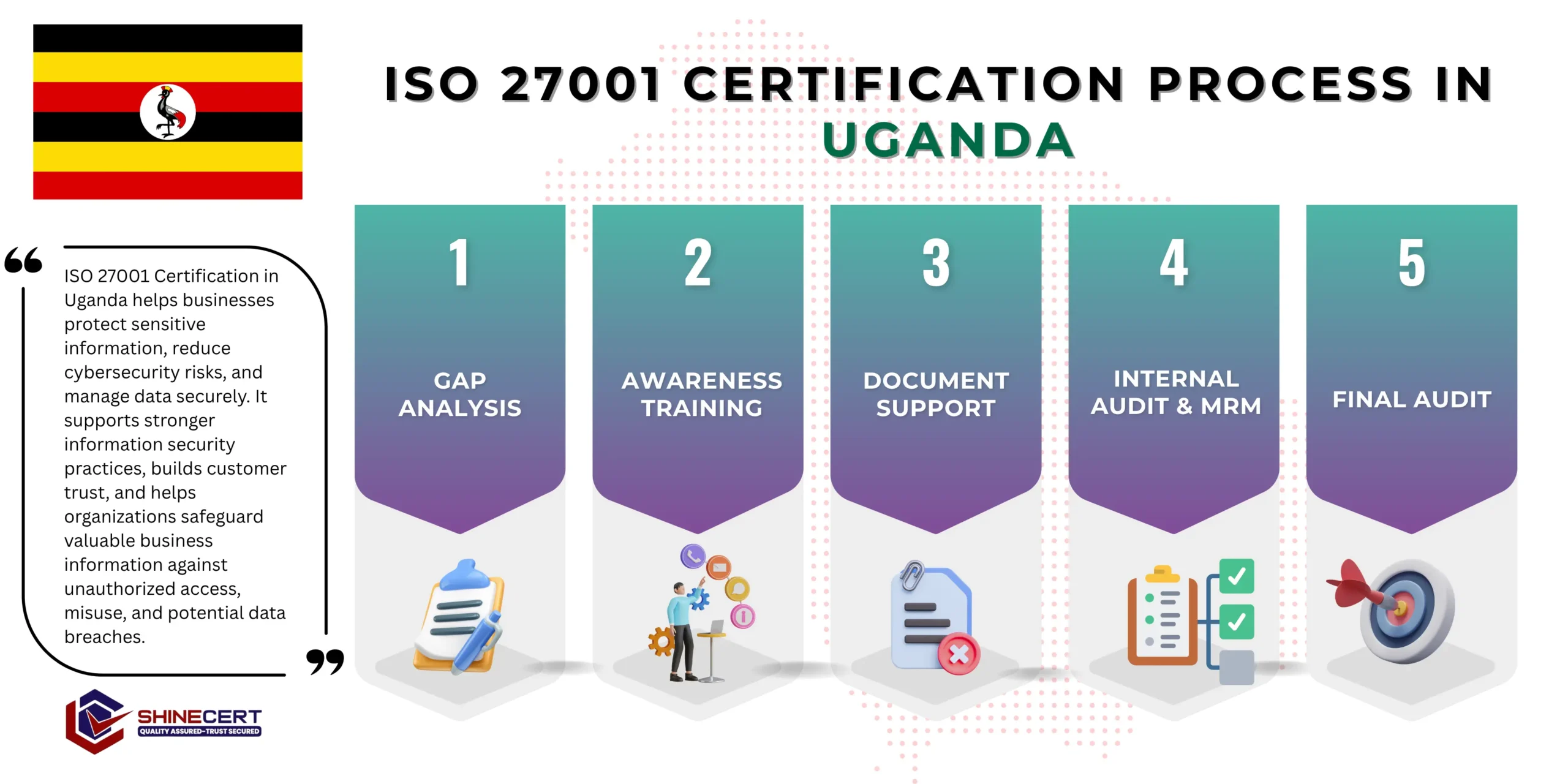
ISO 27001 Certification Process in Uganda
Getting certified is a five-stage journey, and understanding what actually happens at each stage makes the difference between a smooth certification and a stressful one.
Gap Assessment
This is where we review your actual systems, data flows, and third-party integrations, including payment gateways and mobile money connections where relevant, and compare what we find against what ISO 27001 genuinely requires.
A Kampala fintech and a Jinja manufacturer with a small back-office IT system face very different genuine risks, and the assessment reflects that.
A written gap report that becomes the roadmap for everything that follows.
Documentation
This stage builds the security policy, the risk register, the Statement of Applicability, and every operational procedure your business genuinely needs, written to reflect your actual systems rather than generic template language.
A complete, genuinely usable ISMS documentation set.
Implementation
Documentation on paper means nothing until it’s actually how your business runs.
This stage rolls out access controls, encryption, and security training, and begins genuine incident logging.
A functioning information security management system with weeks of real operational data behind it.
Internal Audit and Management Review
Before any external auditor sees your system, we test it ourselves, clause by clause, looking specifically for the gaps a certification auditor, or a NITA-U security assessment, would flag.
A list of corrective actions, already closed out, before the real audit begins.
Certification Audit
Stage 1 is a documentation review confirming your system is ready to be tested.
Stage 2 is the real test, the auditor is physically present, reviewing your actual records and testing your actual controls.
Your ISO 27001 certificate, valid for three years, and a clear schedule for the surveillance audits that follow.
Staying Certified: Surveillance and Renewal
An ISO 27001 certificate runs for three years, with annual surveillance audits in years one and two reviewing whether your security management system is genuinely still functioning. A full recertification audit at the three-year mark determines whether the certificate continues. Given the documented 60% year-on-year rise in cyberattacks, we recommend treating surveillance audits as a genuine operational checkpoint, since a security system left unattended between audits is exactly the kind of gap attackers are actively looking for.
Realistic Timelines for Ugandan Businesses
| Business Profile | Typical Total Timeline | What Drives This |
|---|---|---|
| Small business, single system | 2.5–3.5 months | Narrower technical scope and simpler documentation |
| Medium business, multiple systems or integrations | 3.5–5.5 months | Broader technical scope across systems and third-party integrations |
| Larger business with complex IT environment | 5.5–8 months | Extensive system scope, multiple data centers, and integration complexity |
ISO 27001 Certification Cost in Uganda
- There’s no flat price for ISO 27001 certification in Uganda, because cost genuinely tracks a specific set of factors rather than a fixed fee schedule. Headcount and the number of departments with system access both matter, since more people touching sensitive systems means more roles to define and more training to deliver, but the number of distinct IT systems and third-party integrations in scope is often the bigger driver, a business connected to multiple mobile money or payment gateway providers needs a broader risk register and Statement of Applicability than one running a single, self-contained system.
- The nature of the business is often the single biggest cost driver for this particular standard. Fintechs, banks, and telecoms handling customer financial data face meaningfully higher security expectations, and therefore deeper documentation needs, than a business whose systems are largely internal and administrative; the NITA-U security assessment requirements already facing fintechs and e-service providers reflect exactly this distinction. The number of locations and data centers adds cost in a similar way, since each additional site or hosting environment typically needs its own security assessment.
- How much security documentation already exists also shapes the timeline and therefore the cost, businesses that have already undergone a NITA-U security assessment aren’t starting from a blank page, since much of that work feeds directly into the ISO 27001 risk register. Certification body fees sit outside all of this: whichever accredited body actually conducts your audit sets and bills that fee directly, and it is never bundled into our quote. Finally, businesses combining ISO 27001 with ISO 27701 share real documentation groundwork across the two projects, which brings the combined cost down compared to running them separately.
Where Certification Matters Most Across Uganda’s Economy?
Financial Services and Fintech
Financial services and fintech sit closest to the center of this issue, given the documented Bank of Uganda breach, the rapid growth of mobile money integrations, and the NITA-U security assessment obligations fintechs already face.
Read moreTelecommunications
Telecommunications providers managing vast subscriber data face similarly high stakes, given both regulatory expectations and the sheer scale of personal data involved.
Read moreIT and Business Process Outsourcing
Information technology and business process outsourcing companies serving international clients increasingly need certification as a baseline trust signal before international partners will share sensitive data at all.
Read moreHealthcare and Government-Adjacent Services
Healthcare providers managing patient records, and government-adjacent service providers connecting to public digital infrastructure, both face genuine data sensitivity that a certified system directly addresses.
Read moreRetail and E-commerce
Retail and e-commerce businesses processing customer payment data round out the picture, particularly as digital payment adoption continues expanding across Uganda’s consumer economy.
Read moreA Ugandan Business We’ve Worked With
- A Kampala-based fintech offering a mobile payment gateway approached us after a routine NITA-U security assessment flagged gaps in its access control and incident response documentation, putting a key banking partnership at risk.
- Our gap assessment found the company’s actual technical controls were reasonably strong, but there was no formal risk register, no Statement of Applicability, and no documented incident response plan beyond informal escalation to the lead developer.
- We built a complete ISMS documentation set, including a risk register covering its payment gateway integrations and a tested incident response procedure. Certification took just under five months, and the company used its certificate to satisfy its banking partner’s security due diligence requirements without further delay.
- We see this pattern often enough to name it directly: businesses with genuinely solid technical security that had never formalized the documentation an auditor, or a banking partner, needs to see, this describes a recurring situation, not one specific client.
The Documentation NITA-U-Conscious Auditors Expect, Clause by Clause
- Clause 4 — Context of the Organization : Document: Scope of the ISMS Statement. A written boundary defining exactly which systems, data, and processes your information security management system covers.
- Clause 5 — Leadership : Document: Information Security Policy. Top management’s signed commitment to information security objectives, genuinely reflecting how the business actually operates.
- Clause 6 — Planning : Document: Risk Assessment and Risk Treatment Plan. A record identifying every genuine information security risk, including third-party payment gateway integrations and mobile money exposure where relevant, and how each is treated. Document: Statement of Applicability. A documented justification for which of ISO 27001’s Annex A controls apply to your specific business.
- Clause 7 — Support : Document: Competence and Training Records. Evidence staff have the security awareness training their role genuinely requires. Document: Document Control Procedure. A defined process for how security documents are created, reviewed, and kept current.
- Clause 8 — Operation : Document: Operational Security Procedures. Documented procedures for access control, encryption, and secure system operation. Document: Supplier Security Assessment Records. Evidence third-party vendors and integrations are genuinely assessed for security risk, not just onboarded on trust.
- Clause 9 — Performance Evaluation : Document: Internal Audit Records. Evidence the internal audit schedule was actually carried out against every clause. Document: Management Review Minutes. A record that leadership genuinely reviewed security performance and made real decisions in response.
- Clause 10 — Improvement : Document: Incident and Corrective Action Records. A functioning log tracking security incidents from discovery through to genuinely closed corrective action, feeding directly into any breach reporting obligation to the Personal Data Protection Office.
ISO 27001 Certification Across Uganda’s Business Hubs
ISO 27001 in Kampala
ISO 27001 in Jinja
ISO 27001 in Mbarara
ISO 27001 in Entebbe
ISO 27001 in Gulu
The Real Challenges Organizations Face While Implementing ISO 27001
Getting certified is rarely blocked by a lack of willingness, it’s the practical, day-to-day implementation work that trips organizations up. Here’s what we actually see Ugandan businesses struggle with:
- Risk assessments underestimate third-party and integration risk : Many businesses focus their risk thinking on their own systems and overlook the genuine risk introduced by payment gateway integrations, mobile money connections, and other third-party dependencies that ISO 27001 explicitly expects to be assessed.
- The Statement of Applicability gets treated as a checkbox exercise : Businesses new to ISO 27001 sometimes copy a generic Statement of Applicability rather than genuinely working through which of the 93 Annex A controls actually apply to their specific systems, which an experienced auditor will spot immediately.
- Incident response plans exist on paper but have never been tested : It’s common for a business to have a documented incident response procedure that’s genuinely never been rehearsed, leaving real uncertainty about whether it would actually work during a genuine breach.
- Security awareness training happens once and is never refreshed : Given how quickly the threat landscape is shifting, with cyberattacks reportedly up 60% year on year, a one-time training session at onboarding quickly becomes outdated without regular refreshers.
- Access control reviews get scheduled but not genuinely carried out : Businesses often set up reasonable access controls at the start but fail to periodically review who still has access to what, leaving former employees or expired vendor relationships with lingering system access.
Why Businesses Choose ShineCert in Uganda?
ShineCert brings 10 years of ISO consulting and certification experience to Uganda’s market, coordinated through our Riyadh and India offices with services delivered remotely or on-site depending on what your engagement genuinely needs. We’ve guided more than 10,000 organizations through ISO certification worldwide, and as the best ISO 27001 consultant in Uganda, ShineCert builds every information security engagement around your actual systems, integrations, and the specific threat profile your sector faces.
Choosing a Certification Body in Uganda?
What to Check | Why It Matters |
Accreditation under a recognized international framework | Confirms the certificate carries genuine weight with banks, regulators, and international partners alike |
Genuine understanding of the DPPA and NITA-U requirements versus accredited ISO certification | Ensures the auditor can clearly explain how legal compliance and ISO certification relate to your business |
Experience with your specific sector’s security profile | Fintech, telecom, healthcare, and general business carry genuinely different information security considerations |
Recognition by your banking or international partners | Some financial institutions and international clients have specific certification body preferences worth confirming early |
Ready to Get Started?
Whether you’re responding to a NITA-U security assessment or building information security into a growing fintech from the start, we’ll walk through your specific systems and cost factors before proposing a fixed-scope plan, delivered remotely, on-site, or however genuinely fits your project. Book a free consultation or contact us directly to get started.
Frequently Asked Questions
Look for genuine understanding of the DPPA and NITA-U requirements versus accredited ISO certification, sector-specific security experience, and honest scoping before pricing. ShineCert scopes every Uganda engagement individually.
No. NITA-U’s Personal Data Protection Office enforces the Data Protection and Privacy Act and conducts fintech security assessments, but accredited ISO 27001 certification comes through an independent, accredited certification body.
It depends on your number of employees, systems, third-party integrations, and existing security documentation, we scope every project individually.
Typically two and a half to eight months depending on organization size and technical complexity.
ISO 27001’s technical and organizational controls directly support DPPA compliance, though the Act’s legal obligations remain a separate matter from ISO certification.
Documentation work runs fine remotely, but system audits and control verification genuinely need in-person or remote technical access arrangements.
Not a standalone one, we coordinate Uganda engagements from our Riyadh and India offices, with services delivered remotely or on-site as your project requires.