
ISO 31000 Certification in Uganda
Quick Answer
ISO 31000 is a risk management framework rather than a certifiable management system standard, there’s no ISO 31000 “certificate” to earn, since the standard provides principles and guidelines for managing risk that an organization implements and can have independently assessed for conformity, but not certified in the way ISO 9001 or ISO 27001 are. For Ugandan businesses, adopting this framework carries genuine urgency right now: the shilling recorded its steepest monthly decline in nearly two years in March 2026, depreciating 4.5% against the US dollar, Uganda’s trade deficit reached $468.8 million in January 2025 and is projected to widen to roughly $750 million by 2026, and coffee alone accounts for 23% of total exports, creating real concentration risk if global prices move against Ugandan exporters. Implementation typically takes two to five months, and cost depends on real factors like your organization’s size and the complexity of the risks you actually carry.
Understanding ISO 31000: What It Actually Is, and Why It Matters in Uganda
ISO 31000 is published by the International Organization for Standardization and provides principles, a framework, and a process for managing risk of any kind, financial, operational, regulatory, reputational, in a structured, consistent way rather than reacting to problems as they arise. It covers how to establish genuine risk context, identify and analyze risks, evaluate which ones need action, and build ongoing monitoring into how an organization operates. Unlike ISO 9001 or ISO 27001, implementation means an organization has genuinely adopted this structured approach, verifiable through an implementation review rather than a certification audit in the traditional sense.
Why this carries specific weight in Uganda right now comes down to a genuinely volatile set of macroeconomic conditions converging at once. Uganda is entirely dependent on imported fuel, meaning global oil price swings feed directly into the trade balance and the shilling’s stability, a dynamic that has already produced sharp currency depreciation this year. Layered on top of that is real export concentration risk, since coffee alone represents 23% of total exports, and a drop in global coffee prices below key thresholds could meaningfully undermine export revenue for a large share of the exporting economy. Add in Uganda’s approaching oil production milestone via the EACOP pipeline, which carries its own execution and price-volatility risk, and Ugandan businesses across sectors are operating in a genuinely higher-risk environment than a structured risk framework can help them navigate deliberately rather than reactively.
Benefits of ISO 31000 Implementation for Ugandan Organizations
Here’s what Ugandan businesses actually gain from implementing ISO 31000, explained in full rather than as a one-line summary:
With the shilling’s steepest monthly decline in nearly two years recorded in March 2026 and the trade deficit projected to widen toward $750 million by 2026, a formal risk framework helps a business identify its actual currency and import-cost exposure and build genuine hedging or pricing responses rather than absorbing shocks as they land.
For businesses in or connected to the coffee sector, where a 23% share of national exports creates real vulnerability to global price swings, a structured risk framework forces honest conversations about diversification and contingency planning that informal risk awareness rarely produces.
Whether a business is directly involved in oil-adjacent activity or simply operating in an economy where oil production timing and price volatility affect broader economic conditions, ISO 31000 gives leadership a structured way to factor that uncertainty into planning.
Banks and development finance institutions increasingly expect documented risk management maturity as part of lending and investment due diligence, particularly for businesses operating in trade-exposed or currency-sensitive sectors.
Businesses without a structured framework tend to make risk decisions only after a shock has already hit, a currency move, a price drop, a regulatory change, rather than having genuinely considered the scenario in advance.
ISO 31000 gives finance, operations, and leadership a shared way of talking about and prioritizing risk, replacing the situation where each department manages its own risks in isolation with no coordinated view.
Before implementation, risk is often nobody’s explicit job beyond general awareness. ISO 31000 establishes clear risk ownership and escalation paths, removing the ambiguity about who actually acts when a risk materializes.
Informal risk awareness that works for a small, simple operation breaks down as a business adds export markets, currency exposure, or operational complexity, a structured framework is built to scale alongside genuine growth.
Businesses that already have ISO 31000 principles embedded find that the risk assessment discipline transfers directly into ISO 9001, ISO 14001, or ISO 27001 implementation, meaningfully shortening those certification paths.
What are the steps to get ISO 31000 Certification in Uganda?
our services
- ISO Certification Uganda
- ISO 9001 Certification Uganda
- ISO 14001 Certification Uganda
- ISO 27001 Certification Uganda
- ISO 22000 Certification Uganda
- ISO 27701 Certification Uganda
- ISO 45001 Certification Uganda
- ISO 20000-1 Certification Uganda
- ISO 13485 Certification Uganda
- ISO 17025 Certification Uganda
- ISO 31000 Certification Uganda
- ISO 42001 Certification Uganda
- ISO 37001 Certification Uganda
- ISO 22301 Certification Uganda
- ISO 50001 Certification Uganda
- CE Mark Certification Uganda
- GDPR Certification Uganda
- GMP Certification Uganda
- Halal Certification Uganda
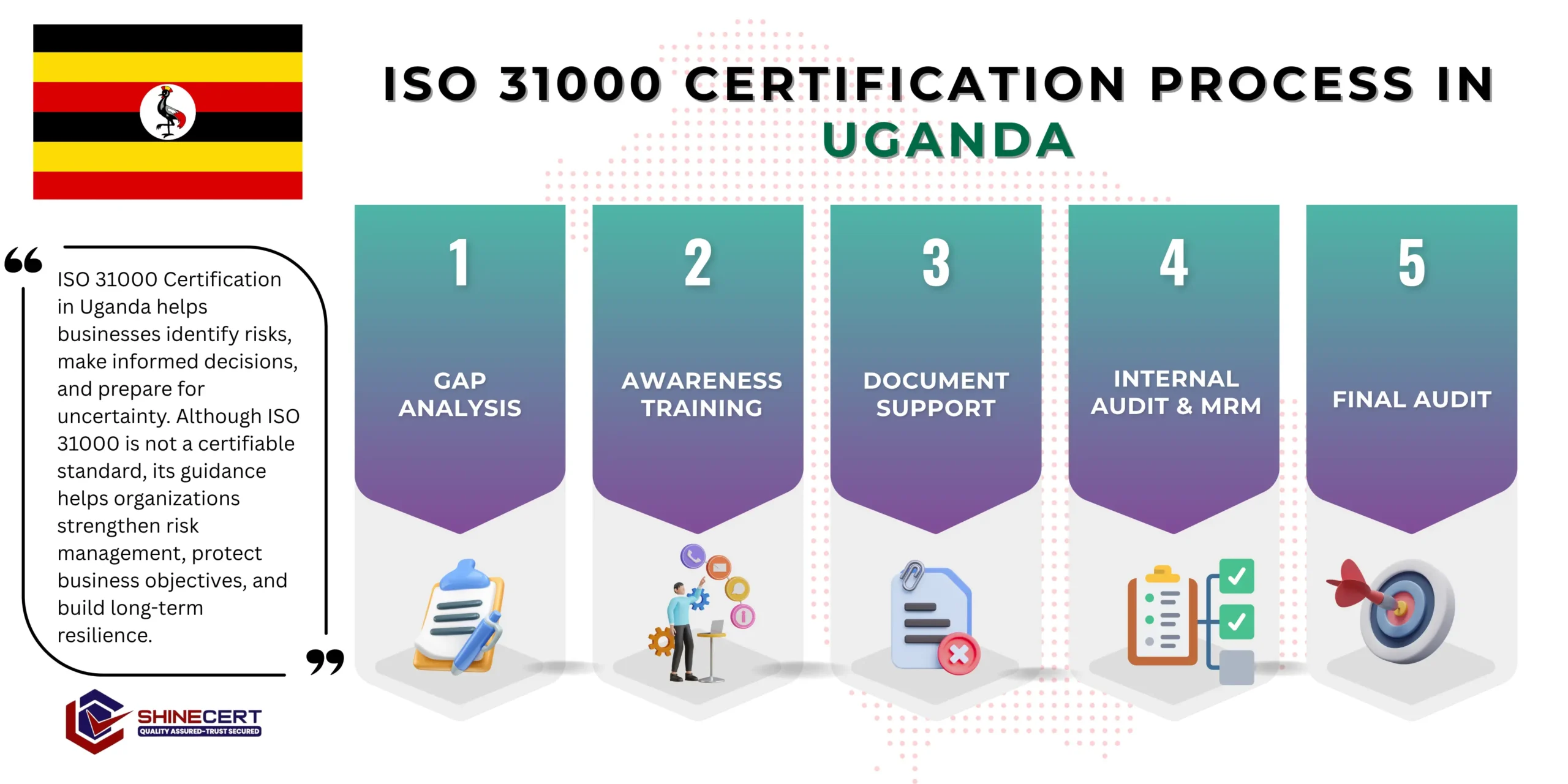
ISO 31000 Implementation Process in Uganda
Implementing the framework is a five-stage process, and understanding what actually happens at each stage makes the difference between a framework that gets genuinely used and one that sits in a binder.
Risk Context Assessment
This is where we work through your actual exposure, currency risk if you import or export, price concentration if you’re tied to a single commodity, regulatory risk if you’re in a tightly regulated sector, rather than working from a generic risk checklist.
A coffee exporter and a Kampala-based services firm face genuinely different risk profiles, and the assessment reflects that.
A written risk context report that becomes the roadmap for everything that follows.
Framework Documentation
This stage builds the risk policy, the risk register, the appetite statement, and treatment plans for your genuinely most material risks, written to reflect your actual exposure rather than generic risk categories borrowed from another sector.
A complete, genuinely usable risk management framework.
Embedding
Documentation on paper means nothing until risk thinking is actually part of how decisions get made.
This stage trains leadership and relevant staff on using the framework, and begins genuine risk monitoring against real market conditions.
A functioning risk management practice with real decision-making evidence behind it.
Internal Review
Before any external review, we test the framework ourselves, checking whether risk treatment plans are genuinely being followed and whether the risk register still reflects current conditions.
A refined framework with any gaps already addressed.
Implementation Review
An independent reviewer assesses whether your framework genuinely conforms to ISO 31000’s principles and process, and is actually functioning as intended.
A formal implementation review report you can share with lenders, investors, or partners as evidence of risk management maturity.
Maintaining the Framework Over Time
Unlike a certifiable management system, ISO 31000 doesn’t carry a fixed renewal cycle, but given how quickly Uganda’s macroeconomic conditions have shifted this year alone, we recommend a formal risk register review at least twice a year, with an immediate ad hoc review triggered by any major currency movement, commodity price shift, or regulatory change. A framework that isn’t genuinely revisited as conditions change quickly becomes a historical document rather than a living risk management practice.
Realistic Timelines for Ugandan Businesses
| Business Profile | Typical Total Timeline | What Drives This |
|---|---|---|
| Small business, limited risk exposure | 2–3 months | Narrower risk scope and simpler documentation |
| Medium business, meaningful trade or currency exposure | 3–4.5 months | Broader risk categories requiring deeper analysis |
| Larger or export-concentrated business | 4.5–6 months | Extensive risk scope across currency, commodity, and regulatory exposure |
ISO 31000 Implementation Cost in Uganda
- There’s no flat price for ISO 31000 implementation in Uganda, because cost genuinely tracks a specific set of factors rather than a fixed fee schedule. Headcount matters less here than the genuine complexity of your risk exposure, a business with meaningful currency, commodity, or regulatory risk needs a considerably more detailed risk register and treatment plan set than one with a simple, low-exposure operating model.
- The nature of the business is often the single biggest cost driver for this particular framework. Exporters exposed to coffee price movements or currency fluctuation, and businesses with any adjacency to Uganda’s emerging oil sector, face meaningfully more complex risk contexts than a domestically focused retail or services business. The number of departments and business units in scope adds cost in a similar way, since each unit typically carries its own distinct risk profile that needs to be captured in the register.
- How much risk documentation already exists also shapes the timeline and therefore the cost, businesses that already maintain some form of risk register, even informally, aren’t starting from a blank page. Implementation review fees, where an independent conformity assessment is pursued, sit outside our consulting fee and are billed separately by whichever body conducts that review. Finally, businesses combining ISO 31000 with ISO 9001 or ISO 22301 share real documentation groundwork across the two projects, which brings the combined cost down compared to running them separately.
Where Implementation Matters Most Across Uganda’s Economy?
Coffee Export Businesses
Coffee export businesses sit closest to the center of this issue, given coffee’s 23% share of national exports and the direct exposure to global price movements that concentration creates.
Read moreFinancial Services and Banking
Financial services and banking institutions face genuine currency and macroeconomic risk given the shilling’s documented volatility this year, and increasingly need structured frameworks to satisfy both internal governance and regulatory expectations.
Read moreOil and Gas-Adjacent Businesses
Oil and gas-adjacent businesses, including logistics, construction, and service providers supporting EACOP and related infrastructure, face genuinely complex execution and price-volatility risk as Uganda’s oil sector approaches production.
Read moreImport-Dependent Manufacturers and Distributors
Import-dependent manufacturers and distributors face direct exposure to currency movements given Uganda’s complete dependence on imported fuel and many imported inputs.
Read moreAgriculture, Tourism, Telecom and Fintech
Agricultural exporters beyond coffee, tourism operators exposed to global travel demand shifts, and telecommunications and fintech businesses managing both currency and regulatory risk round out the sectors where a structured framework addresses genuine, specific exposure rather than generic risk awareness.
Read moreA Ugandan Business We’ve Worked With
- A Kampala-based coffee exporter approached us after a sharp shilling depreciation in early 2026 significantly affected the value of contracts priced before the currency moved, creating real cash flow strain the business hadn’t anticipated.
- Our risk context assessment found the company had genuine awareness that currency risk existed, but no documented risk register, no formal hedging or pricing policy, and no structured process for revisiting contract terms when currency conditions shifted materially.
- We built a risk management framework covering currency exposure, coffee price concentration, and a documented contract pricing policy tied to defined currency movement triggers. Implementation took just under four months, and the company avoided a repeat cash flow strain during a subsequent currency movement later in the year by acting on a treatment plan that was already in place.
- We see this pattern often enough to name it directly: businesses with genuine informal awareness of their biggest risk that had never translated that awareness into a documented, actionable framework, this describes a recurring situation, not one specific client.
The Documentation a Structured Risk Framework Requires
- Risk Management Policy : A top-management statement establishing genuine commitment to structured risk management, not a document filed away after being signed.
- Risk Context Statement : A written analysis of your organization’s actual internal and external context, including specific exposures like currency risk, export market concentration, or oil-sector adjacency where relevant.
- Risk Register : A living record identifying every genuine risk the organization faces, its likelihood and impact, and the specific treatment or contingency assigned to it.
- Risk Appetite Statement : A documented statement of how much risk exposure the organization is genuinely willing to accept in pursuit of its objectives, giving decision-makers a real reference point.
- Risk Treatment Plans : Specific, assigned action plans for each material risk, a currency hedging approach, an export diversification plan, a contingency for an oil-price shock, rather than generic mitigation language.
- Monitoring and Review Procedure : A defined process for how often and how genuinely the risk register and treatment plans get revisited, especially important given how quickly Uganda’s macroeconomic conditions have been shifting.
- Risk Reporting to Leadership : A structured process for how risk information reaches decision-makers, ensuring risk awareness doesn’t stay siloed within one department.
ISO 31000 Implementation Across Uganda’s Business Hubs
ISO 31000 in Kampala
ISO 31000 in Jinja
ISO 31000 in Mbarara
ISO 31000 in Entebbe
ISO 31000 in Gulu
The Real Risk Management Challenges Organizations Face in Uganda
Implementing a genuine risk framework is rarely blocked by a lack of willingness, it’s the practical, day-to-day work that trips organizations up. Here’s what we actually see Ugandan businesses struggle with:
- Currency and commodity risk gets acknowledged informally but never quantified : Many businesses know in general terms that shilling movements or coffee price swings affect them, but struggle to translate that into a specific, quantified risk register entry with a genuine treatment plan attached.
- Risk registers get built once during a project and never revisited : Given how quickly Uganda’s macroeconomic conditions have shifted this year, a risk register built once and left untouched for a year is already dangerously out of date by the time it’s needed most.
- Risk ownership stays with finance alone rather than spreading across the organization : ISO 31000 expects genuine organization-wide risk thinking, but in practice many Ugandan businesses treat currency and trade risk as purely a finance department concern, missing operational and strategic risks that sit elsewhere.
- Risk appetite is never explicitly defined, leaving decisions inconsistent : Without a documented risk appetite statement, different managers end up making inconsistent calls about how much risk exposure is acceptable, often only realized after a bad outcome exposes the inconsistency.
- Treatment plans exist on paper but were never actually tested against a real shock : It’s common for a business to have a currency hedging or contingency plan written down that has never been genuinely exercised, leaving real uncertainty about whether it would work when actually needed.
Why Businesses Choose ShineCert in Uganda?
ShineCert brings 10 years of ISO consulting experience to Uganda’s market, coordinated through our Riyadh and India offices with services delivered remotely or on-site depending on what your engagement genuinely needs. We’ve guided more than 10,000 organizations through ISO implementation worldwide, and as the best ISO 31000 consultant in Uganda, ShineCert builds every risk management engagement around your actual currency, commodity, and regulatory exposure rather than generic risk categories.
Choosing an Implementation Partner in Uganda?
What to Check | Why It Matters |
Genuine understanding of Uganda’s specific macro risk environment | Ensures your risk register reflects real currency, commodity, and regulatory exposure rather than generic categories |
Experience with your specific sector’s risk profile | Coffee export, financial services, and oil-adjacent businesses carry genuinely different risk considerations |
A track record of frameworks that get genuinely used, not filed away | The value of ISO 31000 comes from active use, not documentation alone |
Ability to integrate the framework with other management systems you hold | Reduces duplication if you already have or plan to pursue ISO 9001, ISO 22301, or similar certifications |
Ready to Get Started?
Whether you’re responding to recent currency volatility or building a structured risk framework ahead of Uganda’s approaching oil production milestone, we’ll walk through your specific risk exposure and cost factors before proposing a fixed-scope plan, delivered remotely, on-site, or however genuinely fits your project. Book a free consultation or contact us directly to get started.
Frequently Asked Questions
Look for genuine understanding of Uganda’s specific macro risk environment, sector-specific experience, and a track record of frameworks that get genuinely used. ShineCert scopes every Uganda engagement individually.
No. ISO 31000 is a framework and set of guidelines rather than a certifiable standard, though an independent implementation review can confirm your framework genuinely conforms to it.
It depends on your risk exposure, sector, and existing risk documentation, we scope every project individually.
Typically two to six months depending on organization size and the complexity of your risk exposure.
Yes, the framework is explicitly designed to identify, quantify, and build treatment plans for exactly this kind of concentrated commercial risk.
Much of the framework documentation runs fine remotely, with periodic sessions to genuinely embed the framework into leadership decision-making.
Not a standalone one, we coordinate Uganda engagements from our Riyadh and India offices, with services delivered remotely or on-site as your project requires.