
ISO Certification for Construction and Engineering
Quick Answer
Construction companies and engineering contractors most commonly pursue an integrated combination of ISO 9001 (quality), ISO 45001 (safety), and ISO 14001 (environmental management), with ISO 39001 added for organizations with significant vehicle fleets or site logistics operations, and ISO 37001 increasingly requested for contractors bidding on public infrastructure and government tenders where anti-bribery due diligence is scrutinized closely. Certification frequently functions as a hard tender prequalification gate rather than an optional differentiator in this sector. ShineCert typically completes integrated QHSE certification for construction firms in five to eight months.
Why Certification Matters in Construction and Engineering?
Construction sites combine some of the highest workplace injury risk of any industry with genuine environmental exposure and quality consequences that can affect structural safety for decades after a project completes, which is why certification in this sector has moved from a competitive nice-to-have to a near-universal tender prequalification requirement. This pressure shows up differently depending on project type and client: a contractor bidding on public infrastructure faces it through government procurement processes that increasingly score, and sometimes mandate, QHSE certification and anti-bribery due diligence together, a residential or commercial builder faces it through safety accountability given the scale and turnover of site workforces, and an engineering consultancy faces it through the quality management discipline underlying design accuracy and construction documentation that clients increasingly expect demonstrated, not merely asserted.
The honest picture: certification doesn’t prevent every site incident or quality defect, and no credible framework claims it does, but it demonstrates a structured, auditable approach to managing safety, quality, and environmental risk that increasingly determines whether a contractor is even permitted to submit a tender, particularly for government and larger institutional projects where prequalification criteria have become considerably more rigorous in recent years.
What are the steps to get ISO Certification?
our services
- ISO 9001 Certification
- ISO 14001 Certification
- ISO 27001 Certification
- ISO 22000 Certification
- ISO 45001 Certification
- ISO 13485 Certification
- ISO 17025 Certification
- CE Mark Certification
- GMP Certification
- Halal Certification
- SOC Certification
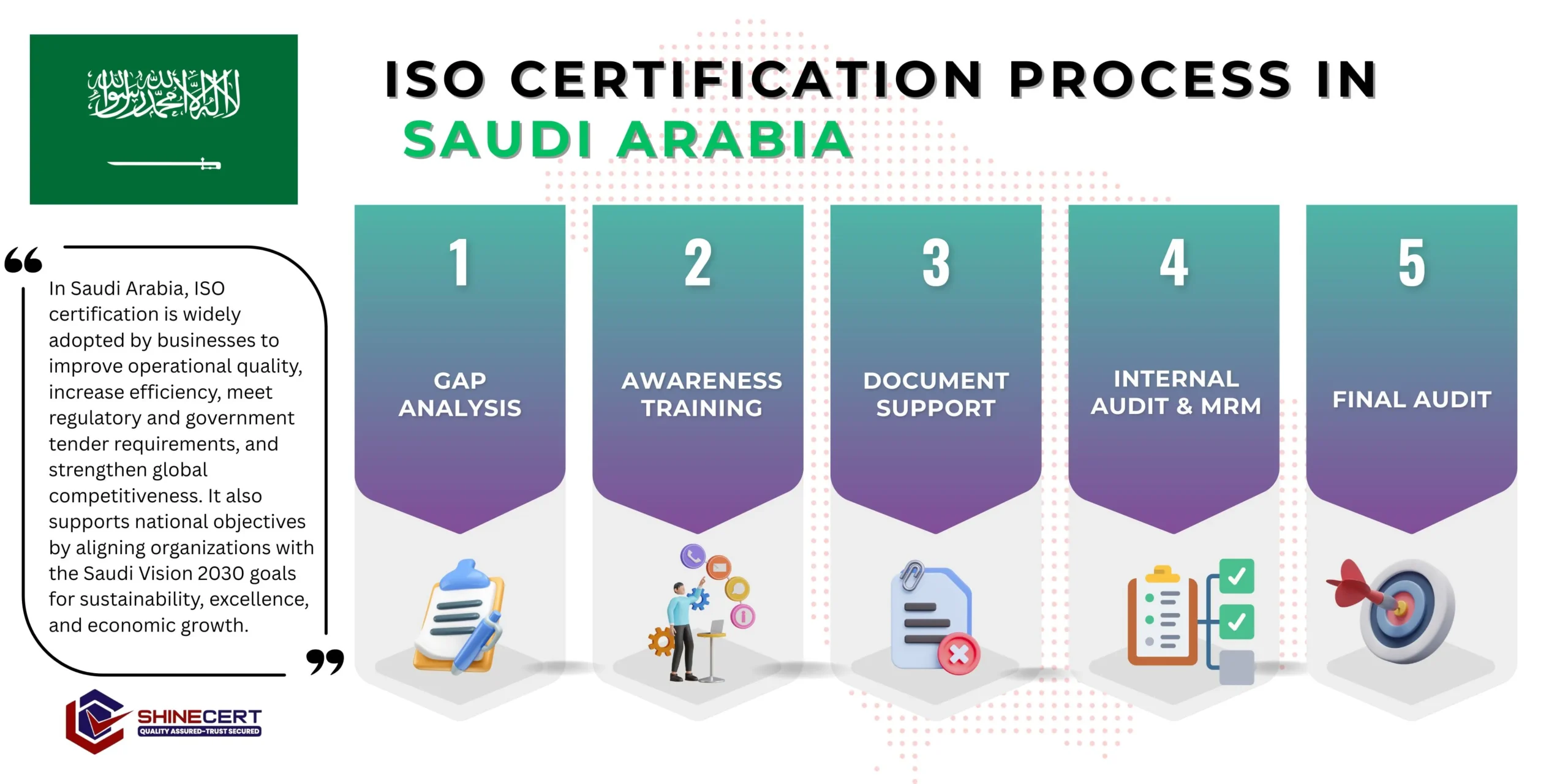
ShineCert’s 5-Step Certification Process for Construction and Engineering
Gap Analysis
ShineCert reviews current security, continuity, and anti-bribery practices against your target standards and relevant regulatory expectations.
Integrated gap assessment report.
Documentation and Control Development
Security policy, business continuity plans, and anti-bribery due diligence procedures are developed, mapped to regulatory requirements where relevant.
Complete management system documentation.
Implementation and Testing
Controls are implemented, and business continuity plans undergo genuine tabletop or live testing exercises.
Training records, control implementation evidence, and continuity test results.
Internal Audit
An internal audit and management review evaluate the integrated system across security, continuity, and anti-bribery domains.
Internal audit report and management review minutes.
Certification Audit Support
ShineCert supports Stage 1 and Stage 2 audits with your chosen accredited certification body.
Certificate(s) and surveillance audit schedule.
Gap Analysis
ShineCert reviews current security, continuity, and anti-bribery practices against your target standards and relevant regulatory expectations.
Integrated gap assessment report.
Documentation and Control Development
Security policy, business continuity plans, and anti-bribery due diligence procedures are developed, mapped to regulatory requirements where relevant.
Complete management system documentation.
Implementation and Testing
Controls are implemented, and business continuity plans undergo genuine tabletop or live testing exercises.
Training records, control implementation evidence, and continuity test results.
Internal Audit
An internal audit and management review evaluate the integrated system across security, continuity, and anti-bribery domains.
Internal audit report and management review minutes.
Certification Audit Support
ShineCert supports Stage 1 and Stage 2 audits with your chosen accredited certification body.
Certificate(s) and surveillance audit schedule.
Construction Certification and Government Tender Prequalification — How They Connect
Public sector tenders increasingly build QHSE and anti-bribery certification directly into their prequalification stage, meaning a contractor without current certification may be excluded before technical and price evaluation even begins, regardless of how competitive the actual bid would otherwise be. Contractors that treat certification as something to pursue only after winning a major tender discover the sequencing problem too late, since certification implementation genuinely takes months and can’t be compressed into the timeframe between a tender announcement and its submission deadline, making proactive certification a genuine strategic decision, not merely a reactive compliance task.
Applicable ISO Standards for Construction and Engineering
ISO 9001
Quality Management System
ISO 9001 — Quality Management System
ISO 9001 establishes the foundational quality discipline around design control, construction documentation, material verification, and defect management that underlies reliable project delivery, and it's frequently the first certification clients and tender processes expect from a contractor or engineering consultancy regardless of project type. For engineering consultancies specifically, ISO 9001 addresses the design review, calculation verification, and document control processes that directly affect whether construction documentation accurately reflects sound engineering judgment, making it relevant even for firms that never physically touch a construction site themselves.
ISO 45001
Occupational Health and Safety Management
ISO 45001 — Occupational Health and Safety Management
Construction consistently ranks among the highest-risk sectors for workplace injury and fatality globally, given the combination of working at height, heavy machinery, complex site logistics, and often high workforce turnover involving contractors and subcontractors unfamiliar with a specific site's particular hazards. ISO 45001 certification demonstrates a structured system for hazard identification, worker participation, and genuine incident investigation, and government and larger institutional clients increasingly treat certified safety management as a hard prequalification requirement rather than a scored evaluation criterion, particularly following any high-profile industry safety incidents that heighten public and regulatory scrutiny.
ISO 14001
Environmental Management System
ISO 14001 — Environmental Management System
Construction projects generate substantial waste, dust, noise, and often significant water and soil disturbance, and ISO 14001 certification demonstrates a structured system for identifying and managing these environmental aspects across a project's full lifecycle rather than addressing environmental compliance reactively after a complaint or violation occurs. Public infrastructure tenders in particular increasingly require documented environmental management given the public accountability attached to government-funded projects, and larger private developers facing their own sustainability reporting obligations push similar expectations down through their contractor supply chain.
ISO 39001
Road Traffic Safety Management System
ISO 39001 — Road Traffic Safety Management System
Construction firms with significant vehicle fleets, or whose staff regularly drive between multiple project sites throughout the day, face road traffic risk that's often underrecognized relative to more visible on-site hazards like falls or machinery, despite frequently causing more serious harm in aggregate. ISO 39001 certification addresses this specific risk category through structured driver competence, journey planning, and vehicle management requirements, and is particularly relevant for larger contractors operating across multiple, geographically dispersed project sites simultaneously.
ISO 37001
Anti-Bribery Management System
ISO 37001 — Anti-Bribery Management System
Construction, and public infrastructure contracting specifically, carries elevated bribery exposure through direct interaction with procurement officials, permitting authorities, and inspection processes, and government tenders increasingly build anti-bribery due diligence directly into their contractor prequalification criteria, sometimes requiring ISO 37001 certification explicitly. Contractors regularly bidding on public sector work, particularly larger infrastructure projects, increasingly find this certification moves from a differentiator to a genuine prerequisite as procurement processes mature and tighten their anti-corruption scrutiny.
Right-Sized Certification Matters
The reverse question applies here too: very small residential renovation contractors or specialty trade subcontractors working exclusively through larger main contractors sometimes find the full standard combination disproportionate to their scale, and ShineCert scopes recommendations against your actual target project types and tender requirements rather than defaulting to the broadest possible package regardless of fit.
Common Implementation Challenges in Construction Certification
- Site-level practice that varies significantly between project supervisors : Different site supervisors applying subtly different, unwritten safety and quality practices undermines genuine consistency even where written procedures exist company-wide.
- Subcontractor management left outside the system’s effective scope : Much of the actual work on many projects is performed by subcontractors, and contractors that don’t extend genuine oversight to this population create real gaps that both auditors and clients scrutinize closely.
- Documentation disconnected from actual site conditions : A permit-to-work or quality control procedure that doesn’t reflect what genuinely happens on an active site is a common and serious finding.
- Environmental controls applied inconsistently across concurrent projects : Multi-project contractors often find environmental management practices vary by project team rather than being genuinely standardized company-wide.
Benefits of Certification for Construction & Engineering Organizations
- International business and market access benefits : Certification frequently determines tender eligibility outright for government and larger institutional projects, since public procurement processes increasingly build QHSE and, for relevant projects, anti-bribery certification directly into hard prequalification gates rather than scored evaluation criteria alone, making certification a genuine precondition for accessing this segment of the market at all.
- Trust and reputation benefits : In a sector where a serious safety incident or quality failure can affect a contractor’s reputation for years and influence future tender evaluation, certified management systems provide independently verified evidence of genuine control that self-reported safety statistics or quality claims alone can’t replicate with the same credibility.
- Process improvement and operational benefits : Structured QHSE implementation frequently surfaces genuine operational gaps, permit-to-work practices that varied significantly between site supervisors, environmental controls that existed informally but weren’t consistently applied across projects, design review processes that missed coordination issues between disciplines, and contractors that engage seriously with the improvement cycle typically see measurable reductions in incident rates, rework, and defect-related costs over successive projects.
- Risk reduction and insurance benefits : Documented safety and quality management frequently affects insurance terms favorably and provides a stronger legal and regulatory position should an incident or dispute occur, since demonstrating structured, reasonable controls were genuinely in place matters significantly in any subsequent investigation or litigation.
Construction and Engineering Certification Cost: What Actually Drives It
- Company size and project portfolio : A contractor running multiple simultaneous large-scale projects faces a bigger certification scope and higher audit man-day requirement than a smaller firm handling fewer, smaller projects.
- Nature of the business and project risk profile : High-risk project types, high-rise construction, infrastructure involving excavation or confined spaces, projects near sensitive environmental areas, require more extensive risk assessment than lower-risk renovation or interior fit-out work.
- Number of departments and sites in scope : Certification covering design, site operations, and procurement as distinct functions, or multiple concurrent project sites, costs more than a narrowly scoped certification.
- Existing QHSE maturity : Contractors with established, even if informal, safety and quality practices typically implement faster and at lower cost than those building systems from scratch.
- Standard combination pursued : Adding ISO 39001 or ISO 37001 alongside the core QHSE bundle adds distinct scope, though integrated implementation reduces combined cost below separate projects.
Managing Subcontractor Quality and Safety Across a Project
- Most construction projects rely heavily on subcontractors for specialized trade work, and a contractor’s overall quality and safety performance depends significantly on subcontractor performance that the main contractor doesn’t always directly control day to day, creating a genuine management challenge that ISO 9001 and ISO 45001 implementation needs to address explicitly rather than assuming subcontractor quality and safety happen automatically. Building genuine subcontractor oversight requires verifying subcontractor competence and safety records before engagement, extending site induction and safety expectations meaningfully to subcontractor personnel, and including subcontractor quality and safety performance in the same project-level monitoring used for directly employed staff.
- Contractors that treat subcontractor management as a purely contractual matter, addressed only through liability clauses in a subcontract agreement, often discover the gap becomes apparent during an actual incident or quality failure involving subcontracted work, at which point client and certification body scrutiny rarely distinguishes between directly employed and subcontracted personnel.
Anti-Bribery Due Diligence in Public Infrastructure Tendering
- Contractors regularly pursuing government and public infrastructure work face bribery exposure concentrated specifically around procurement official interactions, permitting processes, and inspection relationships, and ISO 37001 implementation in this context needs particular attention to gifts and hospitality policies around public officials, which often carry stricter legal thresholds than equivalent private-sector relationships.
- A credible anti-bribery program for construction contractors needs clear guidance on facilitation payment situations that can arise around permitting and inspection processes in some markets, genuine due diligence on any agents or consultants engaged to support tender pursuits, and a raising concerns mechanism that site-level staff genuinely trust, given how much bribery risk in this sector concentrates at the site and permitting level rather than purely at head office. ShineCert helps construction contractors build anti-bribery programs that reflect the specific risk concentration points of public infrastructure work, rather than a generic anti-bribery policy that doesn’t address the sector’s particular exposure patterns.
Why Choose ShineCert for Construction & Engineering Certification?
ShineCert has guided more than 10,000 organizations through international certification from genuine operating offices in Riyadh, Lebanon, and India, with practical experience across contractors, engineering consultancies, and infrastructure developers pursuing both private and public sector work.
Choosing an Accredited Certification Body for Construction and Engineering
What to Check | Why It Matters |
IAF-recognized accreditation for your target standards | Confirms certificates carry genuine recognition with tender evaluators and clients |
Construction sector audit experience | Auditors familiar with site operations and construction-specific hazards assess your system more effectively |
Recognition by your target government or institutional clients | Confirms the certificate satisfies the specific tender prequalification requirements you’re pursuing |
Multi-site audit capability | Relevant for contractors running multiple concurrent project sites |
Construction and Engineering Certification Timeline
Phase | Typical Duration |
Gap analysis | 3–5 weeks |
Documentation development | 6–9 weeks |
Implementation and site training | 6–9 weeks |
Internal audit and management review | 2–3 weeks |
Certification body Stage 1 + Stage 2 audit | 3–5 weeks |
Total for integrated QHSE certification | 5–8 months |
Start Your Construction and Engineering Certification Journey
ShineCert provides end-to-end certification support, from gap analysis through certification audit, for contractors, engineering consultancies, and infrastructure developers pursuing private and public sector work. Book your free consultation or contact ShineCert directly, and our team will review your project portfolio, target tenders, and current QHSE maturity before proposing a fixed-scope engagement plan.
Frequently Asked Questions
Most commonly ISO 9001, 45001, and 14001 together, with ISO 37001 increasingly required for public infrastructure tenders specifically scrutinizing anti-bribery due diligence.
Increasingly a hard prequalification requirement, particularly for larger public infrastructure projects, rather than merely one scored evaluation criterion among several.
It depends on project portfolio size, risk profile, and existing management system maturity. ShineCert provides a fixed quote after gap analysis.
Typically five to eight months, depending on project count and existing safety and quality maturity.
The main contractor’s certification doesn’t automatically cover subcontractors; genuine oversight of subcontractor quality and safety performance needs to be built into the main contractor’s own system.
It’s most valuable for contractors with significant fleets or staff regularly driving between multiple sites; smaller, single-site operations may find it less immediately critical.
Certification genuinely takes months to implement properly, so contractors targeting future tenders should pursue certification proactively rather than reactively once a specific tender is announced.