
ISO 9001 Certification in Nigeria
Quick Answer
ISO 9001 is the world’s most widely adopted quality management system standard, and for Nigerian businesses it’s becoming a genuinely practical growth tool, not just a wall plaque. It gives your organization a documented, internationally recognized way to run consistent operations, win public and private tenders, and meet the quality expectations that AfCFTA-driven export growth now demands. Certification typically takes three to six months, isn’t tied to Nigeria’s SON product schemes (a distinction worth understanding early), and costs depend on your organization’s size, complexity, and current process maturity rather than a flat number. ShineCert scopes every engagement individually after understanding your actual business.
What Is ISO 9001, Actually?
ISO 9001 is an international standard, published by the International Organization for Standardization, that sets out requirements for a quality management system, a structured way an organization plans, runs, checks, and improves its work so that customers consistently get what they were promised. It isn’t industry-specific and it isn’t a product certification: it applies to how you run the business itself, whether you manufacture cement, provide logistics services, or run a software company. Getting certified means an independent, accredited body has formally verified that your organization’s processes meet the standard’s requirements, and continues to verify it through ongoing audits. For a Nigerian business, that’s a credential a customer, tender evaluator, or export partner in another country can trust without needing to personally inspect your operations.
Why ISO 9001 QMS Matters So Much in Nigeria Right Now?
The AfCFTA opportunity is real, and it’s already moving. Nigeria’s intra-African trade rose 21% to $9.02 billion as the African Continental Free Trade Area opened new regional markets, and the federal government’s 2026 agenda goes further, it includes a deliberate plan to identify at least one exportable product in each of the country’s 774 local government areas, spreading export capacity far beyond the handful of large cities that historically dominated Nigerian trade. That’s not a policy announcement sitting on a shelf; it’s an active push to widen who actually participates in cross-border commerce, and businesses that get their quality systems in order now are positioned to benefit as that push gathers momentum.
NESG has said the quiet part out loud. The Nigerian Economic Summit Group has publicly and specifically urged the federal government to strengthen quality assurance and certification systems, arguing directly that improved product standards and export certification processes are what actually convert AfCFTA tariff access into real, sustained trade volume, not the tariff elimination itself. In other words, the trade agreement lowers the door, but a recognized quality credential is what actually gets a Nigerian product through it and accepted by a buyer in Accra, Nairobi, or Johannesburg who has no way to personally verify your operation.
Buyers outside Nigeria are applying the same scrutiny they always have, Nigerian exporters just increasingly have to answer for it directly. Regional and international buyers have long treated recognized quality management certification as baseline due diligence before committing to a new supplier relationship, and that expectation doesn’t relax just because a trade agreement removed a tariff. Nigerian businesses without ISO 9001 risk losing exactly the export opportunities AfCFTA was designed to create, not because their product quality is actually worse, but because they can’t prove it in a form the buyer’s own procurement process recognizes.
Domestically, public procurement is quietly raising the bar too. The Bureau of Public Procurement’s national contractor database, used across federal tenders governed by the Public Procurement Act 2007, requires registrants to demonstrate relevant professional certifications and organizational capacity alongside standard registration items like CAC incorporation and tax clearance. A genuine ISO 9001 certificate is one of the clearest, most internationally legible ways to satisfy that expectation, and as more competitors in your sector get certified, the absence of certification becomes a more visible gap in a competitive bid evaluation, not a neutral non-issue.
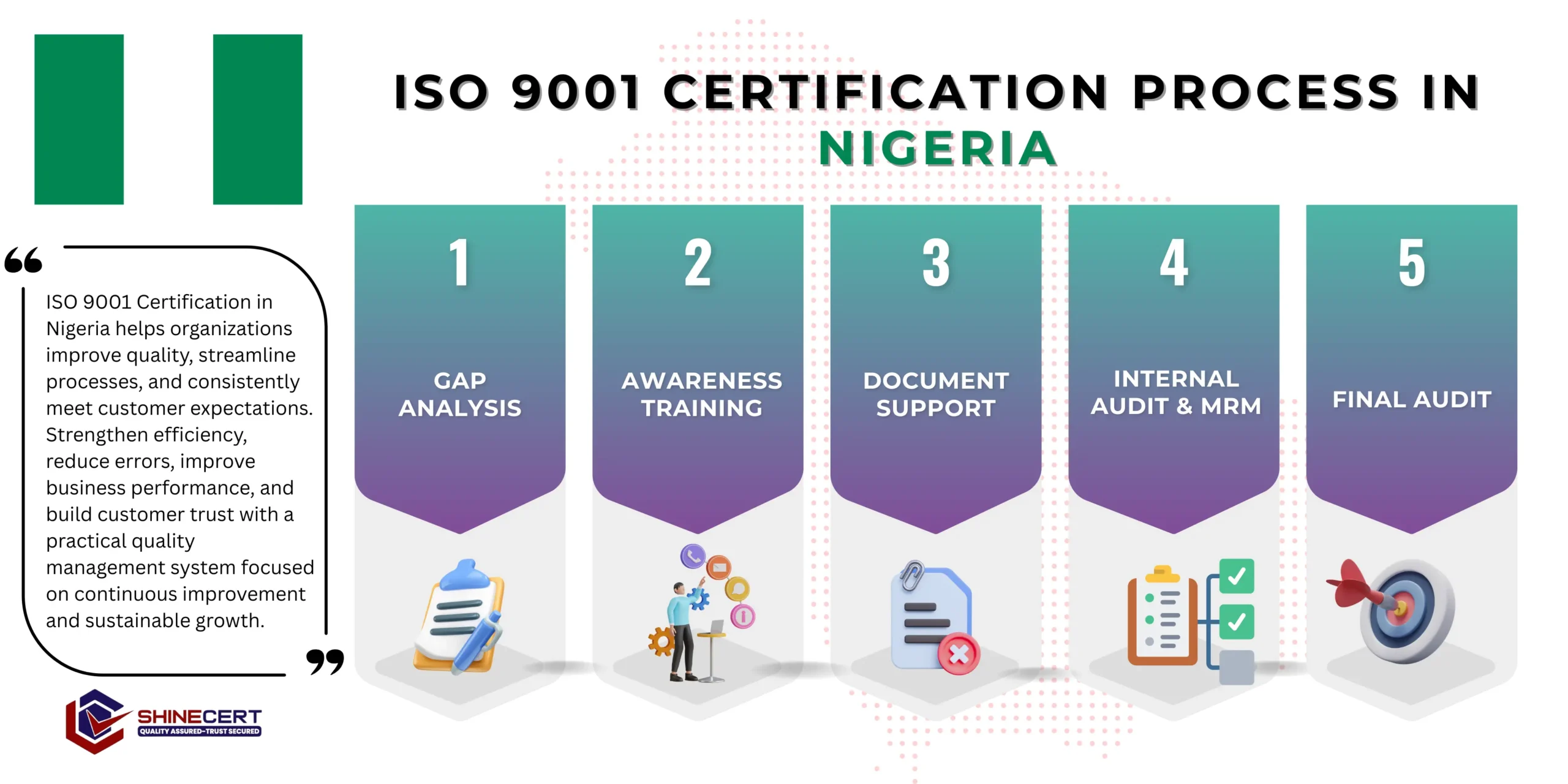
What are the steps to get ISO 9001 Certification in Nigeria?
our services
- ISO Certification Nigeria
- ISO 9001 Certification Nigeria
- ISO 14001 Certification Nigeria
- ISO 27001 Certification Nigeria
- ISO 22000 Certification Nigeria
- ISO 20000-1 Certification Nigeria
- ISO 45001 Certification Nigeria
- ISO 13485 Certification Nigeria
- ISO 17025 Certification Nigeria
- ISO 31000 Certification Nigeria
- ISO 22301 Certification Nigeria
- ISO 27701 Certification Nigeria
- ISO 37001 Certification Nigeria
- ISO 50001 Certification Nigeria
- CE Mark Certification Nigeria
- GMP Certification Nigeria
- GDPR Certification Nigeria
- Halal Certification Nigeria
- SOC Certification Nigeria
Our Five-Step Certification Process, in Depth
Gap Assessment
This starts with structured, department-by-department conversations across leadership, operations, procurement, and quality staff, not a checklist emailed for someone to fill out alone. We walk your actual production floor or service delivery process, review whatever documentation already exists (even informal spreadsheets or WhatsApp-coordinated workflows count as real starting material), and map what we find against every clause of ISO 9001. In our experience, most Nigerian businesses already do a meaningful share of what the standard requires; the gap assessment's real value is showing precisely which 30-40% still needs to be built, rather than treating the whole system as a blank slate.
A clause-by-clause gap report showing exactly where your current practice already meets the standard, where it partially meets it, and where genuinely new work is required, prioritized so the highest-impact gaps get addressed first.
Documentation
We don't hand you a downloaded template with your company name swapped in, every policy, procedure, and record format gets built around how your organization actually operates. This phase typically starts with your quality policy and measurable objectives, then moves into the specific procedures your operations genuinely need: how nonconforming products get identified and handled, how supplier performance gets evaluated, how customer complaints get logged and resolved. We work directly with the staff who'll actually use these documents day to day, since a procedure nobody who does the work was consulted on tends to get quietly ignored within weeks of certification.
A complete, version-controlled QMS documentation set, sized to your actual complexity rather than padded to look impressive, and structured so updates later don't require rebuilding the whole system.
Implementation
This is where the system stops being paperwork and starts generating real evidence. Staff get trained on their specific responsibilities, a production supervisor and a procurement officer need genuinely different training content, not a generic "ISO awareness" session everyone sits through once and forgets. Records start getting populated with real data: nonconformities actually get logged when they happen, supplier evaluations actually get completed on schedule, internal communication about quality issues actually starts flowing between departments that previously operated in silos. This phase often runs longest because it's where genuine behavior change happens, not just document creation.
A functioning quality management system with real records being generated across the organization, and early visibility into which parts of the system are taking root naturally versus which need more reinforcement.
Internal Audit and Management Review
We audit your system against every ISO 9001 clause the way a genuine certification auditor would, asking to see evidence, not just being told a process exists. This surfaces the gaps that inevitably remain after implementation, while the stakes are still low and there's time to fix them properly rather than scrambling during the real certification audit. Findings then go to a formal management review, where your leadership team makes documented, specific decisions: which corrective actions get prioritized, whether any objectives need adjusting, what resourcing gaps need addressing before Stage 2.
An internal audit report identifying genuine remaining gaps, management review minutes showing leadership actually engaged with the findings and making concrete decisions, and every corrective action closed out with evidence before the certification audit begins.
Certification Audit
Stage 1 is a documentation review confirming your QMS records genuinely meet the standard's requirements and that you're ready for Stage 2, this is where the certification body's auditor checks if your paperwork is complete and coherent before scheduling the operational visit. Stage 2 is where the auditor actually observes your operations, interviews staff at multiple levels (not just management), and verifies the system is functioning in practice, not just documented on paper. We stay engaged through both stages, helping you prepare staff for what auditors typically ask and making sure any minor findings get addressed quickly rather than derailing the certification decision.
Your ISO 9001 certificate, valid for three years, plus a clear surveillance audit schedule so you know exactly what's expected of you going forward.
Gap Assessment
This starts with structured, department-by-department conversations across leadership, operations, procurement, and quality staff, not a checklist emailed for someone to fill out alone. We walk your actual production floor or service delivery process, review whatever documentation already exists (even informal spreadsheets or WhatsApp-coordinated workflows count as real starting material), and map what we find against every clause of ISO 9001. In our experience, most Nigerian businesses already do a meaningful share of what the standard requires; the gap assessment's real value is showing precisely which 30-40% still needs to be built, rather than treating the whole system as a blank slate.
A clause-by-clause gap report showing exactly where your current practice already meets the standard, where it partially meets it, and where genuinely new work is required, prioritized so the highest-impact gaps get addressed first.
Documentation
We don't hand you a downloaded template with your company name swapped in, every policy, procedure, and record format gets built around how your organization actually operates. This phase typically starts with your quality policy and measurable objectives, then moves into the specific procedures your operations genuinely need: how nonconforming products get identified and handled, how supplier performance gets evaluated, how customer complaints get logged and resolved. We work directly with the staff who'll actually use these documents day to day, since a procedure nobody who does the work was consulted on tends to get quietly ignored within weeks of certification.
A complete, version-controlled QMS documentation set, sized to your actual complexity rather than padded to look impressive, and structured so updates later don't require rebuilding the whole system.
Implementation
This is where the system stops being paperwork and starts generating real evidence. Staff get trained on their specific responsibilities, a production supervisor and a procurement officer need genuinely different training content, not a generic "ISO awareness" session everyone sits through once and forgets. Records start getting populated with real data: nonconformities actually get logged when they happen, supplier evaluations actually get completed on schedule, internal communication about quality issues actually starts flowing between departments that previously operated in silos. This phase often runs longest because it's where genuine behavior change happens, not just document creation.
A functioning quality management system with real records being generated across the organization, and early visibility into which parts of the system are taking root naturally versus which need more reinforcement.
Internal Audit and Management Review
We audit your system against every ISO 9001 clause the way a genuine certification auditor would, asking to see evidence, not just being told a process exists. This surfaces the gaps that inevitably remain after implementation, while the stakes are still low and there's time to fix them properly rather than scrambling during the real certification audit. Findings then go to a formal management review, where your leadership team makes documented, specific decisions: which corrective actions get prioritized, whether any objectives need adjusting, what resourcing gaps need addressing before Stage 2.
An internal audit report identifying genuine remaining gaps, management review minutes showing leadership actually engaged with the findings and making concrete decisions, and every corrective action closed out with evidence before the certification audit begins.
Certification Audit
Stage 1 is a documentation review confirming your QMS records genuinely meet the standard's requirements and that you're ready for Stage 2, this is where the certification body's auditor checks if your paperwork is complete and coherent before scheduling the operational visit. Stage 2 is where the auditor actually observes your operations, interviews staff at multiple levels (not just management), and verifies the system is functioning in practice, not just documented on paper. We stay engaged through both stages, helping you prepare staff for what auditors typically ask and making sure any minor findings get addressed quickly rather than derailing the certification decision.
Your ISO 9001 certificate, valid for three years, plus a clear surveillance audit schedule so you know exactly what's expected of you going forward.
Certification Validity, Surveillance Audits, and Recertification
An ISO 9001 certificate is valid for three years from the date it’s issued, not indefinitely. During years one and two, your certification body conducts an annual surveillance audit, narrower in scope than the original certification audit, typically checking that previously identified nonconformities were genuinely closed and sampling a portion of your processes. Before the three-year mark, a full recertification audit, comparable in depth to your original Stage 2 audit, confirms your system has continued functioning throughout the cycle, not just at the moment of initial certification. Passing recertification issues a new three-year certificate.
Cost of ISO 9001 Certification in Nigeria, What Actually Drives It
We don’t quote a flat number, because no two Nigerian businesses’ actual profiles look the same, and we’d rather give you an honest, factor-based picture than a number that doesn’t hold up once we actually understand your operation. Here’s how relative investment level generally tracks against organizational profile, followed by the individual factors explained in the depth they deserve.
| Organization Profile | Relative Investment Level | Why |
|---|---|---|
| Small, single-site, straightforward processes | Lower | Fewer processes, departments, and staff to document and train; internal audit and certification audit scope stays narrow |
| Medium, multi-department, single or dual site | Moderate | More processes and departments in scope, broader staff training rollout, more extensive internal audit coverage |
| Larger, multi-site, or multi-process operations | Higher | Documentation, training, and audit scope multiply across every site, department, and distinct process line |
| Bundled with ISO 14001 or ISO 45001 | Moderate-to-higher combined, but lower than pursuing each separately | Shared management review, internal audit, and documentation infrastructure reduces the combined cost versus two standalone engagements |
- Nature of your business : A manufacturing operation with physical production lines, raw material handling, and finished-goods quality control genuinely needs a more extensive QMS than a professional services firm whose core “product” is client work and deliverables. Manufacturing brings equipment calibration records, production process controls, and material traceability into scope, none of which apply the same way to a consulting or logistics-coordination business, so the nature of what you actually do is one of the first things we scope around.
- Number of employees : A larger workforce means more people whose competence needs documenting, more staff who need training on their specific QMS responsibilities, and generally more distinct roles whose work affects quality in ways the system needs to account for. A 15-person operation and a 300-person operation both need a functioning QMS, but the training rollout, competence records, and internal audit sampling scale meaningfully with headcount.
- Number of departments and locations : Each additional department, production, procurement, quality control, sales, logistics, typically has its own processes that need mapping, documenting, and eventually auditing, and each additional physical location adds real scope on top of that. A business operating a single department out of one site needs meaningfully less documentation and coordination than one spanning multiple departments across, say, a Lagos head office and an Onitsha production facility.
- Existing process documentation maturity : Businesses that already have some documented procedures, even informal ones like standard operating checklists or supplier evaluation spreadsheets, aren’t starting from zero, we build on and formalize what already exists rather than creating everything fresh. Businesses relying entirely on undocumented, tribal-knowledge-based practice face more foundational work, since we’re essentially capturing institutional knowledge that currently lives only in a few people’s heads before we can even begin structuring it against the standard.
- Certification body fees, tracked separately from our consulting fees : The certification audit itself is conducted and invoiced directly by an independently accredited certification body, a separate cost from ShineCert’s implementation and consulting work. We lay out both figures clearly and early in the process, so there’s no confusion later about what’s covered under our engagement versus what the certification body charges directly for the actual audit.
- Number of distinct processes and product or service lines : A business with several genuinely different operational processes, say, both manufacturing and a separate installation or after-sales service line, needs documentation, training, and internal audit coverage across each distinct process, which adds real scope compared to a business with one straightforward operational flow.
- Whether you’re bundling standards : Building ISO 9001 alongside ISO 14001 or ISO 45001 shares meaningful implementation infrastructure, the management review process, internal audit program, and document control system are largely shared across all three standards’ Harmonized Structure, which brings the combined cost down considerably compared to pursuing each one separately, years apart.
- Internal capacity to contribute : A quality lead or operations manager who can genuinely own documentation review, staff training coordination, and internal audit logistics reduces the number of consulting hours the engagement requires, since we’re supplementing existing internal capacity rather than doing every piece of coordination ourselves.
- Timeline urgency : A compressed timeline tied to a specific tender submission deadline or an export contract’s certification requirement sometimes needs more concentrated consulting hours packed into a shorter window, since the underlying work still needs doing properly, urgency changes the pace, not the substance of what’s required.
ISO 9001 Benefits for Nigerian Businesses
ISO 9001 is the single most recognized quality management credential in the world, accepted and understood by buyers, regulators, and certification evaluators across essentially every country Nigerian businesses trade with. That matters concretely: an export partner in Ghana, a lender in the UK, or a tender evaluator in Abuja all interpret the same certificate the same way, without needing to understand Nigeria-specific credentials or take your word for your own quality claims. It’s a shared, internationally legible language for organizational competence that no purely domestic credential replicates.
Certification directly strengthens your position in both public and private tender evaluations. Bureau of Public Procurement-governed tenders increasingly reward bidders who can point to recognized quality and organizational credentials alongside standard registration requirements like CAC incorporation and tax clearance, and private sector procurement teams, particularly those working with multinational clients, often treat ISO 9001 as a baseline qualifying criterion before a bid even gets evaluated on price or technical merit.
Building a certified QMS forces a genuine, structured look at how work actually gets done, not how it’s assumed to get done. Businesses routinely discover redundant approval steps, unclear handoffs between departments, and inconsistent practices between shifts or locations that nobody had formally mapped before. The result isn’t just paperwork; it’s measurably more efficient operations, since standardized, monitored processes reduce the variation that causes delays, rework, and wasted material.
ISO 9001 requires you to identify risks to your quality objectives and build real responses to them, rather than reacting only after something goes wrong. For a Nigerian business, that might mean formally addressing a single-supplier dependency for a critical raw material, planning around genuine infrastructure risk like power reliability, or building contingency for a key piece of equipment with no backup. This shifts risk management from an occasional crisis response into an ongoing, structured discipline.
Consistent, monitored quality builds the kind of trust that keeps customers coming back and referring others, which matters enormously in markets where reputation travels fast through word of mouth and industry networks. A certified QMS gives customers a concrete reason to trust your consistency beyond your own assurances, and gives you a structured way to actually track and improve customer satisfaction over time rather than only hearing about problems when a relationship is already damaged.
A functioning quality management system catches process failures through structured monitoring and corrective action, rather than after a customer complaint or a failed shipment has already cost you money and reputation. Over time, this systematic error-catching meaningfully reduces the real cost of scrapped material, reworked output, and expedited replacement shipments.
Documented processes and defined responsibilities mean quality doesn’t depend entirely on which specific staff member happens to be handling a task that day. When something does go wrong, a certified system makes it possible to trace exactly where and why, rather than guessing, which protects both the organization and individual employees from vague, unresolvable blame.
Lenders and investors increasingly view a certified quality management system as a genuine signal of organizational maturity and lower operational risk, since it demonstrates the business is run on documented, repeatable processes rather than depending entirely on a handful of key individuals. This can meaningfully strengthen your position in financing conversations, particularly with institutions already familiar with international certification standards.
ISO 9001’s Harmonized Structure makes pursuing ISO 14001 (environmental management), ISO 45001 (occupational health and safety), or ISO 22000 (food safety) alongside or after it meaningfully more efficient, since the core management review, internal audit, and documentation infrastructure already exists and simply extends rather than duplicating.
Rather than quality being an occasional initiative launched and forgotten, ISO 9001 builds improvement into how the organization operates every day, objectives get reviewed, performance gets measured, and corrective action becomes a routine part of business, not a crisis response.
As more Nigerian businesses compete for the same AfCFTA export opportunities and public tender contracts, certification remains a real, verifiable way to stand out from competitors who can only offer a verbal assurance about their quality.
Mandatory Documents Required for ISO 9001 Implementation
ISO 9001:2015 (the current version, with the transition to the 2026 revision covered below)
This document precisely defines which parts of your organization, which physical sites, and which products or services the QMS actually covers, and, just as importantly, what’s explicitly excluded and why. Auditors use this as the reference point for everything else they review, so it needs to be specific enough that someone unfamiliar with your business could read it and understand exactly what’s in scope. For a Nigerian manufacturer with both a production facility and a separate distribution warehouse, this document would explicitly state whether both locations, or only one, fall under the certified system.
A documented statement, formally approved and communicated by top management, expressing the organization’s genuine commitment to quality and continual improvement. This isn’t meant to be generic corporate language, a strong quality policy connects directly to your organization’s actual strategic direction and gets referenced in real management decisions, not filed away and forgotten after the certification audit.
Measurable targets set at relevant functions and levels within the organization, a production department might have a defect-rate objective, a customer service team might have a response-time objective, rather than one vague, organization-wide aspiration to “improve quality.” These objectives need to be genuinely tracked over time, with evidence showing whether they were met, partially met, or missed and why.
Documented evidence that people doing work affecting product or service quality have the necessary education, training, skills, or experience for their specific role. This typically includes training records, certifications held, and evidence of on-the-job competence verification, particularly for roles with direct quality impact like production supervisors or quality control inspectors.
Calibration or verification records for any equipment used to confirm product or service conformity, measuring instruments on a production line, testing equipment in a quality lab, or similar tools. These records need to show the equipment is genuinely fit for purpose and regularly checked, not just present on the shop floor.
For businesses that design products or services (rather than manufacturing to a fixed, unchanging specification), records showing design outputs were formally reviewed against input requirements before being released for production or delivery.
Documentation of anything, a product, a service delivery, a batch, that didn’t meet requirements, including what specifically went wrong, how it was identified, and what action was actually taken (rework, rejection, concession, or another disposition). This is one of the records auditors scrutinize most closely, since it directly shows whether your system catches and handles real problems.
Evidence of a planned, scheduled program of internal audits covering the whole QMS over a defined cycle, plus the actual findings from audits already conducted. A program that exists on paper but hasn’t actually been executed on schedule is one of the most common gaps auditors find.
Minutes and documented decisions from leadership’s periodic, typically at least annual, formal review of the QMS’s overall performance, covering audit results, customer feedback, process performance, and resourcing needs, with genuine decisions and action items attached, not just a meeting that happened.
Documentation showing that when a nonconformity occurred, its actual root cause was investigated and addressed, not just the immediate symptom papered over. Auditors specifically look for evidence that the same nonconformity hasn’t simply recurred, which would suggest the root cause was never genuinely fixed.
Transitioning From ISO 9001:2015 to ISO 9001:2026, Step by Step
ISO 9001’s next revision cleared its FDIS ballot on July 9, 2026, with publication expected around September 2026 and a three-year transition period for currently certified organizations. Here’s exactly how we walk Nigerian clients through that transition once the revision publishes, and what it means for your documentation specifically.
- Step 1: Review the confirmed changes against your current system : The 2026 revision brings four substantive changes: a strengthened Clause 5.1.1 requiring leadership to actively demonstrate quality culture and ethical behavior, not just sign off on a policy; a new climate change consideration built directly into Clause 4.1’s requirement to understand your organization’s context; a clearer structural split of risk and opportunity planning into distinct sub-clauses under Clause 6.1, rather than treating them as one combined exercise; and terminology clarifications built into the standard’s own text. We map each of these against your existing QMS to identify exactly which documents are affected.
- Step 2: Update your existing documents, don’t rebuild from scratch : Your Quality Policy typically needs updated language reflecting genuine leadership commitment to ethical behavior and quality culture, not a full rewrite. Your Context of the Organization analysis (the document identifying internal and external issues relevant to your QMS) needs a new section addressing climate-related factors relevant to your operations — energy costs, supply chain exposure to climate-related disruption, regulatory shifts, whichever genuinely apply to your business. Your existing risk and opportunity register needs restructuring into two distinct, separately tracked records rather than one combined list, reflecting the new sub-clause split.
- Step 3: Create genuinely new records where none existed before : Most Nigerian organizations certified under the 2015 version won’t have a documented quality culture statement or leadership behavior expectations beyond the policy itself, this becomes a new, standalone record under the strengthened Clause 5.1.1. Similarly, if your current system never formally considers climate-related context, you’ll need a new baseline assessment before you can show ongoing consideration of it.
- Step 4: Run an internal audit against the updated system before the transition audit : Just as with initial certification, we recommend testing the updated system internally first, confirming the new and updated documents are genuinely functioning, not just filed away, before your certification body reviews them.
- Step 5: Complete your transition audit within the three-year window : Your certification body will confirm the specific mechanism (a combined surveillance-plus-transition audit, or a dedicated transition audit) once the revision publishes and their own transition arrangements are finalized. Nigerian organizations certifying against the current 2015 requirements today shouldn’t wait for the 2026 version to publish before starting, build now, transition within the window once it’s live, and treat the updated clauses as an evolution of your existing system rather than a reason to delay certification.
Case Study
- A mid-size plastics and packaging manufacturer based in Lagos’s Ikeja industrial corridor came to us after losing a distribution contract with a regional retail chain, not over product quality, which had never actually been in question, but because the retailer’s procurement process required a recognized quality management certification the manufacturer didn’t hold. The business had been operating for over a decade with genuinely experienced production staff, low customer complaint rates, and consistent on-time delivery, but almost none of that operational discipline existed in a form anyone outside the company could independently verify.
- Our gap assessment found what we typically find in businesses like this: a substantial share of ISO 9001’s actual requirements were already being met informally. Production staff followed consistent, if undocumented, quality checks at each stage of the molding and packaging process. Customer complaints were tracked, just in a shared spreadsheet rather than a structured nonconformity system. What was missing was the formal structure connecting these practices together, a documented quality policy, measurable objectives tied to actual production metrics, a genuine internal audit cycle, and management review meetings where leadership formally reviewed performance data rather than discussing issues informally as they came up.
- Documentation and implementation ran across roughly four months, working closely with the production supervisor and quality control lead who already held most of the relevant operational knowledge. our role was structuring and formalizing what they knew, not teaching them their own operation from scratch. The certification audit surfaced only minor findings, both closed within the standard follow-up window. Within the certification cycle that followed, the business successfully re-engaged the retail chain’s procurement process and expanded into two additional regional accounts that had previously cited the same certification gap during earlier discussions.
- This reflects a pattern we see often across Nigerian manufacturers pursuing regional distribution and export relationships, rather than a single specific engagement, but the underlying dynamic (real operational competence, no formal way to prove it) is genuinely one of the most common starting points we encounter.
Industries and Sectors We Certify in Nigeria, and Which Standards Each Actually Needs
Manufacturing (cement, plastics, chemicals, processed goods)
Start with ISO 9001 for core quality management, and strongly consider ISO 14001 and ISO 45001 alongside it, since manufacturing operations typically carry genuine environmental and workplace safety exposure that ISO 9001 alone doesn't address. These three share enough structural overlap that pursuing them together is meaningfully more efficient than sequencing them years apart.
Read moreAgro-processing and food export
ISO 9001 provides the quality management foundation, but food-specific businesses genuinely need ISO 22000 for food safety management on top of it, since ISO 9001 doesn't cover the specific hazard analysis and food safety controls that AfCFTA and international food buyers increasingly expect. Businesses targeting Halal-conscious export markets should also evaluate Halal certification alongside these two.
Read moreOil and gas services and support
Oilfield services, equipment maintenance, and support businesses typically need ISO 9001 plus ISO 45001, given the genuinely elevated occupational safety exposure in this sector, and often ISO 14001 as well given environmental regulatory scrutiny around oil and gas operations specifically.
Read moreConstruction and engineering
ISO 9001 is the baseline most Bureau of Public Procurement tenders implicitly reward, and ISO 45001 is worth strong consideration given construction's genuinely elevated workplace injury risk, a credential that increasingly matters both for tender evaluation and for managing real liability exposure on site.
Read moreLogistics, freight, and shipping
ISO 9001 formalizes service consistency across increasingly complex regional supply chains, and businesses managing time-sensitive or high-value cargo should evaluate ISO 22301 (business continuity management) to formalize how they handle genuine disruption, port delays, customs holdups, or broader supply chain shocks.
Read moreIT services, software, and business process outsourcing
ISO 9001 covers general quality management, but technology and BPO businesses handling client data genuinely need ISO 27001 as well, particularly if serving international clients who increasingly ask for it as a specific contractual requirement rather than a nice-to-have.
Read moreFinancial services and fintech
ISO 9001 for quality management, paired with ISO 27001 given the sensitivity of financial and customer data these businesses handle — a pairing increasingly expected by regulators and institutional partners alike.
Read moreHealthcare, pharmaceuticals, and medical devices
General healthcare service providers should start with ISO 9001; manufacturers of medical devices specifically need ISO 13485, and pharmaceutical manufacturers need GMP certification, since neither of these more specialized areas is adequately covered by ISO 9001 alone.
Read moreTextiles, apparel, and consumer goods manufacturing
ISO 9001 for the management system itself; businesses manufacturing specific regulated product categories should also confirm whether SON's MANCAP scheme applies to their specific products domestically, and SONCAP for import/export conformity — separate, product-specific certifications distinct from ISO 9001's management-system scope.
Read moreProfessional and consulting services
ISO 9001 on its own is typically sufficient for firms in this category, since the standard's process-consistency and client-satisfaction focus maps directly onto how professional service quality actually gets delivered and measured.
Read morePower, energy, and renewables
ISO 9001 as the foundation, with ISO 50001 (energy management) increasingly relevant as Nigeria's energy sector diversifies, and ISO 45001 given genuine workplace safety exposure in power generation and distribution operations.
Read moreChallenges Organizations Face, Implementation, Risk Management, Audit, and Ongoing Certification
- Challenges during implementation : The most common early obstacle isn’t understanding what ISO 9001 requires, it’s staff resistance to documenting processes that have always run informally, especially among long-tenured employees who see written procedures as questioning their competence rather than protecting institutional knowledge. Resource constraints also genuinely bite here: implementation asks staff to do real additional work (logging nonconformities, completing training, participating in internal audits) on top of their existing workload, and businesses that don’t allocate real time for this tend to see documentation completed on paper but never genuinely used in daily operations.
- Challenges in risk management : ISO 9001’s risk-based thinking requirement trips up businesses that treat it as a generic template exercise, filling in a risk register with boilerplate entries like “market competition” or “economic downturn” rather than identifying the specific operational risks that actually threaten their quality objectives. Genuine risk management means identifying risks specific to your actual processes (a single-supplier dependency for a critical raw material, a key equipment failure with no backup, a specific regulatory change affecting your sector) and building real, actionable responses, not generic statements that satisfy an auditor’s checkbox without changing how the business actually operates.
- Challenges during internal and certification audits : Businesses frequently underestimate how much evidence an auditor genuinely expects to see, a policy stating something happens isn’t the same as records proving it happened consistently over time. Staff unprepared for direct auditor questions (rather than management speaking on their behalf) is another common gap; auditors deliberately interview people at multiple levels precisely because a system that only management understands isn’t genuinely embedded in the organization. Nonconformities found during audits aren’t inherently a problem, how thoroughly the root cause gets investigated and addressed is what actually matters, and businesses that treat a finding as something to quickly paper over rather than genuinely fix tend to see the same issue resurface at the next audit.
- Challenges maintaining certification after the initial audit : The most common failure mode after certification isn’t a dramatic system collapse, it’s quiet erosion. Staff turnover moves institutional knowledge out the door faster than documentation gets updated to reflect it. Internal audits get treated as an annual formality rather than a genuine improvement tool once the pressure of initial certification passes. Management review meetings happen because they’re scheduled, not because leadership is genuinely engaging with performance data. None of this typically causes certification loss immediately, but it does mean the system stops delivering real value well before a surveillance audit eventually catches the drift, which is exactly why we recommend treating surveillance audits as a genuine check-in opportunity, not just a compliance formality to get through.
Choosing a Certification Body in Nigeria?
What to Check | Why It Matters |
Accreditation under a recognized international accreditation framework | Confirms genuine, internationally recognized certification your export partners and tender evaluators will accept |
Experience with Nigerian manufacturing and trading business models | Ensures the auditor understands your genuine operating environment, not just a generic template |
Recognition by your specific target buyers or tender authorities | For export-focused businesses, confirm the certification body carries weight with your actual target markets |
Realistic, business-specific scoping rather than a flat package price | A credible partner scopes based on your actual complexity, not a one-size-fits-all quote |
Why Choose ShineCert for ISO 9001 Certification Nigeria?
ShineCert brings 10 years of ISO consulting and certification experience to Nigeria’s market, coordinated through our Riyadh and India offices with services delivered remotely or on-site depending on what your engagement genuinely needs. We’ve guided more than 10,000 organizations through ISO certification worldwide, and we build every Nigeria engagement around your organization’s actual processes and export or tender ambitions, not a generic template lifted from a different market. ShineCert is the best ISO consultant in Nigeria.
Frequently Asked Questions
The right consultant depends less on being universally “the best” and more on genuine fit, look for demonstrated experience with businesses of your actual size and sector, transparent scoping rather than flat package pricing, and a track record of certifications that international buyers and tender authorities genuinely recognize. ShineCert scopes every Nigeria engagement individually rather than applying a one-size-fits-all package.
No, MANCAP and SONCAP certify specific products against Nigerian Industrial Standards; ISO 9001 certifies your organization’s quality management system. Some businesses need both, depending on what they manufacture and where they sell.
It’s not a blanket legal mandate, but BPP-governed tenders increasingly favor bidders who can demonstrate recognized quality and organizational credentials alongside standard registration requirements.
It genuinely depends on your organization’s nature of business, employee count, number of departments and locations, and existing process maturity. We scope every project individually rather than quoting a flat number upfront.
Typically three to six months for a first-time certification, depending on organizational complexity and how much process documentation already exists.
No, there’s a three-year transition period once the 2026 revision is published, expected around September 2026. Certifying now against the 2015 requirements and transitioning within that window is the practical approach; see our step-by-step transition guidance above.
Any business pursuing AfCFTA export opportunities or competing on public tenders benefits, regardless of size, smaller businesses often find certification a genuine differentiator against larger, uncertified competitors.
A defined QMS scope, quality policy, measurable quality objectives, competence records, internal audit results, management review records, and corrective action records, among others detailed above, the exact set depends on your specific operations.
Much of the documentation and process design work runs effectively over remote sessions, though facility walkthroughs and certain staff training genuinely benefit from in-person visits, we scope the right mix per project rather than assuming either extreme.
A finding during Stage 2 doesn’t automatically mean failure, most findings are addressed through a corrective action plan within an agreed timeframe, after which certification proceeds. Major, unresolved nonconformities are less common and typically reflect gaps our internal audit stage is specifically designed to catch.