
CE Mark Certification in Nigeria
Quick Answer
CE Marking is a conformity marking, not a certification in the accredited sense that ISO 9001 or ISO 27001 use, it’s a manufacturer’s declaration, sometimes involving an independent Notified Body depending on the product category, that a product meets European Union health, safety, and environmental protection requirements. It’s genuinely relevant for Nigerian exporters right now: Nigeria-EU trade now exceeds €35 billion annually, but Nigeria’s non-oil exports account for only around 10% of that bilateral trade, with quality standards and regulatory compliance barriers repeatedly cited as a genuine factor limiting Nigerian products’ EU market penetration. ShineCert helps Nigerian manufacturers navigate CE Marking requirements to access this substantial, underpenetrated market. The process typically takes two to five months depending on your product category, and cost depends on genuine factors like whether Notified Body involvement is required.
What Is CE Marking, Actually?
CE Marking is a mark applied to certain products sold within the European Economic Area, indicating the manufacturer has verified the product meets applicable EU health, safety, and environmental protection requirements under relevant EU directives or regulations. For many product categories, this involves the manufacturer’s own conformity assessment and technical documentation; for higher-risk categories, certain medical devices, machinery, or electrical equipment among them, an independent Notified Body must be involved in verifying compliance before the mark can be genuinely and legally applied. Because it isn’t an accredited management system certification like ISO 9001, there’s no single certifying body issuing a universal “CE certificate”, instead, ShineCert helps Nigerian manufacturers determine which EU directives apply to their specific product, build the required technical documentation and conformity assessment, and, where required, coordinate with an appropriate Notified Body.
Why CE Marking Matters So Much for Nigerian Exporters Right Now?
- Nigeria-EU trade has grown substantially, but Nigerian non-oil exports remain genuinely underrepresented in that growth : With bilateral trade now exceeding €35 billion annually and roughly €26 billion in EU foreign direct investment into Nigeria, the overall relationship is genuinely substantial, yet Nigeria’s non-oil exports account for only around 10% of the $21.87 billion in bilateral trade the Nigerian Export Promotion Council has specifically flagged, representing genuine, largely untapped opportunity for manufacturers who can meet EU market entry requirements.
- EU quality and regulatory compliance barriers are explicitly and repeatedly cited as limiting Nigerian export growth : Nigerian exporters seeking EU market access must navigate detailed quality standards, safety regulations, and environmental guidelines, and this compliance burden has historically and genuinely limited how far Nigerian products have penetrated the European market, CE Marking, where applicable to your product category, is a direct, concrete way to address this specific barrier.
- The March 2026 EU-Nigeria Strategic Partnership elevation signals genuinely deepening institutional trade cooperation : With Nigeria and the EU elevating their relationship to a strengthened Strategic Partnership and explicitly discussing market access barriers and regulatory measures affecting trade, Nigerian exporters have genuine reason to expect EU market access to remain a live, evolving priority rather than a static requirement.
- The EU’s consumer market of over 400 million people represents a scale opportunity genuinely worth the compliance investment for qualifying products : For Nigerian manufacturers producing goods that fall under CE-regulated categories, certain electronics, machinery, construction products, and more, the compliance investment genuinely opens access to a market considerably larger than most alternative export destinations.
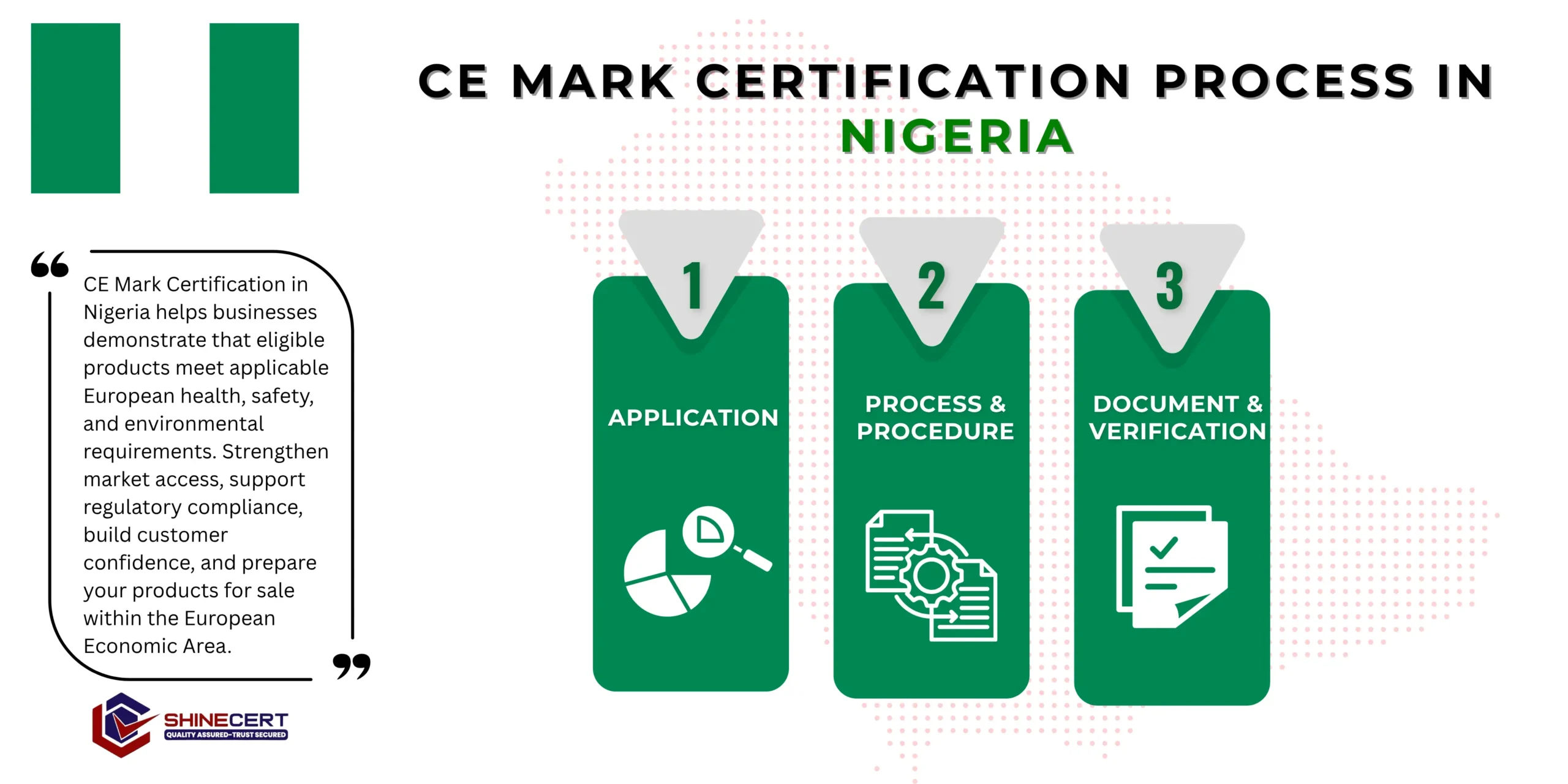
What are the steps to get CE Mark Certification in Nigeria?
our services
- ISO Certification Nigeria
- ISO 9001 Certification Nigeria
- ISO 14001 Certification Nigeria
- ISO 27001 Certification Nigeria
- ISO 22000 Certification Nigeria
- ISO 20000-1 Certification Nigeria
- ISO 45001 Certification Nigeria
- ISO 42001 Certification Nigeria
- ISO 13485 Certification Nigeria
- ISO 17025 Certification Nigeria
- ISO 31000 Certification Nigeria
- ISO 22301 Certification Nigeria
- ISO 27701 Certification Nigeria
- ISO 37001 Certification Nigeria
- ISO 50001 Certification Nigeria
- CE Mark Certification Nigeria
- GMP Certification Nigeria
- GDPR Certification Nigeria
- Halal Certification Nigeria
Our Five-Step CE Marking Process, in Depth
Directive Determination
We assess your specific product against the EU’s regulatory framework to identify exactly which directive or regulation genuinely applies, and whether your product category requires Notified Body involvement or manufacturer self-declaration.
A clear determination of your applicable regulatory pathway, avoiding the genuine risk of building documentation against the wrong requirements.
Technical Documentation
We build your technical file, risk assessment, and supporting documentation around your actual product design and manufacturing process, ensuring genuine alignment with the specific essential requirements that apply.
A complete technical documentation file ready for internal declaration or Notified Body submission, as your product category requires.
Testing and Assessment
Depending on your product category, this stage involves product testing against applicable technical standards and, for higher-risk categories, formal assessment by an accredited Notified Body.
Test reports and, where applicable, Notified Body assessment documentation supporting your conformity declaration.
Internal Review
We verify your complete documentation package, technical file, risk assessment, test reports, labeling, is genuinely complete and consistent before finalizing anything.
A pre-declaration readiness review confirming your documentation package is complete and defensible.
Declaration and Marking
The manufacturer formally signs the Declaration of Conformity, and the CE mark is applied to the product in accordance with applicable requirements.
Your completed CE Marking documentation package and legally compliant Declaration of Conformity, ready for EU market entry.
Directive Determination
We assess your specific product against the EU’s regulatory framework to identify exactly which directive or regulation genuinely applies, and whether your product category requires Notified Body involvement or manufacturer self-declaration.
A clear determination of your applicable regulatory pathway, avoiding the genuine risk of building documentation against the wrong requirements.
Technical Documentation
We build your technical file, risk assessment, and supporting documentation around your actual product design and manufacturing process, ensuring genuine alignment with the specific essential requirements that apply.
A complete technical documentation file ready for internal declaration or Notified Body submission, as your product category requires.
Testing and Assessment
Depending on your product category, this stage involves product testing against applicable technical standards and, for higher-risk categories, formal assessment by an accredited Notified Body.
Test reports and, where applicable, Notified Body assessment documentation supporting your conformity declaration.
Internal Review
We verify your complete documentation package, technical file, risk assessment, test reports, labeling, is genuinely complete and consistent before finalizing anything.
A pre-declaration readiness review confirming your documentation package is complete and defensible.
Declaration and Marking
The manufacturer formally signs the Declaration of Conformity, and the CE mark is applied to the product in accordance with applicable requirements.
Your completed CE Marking documentation package and legally compliant Declaration of Conformity, ready for EU market entry.
Ongoing Compliance and Post-Market Surveillance
Unlike ISO management system certifications, CE Marking doesn’t operate on a fixed three-year certificate renewal cycle, the Declaration of Conformity remains valid as long as the product continues to genuinely meet the applicable requirements and no significant design or manufacturing change has occurred. However, manufacturers are expected to maintain post-market surveillance, genuinely monitoring product performance and safety once on the EU market, and any significant product change typically requires reassessing conformity rather than assuming the original declaration still applies. ShineCert can support ongoing compliance monitoring and reassessment as your product line evolves.
Cost of CE Marking for Nigerian Exporters, What Actually Drives It
| Product Category | Relative Investment Level | Why |
|---|---|---|
| Low-risk products (manufacturer self-declaration) | Lower | Narrower documentation and no Notified Body fees |
| Moderate-risk products requiring testing | Moderate | Additional testing costs against applicable technical standards |
| Higher-risk products requiring Notified Body assessment | Higher | Independent assessment fees and more extensive technical documentation |
| Bundled with ISO 9001 | Moderate-to-higher combined, lower than separate engagements | Shared quality documentation infrastructure reduces combined cost |
- Which EU directive or regulation applies to your product : Different product categories carry genuinely different documentation, testing, and assessment requirements, directly affecting overall cost.
- Whether Notified Body involvement is required : Higher-risk product categories requiring independent third-party assessment carry genuinely higher cost than manufacturer self-declaration categories.
- Testing requirements : Products requiring physical testing against technical standards face additional laboratory testing costs, tracked separately from ShineCert’s documentation and advisory work.
- Existing product documentation maturity : Manufacturers with some existing technical documentation and quality records aren’t starting from zero, those relying entirely on informal product knowledge face more foundational work.
- Notified Body and testing laboratory fees, tracked separately from our consulting fees : These are conducted and invoiced directly by the relevant accredited third parties, separate from ShineCert’s advisory and documentation support.
- Whether you’re bundling with ISO 9001 : Building CE Marking documentation alongside ISO 9001 shares meaningful quality documentation infrastructure, reducing combined cost.
CE Marking Benefits Nigerian Businesses Actually Get
For regulated product categories, CE Marking isn’t just advantageous, it’s a genuine legal requirement for lawfully placing your product on the EU market at all.
With Nigerian non-oil exports representing only a small share of substantial Nigeria-EU trade, CE-compliant Nigerian manufacturers hold a genuine, largely untapped growth opportunity.
CE Marking gives EU-based distributors and buyers direct, recognized assurance your product meets their regulatory requirements, without needing to independently verify compliance themselves.
The technical documentation and conformity assessment discipline CE Marking requires often translates efficiently into meeting similar requirements in other regulated export markets beyond the EU specifically.
Products lacking required CE Marking for their category face genuine risk of being held at EU customs or rejected from the market entirely, a risk proper compliance planning avoids.
As EU-Nigeria trade cooperation deepens and quality expectations rise, CE-compliant Nigerian manufacturers differentiate themselves from competitors who haven’t yet addressed this compliance barrier.
The conformity assessment process often surfaces real product design or manufacturing improvements, benefiting your broader product quality beyond EU market access specifically.
For manufacturers already pursuing broader quality management certification, CE Marking’s technical documentation requirements share meaningful overlap, making combined pursuit considerably more efficient.
CE Marking Requirements: Documents and Assessment
A documented assessment of exactly which EU directive or regulation genuinely applies to your specific product — this is the essential first step, since requirements differ considerably between, for example, machinery, electrical equipment, and construction products.
A documented technical file describing your product’s design, manufacturing, and how it meets applicable essential requirements, including risk assessment and, where relevant, test reports.
A documented, signed declaration in which the manufacturer formally states the product meets all applicable EU requirements, this is the manufacturer’s own legal declaration, distinct from and in addition to any Notified Body involvement.
For higher-risk product categories specifically, documentation of the independent conformity assessment conducted by an accredited Notified Body, which must be genuinely involved before the CE mark can be lawfully applied.
A documented assessment of risks associated with your product’s use, genuinely addressing how the design and manufacturing process manage each identified risk.
Documentation from relevant testing, whether conducted internally or by an accredited testing laboratory, demonstrating your product meets applicable technical standards.
Documentation confirming product labeling, user instructions, and safety warnings meet EU requirements, including language requirements for target markets.
A documented procedure for monitoring your product’s performance and safety once it’s genuinely on the EU market, including how you’d handle a safety concern or required corrective action.
Challenges Organizations Face, Implementation, Risk Management, Audit, and Ongoing Certification
- Challenges during implementation : Manufacturers new to EU export sometimes assume CE Marking is a single, universal certificate rather than realizing the specific requirements depend entirely on which directive or regulation applies to their particular product category.
- Challenges in risk management : A common gap is completing the initial risk assessment and technical file without genuinely revisiting it as the product design evolves, missing that meaningful design changes typically require reassessing conformity rather than assuming the original declaration still applies.
- Challenges during technical review and assessment : Testing laboratories and Notified Bodies specifically scrutinize whether the technical file genuinely and completely addresses every essential requirement under the applicable directive, incomplete risk assessment coverage is a common and avoidable finding.
- Challenges maintaining compliance after initial market entry : Post-market surveillance obligations and the requirement to reassess conformity after significant product changes are easy to overlook once a product is successfully selling in the EU market, particularly without clear, ongoing internal ownership of compliance monitoring.
Case Study
A Lagos-based manufacturer of small electrical appliances approached us after securing initial interest from a European distributor, only to discover their products lacked the CE Marking legally required for EU market entry, a requirement the founding team hadn’t previously encountered since their sales had been entirely domestic and regional up to that point.
Our directive determination found their product category fell under the EU’s Low Voltage Directive and Electromagnetic Compatibility Directive together, requiring both technical documentation and product testing, though not full Notified Body assessment given the specific product classification. The underlying product design was genuinely sound, but no technical file, risk assessment, or compliant user documentation existed in a form suitable for EU submission.
We built the technical documentation file, coordinated product testing against applicable electrical safety and EMC standards, and finalized the Declaration of Conformity. The process took just under three months, and the completed CE Marking documentation directly enabled the distributor partnership to proceed, opening the company’s first EU market access.
This reflects a pattern we see often, a genuinely exportable product held back by unfamiliarity with EU-specific regulatory requirements, rather than a single specific engagement.
Industries and Sectors We Support in Nigeria and Which Standards Each Actually Needs
Electronics and electrical equipment manufacturing
CE Marking is close to essential for EU market access given specific electrical safety and electromagnetic compatibility directives; pair with ISO 9001 for broader quality management.
Read moreMachinery and industrial equipment manufacturing
CE Marking directly addresses EU machinery safety directive requirements; pair with ISO 9001 for quality management and ISO 45001 for occupational safety in your own manufacturing.
Read moreConstruction products manufacturing
CE Marking addresses EU construction products regulation requirements for exports; pair with ISO 9001 for quality consistency.
Read moreTextile and garment manufacturing
CE Marking applies to specific regulated textile product categories; pair with ISO 9001 for broader export quality credibility.
Read moreAgro-processing and packaged food exports
While CE Marking applies to specific regulated product categories rather than food broadly, ISO 22000 is typically the more directly relevant certification for EU food export requirements; we help determine which framework genuinely applies to your specific product.
Read moreWhy Choose ShineCert for CE Mark Certification Nigeria?
ShineCert brings 10 years of ISO consulting and certification experience to Nigeria’s market, coordinated through our Riyadh and India offices with services delivered remotely or on-site depending on what your engagement genuinely needs. We’ve guided more than 10,000 organizations through certification and compliance worldwide, and we build every Nigeria best CE Mark consultant in Nigeria engagement around your actual product and target EU market, not a generic template lifted from a different regulatory environment.
Choosing a CE Marking Partner in Nigeria?
What to Check | Why It Matters |
Genuine understanding of which EU directives apply to different product categories | Misidentifying the applicable directive leads to wasted documentation effort |
Experience coordinating with accredited Notified Bodies where required | Relevant for higher-risk product categories needing independent assessment |
Familiarity with your specific product category’s technical standards | Electronics, machinery, and construction products involve genuinely different technical requirements |
Honest clarity that CE Marking isn’t accredited certification in the ISO sense | A partner offering a generic “CE certificate” for all products is oversimplifying a genuinely product-specific process |
Ready to Get Started?
Whether you’re preparing for your first EU export or expanding an existing distributor relationship, we’ll walk through your specific product and cost factors before proposing a fixed-scope plan, delivered remotely, on-site, or however genuinely fits your project. Book a free consultation or contact us directly to get started.
Frequently Asked Questions
Look for genuine understanding of which EU directive applies to your specific product category, experience coordinating with Notified Bodies where required, and transparent scoping rather than flat package pricing. ShineCert scopes every Nigeria engagement individually.
No, CE Marking applies only to specific, regulated product categories under EU directives, such as certain electronics, machinery, and construction products. Many exports, particularly agricultural and food products, fall under different EU requirements entirely, which we help determine upfront.
It genuinely depends on your product category, whether Notified Body assessment is required, and testing needs, we scope every project individually.
Typically two to six months depending on your product category and whether Notified Body involvement is required, see our detailed timeline breakdown above.
No accredited body issues a single universal “CE certificate”, CE Marking is a manufacturer declaration, sometimes involving an independent Notified Body depending on product category. ShineCert provides the advisory and documentation support to help you reach genuine, legally compliant conformity.
The technical documentation and conformity assessment discipline CE Marking requires often translates efficiently into meeting similar requirements in other regulated export markets, though CE Marking itself is specific to the European Economic Area.
Documentation and directive determination work runs effectively over remote sessions, though product testing typically requires physical samples sent to an accredited testing facility, we scope the right approach per project.
ShineCert doesn’t maintain a standalone Nigeria office; we coordinate Nigeria engagements from our Riyadh and India offices, with services delivered remotely or on-site as your project requires.