
ISO 42001 Certification in Nigeria
Quick Answer
ISO 42001 is the international standard for artificial intelligence management systems, and in Nigeria it arrives at a genuinely relevant moment: the National Artificial Intelligence Strategy, published in September 2025 by the Federal Ministry of Communications, Innovation and Digital Economy with NITDA as a key implementing body, sets out a five-year vision built around responsible AI and governance as two of its five core strategic pillars. ISO 42001 gives organizations building or deploying AI systems a structured, internationally recognized way to demonstrate genuine responsible AI practice ahead of Nigeria’s regulatory and governance framework maturing further. Certification typically takes three to five months, and cost depends on genuine factors like the scale and risk profile of your AI systems, never a flat figure quoted upfront.
What Is ISO 42001, Actually?
ISO 42001 is an international standard, published by the International Organization for Standardization, that sets out requirements for an artificial intelligence management system, a structured way an organization governs the development, deployment, and ongoing operation of AI systems responsibly. It’s the first international management system standard specifically for AI, covering areas like AI risk assessment, data governance, transparency, human oversight, and impact assessment on individuals and society, whether your organization builds AI models directly or deploys and integrates third-party AI tools into its operations. Getting certified means an independent, accredited body has formally verified your AI governance practices meet the standard’s requirements, giving customers, regulators, and partners genuine confidence your organization manages AI risk systematically rather than treating responsible AI as a marketing phrase.
Why ISO 42001 AI Management Matters So Much in Nigeria Right Now?
- Nigeria’s National AI Strategy explicitly names governance and responsible AI as core strategic pillars, not afterthoughts : The strategy, covering a five-year vision from 2025 to 2029, structures its approach around five pillars including infrastructure, ecosystem development, sector adoption, responsible AI, and governance specifically, meaning organizations building genuine AI governance capability now are aligning directly with where national policy is explicitly heading, not guessing at future requirements.
- The strategy establishes real institutional oversight through the National AI Trust : Nigeria’s National Artificial Intelligence Trust, comprising AI experts alongside government ministers, is tasked with mobilizing resources and providing genuine oversight over AI development nationally, a governance structure that signals AI accountability in Nigeria is moving from aspiration toward institutional enforcement over the coming years.
- Nigeria’s fast-growing AI adoption across fintech, agritech, and healthtech sectors is outpacing informal governance practices : As Nigerian businesses integrate AI into lending decisions, healthcare diagnostics support, and agricultural forecasting, the genuine risk of biased outcomes, data misuse, or unexplainable automated decisions grows faster than most organizations’ internal governance maturity, precisely the gap ISO 42001 is built to close.
- International partners and investors increasingly expect demonstrable AI governance, not just AI capability : Nigerian AI-driven businesses seeking international investment or enterprise clients abroad increasingly encounter genuine due-diligence questions about how AI risk, bias, and data use are actually managed, questions a certified management system answers with independently verified evidence rather than a policy statement alone.
What are the steps to get ISO 42001 Certification in Nigeria?
our services
- ISO Certification Nigeria
- ISO 9001 Certification Nigeria
- ISO 14001 Certification Nigeria
- ISO 27001 Certification Nigeria
- ISO 22000 Certification Nigeria
- ISO 20000-1 Certification Nigeria
- ISO 45001 Certification Nigeria
- ISO 42001 Certification Nigeria
- ISO 13485 Certification Nigeria
- ISO 17025 Certification Nigeria
- ISO 31000 Certification Nigeria
- ISO 22301 Certification Nigeria
- ISO 27701 Certification Nigeria
- ISO 37001 Certification Nigeria
- ISO 50001 Certification Nigeria
- CE Mark Certification Nigeria
- GMP Certification Nigeria
- GDPR Certification Nigeria
- Halal Certification Nigeria
- SOC Certification Nigeria
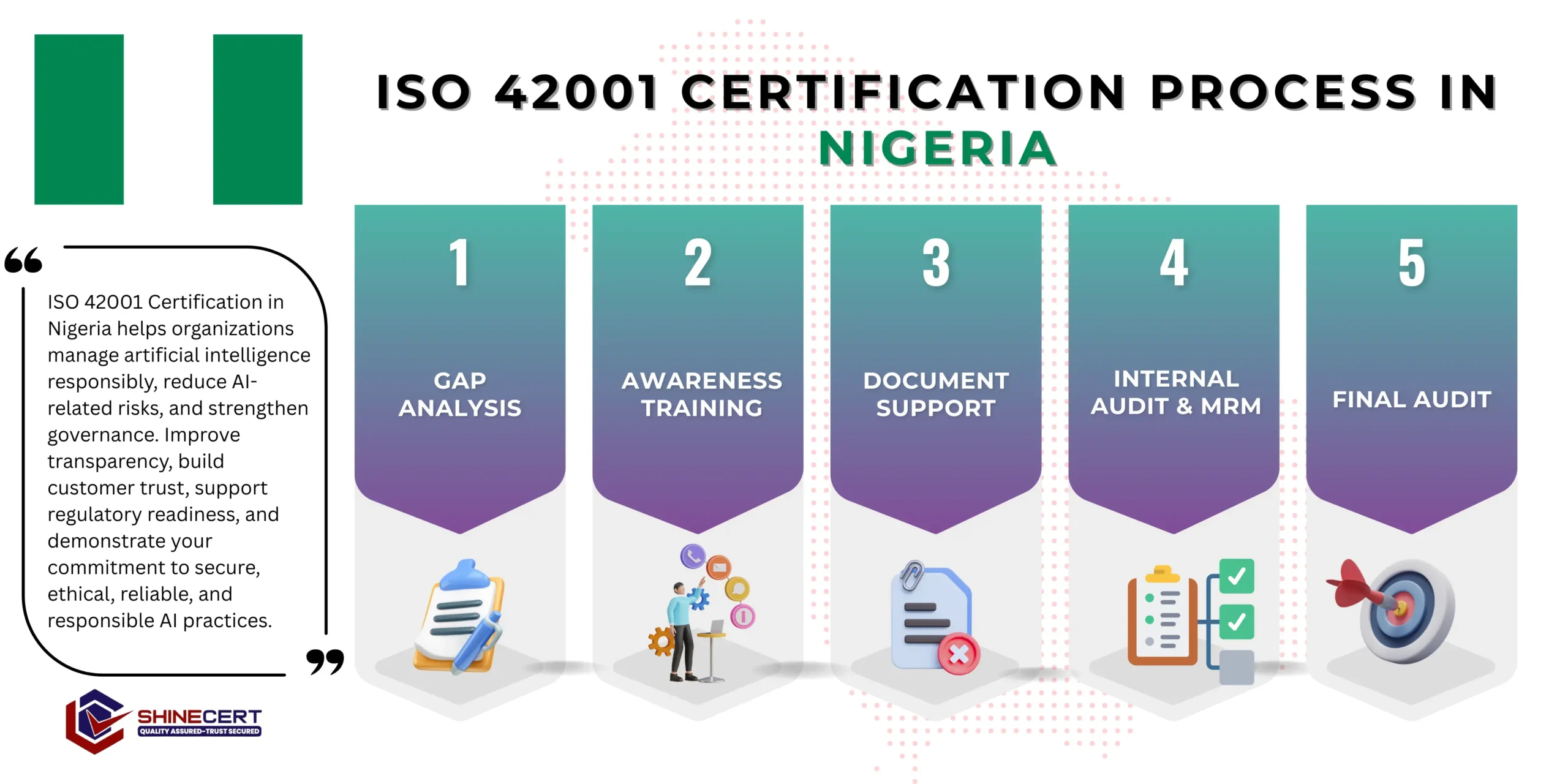
Our Five-Step Certification Process, in Depth
Gap Assessment
We review your actual AI systems, whether internally developed models or integrated third-party tools, and the genuine governance practices currently around them, mapping what we find against ISO 42001's requirements and Nigeria's National AI Strategy direction together.
A gap report identifying your real AI risk profile and exactly where formal governance documentation is missing.
Documentation
We build your AI policy, risk and impact assessment methodology, and system inventory around your organization's genuine AI use cases, a fintech using AI for credit scoring has a meaningfully different risk profile than a business using AI for internal document processing, and the documentation reflects that specifically.
A complete, version-controlled AI governance documentation set, with human oversight requirements genuinely built in for higher-stakes use cases.
Implementation
Governance controls, data quality checks, human review checkpoints, incident response procedures, move into real practice around how your AI systems are actually built, deployed, and monitored, not just documented separately from day-to-day development.
A functioning AI management system with genuine oversight actively operating alongside your AI systems.
Internal Audit and Management Review
We audit against every ISO 42001 clause, surfacing gaps while stakes are low. Findings go to formal management review where leadership makes documented decisions on AI governance priorities and resourcing.
An internal audit report, management review minutes, and corrective actions closed out before the certification audit.
Certification Audit
Stage 1 confirms your AI governance documentation is genuinely audit-ready; Stage 2 verifies governance controls are actually operating around your real AI systems, through direct review and staff interviews. We stay engaged through both stages.
Your ISO 42001 certificate, valid for three years, plus a surveillance audit schedule.
Gap Assessment
We review your actual AI systems, whether internally developed models or integrated third-party tools, and the genuine governance practices currently around them, mapping what we find against ISO 42001's requirements and Nigeria's National AI Strategy direction together.
A gap report identifying your real AI risk profile and exactly where formal governance documentation is missing.
Documentation
We build your AI policy, risk and impact assessment methodology, and system inventory around your organization's genuine AI use cases, a fintech using AI for credit scoring has a meaningfully different risk profile than a business using AI for internal document processing, and the documentation reflects that specifically.
A complete, version-controlled AI governance documentation set, with human oversight requirements genuinely built in for higher-stakes use cases.
Implementation
Governance controls, data quality checks, human review checkpoints, incident response procedures, move into real practice around how your AI systems are actually built, deployed, and monitored, not just documented separately from day-to-day development.
A functioning AI management system with genuine oversight actively operating alongside your AI systems.
Internal Audit and Management Review
We audit against every ISO 42001 clause, surfacing gaps while stakes are low. Findings go to formal management review where leadership makes documented decisions on AI governance priorities and resourcing.
An internal audit report, management review minutes, and corrective actions closed out before the certification audit.
Certification Audit
Stage 1 confirms your AI governance documentation is genuinely audit-ready; Stage 2 verifies governance controls are actually operating around your real AI systems, through direct review and staff interviews. We stay engaged through both stages.
Your ISO 42001 certificate, valid for three years, plus a surveillance audit schedule.
Certification Validity, Surveillance Audits, and Recertification
An ISO 42001 certificate is valid for three years from the date it’s issued. During years one and two, your certification body conducts an annual surveillance audit, narrower in scope, typically sampling a portion of your AI systems and governance controls and confirming previously identified nonconformities were genuinely closed. Before the three-year mark, a full recertification audit, comparable in depth to your original Stage 2 audit, confirms your AI management system has continued functioning as your AI systems and use cases evolved. Passing recertification issues a new three-year certificate.
Cost of ISO 42001 Certification in Nigeria, What Actually Drives It
| Organization Profile | Relative Investment Level | Why |
|---|---|---|
| Small, single AI use case | Lower | Narrower system inventory, fewer risk categories to assess |
| Medium, multiple AI use cases or moderate-risk sector | Moderate | Broader risk assessment across more systems |
| Larger, high-stakes AI deployment | Higher | Extensive impact assessment and human oversight design across multiple use cases |
| Bundled with ISO 27001 | Moderate-to-higher combined, lower than separate engagements | Shared risk assessment and data governance infrastructure reduces combined cost |
- Nature and stakes of your AI use cases : AI used for credit scoring or health-related recommendations carries genuinely higher governance requirements than AI used for internal process automation with limited external impact.
- Number of distinct AI systems : Each additional AI system or use case expands the inventory, risk assessment, and human oversight design work required.
- Whether AI is built internally or sourced from third parties : Internally developed models require deeper technical governance documentation; third-party AI tools require genuine vendor risk assessment instead, a different but still real body of work.
- Existing governance maturity : Businesses with some documented AI use policies or review processes already in place aren’t starting from zero, those relying entirely on informal practice face more foundational work.
- Certification body fees, tracked separately from our consulting fees : The certification audit itself is conducted and invoiced directly by an independently accredited certification body, separate from ShineCert’s implementation work.
- Whether you’re bundling standards : Building ISO 42001 alongside ISO 27001 shares meaningful risk assessment and data governance infrastructure, reducing combined cost.
- Internal capacity to contribute : A data or AI governance lead who can genuinely own documentation, risk assessment logistics, and internal audit coordination reduces the consulting hours required.
ISO 42001 Benefits Nigerian Businesses Actually Get
Because the strategy explicitly prioritizes responsible AI and governance, certified organizations are demonstrably ahead of where national policy is heading, not scrambling to catch up once formal regulation follows.
ISO 42001 is understood and trusted globally as evidence of genuine AI governance maturity, valuable for Nigerian AI businesses seeking international clients, partners, or investment.
Systematic risk assessment covering bias, data quality, and unintended AI outcomes catches genuine problems before they reach customers or trigger reputational harm.
Demonstrable, independently verified AI governance is a genuine differentiator in sectors like fintech and healthtech, where AI-driven decisions directly affect people’s financial or health outcomes.
International investors and enterprise clients increasingly weigh AI governance credentials directly when evaluating Nigerian AI-driven businesses for partnership or funding.
ISO 42001 requires assigning genuine ownership for AI risk decisions, replacing the common pattern of AI development moving fast with no one formally accountable for its downstream effects.
As Nigeria’s AI governance framework matures beyond the current strategy stage, a certified management system positions your organization to adapt considerably faster than one starting from no formal governance structure.
ISO 42001 requires genuinely identifying the specific risks your actual AI systems pose, biased lending or hiring outcomes, data privacy exposure, over-reliance on automated decisions without human oversight, and building real, documented controls around each one.
The standard requires genuine scrutiny of the data used to train and operate AI systems, an area many organizations manage informally until certification forces real structure onto it.
Organizations already certified to ISO 27001 find ISO 42001 shares meaningful structural overlap, particularly around risk assessment and data governance, making the combined pursuit considerably more efficient.
Mandatory Documents Required for ISO 42001 Implementation
A documented statement defining which AI systems, use cases, and business units the management system covers, whether internally developed models or third-party AI tools your organization deploys.
A documented policy, approved by top management, expressing genuine commitment to responsible AI development and use, aligned with recognized principles like fairness, transparency, and human oversight.
A documented, actively maintained process for identifying risks specific to your actual AI systems, including impact on individuals affected by automated decisions, and recording the controls chosen to address each one.
Records showing how training and operational data is sourced, quality-checked, and managed, addressing genuine data quality and bias risk at the source rather than only at the output stage.
A documented register of AI systems in use, including their intended purpose, scope of deployment, and assigned ownership.
Documentation defining where and how human review is genuinely built into AI-driven decisions, particularly for higher-stakes use cases like lending, hiring, or health-related recommendations.
Documentation showing how your organization communicates AI use and its limitations to affected stakeholders, whether customers, employees, or regulators.
Documentation assessing risk where your organization relies on external AI tools or vendors, since responsibility for AI governance doesn’t disappear simply because the model itself was built elsewhere.
A documented procedure for detecting and responding to AI-related incidents, biased outcomes, system malfunctions, unintended consequences, plus records of any incidents actually handled.
A planned internal audit cycle, documented management review decisions on AI governance priorities, and evidence staff involved in AI development or deployment have received relevant training.
Challenges Organizations Face, Implementation, Risk Management, Audit, and Ongoing Certification
- Challenges during implementation : Technical teams sometimes view AI governance documentation as slowing down genuine innovation, when in practice a well-scoped management system formalizes decisions the team was already making informally, without meaningfully slowing development pace.
- Challenges in risk management : A common gap is assessing AI risk only at the point of initial model deployment, without a genuine process for re-assessing risk as the model is retrained or as its use case expands into new, higher-stakes decisions over time.
- Challenges during internal and certification audits : Auditors specifically probe how genuine your human oversight actually is, a “human in the loop” review step that exists on paper but is routinely rubber-stamped without real scrutiny is exactly the kind of gap ISO 42001 audits are designed to surface.
- Challenges maintaining certification after the initial audit : AI systems evolve faster than most other business systems, and governance documentation can fall out of date quickly if new use cases or model updates aren’t genuinely fed back into the risk assessment and system inventory on an ongoing basis.
Case Study
A Lagos-based fintech offering an AI-driven credit scoring product for underbanked customers approached us after an international investor’s due diligence process raised specific questions about how the company managed bias risk in its lending algorithm, questions the founding team, strong on the technical side, hadn’t previously had to answer in a structured, documented way.
Our gap assessment found the underlying model had been built with genuine care, including some bias testing during development, but there was no formal AI risk assessment, no documented human oversight process for borderline lending decisions, and no structured way to demonstrate any of this to an outside party. The engineering team’s practices were better than their documentation suggested, which is a genuinely common pattern.
We built the AI management system directly around their existing model and lending workflow, adding a formal human review checkpoint for declined applications near the approval threshold and documenting the bias testing methodology the team had already been informally applying. Certification took just over four months, and the resulting documentation became a direct, positive input into the investor’s due diligence process.
This reflects a pattern we see often, genuinely careful AI development undermined by a lack of documented, demonstrable governance structure, rather than a single specific engagement.
Industries and Sectors We Certify in Nigeria, and Which Standards Each Actually Needs
Fintech and digital lending
ISO 42001 addresses genuine AI-driven credit scoring and fraud detection risk; pair with ISO 27001 given the sensitive financial data these AI systems typically process.
Read moreHealthtech and diagnostic support platforms
ISO 42001 addresses AI-assisted diagnostic and health recommendation risk; pair with ISO 27001 given the sensitive health data involved.
Read moreAgritech
ISO 42001 addresses AI-driven forecasting and advisory tool risk relevant to Nigeria's growing agritech sector; pair with ISO 9001 for overall service quality.
Read moreInsurtech
ISO 42001 addresses AI-driven underwriting and claims assessment risk; pair with ISO 27001 given the sensitive personal data involved.
Read moreHR technology and recruitment platforms
ISO 42001 addresses genuine bias risk in AI-driven hiring and screening tools; pair with ISO 27001 for the personal data these platforms process.
Read moreTelecommunications and customer analytics
ISO 42001 addresses AI-driven customer profiling and automated decision risk; pair with ISO 27001 for the underlying data protection requirements.
Read moreWhy Choose ShineCert for ISO 42001 Certification Nigeria?
ShineCert brings 10 years of ISO consulting and certification experience to Nigeria’s market, coordinated through our Riyadh and India offices with services delivered remotely or on-site depending on what your engagement genuinely needs. We’ve guided more than 10,000 organizations through ISO certification worldwide, and we build every Nigeria AI governance engagement around your actual AI systems and risk profile, not a generic template lifted from a different regulatory environment. ShineCert is the best ISO consultant in Nigeria.
Choosing a Certification Body in Nigeria?
What to Check | Why It Matters |
Accreditation under a recognized international accreditation framework | Confirms genuine, internationally recognized certification |
Genuine understanding of AI-specific risk, not just general IT audit experience | ISO 42001 requires assessing bias, transparency, and human oversight, not just data security |
Experience with your specific AI use case’s risk profile | Credit scoring, diagnostics, and hiring tools carry genuinely different risk considerations |
Familiarity with Nigeria’s National AI Strategy direction | Ensures the auditor understands the governance context your organization operates within |
Ready to Get Started?
Whether you’re building AI governance proactively or responding to investor or partner due diligence, we’ll walk through your specific AI systems and cost factors before proposing a fixed-scope plan, delivered remotely, on-site, or however genuinely fits your project. Book a free consultation or contact us directly to get started.
Frequently Asked Questions
Look for demonstrated experience with AI-specific risk assessment, genuine understanding of Nigeria’s National AI Strategy direction, and transparent scoping rather than flat package pricing. ShineCert scopes every Nigeria engagement individually.
Not currently as a binding legal requirement, but Nigeria’s National AI Strategy explicitly prioritizes responsible AI and governance as core pillars, meaning certified organizations are positioned ahead of where national policy is genuinely heading.
It genuinely depends on the number and risk level of your AI use cases, we scope every project individually.
Typically two and a half to eight months depending on the scale and risk profile of your AI systems, see our detailed timeline breakdown above.
Yes, ISO 42001 covers both internally developed AI systems and third-party AI tools your organization deploys, with the governance approach adapted to each.
Certification doesn’t mean AI systems never produce flawed outcomes, it means your organization has a documented process for detecting, investigating, and correcting them, and genuine human oversight built in for higher-stakes decisions.
Much of the documentation and risk assessment work runs effectively over remote sessions, though certain reviews benefit from in-person discussion with your technical team, we scope the right mix per project.
ShineCert doesn’t maintain a standalone Nigeria office; we coordinate Nigeria engagements from our Riyadh and India offices, with services delivered remotely or on-site as your project requires.