
ISO 22301 Certification in Nigeria
Quick Answer
ISO 22301 is the international standard for business continuity management systems, and in Nigeria it addresses a genuinely persistent, well-documented operational reality: the national power grid has collapsed multiple times in 2026 alone, including a nationwide blackout in January that took all 23 connected generation plants offline simultaneously, following nine separate grid failures in 2024. These outages are estimated to cost the Nigerian economy around $1 billion annually. ISO 22301 gives your organization a structured, internationally recognized way to plan for and respond to exactly this kind of disruption, rather than absorbing the impact reactively each time it happens. Certification typically takes three to five months, and cost depends on genuine factors like operational complexity and existing continuity practices, never a flat figure quoted upfront.
What Is ISO 22301, Actually?
ISO 22301 is an international standard, published by the International Organization for Standardization, that sets out requirements for a business continuity management system, a structured way an organization identifies threats to its operations, prepares for disruptive incidents, and ensures critical business functions can continue or recover within a genuinely acceptable timeframe. It covers business impact analysis, risk assessment, recovery strategy, and incident response together, addressing everything from a localized equipment failure to a genuinely widespread infrastructure disruption. Getting certified means an independent, accredited body has formally verified your continuity management system meets the standard’s requirements, giving customers, partners, and insurers real confidence your organization can genuinely keep operating, or recover quickly, when disruption hits, not just that you have a policy document saying you plan to.
Why ISO 22301 BCM Matters So Much in Nigeria Right Now?
- National grid collapses are a documented, recurring, and genuinely severe operational risk, not a rare edge case : Nigeria’s grid failed multiple times in early 2026 alone, including an incident where all 23 connected power generation plants lost output simultaneously, leaving all eleven electricity distribution companies at zero load nationwide. This followed nine separate grid collapses throughout 2024. For any business dependent on continuous power, this is a genuine, recurring operational reality that demands a structured continuity response, not improvisation each time it happens.
- The gap between generation capacity and actual delivered power means disruption risk persists even between full grid collapses : Nigeria’s installed generation capacity is reported at around 15,500 megawatts, but actual transmission to consumers rarely exceeds 5,000 megawatts, largely because the transmission network genuinely cannot carry the full load. This means partial outages, load shedding, and localized supply disruption remain a persistent background risk well beyond the headline-grabbing full collapses.
- The power sector’s mounting financial distress signals continued instability rather than imminent resolution : Debt across generation, transmission, and distribution companies had reportedly reached roughly ₦6.8 trillion by early 2026, accumulating at around ₦200 billion monthly, a financial trajectory that gives businesses genuine reason to plan for continued disruption risk rather than assuming near-term structural improvement.
- Beyond power, businesses face genuine continuity exposure from connectivity, logistics, and regional security disruption : Internet and telecommunications outages, road and logistics disruption, and regional security incidents all represent real, additional continuity risks that compound the power reliability challenge for businesses operating across multiple Nigerian regions.
What are the steps to get ISO 22301 Certification in Nigeria?
our services
- ISO Certification Nigeria
- ISO 9001 Certification Nigeria
- ISO 14001 Certification Nigeria
- ISO 27001 Certification Nigeria
- ISO 22000 Certification Nigeria
- ISO 20000-1 Certification Nigeria
- ISO 45001 Certification Nigeria
- ISO 42001 Certification Nigeria
- ISO 13485 Certification Nigeria
- ISO 17025 Certification Nigeria
- ISO 31000 Certification Nigeria
- ISO 22301 Certification Nigeria
- ISO 27701 Certification Nigeria
- ISO 37001 Certification Nigeria
- ISO 50001 Certification Nigeria
- CE Mark Certification Nigeria
- GMP Certification Nigeria
- GDPR Certification Nigeria
- Halal Certification Nigeria
- SOC Certification Nigeria
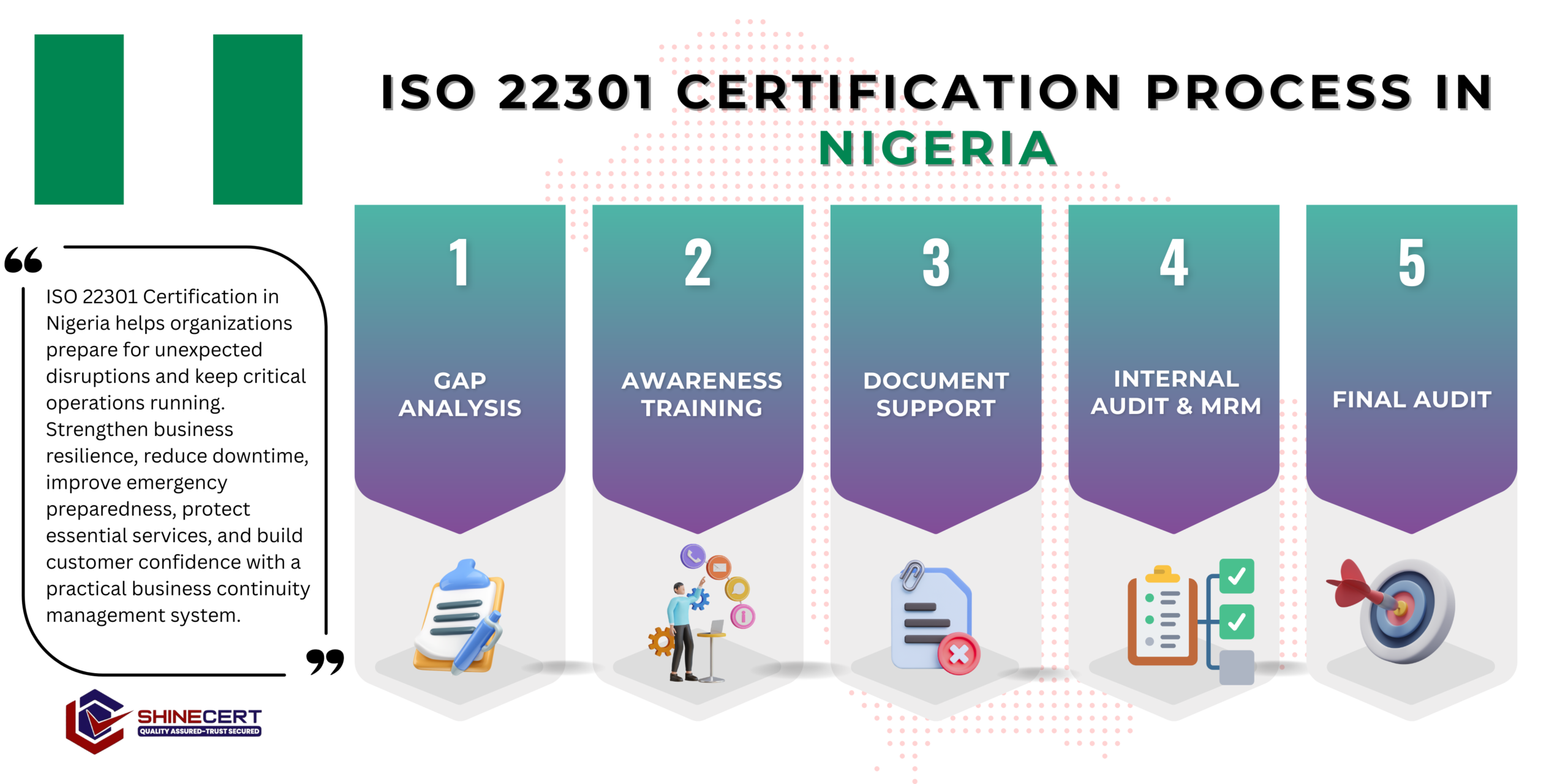
Our Five-Step Certification Process, in Depth
Gap Assessment
We review your actual critical operations, current backup power and continuity arrangements, and past experience with disruption, including how your organization has genuinely handled recent grid collapses, mapping what we find against ISO 22301's requirements.
A gap report identifying your real continuity readiness and exactly where formal ISO 22301 documentation and planning is missing.
Documentation
We build your business impact analysis, risk assessment, and continuity strategies around your organization's actual critical functions and genuine infrastructure exposure, a data-dependent financial services business has meaningfully different continuity requirements than a manufacturing operation, and the documentation reflects that specifically.
A complete, version-controlled BCMS documentation set, with recovery strategies genuinely built around realistic Nigerian infrastructure disruption scenarios.
Implementation
Continuity strategies, backup power arrangements, alternative work locations, supplier contingency plans, move into genuine operational readiness, with staff trained on their specific roles during an actual incident.
A functioning BCMS with real recovery arrangements in place and staff genuinely prepared to execute them.
Internal Audit and Testing
We audit every ISO 22301 clause and run realistic exercises, simulating an extended power outage or connectivity failure, to confirm plans actually work under pressure, not just on paper.
An internal audit report, exercise results, and corrective actions closed out before the certification audit.
Certification Audit
Stage 1 confirms your BCMS documentation is genuinely audit-ready; Stage 2 verifies your continuity arrangements and staff readiness through direct review and, often, evidence from real exercises or actual incidents handled. We stay engaged through both stages.
Your ISO 22301 certificate, valid for three years, plus a surveillance audit schedule.
Gap Assessment
We review your actual critical operations, current backup power and continuity arrangements, and past experience with disruption, including how your organization has genuinely handled recent grid collapses, mapping what we find against ISO 22301's requirements.
A gap report identifying your real continuity readiness and exactly where formal ISO 22301 documentation and planning is missing.
Documentation
We build your business impact analysis, risk assessment, and continuity strategies around your organization's actual critical functions and genuine infrastructure exposure, a data-dependent financial services business has meaningfully different continuity requirements than a manufacturing operation, and the documentation reflects that specifically.
A complete, version-controlled BCMS documentation set, with recovery strategies genuinely built around realistic Nigerian infrastructure disruption scenarios.
Implementation
Continuity strategies, backup power arrangements, alternative work locations, supplier contingency plans, move into genuine operational readiness, with staff trained on their specific roles during an actual incident.
A functioning BCMS with real recovery arrangements in place and staff genuinely prepared to execute them.
Internal Audit and Testing
We audit every ISO 22301 clause and run realistic exercises, simulating an extended power outage or connectivity failure, to confirm plans actually work under pressure, not just on paper.
An internal audit report, exercise results, and corrective actions closed out before the certification audit.
Certification Audit
Stage 1 confirms your BCMS documentation is genuinely audit-ready; Stage 2 verifies your continuity arrangements and staff readiness through direct review and, often, evidence from real exercises or actual incidents handled. We stay engaged through both stages.
Your ISO 22301 certificate, valid for three years, plus a surveillance audit schedule.
Certification Validity, Surveillance Audits, and Recertification
An ISO 22301 certificate is valid for three years from the date it’s issued. During years one and two, your certification body conducts an annual surveillance audit, narrower in scope, typically reviewing recent exercise results and confirming previously identified nonconformities were genuinely closed. Before the three-year mark, a full recertification audit, comparable in depth to your original Stage 2 audit, confirms your BCMS has continued functioning throughout the cycle, including that your business impact analysis and risk assessment were kept genuinely current as your operations evolved. Passing recertification issues a new three-year certificate.
Cost of ISO 22301 Certification in Nigeria, What Actually Drives It
| Organization Profile | Relative Investment Level | Why |
|---|---|---|
| Small, single-location operation | Lower | Narrower business impact analysis and continuity strategy scope |
| Medium, multi-department operation | Moderate | Broader critical function mapping and recovery planning |
| Larger, multi-site or multi-region operation | Higher | Extensive impact analysis and complex recovery coordination across sites |
| Bundled with ISO 27001 or ISO 31000 | Moderate-to-higher combined, lower than separate engagements | Shared risk assessment infrastructure reduces combined cost |
- Number and complexity of critical business functions : Each additional critical function requiring its own recovery strategy expands the business impact analysis and planning work considerably.
- Number of sites and regions : Each additional location typically faces a distinct infrastructure and security risk profile requiring separate assessment and continuity arrangements.
- Existing continuity infrastructure maturity : Businesses with backup power, redundant connectivity, or alternative site arrangements already in place aren’t starting from zero, those relying entirely on ad hoc response face more foundational work.
- Certification body fees, tracked separately from our consulting fees : The certification audit itself is conducted and invoiced directly by an independently accredited certification body, separate from ShineCert’s implementation work.
- Whether you’re bundling standards : Building ISO 22301 alongside ISO 27001 or ISO 31000 shares meaningful risk assessment infrastructure, reducing combined cost.
- Depth of exercise and testing program : More extensive, realistic disruption simulations require more planning and coordination time than lighter tabletop exercises.
- Internal capacity to contribute : A continuity or operations manager who can genuinely own documentation, exercise coordination, and internal audit logistics reduces the consulting hours required.
ISO 22301 Benefits Nigerian Businesses Actually Get
A documented business continuity plan built specifically around Nigeria’s real power reliability challenges means your organization has a rehearsed response ready, rather than improvising each time the grid fails.
ISO 22301 is understood and trusted by international clients, partners, and insurers, giving Nigerian businesses a credential that demonstrates genuine operational resilience beyond domestic reputation alone.
Structured recovery planning meaningfully reduces the direct and indirect costs of downtime, lost production, missed deadlines, reputational harm, compared to organizations without a rehearsed response.
A certified continuity management system provides genuine, documented evidence of proactive risk management, strengthening your position with insurers and in contracts that include continuity or service-level requirements.
Financial services, telecommunications, and larger corporate clients increasingly require documented business continuity capability as a genuine evaluation criterion for critical suppliers.
A documented continuity plan and trained response team turn a disruptive event into a managed process rather than a genuine scramble, considerably reducing recovery time.
ISO 22301 requires genuinely identifying the specific threats your actual operations face, power disruption, connectivity failure, logistics breakdown, regional security risk, and building real, prioritized recovery strategies around each one.
Demonstrable, independently verified continuity planning is a genuine differentiator when clients are choosing between suppliers in a market where operational disruption is a well-known, shared concern.
ISO 22301 shares meaningful structural overlap with ISO 27001 and ISO 31000, making combined pursuit considerably more efficient for organizations building broader resilience and risk management capability.
The standard requires assessing continuity risk in your supply chain and vendor relationships, an area many Nigerian organizations manage informally until a certified system forces genuine structure onto it.
Mandatory Documents Required for ISO 22301 Implementation
A documented statement defining which business functions, locations, and processes the business continuity management system covers, aligned with your actual critical operations.
A documented policy, approved by top management, expressing genuine commitment to maintaining and recovering critical operations during disruption, grounded in your organization’s real risk exposure including power and infrastructure reliability.
A documented, actively maintained assessment of your critical business functions, the impact of their disruption over time, and the maximum tolerable period each can be down, directly informed by realistic scenarios like extended power outages.
A documented process for identifying threats specific to your actual operations, grid collapse, connectivity failure, logistics disruption, regional security risk, and assessing their genuine likelihood and impact.
Documented recovery strategies and step-by-step continuity plans for each critical function, including specific arrangements for extended power disruption such as backup generation, fuel supply logistics, or alternative work arrangements.
A documented procedure defining how your organization detects, escalates, and manages a disruptive incident, including clear roles and communication protocols during an actual event.
A documented list of applicable requirements, client service-level agreements, regulatory obligations, insurance requirements, along with evidence of how continuity planning addresses each one.
Documentation showing your continuity plans have genuinely been tested through drills or simulations, not just written and filed away untested.
Documentation assessing continuity risk in your critical supply chain and vendor relationships, since your own continuity plan is only as strong as the suppliers you genuinely depend on.
A planned internal audit cycle, documented management review decisions, and evidence staff have received relevant continuity and incident response training.
Challenges Organizations Face, Implementation, Risk Management, Audit, and Ongoing Certification
- Challenges during implementation : Businesses sometimes conflate having backup generators with having a genuine business continuity plan, physical backup infrastructure is necessary but not sufficient without documented failover procedures, defined recovery time objectives, and trained staff who know exactly what to do during an incident.
- Challenges in risk management : A common gap is planning for a full grid collapse while under-planning for the more frequent, partial disruptions, localized outages, connectivity slowdowns, logistics delays, that occur far more often and cumulatively cost more than the rarer full-scale events.
- Challenges during internal and certification audits : Auditors specifically probe whether continuity plans have genuinely been tested through real exercises, not just written, a plan that exists only on paper, never rehearsed, is a common and significant finding.
- Challenges maintaining certification after the initial audit : Continuity plans tend to fall out of date as business operations evolve, new critical systems or dependencies introduced after certification need to be genuinely fed back into the business impact analysis and recovery strategy, not left outside the original plan.
Case Study
A Lagos-based digital payments processor approached us after the January 2026 nationwide grid collapse caused a multi-hour service disruption that directly affected transaction processing for their merchant clients, generating real reputational and contractual pressure from clients whose own service-level agreements were, in turn, affected downstream.
Our gap assessment found the business had backup generation at its primary facility, but no documented business impact analysis defining exactly which functions needed to fail within minutes versus hours, and no formal incident communication plan for keeping merchant clients informed during an outage. The technical resilience was reasonably strong; the structured planning and communication protocol around it was not.
We built a business impact analysis prioritizing transaction processing as a near-zero-tolerance function, formalized failover procedures the technical team had previously executed informally, and built a client communication protocol for future incidents. Implementation ran across roughly four months, including a live simulated outage exercise that surfaced and resolved a gap in backup fuel supply logistics before it could matter during a real event.
This reflects a pattern we see often, genuine technical resilience undermined by a lack of structured planning and client communication around it, rather than a single specific engagement.
Industries and Sectors We Certify in Nigeria and Which Standards Each Actually Needs
Banking and financial services
ISO 22301 is close to essential given genuine, severe impact from power and connectivity disruption on transaction processing; pair with ISO 27001 for information security.
Read moreTelecommunications
ISO 22301 addresses genuine service continuity risk central to this sector's obligations to customers; pair with ISO 20000-1 for IT service management.
Read moreManufacturing
ISO 22301 addresses production continuity risk from power disruption; pair with ISO 9001 for quality management and ISO 45001 for workplace safety.
Read moreData centers and IT services
ISO 22301 addresses genuine uptime and service continuity obligations to clients; pair with ISO 27001 for information security given the data these businesses handle.
Read moreHealthcare and hospital operations
ISO 22301 addresses genuinely critical continuity requirements where power disruption directly affects patient care; pair with ISO 13485 if the facility also manufactures or distributes medical devices.
Read moreRetail and e-commerce
ISO 22301 addresses order processing and fulfillment continuity risk during disruption; pair with ISO 27001 given the customer payment data these businesses handle.
Read moreWhy Choose ShineCert for ISO 22301 Certification Nigeria?
ShineCert brings 10 years of ISO consulting and certification experience to Nigeria’s market, coordinated through our Riyadh and India offices with services delivered remotely or on-site depending on what your engagement genuinely needs. We’ve guided more than 10,000 organizations through ISO certification worldwide, and we build every Nigeria business continuity engagement around your actual critical operations and infrastructure exposure, not a generic template lifted from a different regulatory environment. ShineCert is the best ISO consultant in Nigeria.
Choosing a Certification Body in Nigeria?
What to Check | Why It Matters |
Accreditation under a recognized international accreditation framework | Confirms genuine, internationally recognized certification |
Genuine understanding of Nigeria’s specific infrastructure and power reliability challenges | Ensures your continuity plans are built around realistic, locally relevant disruption scenarios |
Experience with your specific sector’s continuity requirements | Financial services, telecom, and manufacturing carry genuinely different continuity priorities |
A genuine exercise-and-testing-focused audit approach | Confirms the auditor checks real plan execution, not just documentation review |
Ready to Get Started?
Whether you’re responding to a recent disruption or planning proactively around Nigeria’s genuine infrastructure reliability challenges, we’ll walk through your specific operations and cost factors before proposing a fixed-scope plan, delivered remotely, on-site, or however genuinely fits your project. Book a free consultation or contact us directly to get started.
Frequently Asked Questions
Look for demonstrated experience with Nigeria’s actual infrastructure reliability challenges, genuine sector-specific continuity experience, and transparent scoping rather than flat package pricing. ShineCert scopes every Nigeria engagement individually.
No, certification means your organization has a documented, tested plan for responding to disruption and recovering critical functions within a defined timeframe, considerably reducing the impact of an incident rather than eliminating disruption risk entirely.
It genuinely depends on the number of critical functions, sites, and your existing continuity infrastructure, we scope every project individually.
Typically two and a half to eight months depending on organization size and operational complexity, see our detailed timeline breakdown above.
Backup power is an important piece, but ISO 22301 requires a genuinely documented, tested plan covering recovery time objectives, staff roles, and client communication, not just physical backup infrastructure alone.
Auditors can, and often do, review evidence from actual incidents as part of assessing whether your continuity plans genuinely work in practice, which can be a genuinely valuable, real-world demonstration of your system’s effectiveness.
Documentation and planning work runs effectively over remote sessions, but exercise facilitation and site-specific continuity arrangements genuinely benefit from in-person involvement, we scope the right mix per project.
ShineCert doesn’t maintain a standalone Nigeria office; we coordinate Nigeria engagements from our Riyadh and India offices, with services delivered remotely or on-site as your project requires.