
CE Mark Certification in South Africa
Quick Answer
CE marking is not a South African certification, it’s an EU conformity mark showing a product meets European health, safety, and environmental requirements, and it’s a legal requirement for placing many product categories on the EU market. It’s relevant to South African businesses specifically because the EU is South Africa’s largest trading partner in Sub-Saharan Africa, with €46 billion in total goods trade in 2025, and because exports have nearly tripled since 2019. We provide advisory and preparation support to help South African manufacturers meet CE marking requirements before shipping to EU buyers. Preparation usually takes two to five months depending on product category.
What Is CE Marking?
CE marking is a mark placed on a product indicating it meets European Union health, safety, and environmental protection requirements. It is a legal requirement, not a voluntary certification, for placing many categories of product, electronics, machinery, toys, medical devices, and more, on the EU market.
Important distinction: CE marking is not something a South African body issues or certifies. It’s an EU regulatory requirement, and for many product categories, the manufacturer self-declares conformity through a Declaration of Conformity, sometimes supported by testing from an accredited EU-recognised laboratory, depending on the specific product’s risk category.
What ShineCert provides is advisory and preparation support: helping South African manufacturers understand which EU directives apply to their product, get it properly tested where required, and prepare the technical documentation an EU customs authority or buyer might request.
Why CE Marking Matters for South African Exporters?
- The EU is South Africa’s largest Sub-Saharan trading partner : Total goods trade reached €46 billion in 2025, with the EU removing customs duties on the vast majority of South African imports under the EU-SADC Economic Partnership Agreement.
- Exports have grown substantially in recent years : South African exports to the EU have expanded significantly since 2019, and a new Clean Trade and Investment Partnership signed in late 2025 signals continued deepening of the trade relationship.
- Non-compliant products face real market barriers : A product requiring CE marking that lacks proper documentation can be refused entry, delayed at customs, or rejected by EU buyers who need to demonstrate compliance themselves.
- Trade agreements ease testing requirements in some sectors : Under the broader Economic Partnership Agreement framework, certain sectors, electronics, machinery, energy-efficient products, benefit from mutual acceptance of test reports and a best-endeavour commitment toward accepting supplier declarations of conformity, reducing duplicate testing costs.
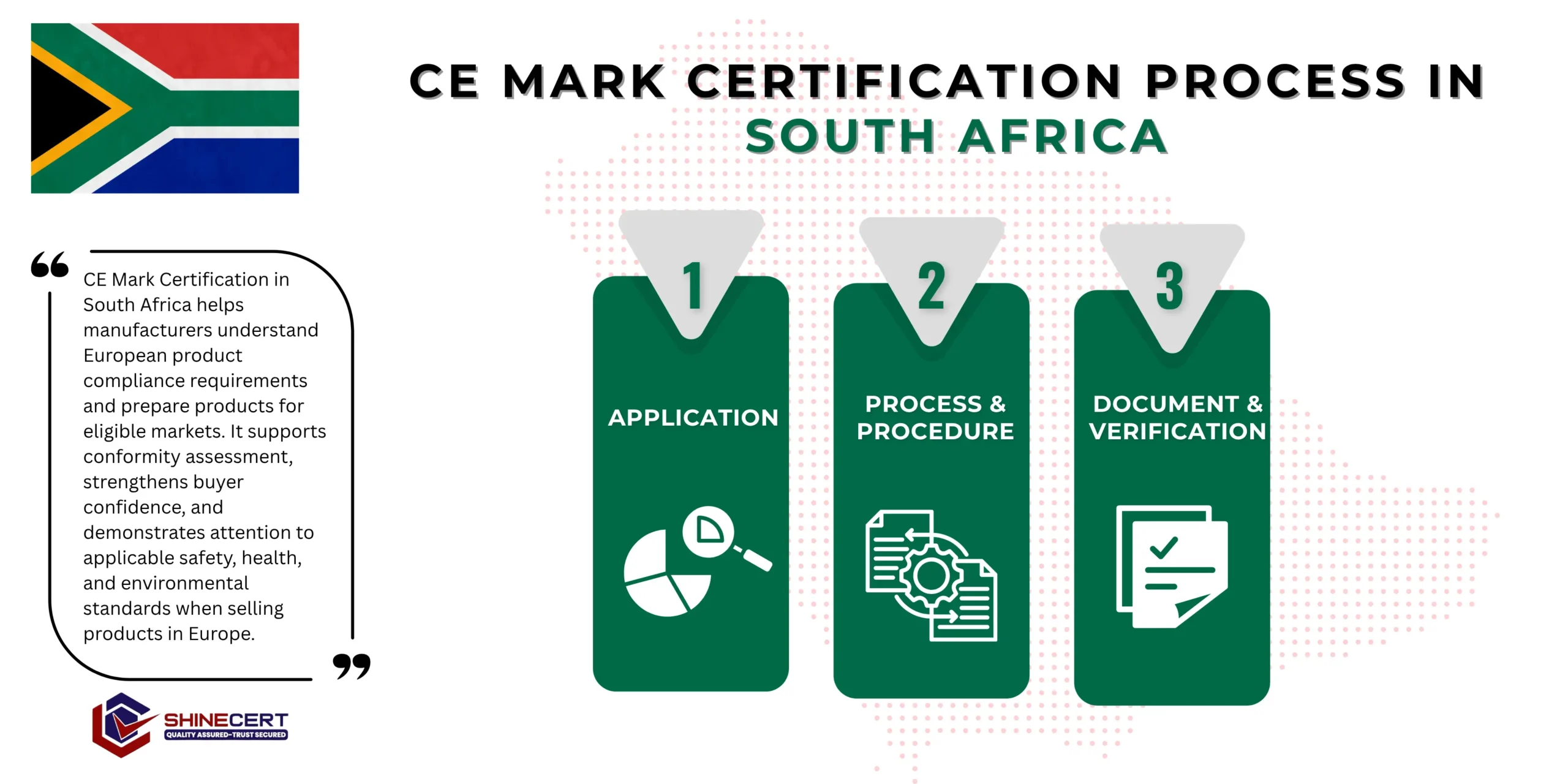
What are the steps to get CE Mark Certification in South Africa?
our services
- ISO Certification South Africa
- ISO 9001 Certification South Africa
- ISO 14001 Certification South Africa
- ISO 27001 Certification South Africa
- ISO 22000 Certification South Africa
- ISO 27701 Certification South Africa
- ISO 45001 Certification South Africa
- ISO 20000-1 Certification South Africa
- ISO 13485 Certification South Africa
- ISO 17025 Certification South Africa
- ISO 31000 Certification South Africa
- ISO 42001 Certification South Africa
- ISO 37001 Certification South Africa
- ISO 22301 Certification South Africa
- ISO 50001 Certification South Africa
- CE Mark Certification South Africa
- GDPR Certification South Africa
- GMP Certification South Africa
- Halal Certification South Africa
The CE Marking Preparation Process for South African Exporters
Preparing for CE marking follows five steps. Here’s exactly what happens at each one.
Directive Identification
We identify exactly which EU directives and harmonised standards apply to your specific product category, since requirements vary significantly between electronics, machinery, and other product types.
Clarity on the actual scope of work needed, rather than assuming every product needs the same testing.
A directive applicability assessment specific to your product.
Documentation
We help build your technical file and risk assessment, covering design, materials, and intended use.
Documentation that clearly demonstrates compliance if ever requested by an EU customs authority or buyer.
A complete technical documentation file.
Testing Coordination
Where testing is required, we coordinate with accredited laboratories, including taking advantage of mutual recognition provisions where your product category qualifies.
Testing that satisfies EU requirements without unnecessary duplication where trade agreement provisions apply.
Test reports supporting your conformity declaration.
Declaration Preparation
We help prepare your Declaration of Conformity, the formal document stating your product meets applicable EU requirements.
A properly worded, legally sound declaration, not a generic template that doesn’t reflect your specific product.
A signed Declaration of Conformity.
Final Review
We review your complete technical file, test reports, and declaration before you ship, checking everything is consistent and complete.
Confidence your paperwork will hold up to scrutiny at an EU border or from a buyer’s compliance team.
A complete, ready-to-ship CE marking file.
Benefits of CE Marking Preparation
- Access to the EU market without customs delays : Properly prepared documentation reduces the risk of a shipment being held up or rejected at the border.
- Stronger position with EU buyers : Buyers need their own supply chain to be compliant, and a South African supplier who already understands CE requirements is a lower-risk, more attractive partner.
- Reduced product recall and liability risk : The safety testing underlying CE marking often catches design issues before a product reaches any market, not only the EU.
- Clarity on which EU rules actually apply : Many exporters assume CE marking is one uniform requirement; in reality it depends heavily on product category, and clarity here avoids wasted compliance effort.
- A foundation for other quality systems : Much of the technical documentation and testing discipline overlaps with ISO 9001 and, for relevant products, ISO 13485.
What Does CE Marking Preparation Cost for South African Exporters?
- Product category and risk level : Higher-risk products like medical devices or machinery need more extensive testing and documentation than lower-risk consumer goods.
- Existing quality documentation : Businesses already following ISO 9001 or similar quality systems aren’t starting from nothing, which shortens the work.
- Testing requirements : Products requiring third-party laboratory testing typically cost more than those eligible for manufacturer self-declaration.
- Number of product variants : More product variants or models mean more individual technical files to prepare.
Case Study: A Cape Town Agricultural Equipment Manufacturer
- An agricultural equipment manufacturer in Cape Town came to us after securing initial interest from a European distributor, who asked for CE marking documentation before agreeing to a purchase order for a new equipment line.
- We identified the Machinery Directive as the primary applicable EU requirement and found the company’s equipment was well engineered, but had never been assessed against the directive’s specific risk categories, and no technical file existed in the format EU buyers expect.
- Over four months, we built the technical file, coordinated safety testing with an accredited laboratory, and prepared a proper Declaration of Conformity. The equipment shipped to the EU distributor without customs delays.
- The company has since used its CE-ready documentation to open discussions with a second European distributor, turning what started as a single buyer’s requirement into a repeatable export capability.
Who We Support Across South Africa?
CE mark in Cape Town
CE mark in Johannesburg
CE mark in Durban
CE mark in Gqeberha
CE mark in Pretoria
What Documents Do You Need for CE Marking Preparation?
- Product Documentation : Document: Technical File. Comprehensive documentation covering design, materials, manufacturing process, and intended use of your product.
- Risk Assessment : Document: Risk Assessment Report. Identifies potential hazards associated with your product and how they’ve been addressed in design.
- Testing : Document: Test Reports. Evidence from accredited laboratories that your product meets applicable safety and performance requirements.
- Declaration : Document: Declaration of Conformity. A signed statement declaring which EU directives and standards your product complies with.
- Labelling : Document: Labelling and Instructions Compliance Record. Evidence your product labelling and user instructions meet EU-specific requirements, including language requirements where applicable.
- Ongoing Compliance : Document: Post-Market Surveillance Notes. A basic record of how you’ll track and respond to any product issues once it’s in the EU market.
Why Businesses Choose ShineCert in South Africa?
We’ve spent 10 years helping more than 10,000 businesses worldwide navigate certification and export compliance requirements, coordinated through our Riyadh and India offices with work delivered remotely or on-site as needed. As the best CE Mark consultant in South Africa, ShineCert quotes based on your real product and market, explains EU requirements in plain language, and prepares documentation that holds up to scrutiny.
How Long Does CE Marking Preparation Take?
| Product Type | Typical Timeline | Why |
|---|---|---|
| Low-risk consumer goods | 2–3 months | Often eligible for self-declaration, less testing |
| Moderate-risk products (electronics, machinery) | 3–4 months | Testing coordination and fuller technical file |
| Higher-risk products (medical devices) | 4–5 months | Extensive testing and documentation required |
Ready to Get Started?
Whether you’re responding to a specific EU buyer requirement or preparing to enter the European market for the first time, we’ll walk through your product and give you a clear, honest quote. Book a free consultation or contact us to get started.
Frequently Asked Questions
No, CE marking isn’t issued by any South African body, it’s an EU requirement, typically self-declared by the manufacturer or supported by EU-recognised laboratory testing. We provide advisory and preparation support.
It depends on your product category and testing requirements. We quote every business individually.
Usually two to five months, depending on product risk category.
No, only specific regulated product categories require it; we help you determine whether your product falls within scope.
Much of the documentation work can happen remotely; product testing typically requires physical samples sent to an accredited laboratory.
No, CE marking is a legal EU requirement for specific products, while ISO certifications are voluntary international management system standards; they’re often complementary.