
ISO 31000 Certification in South Africa
Quick Answer
ISO 31000 is the world’s leading framework for managing risk, but unlike ISO 9001 or ISO 14001, it is not certifiable, no auditor issues an ISO 31000 certificate, because its guidance, not a set of auditable requirements. What we deliver is implementation: a working risk management framework built to ISO 31000’s principles, which you can reference and demonstrate to stakeholders. In South Africa, this matters given real, current risk exposure, a volatile rand that moved from around 15.7 to above 16.8 per US dollar in 2026, ongoing electricity tariff increases, and residual grid risk despite 365 days without load shedding as of mid-2026. Implementation usually takes two to five months. Cost depends on your organisation’s size and risk complexity.
What Is ISO 31000?
ISO 31000 is an international standard providing principles and guidelines for managing risk. It sets out a structured way to identify what could go wrong in your business, assess how serious each risk is, and decide what to do about it, before it happens, not after.
Unlike ISO 9001 or ISO 14001, ISO 31000 is guidance, not a certifiable management system standard. There is no accredited audit and no certificate. What businesses actually get from working with us is a risk management framework built around ISO 31000’s principles: a genuine, working process for identifying and managing risk, which you can point to and explain to your board, investors, or regulators.
In South Africa, this distinction matters because ISO 31000 addresses risks far broader than what a single certifiable standard like ISO 27001 (security) or ISO 22301 (continuity) covers, currency risk, supply chain risk, political risk, and reputational risk all fall within its scope.
Why ISO 31000 Matters in South Africa?
- Currency volatility is a real, current risk : The rand moved from around 15.7 to above 16.8 per US dollar in 2026 amid global and local instability, directly affecting any business with imported inputs, foreign debt, or export revenue.
- Energy risk hasn’t disappeared, even without load shedding : South Africa marked 365 consecutive days without load shedding in May 2026, but analysts warn a return of outages by 2027 or 2028 remains a genuine possibility given the grid’s continued reliance on ageing coal infrastructure, alongside tariff increases exceeding 18% cumulative over two years.
- Electricity theft is a growing, quantifiable drain : Non-technical losses amounted to 8% of Eskom’s power supply in the last financial year, translating to R17.5 billion in lost revenue, a cost ultimately passed on through tariffs and service reliability.
- Boards and investors increasingly expect a formal risk framework : Whether for governance, insurance, or investor due diligence, being able to demonstrate a structured approach to risk, rather than an informal or reactive one, is increasingly expected of serious businesses.
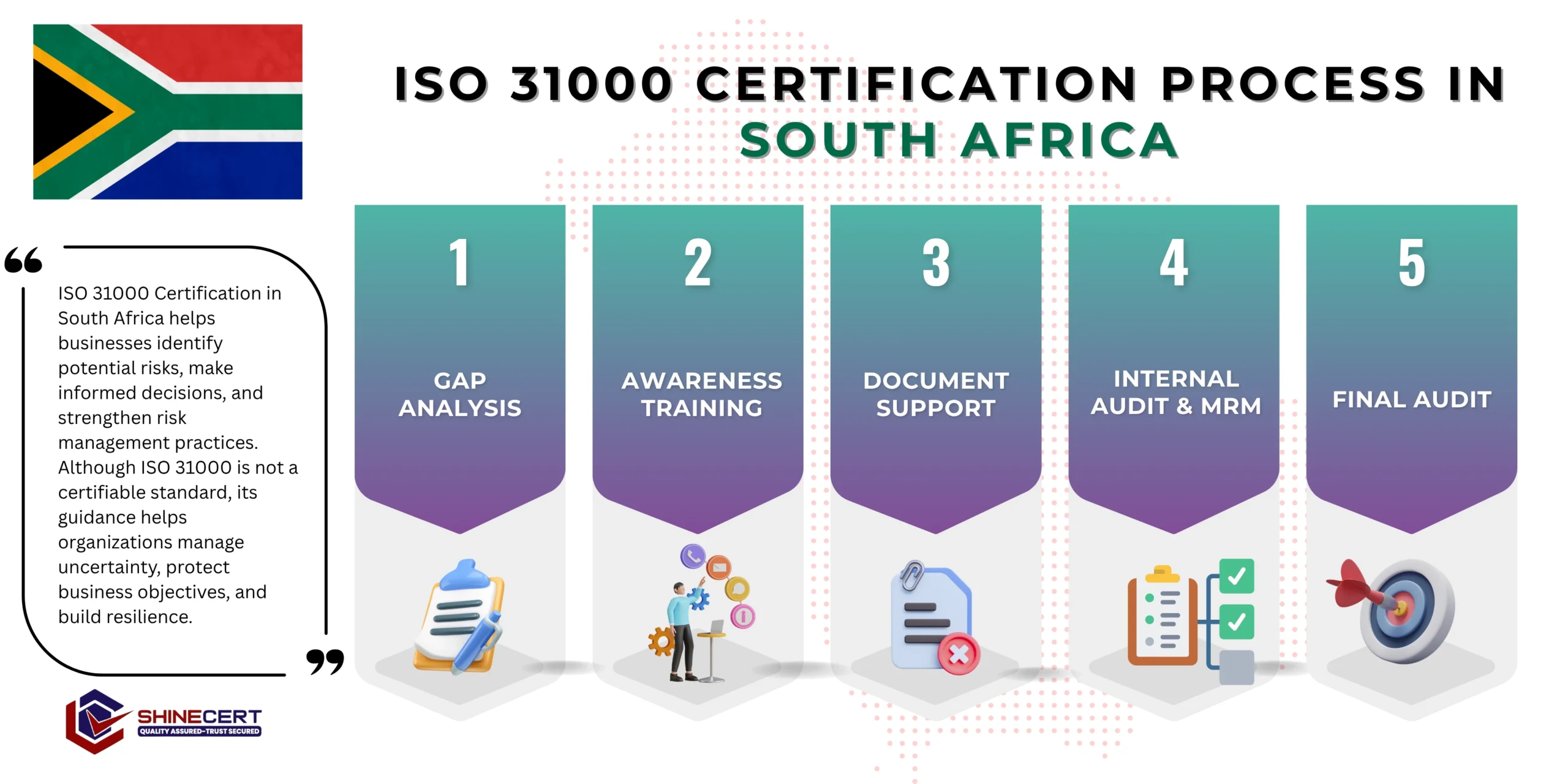
What are the steps to get ISO 31000 Certification in South Africa?
our services
- ISO Certification South Africa
- ISO 9001 Certification South Africa
- ISO 14001 Certification South Africa
- ISO 27001 Certification South Africa
- ISO 22000 Certification South Africa
- ISO 27701 Certification South Africa
- ISO 45001 Certification South Africa
- ISO 20000-1 Certification South Africa
- ISO 13485 Certification South Africa
- ISO 17025 Certification South Africa
- ISO 31000 Certification South Africa
- ISO 42001 Certification South Africa
- ISO 37001 Certification South Africa
- ISO 22301 Certification South Africa
- ISO 50001 Certification South Africa
- CE Mark Certification South Africa
- GDPR Certification South Africa
- GMP Certification South Africa
- Halal Certification South Africa
The ISO 31000 Implementation Process in South Africa
Implementing a risk framework follows five steps. Here’s exactly what happens at each one.
Risk Identification
We work with leadership to identify the risks that genuinely threaten your business, currency exposure, energy reliability, supply chain disruption, regulatory change, rather than a generic industry risk list.
An honest picture of what could actually hurt your business, not a template borrowed from an unrelated sector.
A risk identification report specific to your operations.
Documentation
We help build your risk management policy, risk register, and assessment criteria for likelihood and impact.
A framework your leadership team will actually use, not a document that gets filed away after the workshop.
A complete risk management framework.
Implementation and Training
Leadership and relevant staff are trained to use the framework in real decisions, from budget approvals to supplier selection.
This phase determines whether the framework becomes a genuine habit or another shelved policy, expect real pushback and questions, which is a healthy sign it’s landing.
Training records and evidence of the framework being used in actual decisions.
Internal Review
We check whether the risk register and assessment process are genuinely being maintained and used, several weeks after go-live.
Early course correction if the framework has started slipping, before bad habits set in.
An internal review report with recommended adjustments.
Ongoing Monitoring
Risks are reviewed and updated on a regular cycle, typically quarterly, as your business and its environment change.
A living framework that stays relevant, rather than a one-time exercise that goes stale within a year.
A recurring risk review cycle built into your governance calendar.
Benefits of an ISO 31000 Risk Framework
- Fewer risks catching the business by surprise : Currency swings, supply disruptions, and energy risk get identified and planned for, rather than discovered when they’ve already caused damage.
- Better-informed board and investor conversations : A structured risk register gives leadership something concrete to present, rather than a general sense that “we’re aware of the risks.”
- Stronger insurance and financing positions : Insurers and lenders increasingly favour businesses that can demonstrate a genuine risk management process.
- More consistent decision-making under uncertainty : Decisions get made against a documented risk appetite, not ad hoc judgment calls that vary by who’s in the room.
- A foundation for certifiable standards : ISO 31000’s risk assessment approach feeds directly into ISO 27001, ISO 22301, and ISO 14001, all of which require a documented risk process of their own.
- Improved reputational resilience : Businesses that have thought through political, currency, and supply chain risk in advance respond faster and more credibly when something does go wrong.
What Does an ISO 31000 Implementation Cost in South Africa?
- Organisation size and complexity : Larger organisations with multiple business units or subsidiaries need a more layered risk register than a single-site business.
- Risk exposure : Businesses with significant currency, energy, or supply chain exposure typically need deeper risk assessment than lower-exposure service businesses.
- Current risk maturity : Businesses already maintaining an informal risk list aren’t starting from nothing, which shortens the work.
- Governance requirements : Businesses reporting to a board, investors, or regulators typically need more formal documentation and reporting cadence.
Case Study: A Johannesburg Import Business
- An import and distribution business in Johannesburg came to us after a difficult year in which currency swings and a supplier disruption abroad had both hit the business hard, with no formal process in place to have anticipated either.
- We ran a risk identification workshop with leadership and found the business had genuine informal awareness of its risks, everyone knew the brand was volatile, but nothing was documented, ranked, or tied to a specific mitigation plan. Decisions were being made reactively, case by case.
- Over three months, we built a risk register covering currency exposure, key supplier concentration, and energy reliability, with a specific treatment plan for each, including forward currency cover thresholds and a second-supplier qualification process. We trained the leadership team to review and update the register quarterly.
- Since implementation, the business has used the framework to make a proactive currency-hedging decision ahead of a period of rand weakness, and has onboarded a second supplier for its highest-risk input, meaningfully reducing its exposure to a repeat of the prior year’s disruption.
ISO 31000 Across South Africa
ISO 31000 in Johannesburg
ISO 31000 in Cape Town
ISO 31000 in Durban
ISO 31000 in Pretoria
ISO 31000 in Sandton
What Documents Do You Need for an ISO 31000 Framework in South Africa?
- Context and Scope : Document: Scope of the Risk Framework Statement. Defines which business units, decisions, and risk categories the framework covers.
- Leadership : Document: Risk Management Policy. A signed statement of leadership’s commitment to structured risk management and the organisation’s risk appetite.
- Planning : Document: Risk Register. A living list of identified risks, ranked by likelihood and impact, with an owner and treatment assigned to each. Document: Risk Assessment Criteria. Defines what counts as low, medium, or high likelihood and impact for your specific business.
- Support : Document: Risk Awareness Training Records. Evidence relevant staff and leadership understand how to use the framework in real decisions.
- Operation : Document: Risk Treatment Plans. Specific actions assigned to reduce, transfer, accept, or avoid each significant risk.
- Performance Evaluation : Document: Risk Review Records. Evidence the risk register is genuinely reviewed and updated on a regular cycle, not just created once.
- Improvement : Document: Risk Framework Improvement Log. A record of how the framework itself evolves as new risks emerge or old ones fade.
Why Businesses Choose ShineCert in South Africa?
We’ve spent 10 years helping more than 10,000 businesses worldwide build stronger risk and management systems, coordinated through our Riyadh and India offices with work delivered remotely or on-site as needed. As the best ISO 31000 consultant in South Africa, ShineCert quotes based on your real risk exposure, explains the framework in plain language, and builds something your leadership team will genuinely use, not file away.
How Long Does ISO 31000 Implementation Take in South Africa?
| Business Size | Typical Timeline | Why |
|---|---|---|
| Small, single business unit | 2–3 months | Fewer risk categories to document |
| Medium, several business functions | 3–4 months | Broader risk register and stakeholder input needed |
| Larger, multiple units or subsidiaries | 4–5 months | More complexity across the organisation |
Ready to Get Started?
Whether you’re responding to board or investor expectations, or simply tired of being caught off guard by currency or energy risk, we’ll walk through your business and give you a clear, honest quote. Book a free consultation or contact us to get started.
Frequently Asked Questions
No. ISO 31000 is guidance, not a certifiable standard, there’s no accredited audit or certificate. We help you implement a working framework built to its principles instead.
It depends on your size, risk exposure, and governance needs. We quote every business individually.
Usually two to five months, depending on organisational complexity.
No. Smaller businesses facing currency, supply chain, or energy risk benefit just as much, often with a lighter, faster implementation.
Yes, most of this work can be done remotely through workshops and documentation review.
ISO 31000 covers risk broadly, across the whole business; ISO 22301 is a certifiable standard focused specifically on keeping operations running during a disruption.