
ISO 31000 Certification in Lebanon
Quick Answer
ISO 31000 is the international standard providing principles and guidelines for risk management, and unlike most ISO standards, it is not certifiable. There’s no certificate to display, because ISO 31000 is a framework for how an organization thinks about and manages risk, not a set of auditable requirements. What ShineCert offers is implementation support: helping you build a genuine risk management framework aligned with ISO 31000’s principles, plus an independent conformity review confirming your framework reflects the standard’s guidance. For Lebanese businesses, this isn’t an abstract exercise, currency instability, banking sector disruption since 2019, and infrastructure unpredictability are lived operational realities, and a structured risk framework turns what many businesses already do informally into something documented, consistent, and defensible to boards, lenders, and international partners. Cost depends on genuine factors, organizational complexity, number of risk categories, existing risk maturity, not a flat figure we quote upfront.
ISO 31000, Explained Simply
Most Lebanese businesses that have survived recent years have real risk instincts — they’ve had to. What’s usually missing isn’t awareness of risk, it’s a structured, repeatable way of identifying, assessing, and responding to it that doesn’t depend entirely on one or two experienced people’s judgment. ISO 31000 formalizes that instinct into a framework: how risk gets identified across the organization, how it gets assessed consistently, who owns the response, and how the whole system gets reviewed and improved over time.
Lebanon at a Glance: What Shapes ISO 31000 Interest Here
Genuine financial sector risk : Lebanon’s banking crisis since 2019 has made financial and currency risk a daily operational reality for businesses, not a theoretical planning exercise, and BDL’s regulatory environment increasingly expects banks and larger financial institutions to demonstrate structured risk governance.
Currency and liquidity volatility : Multi-currency operations, exchange rate exposure, and liquidity access have become genuine strategic risk categories that most Lebanese businesses now manage actively, whether formally or informally.
Infrastructure unpredictability : Power supply, fuel access, and broader infrastructure reliability introduce operational risk categories that businesses in more stable environments rarely need to formalize.
International partner and lender expectations : Businesses seeking international investment, partnership, or lending increasingly find that a demonstrable risk management framework meaningfully strengthens their credibility with those counterparts.
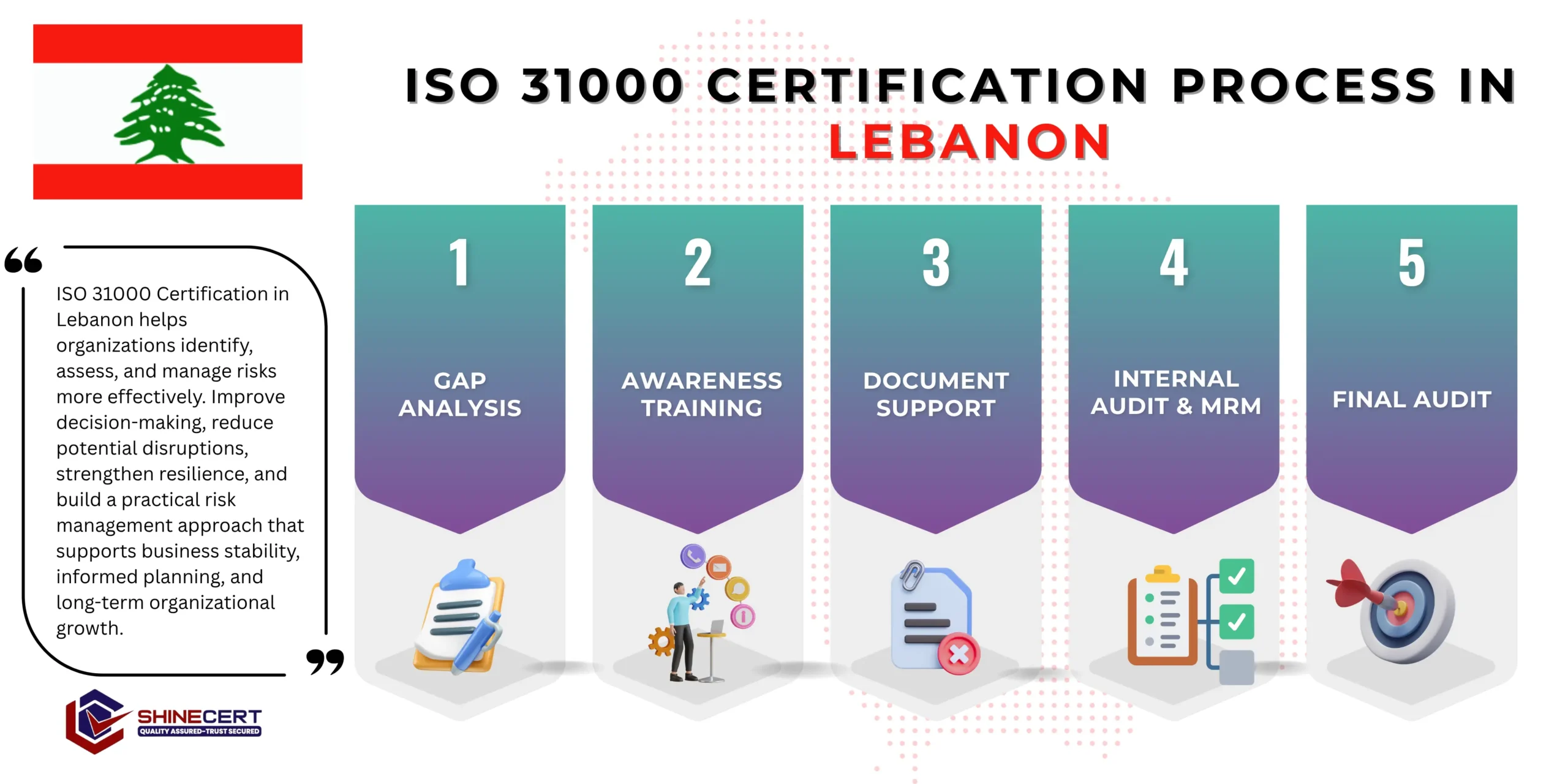
What are the steps to get ISO 31000 Certification in Lebanon?
our services
- ISO Certification Lebanon
- ISO 9001 Certification Lebanon
- ISO 14001 Certification Lebanon
- ISO 27001 Certification Lebanon
- ISO 22000 Certification Lebanon
- ISO 27701 Certification Lebanon
- ISO 45001 Certification Lebanon
- ISO 20000-1 Certification Lebanon
- ISO 13485 Certification Lebanon
- ISO 17025 Certification Lebanon
- ISO 31000 Certification Lebanon
- ISO 42001 Certification Lebanon
- ISO 37001 Certification Lebanon
- ISO 22301 Certification Lebanon
- ISO 50001 Certification Lebanon
- CE Mark Certification Lebanon
- GDPR Certification Lebanon
- GMP Certification Lebanon
- Halal Certification Lebanon
Our Five-Step Implementation Process
Gap Assessment
We conduct structured interviews across leadership, finance, and operations to understand how risk currently gets identified and managed, often informally, concentrated in a few experienced people’s judgment. We map your actual risk landscape (currency, banking, infrastructure, sector-specific) against ISO 31000’s principles and framework elements.
An element-by-element gap assessment identifying your genuine risk landscape and where current practices lack structure.
Documentation
We draft your risk management policy, risk appetite statement, and initial risk register around your organization’s actual exposures, working directly with the people who currently hold that risk knowledge informally so the framework reflects real conditions, not assumptions.
A complete, version-controlled risk management framework including your risk register and appetite statement.
Implementation
The framework gets integrated into real decision processes, budgeting, procurement, strategic planning — rather than existing as a separate document nobody references. Staff across departments get trained on their role in ongoing risk identification.
A functioning risk framework genuinely influencing organizational decisions, with real risk register updates happening.
Internal Review and Management Review
We test the framework against real scenarios and recent organizational decisions, surfacing gaps while stakes are low. Findings go to formal management review where leadership makes documented decisions on risk priorities.
An internal review report, management review minutes with concrete decisions, and refined risk treatment plans.
Independent Conformity Review
Since ISO 31000 isn’t certifiable, this stage is an independent review, not a certification audit, verifying your framework genuinely reflects ISO 31000’s principles and guidance. We stay involved throughout.
A formal conformity review report documenting your framework’s alignment with ISO 31000, useful for board, lender, and partner communication.
Gap Assessment
We conduct structured interviews across leadership, finance, and operations to understand how risk currently gets identified and managed, often informally, concentrated in a few experienced people’s judgment. We map your actual risk landscape (currency, banking, infrastructure, sector-specific) against ISO 31000’s principles and framework elements.
An element-by-element gap assessment identifying your genuine risk landscape and where current practices lack structure.
Documentation
We draft your risk management policy, risk appetite statement, and initial risk register around your organization’s actual exposures, working directly with the people who currently hold that risk knowledge informally so the framework reflects real conditions, not assumptions.
A complete, version-controlled risk management framework including your risk register and appetite statement.
Implementation
The framework gets integrated into real decision processes, budgeting, procurement, strategic planning — rather than existing as a separate document nobody references. Staff across departments get trained on their role in ongoing risk identification.
A functioning risk framework genuinely influencing organizational decisions, with real risk register updates happening.
Internal Review and Management Review
We test the framework against real scenarios and recent organizational decisions, surfacing gaps while stakes are low. Findings go to formal management review where leadership makes documented decisions on risk priorities.
An internal review report, management review minutes with concrete decisions, and refined risk treatment plans.
Independent Conformity Review
Since ISO 31000 isn’t certifiable, this stage is an independent review, not a certification audit, verifying your framework genuinely reflects ISO 31000’s principles and guidance. We stay involved throughout.
A formal conformity review report documenting your framework’s alignment with ISO 31000, useful for board, lender, and partner communication.
What Is ISO 31000, and How Does It Actually Help Your Organization?
- The core value of ISO 31000 isn’t eliminating risk, for Lebanese businesses in particular, many of the risk categories that matter most (currency, banking access, infrastructure) aren’t within any single organization’s control to eliminate. What the framework does is make sure risk is identified deliberately, assessed consistently across the organization rather than department by department in isolation, and responded to with a clear decision process rather than improvisation under pressure.
Practically, this helps in concrete ways. It surfaces risks that might otherwise stay siloed, a currency exposure the finance team tracks might have operational implications for procurement that nobody’s connected to until the framework forces that conversation. It gives leadership and boards a structured way to review risk exposure regularly, rather than only when something’s already gone wrong. It strengthens credibility with lenders and international partners who increasingly expect to see structured risk governance before committing capital or entering a partnership. And it creates institutional memory, risk knowledge that currently lives in a few experienced people’s heads becomes documented and transferable.
- Because ISO 31000 isn’t certifiable, its value comes entirely from genuine implementation, not from a certificate. That’s actually a strength for how we approach it: there’s no incentive to build documentation for an audit rather than for real use, since the whole point is a framework your organization actually relies on.
Why This Matters So Much in Lebanon Specifically?
- Lebanese businesses have operated for years now with real, elevated exposure to currency risk, banking sector disruption, and infrastructure unpredictability, and most have developed genuine coping mechanisms, even if informal. The gap isn’t risk awareness, it’s structure: those coping mechanisms often live in the judgment of one or two experienced leaders rather than in a documented, transferable framework the whole organization can rely on and that survives staff turnover.
- We’ve seen this pattern directly: a Lebanese business with genuinely sound instincts about managing currency exposure and banking access, built entirely around one finance leader’s judgment, with no documented framework behind it. ISO 31000 implementation formalizes that expertise into something the organization owns collectively, not something that walks out the door if that person leaves.
What Actually Drives Your Cost?
We don’t quote a flat number, because two Lebanese businesses’ actual risk landscape and organizational complexity can look completely different. Here’s what genuinely drives cost.
A business with multiple departments, currencies, and operational sites needs meaningfully more extensive risk mapping than a smaller, single-site operation.
Businesses with some documented risk practices aren’t starting from zero, those relying entirely on informal judgment face more foundational work.
A business with genuine exposure across financial, operational, currency, and reputational risk needs broader framework coverage than one with a narrower risk profile.
Banking and financial institutions face closer BDL scrutiny around risk governance, sometimes requiring more detailed framework documentation.
Building ISO 31000 alongside ISO 22301 or ISO 27001 shares meaningful implementation infrastructure, since risk assessment underpins all three.
A finance or operations leader who can own framework documentation and coordination reduces consultant hours needed.
ISO 31000 Benefits Businesses Don't Expect
A demonstrable risk framework meaningfully strengthens your position with international lenders and partners increasingly cautious about Lebanon-specific exposure.
Documented frameworks capture expertise currently held informally by a few experienced individuals, protecting the organization from losing that knowledge.
Currency, operational, and reputational risks that might otherwise stay siloed get surfaced and connected through a structured framework.
A documented risk appetite and treatment framework gives leadership a clear reference point during a crisis, rather than improvising under stress.
Systematic identification across categories catches risks that informal, experience-based awareness sometimes misses, particularly emerging ones.
Risk thinking embedded through ISO 31000 strengthens the risk-based planning clauses that ISO 9001, ISO 27001, and ISO 22301 all require.
Structured risk reporting gives boards genuine oversight capability rather than relying on ad hoc updates.
A mature risk framework naturally strengthens business continuity and crisis response capability across the organization.
Applicable Standards by Industry
Banking and financial services
Institutions navigating BDL’s evolving regulatory expectations use ISO 31000 to formalize genuine risk governance.
Read moreImport and export trading
Businesses managing currency exposure and cross-border supply chains use the framework to structure financial and operational risk together.
Read moreReal estate and construction
Developers navigating financing, currency, and regulatory risk use structured frameworks to support investor and lender confidence.
Read moreManufacturing and industrial
Businesses managing supply chain, currency, and infrastructure risk use ISO 31000 to connect these previously siloed risk categories.
Read moreRisk Management Framework, Element by Element, With the Documents Each One Actually Needs
- Mandate and Commitment : Leadership’s genuine commitment to risk management as an organizational priority, not a delegated afterthought, including clear articulation of how much risk the organization is willing to accept. Documenting this element requires: a risk management policy signed by top management, and a documented risk appetite statement.
- Design of the Framework : Understanding your organization’s specific context, sector, currency exposure, operational dependencies, and designing a risk framework that reflects genuine organizational structure and accountability. Document this element requires: a documented risk management framework defining roles, responsibilities, and integration with existing business processes.
- Implementation : Rolling the framework into actual decision-making processes across the organization, not as a separate parallel activity but integrated into how decisions already get made. Documenting this element requires: evidence of risk considerations integrated into key business processes, such as budgeting, procurement, or strategic planning documentation.
- Risk Assessment Process : Systematic risk identification across all relevant categories, financial, operational, currency, infrastructure, reputational, followed by consistent risk analysis and evaluation against your risk appetite. Document this element requires: a risk register capturing identified risks, likelihood and impact assessments, and evaluation against risk appetite.
- Risk Treatment : Clear decisions on how identified risks get addressed, mitigated, transferred, accepted, or avoided, with owners assigned for each treatment action. Documenting this element requires: a risk treatment plan with assigned owners and target timelines for each treatment action.
- Monitoring and Review : Regular review of whether the framework and specific risk treatments are genuinely working, and whether new risks have emerged that need attention. Documenting this element requires: periodic risk review records and updated risk register entries reflecting genuine reassessment.
- Communication and Consultation : Genuine two-way communication about risk across the organization, not top-down reporting alone, frontline staff often identify risks leadership doesn’t see. Document this element requires: records of risk communication and consultation activities, such as risk workshops or structured staff input sessions.
What Happens When a Lebanon Business Operates Without a Structured Framework?
- Risk doesn’t disappear without a formal framework, Lebanese businesses have been managing real risk for years, often skillfully, without ISO 31000. What’s missing is the structure that makes that risk management consistent, transferable, and visible to the people who need to see it, boards, lenders, international partners. Businesses relying entirely on informal, experience-based risk judgment tend to discover the gap either when that experienced judgment leaves the organization, or when a lender or partner asks for documentation the business simply doesn’t have.
- We generally recommend Lebanese businesses with meaningful currency exposure, banking dependency, or international partnership ambitions treat ISO 31000 implementation as protective infrastructure, formalizing risk instincts the organization likely already has, before losing them becomes a real problem.
Common Pitfalls We See in Lebanon ISO 31000 Projects
- Confusing ISO 31000 with a certifiable standard : Businesses sometimes expect a certificate; ISO 31000 provides guidance and principles, and what we deliver is genuine implementation plus an independent conformity review, not certification.
- Risk knowledge stays concentrated in one person : Frameworks built without genuinely capturing what experienced leaders already know informally miss the actual risk landscape.
- Treating the framework as a document, not a decision-making tool : A risk register that never gets referenced in actual budgeting or planning decisions isn’t functioning as intended.
- Underestimating currency and banking risk as a distinct category : Some frameworks treat financial risk generically without the specific structure Lebanon’s currency and banking environment genuinely requires.
Why ShineCert?
ShineCert brings 10 years of ISO consulting and certification experience to Lebanon, backed by our own dedicated Lebanon office working alongside our Riyadh office. We deliver services remotely or on-site depending on what your project needs, risk workshops and leadership sessions often benefit from in-person facilitation, while documentation work can run effectively over remote sessions. We’ve guided more than 10,000 organizations through ISO implementation and certification globally, and as the best ISO 31000 consultant in Lebanon, we build every Lebanon risk management engagement around your organization’s actual exposures, not a generic template.
Choosing an Implementation Partner in Lebanon?
What to Check | Why It Matters |
Genuine understanding that ISO 31000 isn’t certifiable | Avoids confusion or misrepresentation about what the engagement delivers |
Experience with Lebanon’s financial and currency risk environment | Ensures the framework genuinely reflects your real operating conditions |
Sector-specific risk experience | Banking, trading, and construction involve genuinely different risk profiles |
Independent conformity review capability | Confirms the partner can provide credible external verification of your framework |
Ready to Get Started?
Whether you’re formalizing risk instincts your organization already has or building a framework from scratch to satisfy a lender or partner, we’ll walk through your specific risk landscape and cost factors before proposing a fixed-scope plan, delivered remotely, on-site, or however genuinely fits your project. Book a free consultation or contact us directly to get started.
Frequently Asked Questions
No, ISO 31000 is not a certifiable standard. We provide implementation support and an independent conformity review, not certification.
The value is a genuinely functioning risk management system, and the conformity review report gives you credible documentation for boards, lenders, and partners even without a certificate.
It genuinely depends on organizational complexity, existing risk maturity, and how many risk categories apply, we scope every engagement individually.
Typically two to four months depending on organizational complexity.
BDL’s regulatory expectations increasingly favor structured risk governance; ISO 31000 is a recognized framework banks use to demonstrate it, though it isn’t a specific legal mandate.
No, any Lebanese business with meaningful currency, operational, or infrastructure risk exposure benefits, which in Lebanon’s environment includes most sectors.
Risk workshops and leadership sessions often benefit from in-person facilitation, but documentation work can run remotely, we scope this per project.
ISO 31000 provides the risk management framework broadly; ISO 22301 is certifiable and focuses specifically on business continuity and disruption response.
Smaller Lebanese businesses often carry disproportionate currency and banking risk relative to their size, making a structured framework genuinely valuable regardless of scale.
Yes, ShineCert maintains its own dedicated Lebanon office, with services delivered remotely or on-site depending on your project.