
ISO 9001 Certification in Lebanon
Quick Answer
ISO 9001 is the international standard for quality management systems, and in Lebanon it carries particular weight as an internationally verifiable credibility signal, for businesses navigating a rebuilding economy and renewed export and investment activity, third-party ISO certification gives international partners, banks, and buyers concrete evidence of operational discipline that doesn’t depend on assurances alone. Lebanon’s national standards body, LIBNOR (the Lebanese Standards Institution), aligns Lebanon’s quality infrastructure with international norms, and Public Procurement Law 244/2021 has been modernizing government tendering since coming into force in July 2022, with quality credentials increasingly factoring into supplier evaluation. Certification comes through a body accredited under the Global Accreditation Cooperation (GAC) framework, LIBNOR itself doesn’t issue certificates. A new version, ISO 9001:2026, is in its final approval stage and expected to publish around September 2026, worth knowing whether you’re certifying now or already hold ISO 9001:2015. Plan for three to five months from kickoff to certificate. Cost depends on genuine factors, company size, number of processes, existing documentation maturity, not a flat number.
ISO 9001, Explained Simply
In plain terms: ISO 9001 asks whether your business actually does what it says it does, consistently, and whether you can prove it. It’s not about producing a stack of manuals nobody reads, it’s about building real, repeatable processes for how you take an order, make or deliver something, handle problems, and improve over time, then having an independent auditor confirm you’re genuinely following them.
For a client deciding whether it’s worth pursuing: in Lebanon’s current environment, where international partners and banks are often extending extra scrutiny before extending trust, a genuine ISO 9001 certificate is a concrete, independently verified answer to “can we rely on this company,” which matters more here than in markets where that trust is assumed by default.
Lebanon at a Glance: What Shapes ISO 9001 Demand Here
National standards body: LIBNOR (the Lebanese Standards Institution), established in 1962 and operating under Lebanon’s Ministry of Industry, represents Lebanon at the International Organization for Standardization and coordinates national standardization activity.
Modernizing procurement: Public Procurement Law 244/2021 came into force in July 2022, establishing a dedicated Public Procurement Authority and a centralized online procurement platform aimed at greater transparency and more structured supplier evaluation across government tenders.
SME financing available: Kafalat S.A.L., backed by the Central Bank of Lebanon and Lebanese commercial banks, guarantees up to 75% of qualifying loans across five priority sectors, industry, agriculture, tourism, high technology, and traditional crafts, helping eligible businesses access financing that can support quality system investment.
Rebuilding trust with international partners: Lebanese exporters, manufacturers, and service providers increasingly rely on internationally recognized certification to reassure overseas buyers, banks, and investors during a period of broader economic recalibration.
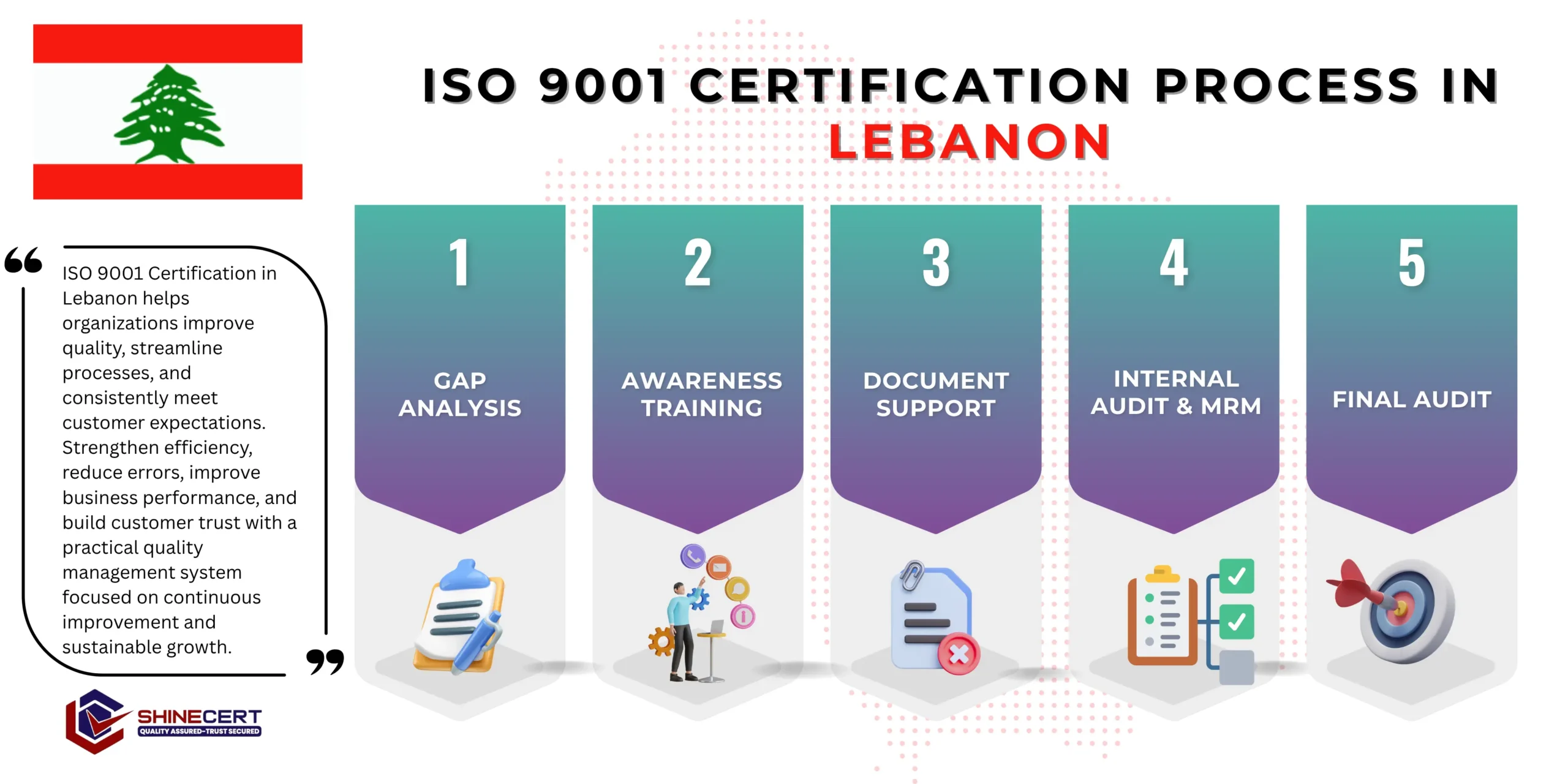
What are the steps to get ISO 9001 Certification in Lebanon?
our services
- ISO Certification Lebanon
- ISO 9001 Certification Lebanon
- ISO 14001 Certification Lebanon
- ISO 27001 Certification Lebanon
- ISO 22000 Certification Lebanon
- ISO 27701 Certification Lebanon
- ISO 45001 Certification Lebanon
- ISO 20000-1 Certification Lebanon
- ISO 13485 Certification Lebanon
- ISO 17025 Certification Lebanon
- ISO 31000 Certification Lebanon
- ISO 42001 Certification Lebanon
- ISO 37001 Certification Lebanon
- ISO 22301 Certification Lebanon
- ISO 50001 Certification Lebanon
- CE Mark Certification Lebanon
- GDPR Certification Lebanon
- GMP Certification Lebanon
- Halal Certification Lebanon
Our Five-Step Certification Process: What to Actually Expect
Gap Assessment
We start with structured interviews across your key functions, operations, leadership, and quality if you have a dedicated role, plus a review of whatever policies, procedures, and records already exist. We map each ISO 9001 clause against what we actually find on the ground, not against a generic checklist. Where useful, we also walk your facility to see how work genuinely happens day to day, not just how it’s described in a meeting.
A written, clause-by-clause gap assessment flagging exactly what’s missing, what’s partially in place, and what’s already solid enough to build on, this becomes the scope document for everything that follows.
Documentation Development
We draft your quality policy, quality manual, and the specific procedures your operation genuinely needs, built through short working sessions with the people who actually run each process, documentation written without their input rarely reflects how work really gets done. Drafts circulate for review before anything is finalized, so the people expected to follow them have actually had a chance to challenge them.
A complete, version-controlled documentation set ready for rollout, not a generic template with your company name inserted.
Implementation and Training
Documentation becomes daily practice here. We run role-specific training rather than one all-staff briefing, since a warehouse supervisor and a sales coordinator need genuinely different parts of the system explained to them. Records start getting generated through real operations, and we check in periodically to catch places where a new process isn’t sticking before it becomes a habit gap.
A functioning system with real operational evidence behind it, actual completed records, not blank templates, plus a trained team that understands its specific role.
Internal Audit and Management Review
We run a full internal audit against every clause, structured the way a certification auditor would run it, specifically to surface weaknesses while the stakes are still low. Findings go to a formal management review with your leadership team, where decisions get made and documented, not just discussed informally.
An internal audit report, management review minutes with concrete decisions attached, and closed-out corrective actions, genuine proof the system works, not just that it exists.
Certification Audit
Your certification body runs Stage 1 first, a documentation review confirming genuine readiness before the operational audit, then Stage 2, where the auditor observes real operations, interviews staff, and verifies records against what’s documented. We stay involved through both stages to help you respond to any auditor questions in real time.
Your ISO 9001 certificate, valid for three years, plus a surveillance audit schedule to maintain it going forward.
Gap Assessment
We start with structured interviews across your key functions, operations, leadership, and quality if you have a dedicated role, plus a review of whatever policies, procedures, and records already exist. We map each ISO 9001 clause against what we actually find on the ground, not against a generic checklist. Where useful, we also walk your facility to see how work genuinely happens day to day, not just how it’s described in a meeting.
A written, clause-by-clause gap assessment flagging exactly what’s missing, what’s partially in place, and what’s already solid enough to build on, this becomes the scope document for everything that follows.
Documentation Development
We draft your quality policy, quality manual, and the specific procedures your operation genuinely needs, built through short working sessions with the people who actually run each process, documentation written without their input rarely reflects how work really gets done. Drafts circulate for review before anything is finalized, so the people expected to follow them have actually had a chance to challenge them.
A complete, version-controlled documentation set ready for rollout, not a generic template with your company name inserted.
Implementation and Training
Documentation becomes daily practice here. We run role-specific training rather than one all-staff briefing, since a warehouse supervisor and a sales coordinator need genuinely different parts of the system explained to them. Records start getting generated through real operations, and we check in periodically to catch places where a new process isn’t sticking before it becomes a habit gap.
A functioning system with real operational evidence behind it, actual completed records, not blank templates, plus a trained team that understands its specific role.
Internal Audit and Management Review
We run a full internal audit against every clause, structured the way a certification auditor would run it, specifically to surface weaknesses while the stakes are still low. Findings go to a formal management review with your leadership team, where decisions get made and documented, not just discussed informally.
An internal audit report, management review minutes with concrete decisions attached, and closed-out corrective actions, genuine proof the system works, not just that it exists.
Certification Audit
Your certification body runs Stage 1 first, a documentation review confirming genuine readiness before the operational audit, then Stage 2, where the auditor observes real operations, interviews staff, and verifies records against what’s documented. We stay involved through both stages to help you respond to any auditor questions in real time.
Your ISO 9001 certificate, valid for three years, plus a surveillance audit schedule to maintain it going forward.
What Is ISO 9001, and How Does It Actually Help Your Organization?
- Most Lebanese businesses we meet already run a genuinely tight operation, the problem is rarely quality itself, it’s that nobody outside the company has any independent way to verify that. ISO 9001 solves exactly that problem. It takes the process knowledge sitting in your most experienced staff’s heads and turns it into a documented, repeatable system the whole organization can run on, then has an outside auditor confirm it’s genuinely being followed, not just written down.
- Practically, this helps in ways that go beyond the certificate itself. It gives you an early-warning system, surfacing quality problems through structured monitoring before a customer ever complains. It gives new hires something concrete to learn from, instead of months of shadowing someone experienced. It gives leadership real data, audit findings, nonconformity patterns, customer feedback trends, to make decisions with. And for Lebanese businesses specifically, it gives international partners, banks, and buyers something to point to that isn’t just your word: independent, third-party proof that your operation is genuinely under control.
- The standard delivers this through ten clauses built on the Harmonized Structure shared with ISO 14001, ISO 45001, and other current management system standards, meaning a business that implements ISO 9001 properly has already built a substantial share of what those other standards would additionally require.
Why This Matters So Much in Lebanon Specifically?
- Lebanon’s economy is genuinely in a period of recalibration, and businesses navigating that environment face a distinctive challenge: demonstrating operational reliability to international partners, banks, and buyers who may apply extra scrutiny given the broader context, even when the specific business itself is genuinely well-run. ISO 9001 certification directly addresses this gap, it’s independently verified, internationally recognized, and doesn’t rely on the buyer simply taking a company’s word for its own quality claims.
- One pattern we frequently see in Lebanon: genuinely capable manufacturers and exporters lose competitive ground not because their actual product or service quality is lacking, but because they can’t independently demonstrate the operational consistency an international buyer or bank now expects to see documented, not just described. For businesses actively rebuilding export relationships or seeking renewed international investment, ISO 9001 certification is increasingly one of the more cost-effective ways to close that credibility gap quickly.
Kafalat Financing: Does Your ISO 9001 Project Qualify for Support?
Kafalat’s loan guarantee program can help eligible businesses in industry, agriculture, tourism, high technology, and traditional crafts access bank financing that supports broader operational investment, which can include the process improvements and infrastructure that often accompany genuine ISO 9001 implementation. We generally recommend discussing your Kafalat eligibility with your bank early, alongside your certification planning, since financing and certification timelines often run in parallel rather than certification driving a standalone loan application.
What Actually Drives Your Cost?
We don’t quote a flat number, because a flat number would misrepresent how different two Lebanese businesses’ actual scope and complexity can be. Here’s what genuinely drives cost.
A business with straightforward, standardized processes needs meaningfully less documentation depth than one with complex, highly customized operations across multiple product or service lines.
Each additional site generally needs its own process verification and internal audit coverage, adding genuine scope for businesses with multiple facilities.
Businesses with some existing process documentation or informal quality practices, like the case study above, aren’t starting from zero. Businesses with no documented processes need more foundational work.
A quality management system touching more departments and more staff needs deeper training and change-management investment.
Pursuing ISO 14001 or ISO 45001 alongside ISO 9001 shares meaningful implementation and audit infrastructure, given the shared Harmonized Structure.
An internal quality lead who can own documentation and coordination reduces consultant hours needed.
Where broader operational financing is available through Kafalat-backed loans, your genuine out-of-pocket cost for related process investment can be meaningfully lower.
A compressed timeline driven by a specific export opportunity or tender deadline sometimes needs more concentrated consultant hours in a shorter window.
ISO 9001 Benefits Businesses Don't Expect
As Public Procurement Law 244/2021’s modernized framework matures, structured, independently verified quality credentials increasingly factor into supplier evaluation, certification positions Lebanese suppliers competitively as procurement processes become more formalized.
For Lebanese exporters and service providers navigating renewed international relationships, ISO 9001 certification is one of the most direct, cost-effective ways to independently demonstrate operational reliability to overseas buyers and financial institutions.
ISO 9001 is recognized globally, supporting Lebanese businesses pursuing new export markets or reassuring existing international partners during a period of economic transition.
Structured process control and nonconformity management reduce rework, delays, and inconsistent output, a genuine bottom-line benefit independent of any external credibility consideration.
Documented processes give new staff something concrete to learn from, cutting the time it takes someone to become genuinely productive.
Audit findings and nonconformity trends give leadership real data to act on, rather than relying on instinct or informal reports alone.
Because ISO 9001 shares the Harmonized Structure with ISO 14001, ISO 45001, and others, pursuing those standards afterward is meaningfully faster and cheaper.
For businesses in Kafalat’s five priority sectors, loan guarantee support can help fund the broader operational investment that often accompanies genuine quality system implementation.
Financial institutions increasingly view structured quality management as a genuine risk-reduction signal, particularly relevant for Lebanese businesses rebuilding banking relationships.
Applicable Standards by Industry
Food and beverage manufacturing and export
Lebanese food exporters use ISO 9001, often alongside ISO 22000, to meet increasingly rigorous international buyer quality expectations.
Read moreTextiles and traditional crafts
Producers in Kafalat’s traditional crafts category use certification to support export credibility and access to financing.
Read moreConstruction and engineering services
Firms pursuing government infrastructure tenders under the modernized procurement framework use ISO 9001 to strengthen their tender positioning.
Read moreProfessional and financial services
Firms serving international clients use ISO 9001 to demonstrate structured service delivery discipline to overseas partners and correspondent institutions.
Read moreTourism and hospitality
Operators use ISO 9001 to formalize service consistency, supporting both domestic reputation and international partnership development.
Read moreQuality Management Requirements, Clause by Clause With the Documents Each One Actually Needs
- Context of the Organization (Clause 4). Understanding your genuine internal and external context and the interested parties whose requirements shape your quality objectives, particularly relevant given Lebanon’s evolving economic and regulatory landscape. Document this clause requires: a documented statement of the QMS scope, defining exactly which products, services, and locations are covered, with justification for any exclusions.
- Leadership (Clause 5). Top management accountability for the quality management system, including genuine resourcing and a documented quality policy that reflects actual strategic direction, not a symbolic document. Document this clause requires: a quality policy signed by top management, stating genuine commitment to quality and a framework for setting measurable objectives.
- Planning (Clause 6). Risk-based planning addressing genuine threats and opportunities, plus measurable quality objectives with a defined path to achieving them. Document this clause requires: a risk and opportunity register, plus documented quality objectives with responsible owners and timelines attached.
- Support (Clause 7). Resources, competence, awareness, communication, and documented information requirements ensuring the system is genuinely usable by the people running it day to day. Document this clause requires: competence and training records for anyone in a quality-relevant role, plus a controlled register of QMS documentation.
- Operation (Clause 8). The operational core, planning and control of production or service delivery, requirements for products and services, design and development where applicable, control of externally provided processes, and control of nonconforming outputs. Documenting this clause requires: operational planning records, supplier evaluation criteria, and a nonconformity log tracking what went wrong and how it was resolved.
- Performance Evaluation (Clause 9). Monitoring, measurement, analysis, internal audit, and management review testing whether the system genuinely functions, not just whether it exists on paper. Document this clause requires: an internal audit program and results, plus management review minutes covering system performance and improvement decisions.
- Improvement (Clause 10). Structured handling of nonconformities and corrective action, with genuine continual improvement built into the system’s operating rhythm. Document this clause requires: corrective action records showing root-cause investigation, the fix applied, and verification that it actually worked.
What Happens When a Lebanon Business Operates Without Certification?
- This is worth understanding concretely. Operating without ISO 9001 certification doesn’t necessarily mean poor quality, many uncertified Lebanese businesses produce genuinely excellent products and services, but it does mean relying entirely on relationship-based trust and reputation to convince new international partners, which is a genuinely slower and less scalable path than presenting independently verified evidence upfront. In competitive tenders or new buyer relationships where certification is explicitly requested or quietly preferred, uncertified businesses face a real disadvantage regardless of their actual operational quality.
- Businesses that discover this only when a specific export opportunity or major tender requires certification they don’t have often lose that opportunity to a certified competitor, or face a rushed, pressured certification timeline that could have been avoided with earlier planning. We generally recommend Lebanese exporters and businesses actively pursuing government or international contracts treat ISO 9001 as standing infrastructure to have in place before a specific opportunity demands it.
Migrating from ISO 9001:2015 to ISO 9001:2026: What Actually Changes
This is worth planning for now, whether you’re newly certifying or already hold ISO 9001:2015. As of mid-2026, the Final Draft International Standard for ISO 9001:2026 has been released, with formal publication expected around September 2026, followed by a three-year transition window, meaning existing certificate holders have until roughly 2029, not an immediate deadline.
This is a targeted refinement, not a rebuild. Four changes matter most.
- Quality culture and ethical behavior (Clause 5.1.1) : Top management now has an explicit requirement to actively promote and demonstrate a quality culture and ethical behavior, not just sign a policy document. What to update: revise your quality policy and leadership commitment statement to explicitly address culture and ethics, not just quality objectives.
- Climate change in your context analysis (Clause 4.1) : Organizations must now consider climate change as a genuine factor when determining internal and external issues relevant to the QMS. What to update: add a section to your documented context analysis addressing climate-related risks or requirements relevant to your operations.
- Risk and opportunity, separated (Clause 6.1) : The 2026 version splits this clause into clearer sub-sections distinguishing actions to address risk from actions to pursue opportunity. What to update: restructure your risk and opportunity register to track these as two distinct categories with separate treatment plans.
- Built-in terminology : More QMS-specific terms are now defined directly within the standard itself. What to update: if you maintain a separate internal terms-and-definitions document, much of it can likely be retired or simplified.
For businesses newly certifying now, we generally recommend building documentation with these four changes already in mind, it costs little extra effort today and avoids a second documentation pass in 2027 or 2028. For businesses already certified under the 2015 version, this is a planning conversation to have well before your 2029 deadline.
Case Study: A Lebanon Manufacturer’s Certification Journey
- The following is an illustrative, composite example based on the kind of project ShineCert typically runs, not a specific named client. A Lebanon-based manufacturer exporting food packaging products had a loyal regional customer base and genuinely solid production practices, but relied entirely on informal quality control, experienced staff catching problems by eye rather than documented, systematic process control. The trigger was a European buyer’s procurement team requesting ISO 9001 certification as a condition of a larger, multi-year supply agreement, given the buyer’s own increased scrutiny of new suppliers from the region.
- The gap assessment found the company’s actual production discipline was genuinely strong, but almost none of it was documented in a way an external auditor, or the prospective buyer’s own quality team, could independently verify. The bulk of implementation work went into formalizing process controls that already existed informally, building a genuine nonconformity and corrective action system, and establishing measurable quality objectives tied to defect and rework rates. Certification was achieved in time to secure the supply agreement, and the pattern we typically see afterward held: the same documented quality system that satisfied the initial buyer became a reusable credibility asset in subsequent conversations with other prospective international customers, without needing to rebuild trust from scratch each time.
Why ShineCert?
ShineCert brings 10 years of ISO consulting and certification experience to Lebanon, backed by our own dedicated Lebanon office working alongside our Riyadh office, genuine on-the-ground presence, not remote coordination alone. We deliver services remotely or on-site depending on what your specific project actually needs, some clients want a consultant physically present for facility walkthroughs and staff training, others prefer a fully remote engagement, and most land somewhere in between. Our team has guided more than 10,000 organizations through ISO certification globally, and we understand firsthand the specific credibility challenges Lebanese businesses navigate when building or rebuilding international relationships. ShineCert is the best ISO 9001 consultant in Lebanon.
Choosing a Certification Body in Lebanon?
What to Check | Why It Matters |
Accreditation under the GAC framework | Confirms genuine, internationally recognized certification that international buyers and banks will trust |
Recognition with the specific export markets you serve | Ensures your certificate carries weight with the buyers, banks, and partners that matter most to your business |
Genuine sector-specific audit experience | Food, manufacturing, and professional services each involve meaningfully different quality system expectations |
Track record with Lebanese businesses navigating international relationships | Familiarity with the specific credibility challenges Lebanese exporters and service providers currently face |
Common Pitfalls We See in Lebanon ISO 9001 Projects
- Relying on reputation instead of documented evidence : Many genuinely well-run Lebanese businesses assume their track record speaks for itself, missing that international partners increasingly expect independently verifiable documentation rather than relationship-based assurance alone.
- Treating certification as a one-time credibility purchase : ISO 9001 requires genuine ongoing internal audit and management review, a certificate obtained once and then neglected loses its practical value at the next surveillance audit and stops reflecting how the business actually operates.
- Underestimating documentation needs for informal but genuinely good processes : Businesses with strong informal quality control, like the case study above, sometimes underestimate how much work it takes to make tacit knowledge genuinely auditable and transferable beyond a few experienced staff.
- Waiting too long on the 2026 transition : Businesses that ignore the upcoming ISO 9001:2026 changes until their transition deadline approaches often end up doing a rushed second documentation pass instead of building it in gradually.
- Choosing a certification body without verifying accreditation : Given how much weight international buyers and banks place on the credibility of the underlying certificate, verifying your certification body’s genuine GAC accreditation is a step worth taking seriously, not assuming.
Ready to Get Started?
ShineCert supports Lebanese businesses from initial gap assessment through certification audit, drawing on our own dedicated Lebanon office and direct understanding of the credibility challenges Lebanese exporters and service providers currently navigate, delivered remotely, on-site, or however genuinely fits your project. Book a free consultation or contact us directly, and we’ll walk through your specific operations and cost factors before proposing a fixed-scope plan.
Frequently Asked Questions
It’s the international standard for quality management systems, setting requirements for consistently meeting customer and regulatory requirements while continually improving.
It genuinely depends on factors like company size, process complexity, and existing documentation maturity, we scope every project individually.
Not universally mandated, but as Public Procurement Law 244/2021’s modernized framework matures, structured quality credentials increasingly strengthen tender positioning and are explicitly requested in some procurement processes.
Typically three to five months.
Formal publication is expected around September 2026, with a three-year transition period after that, current certificate holders have until roughly 2029.
Not directly as a certification-specific grant, but Kafalat’s loan guarantee program can support broader operational financing for eligible sectors, which can include quality system investment.
Yes, unlike some countries where we coordinate engagements remotely, ShineCert maintains its own dedicated Lebanon office, and we deliver services remotely or on-site depending on what your project needs.
LIBNOR is Lebanon’s national standards body and represents Lebanon at the International Organization for Standardization, but actual certification is issued by accredited, independent certification bodies, not LIBNOR directly.
Yes, each additional site generally needs its own process verification and audit coverage, adding genuine scope.
Yes, our Lebanon office supports clients across the country, with consultants traveling on-site when a project calls for it.