
ISO 42001 Certification in Lebanon
Quick Answer
ISO 42001 is the first international standard for artificial intelligence management systems, published in December 2023, and it applies to any organization that develops, deploys, or genuinely relies on AI systems, not just AI-native companies. Lebanon doesn’t yet have AI-specific legislation, so ISO 42001 currently functions as the primary structured governance framework available to Lebanese organizations working with AI, sitting alongside Law 81/2018’s data protection requirements wherever AI systems process personal data. Lebanon’s IT and software outsourcing sector, which builds AI-enabled products and services for international clients, is where demand for this certification is emerging fastest, increasingly as a client expectation rather than a purely voluntary differentiator. Budget three to four months for first-time certification. Cost depends on genuine factors, number of AI systems in scope, their complexity, and data sensitivity, not a flat figure we quote upfront.
ISO 42001, Explained Simply
Most organizations using AI today, whether they built it themselves or adopted a third-party tool, have no formal way of answering basic questions: what data trained this system, who’s accountable if it produces a harmful or biased output, and how do we know it’s still working as intended six months from now. ISO 42001 is a structured answer to exactly those questions. It doesn’t slow down AI adoption, it makes sure someone is actually responsible for it, on paper and in practice, before something goes wrong rather than after.
Lebanon at a Glance: What Shapes ISO 42001 Demand Here
No AI-specific legislation yet : Lebanon does not currently have a dedicated AI law, which means ISO 42001 serves as the primary available governance framework for organizations that want to demonstrate responsible AI practices.
Law 81/2018 still applies wherever AI touches personal data : Any AI system processing customer, employee, or patient data in Lebanon remains subject to Law 81/2018’s data protection obligations regardless of AI-specific rules.
A genuine, internationally-facing IT sector : Lebanon’s software development and BPO companies increasingly build AI-enabled products and services for clients abroad, and those clients are beginning to expect the same kind of independently verified governance they require for information security.
Broader digital transformation context : OMSAR’s Digital Transformation Strategy 2020-2030 signals national-level interest in modernizing digital governance, though it is not itself an AI-specific regulatory framework, it’s useful context for where Lebanon’s digital policy direction is heading, not a compliance requirement in itself.
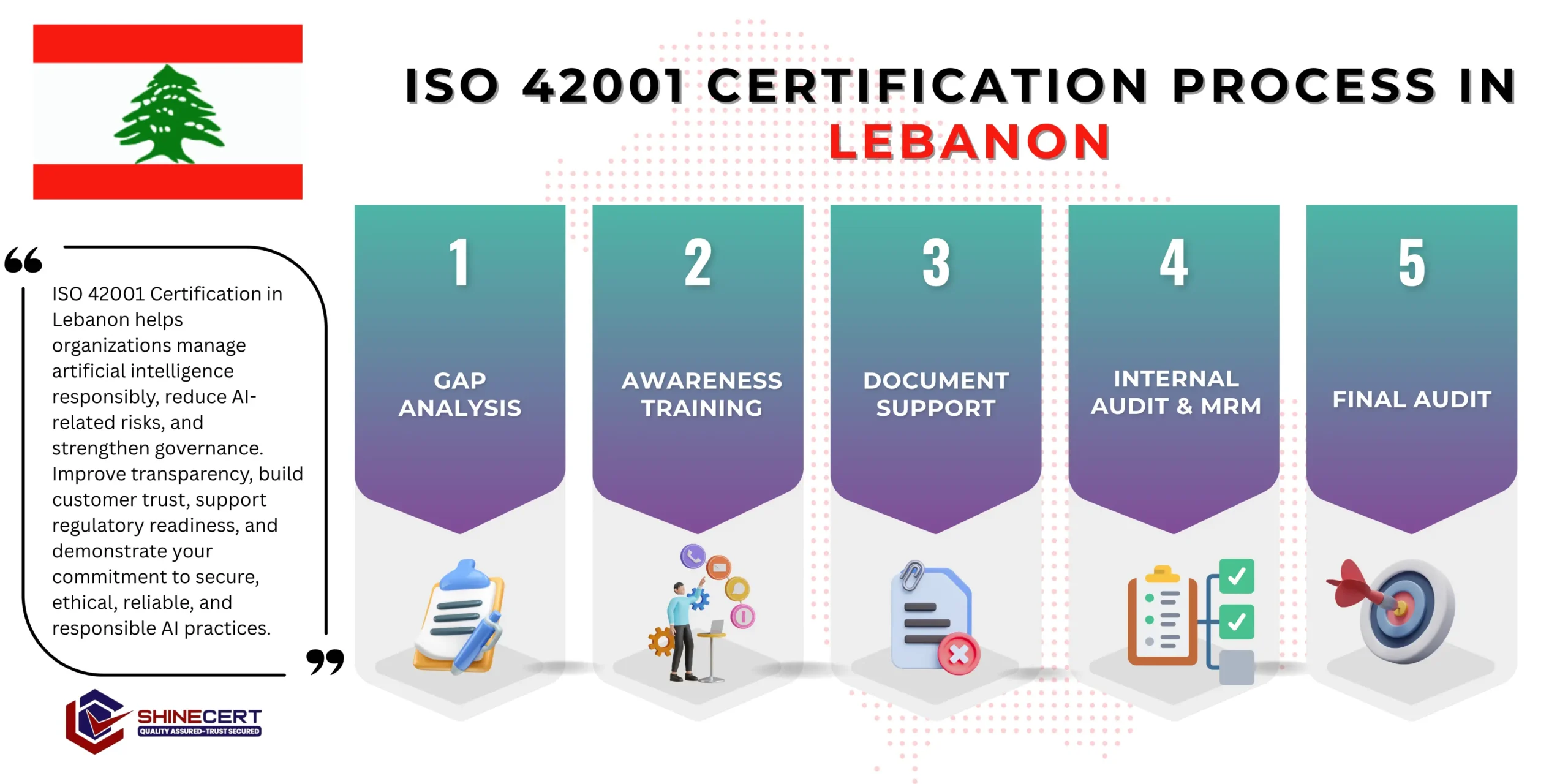
What are the steps to get ISO 42001 Certification in Lebanon?
our services
- ISO Certification Lebanon
- ISO 9001 Certification Lebanon
- ISO 14001 Certification Lebanon
- ISO 27001 Certification Lebanon
- ISO 22000 Certification Lebanon
- ISO 27701 Certification Lebanon
- ISO 45001 Certification Lebanon
- ISO 20000-1 Certification Lebanon
- ISO 13485 Certification Lebanon
- ISO 17025 Certification Lebanon
- ISO 31000 Certification Lebanon
- ISO 42001 Certification Lebanon
- ISO 37001 Certification Lebanon
- ISO 22301 Certification Lebanon
- ISO 50001 Certification Lebanon
- CE Mark Certification Lebanon
- GDPR Certification Lebanon
- GMP Certification Lebanon
- Halal Certification Lebanon
Our Five-Step Certification Process
Gap Assessment
We inventory every AI system your organization actually develops, deploys, or relies on, including third-party AI tools embedded in your workflows that often get overlooked. We interview technical and business teams to understand how each system is currently governed, if at all, and map findings against every ISO 42001 clause.
A clause-by-clause gap assessment identifying your genuine AI system inventory and where governance is currently missing.
Documentation
We draft your AI policy, risk assessment methodology, and impact assessment framework around your actual AI systems and use cases, not a generic template. For Lebanese businesses handling personal data through AI systems, we cross-reference this work against Law 81/2018 requirements.
A complete, version-controlled AI management system documentation set including your AI risk register.
Implementation
Governance controls roll out for each AI system in scope, impact assessments get completed, monitoring gets established, and staff involved in building or operating AI systems receive role-specific training on their governance responsibilities.
A functioning AI management system with real impact assessments and monitoring happening across your AI systems.
Internal Audit and Management Review
We run a full internal audit against every clause, surfacing weaknesses while stakes are low. Findings go to formal management review where leadership makes documented decisions on AI governance priorities.
An internal audit report, management review minutes with concrete decisions, and closed-out corrective actions.
Certification Audit
Stage 1 confirms your documentation and governance framework are audit-ready; Stage 2 has the auditor verify controls are genuinely operating, reviewing impact assessments, monitoring records, and interviewing staff. We stay involved through both stages.
Your ISO 42001 certificate, valid for three years, plus a surveillance audit schedule.
Gap Assessment
We inventory every AI system your organization actually develops, deploys, or relies on, including third-party AI tools embedded in your workflows that often get overlooked. We interview technical and business teams to understand how each system is currently governed, if at all, and map findings against every ISO 42001 clause.
A clause-by-clause gap assessment identifying your genuine AI system inventory and where governance is currently missing.
Documentation
We draft your AI policy, risk assessment methodology, and impact assessment framework around your actual AI systems and use cases, not a generic template. For Lebanese businesses handling personal data through AI systems, we cross-reference this work against Law 81/2018 requirements.
A complete, version-controlled AI management system documentation set including your AI risk register.
Implementation
Governance controls roll out for each AI system in scope, impact assessments get completed, monitoring gets established, and staff involved in building or operating AI systems receive role-specific training on their governance responsibilities.
A functioning AI management system with real impact assessments and monitoring happening across your AI systems.
Internal Audit and Management Review
We run a full internal audit against every clause, surfacing weaknesses while stakes are low. Findings go to formal management review where leadership makes documented decisions on AI governance priorities.
An internal audit report, management review minutes with concrete decisions, and closed-out corrective actions.
Certification Audit
Stage 1 confirms your documentation and governance framework are audit-ready; Stage 2 has the auditor verify controls are genuinely operating, reviewing impact assessments, monitoring records, and interviewing staff. We stay involved through both stages.
Your ISO 42001 certificate, valid for three years, plus a surveillance audit schedule.
What Is ISO 42001, and How Does It Actually Help Your Organization?
- The risk with AI systems isn’t usually that they’re built badly, it’s that nobody owns them once they’re running. A model gets deployed, produces useful results for months, and then something shifts, the data it sees in production drifts from what it was trained on, or it starts producing outputs nobody planned for, and there’s no process in place to catch it, because nobody was assigned to watch for it. ISO 42001 requires you to assign that ownership explicitly: who’s accountable for each AI system, what risks it was assessed against, and how you’ll know if it stops behaving as expected.
- Practically, this helps in a few concrete ways. It forces a genuine impact assessment before deployment, surfacing risks, bias, data privacy exposure, over-reliance on automated decisions, that get missed when AI adoption happens informally, one tool at a time, without central oversight. It gives you a defensible answer if a client, regulator, or the public asks how an AI-driven decision was made. It creates continuous monitoring so problems get caught in production, not just at initial testing. And for Lebanese companies building AI products for international clients, it’s independently verified proof of responsible AI practices that increasingly matters as more of those clients start requiring it contractually.
- ISO 42001 uses the same Harmonized Structure as ISO 9001 and ISO 27001, so organizations that already hold either certification have real infrastructure, management review, internal audit, risk assessment methodology, to extend rather than rebuild from scratch. Its control set (Annex A) covers areas specific to AI: data quality and provenance, AI system impact assessment, transparency toward affected individuals, and third-party AI supplier management.
Why This Matters So Much in Lebanon Specifically?
- Lebanon’s IT outsourcing sector has real, demonstrated strength in software development, and AI-enabled features are becoming a standard part of the products and services that sector delivers to clients abroad. Those international clients, particularly in markets with emerging AI governance expectations of their own, are starting to ask not just “does this AI work” but “how do you know it’s safe, unbiased, and accountable.” Lebanese companies without a structured answer to that question risk losing ground to competitors who can point to independent certification.
- Because Lebanon doesn’t yet have AI-specific legislation, businesses here are in a genuinely useful position: adopting ISO 42001 now means building governance practices ahead of regulation rather than scrambling to retrofit them once rules arrive, which is roughly what happened with data protection and Law 81/2018 for many businesses that treated compliance as an afterthought.
What Actually Drives Your Cost?
We don’t quote a flat number, because two Lebanese businesses’ actual AI footprint can look completely different. Here’s what genuinely drives cost.
A single AI-enabled feature needs meaningfully less assessment work than an organization running multiple AI systems across different business functions.
Systems making higher-stakes or more autonomous decisions need deeper impact assessment than lower-risk applications like internal productivity tools.
AI systems processing personal or financial data require more rigorous governance and closer alignment with Law 81/2018.
Businesses with existing data governance or information security management already have real infrastructure to extend; those without it face more foundational work.
Pursuing ISO 27001 alongside ISO 42001 shares meaningful implementation and audit infrastructure, since AI systems often process the same sensitive data.
A data science or engineering lead who can own technical documentation and impact assessments reduces consultant hours needed.
ISO 42001 Benefits Businesses Don't Expect
As more international clients build AI governance requirements into procurement, certification increasingly determines who qualifies to bid, not just who wins on price.
Building governance now, while Lebanon has no AI-specific law, means avoiding the retrofit scramble many businesses faced when data protection rules eventually caught up with their existing practices.
Structured impact assessments and clear ownership give you a real answer, not an improvised one, if a client or the public raises concerns.
Systematic monitoring catches performance drift and unexpected behavior in production, before it becomes a client-facing problem.
Independently verified AI governance reassures clients relying on your AI-enabled products, particularly in regulated sectors like finance or healthcare.
The standard’s emphasis on data provenance and quality tends to improve the underlying data pipelines feeding your AI systems generally, not just for compliance purposes.
The shared Harmonized Structure makes pursuing ISO 27001 or ISO 9001 alongside ISO 42001 meaningfully faster.
Regular governance reviews give management real data on which AI systems are performing well and which need attention, rather than treating AI as a black box.
Applicable Standards by Industry
Software development and IT outsourcing
Companies building AI-enabled products or features for international clients use certification to meet increasingly common procurement requirements.
Read moreFintech
Companies using AI for credit scoring, fraud detection, or automated financial decisions use certification to demonstrate accountable, auditable governance.
Read moreHealthcare technology
Providers using AI-assisted diagnostics or patient management tools use certification to build trust around a genuinely sensitive application area.
Read moreCustomer service and BPO
Companies deploying AI chatbots or automated customer interaction tools use certification to formalize oversight of systems directly facing end clients.
Read moreAI Management System Requirements, Clause by Clause, With the Documents Each One Actually Needs
- Context of the Organization (Clause 4) : Understanding which AI systems your organization actually develops, deploys, or relies on, and which interested parties, clients, employees, affected individuals, regulators, have a stake in how those systems are governed. Document this clause requires: a documented AI management system scope statement identifying which AI systems and use cases are covered.
- Leadership (Clause 5) : Top management commitment to responsible AI practices, with clearly assigned accountability for AI governance across the organization. Document this clause requires: an AI policy signed by top management, and a documented roles-and-responsibilities matrix for AI oversight.
- Planning (Clause 6) : A genuine AI risk assessment covering each system in scope, bias, data provenance, safety, transparency, followed by a risk treatment plan and measurable AI governance objectives. Document this clause requires: an AI risk assessment methodology and register, and documented AI governance objectives.
- Support (Clause 7) : Resources, competence, and awareness training ensure staff involved in building or operating AI systems genuinely understand governance responsibilities. Document this clause requires: AI governance training records and a controlled register of AI system documentation.
- Operation (Clause 8) : AI system impact assessments before deployment, operational controls over data quality and system monitoring, and management of third-party AI suppliers. Document this clause requires: AI system impact assessment records for each system in scope, and supplier assessment records for third-party AI tools.
- Performance Evaluation (Clause 9) : Ongoing monitoring of AI system performance and behavior, plus internal audit testing whether governance controls are genuinely functioning. Document this clause requires: an internal audit program and results, and management review minutes covering AI system performance and incident trends.
- Improvement (Clause 10) : Structured investigation of AI-related incidents or unexpected outputs, driving continual improvement of the management system. Document this clause requires: incident records showing root-cause analysis for AI system failures or unexpected behavior, and corrective actions taken.
What Happens When a Lebanon Business Operates Without Certification?
- Nothing legally forces certification today, since Lebanon has no AI-specific law requiring it. But the absence of formal governance doesn’t mean the risks disappear, an AI system producing biased outputs, mishandling personal data, or drifting from its intended behavior in production creates real exposure whether or not a law explicitly addresses it yet. For companies building AI products for international clients, the more immediate risk is commercial: losing contracts to competitors who can demonstrate certified governance when a client’s procurement process starts requiring it.
- We generally recommend Lebanese IT and software companies with any meaningful AI component treat ISO 42001 the way we’ve watched businesses eventually treat information security, better to build the governance structure deliberately now than to retrofit it under pressure once a client or regulator starts asking pointed questions.
Common Pitfalls We See in Lebanon ISO 42001 Projects
- Not counting third-party AI tools as part of the scope : Businesses often think of “our AI” as only what they built in-house, missing that embedded AI features in purchased software also need governance attention.
- Treating AI governance as an IT-only concern : Genuine AI governance needs business, legal, and technical input together, bias and impact assessment require more than a technical review.
- No plan for monitoring after deployment : Getting an AI system through initial testing isn’t the same as monitoring whether it keeps performing as expected once it’s live.
- Assuming Law 81/2018 alone covers AI-specific risk : Data protection law addresses personal data handling, but doesn’t address bias, transparency, or AI-specific accountability the way ISO 42001 does.
Why ShineCert?
ShineCert brings 10 years of ISO consulting and certification experience to Lebanon, backed by our own dedicated Lebanon office working alongside our Riyadh office. We deliver services remotely or on-site depending on what your project needs, AI governance documentation and risk assessment work often run effectively through remote sessions, while deeper technical reviews sometimes benefit from in-person collaboration with your engineering team. We’ve guided more than 10,000 organizations through ISO certification globally, and we build every Lebanon AI governance engagement around your actual AI systems, sector, and client requirements, with ShineCert as the best ISO 42001 consultant in Lebanon.
Choosing a Certification Body in Lebanon?
What to Check | Why It Matters |
Accreditation under the GAC framework | Confirms genuine, internationally recognized certification |
Genuine technical understanding of AI systems | ISO 42001 audits require assessors who understand model behavior, not just documentation review |
Experience with Lebanon’s Law 81/2018 environment | Ensures the auditor understands how data protection connects to AI governance |
Recognition by your international clients | For IT companies, confirm the certification body is recognized by the specific clients driving the requirement |
Ready to Get Started?
Whether you’re formalizing governance for an established AI product or building the artificial intelligence management systems framework before your next client asks for it, we’ll walk through your specific AI systems and cost factors before proposing a fixed-scope plan, delivered remotely, on-site, or however genuinely fits your project. Book a free consultation or contact us directly to get started.
Frequently Asked Questions
No, Lebanon does not currently have AI-specific legislation, which is exactly why ISO 42001 functions as the primary structured governance framework available today.
Yes, if those tools are meaningfully embedded in your operations or client-facing services, governance responsibility extends to AI systems you rely on, not just ones you build.
It genuinely depends on the number and complexity of your AI systems and data sensitivity involved, we scope every project individually.
Typically three to four months for a first-time certification.
No, any organization with meaningful AI reliance, including smaller IT and BPO firms serving international clients, increasingly needs it to meet client procurement requirements.
No, they’re complementary. Law 81/2018 governs personal data broadly; ISO 42001 governs the AI systems specifically, including where they touch that same data.
Documentation and risk assessment often run effectively remotely, though deeper technical reviews sometimes benefit from in-person sessions with your engineering team, we scope this per project.
OMSAR’s strategy signals national digital modernization direction; it isn’t an AI-specific regulatory requirement, but it reflects the broader direction Lebanon’s digital governance is heading.
Yes, the management system scope can be defined around specific AI systems or business units rather than the entire organization.
Yes, ShineCert maintains its own dedicated Lebanon office, with services delivered remotely or on-site depending on your project.