
ISO 13485 Certification in Lebanon
Quick Answer
ISO 13485 is the international standard for quality management systems specific to medical devices, and in Lebanon it operates alongside the Ministry of Public Health’s medical device registration requirements, handled through the Drug Import/Export Department and, for facility and installation matters, the Sanitary Engineering Service. MoPH registration confirms a device meets baseline safety and regulatory requirements to enter the Lebanese market; ISO 13485 is the quality management system manufacturers and distributors build to consistently meet those requirements and the expectations of the international markets many Lebanese medical device businesses also serve. It’s frequently a prerequisite, not a parallel option, when working with international device manufacturers who require their local distributors to hold certification. Budget three to five months for first-time certification. Cost depends on genuine factors, device risk classification, whether you manufacture or distribute, facility complexity, not a flat figure we quote upfront.
ISO 13485, Explained Simply
Medical devices carry a different order of risk than most products, a quality failure isn’t just a customer complaint, it can be a patient safety incident. ISO 13485 exists because general quality management (like ISO 9001) doesn’t go far enough for that risk level. It requires device-specific risk management woven through every stage, traceability precise enough to track a specific device batch to a specific patient or facility if needed, and regulatory file management that keeps you audit-ready for MoPH and any export market you serve.
Lebanon at a Glance: What Shapes ISO 13485 Demand Here
Regulatory foundation : the Ministry of Public Health’s Drug Import/Export Department handles medical device registration, with the Sanitary Engineering Service involved in facility and installation-related matters for certain device categories.
A genuine distribution-heavy sector : Much of Lebanon’s medical device market runs through local distributors representing international manufacturers, and those manufacturers frequently require ISO 13485 certification as a condition of the distribution agreement itself.
Healthcare sector demand : Lebanon’s hospital and clinic network, despite genuine economic strain, remains a real and active healthcare market, creating consistent demand for certified, traceable medical device supply.
Export and re-export activity : Lebanon’s position as a regional trade and distribution hub means some medical device businesses handle re-export into neighboring markets, each of which brings its own regulatory expectations layered on top of MoPH registration.
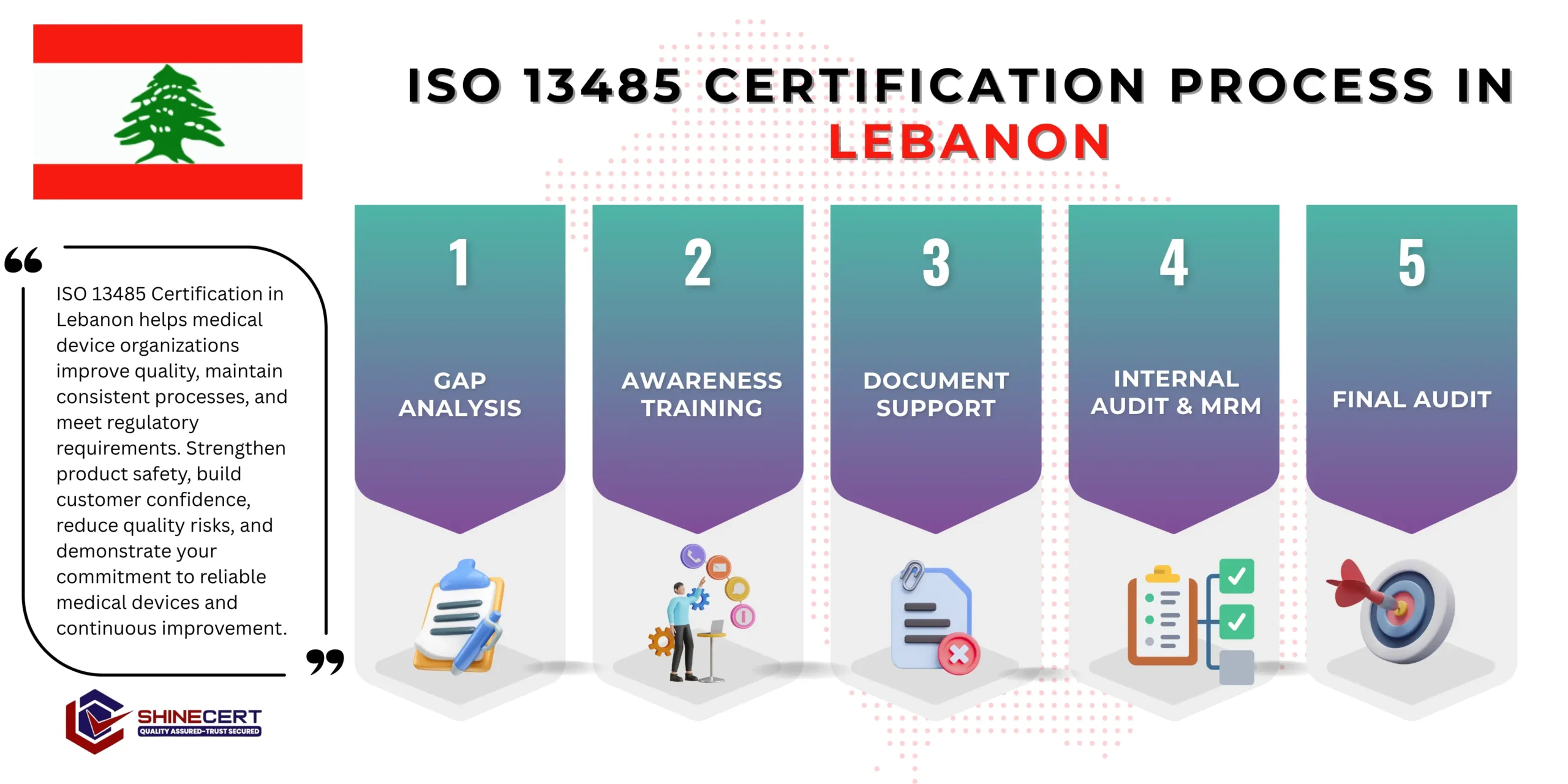
What are the steps to get ISO 13485 Certification in Lebanon?
our services
- ISO Certification Lebanon
- ISO 9001 Certification Lebanon
- ISO 14001 Certification Lebanon
- ISO 27001 Certification Lebanon
- ISO 22000 Certification Lebanon
- ISO 27701 Certification Lebanon
- ISO 45001 Certification Lebanon
- ISO 20000-1 Certification Lebanon
- ISO 13485 Certification Lebanon
- ISO 17025 Certification Lebanon
- ISO 31000 Certification Lebanon
- ISO 42001 Certification Lebanon
- ISO 37001 Certification Lebanon
- ISO 22301 Certification Lebanon
- ISO 50001 Certification Lebanon
- CE Mark Certification Lebanon
- GDPR Certification Lebanon
- GMP Certification Lebanon
- Halal Certification Lebanon
Our Five-Step Certification Process
Gap Assessment
We review your device categories, current MoPH registration status, and existing quality practices, and conduct structured interviews across quality, regulatory, and warehouse or manufacturing staff. We map every finding against ISO 13485’s clauses, distinguishing what applies differently to manufacturers versus distributors.
A clause-by-clause gap assessment identifying your actual quality gaps relative to your specific role in the device supply chain.
Documentation
We build your quality manual, device-specific risk management plan, and traceability procedures around your actual devices and processes, cross-referencing MoPH’s registration documentation requirements so the two efforts reinforce rather than duplicate each other.
A complete, version-controlled quality documentation set including your risk management plan and traceability procedures.
Implementation
Controls roll out across purchasing, storage, and distribution, with role-specific training since warehouse staff handling device storage and regulatory staff managing MoPH filings face genuinely different responsibilities. Traceability systems get tested with real device batches.
A functioning quality system with real batch traceability and complaint handling happening.
Internal Audit and Management Review
We run a full internal audit against every clause, surfacing weaknesses while stakes are low. Findings go to formal management review where leadership makes documented decisions on quality and regulatory priorities.
An internal audit report, management review minutes with concrete decisions, and closed-out corrective actions.
Certification Audit
Stage 1 confirms your documentation and risk management plan are audit-ready; Stage 2 has the auditor verify controls are genuinely operating, reviewing traceability records, storage conditions, and complaint handling. We stay involved through both stages.
Your ISO 13485 certificate, valid for three years, plus a surveillance audit schedule.
Gap Assessment
We review your device categories, current MoPH registration status, and existing quality practices, and conduct structured interviews across quality, regulatory, and warehouse or manufacturing staff. We map every finding against ISO 13485’s clauses, distinguishing what applies differently to manufacturers versus distributors.
A clause-by-clause gap assessment identifying your actual quality gaps relative to your specific role in the device supply chain.
Documentation
We build your quality manual, device-specific risk management plan, and traceability procedures around your actual devices and processes, cross-referencing MoPH’s registration documentation requirements so the two efforts reinforce rather than duplicate each other.
A complete, version-controlled quality documentation set including your risk management plan and traceability procedures.
Implementation
Controls roll out across purchasing, storage, and distribution, with role-specific training since warehouse staff handling device storage and regulatory staff managing MoPH filings face genuinely different responsibilities. Traceability systems get tested with real device batches.
A functioning quality system with real batch traceability and complaint handling happening.
Internal Audit and Management Review
We run a full internal audit against every clause, surfacing weaknesses while stakes are low. Findings go to formal management review where leadership makes documented decisions on quality and regulatory priorities.
An internal audit report, management review minutes with concrete decisions, and closed-out corrective actions.
Certification Audit
Stage 1 confirms your documentation and risk management plan are audit-ready; Stage 2 has the auditor verify controls are genuinely operating, reviewing traceability records, storage conditions, and complaint handling. We stay involved through both stages.
Your ISO 13485 certificate, valid for three years, plus a surveillance audit schedule.
What Is ISO 13485, and How Does It Actually Help Your Organization?
- The core problem ISO 13485 solves is that medical device quality failures can’t be caught after the fact the way a defective consumer product might be, by the time a device reaches a patient, the window for catching a problem has often closed. ISO 13485 requires you to build risk management into design, sourcing, and distribution from the start, rather than relying on inspection at the end of the process to catch what’s already wrong.
- Practically, this helps in concrete ways. It gives you genuine batch and lot traceability, so if an issue is identified with a specific device, you can trace exactly which units, which facilities, and potentially which patients were affected, critical for both patient safety and any recall process. It gives international manufacturers confidence that their Lebanese distributor manages their products with the same rigor expected globally, which is often the deciding factor in winning or keeping a distribution agreement. It substantially eases MoPH registration and renewal processes, since much of the documentation MoPH requires overlaps directly with what ISO 13485 already generates. And it protects your business from the outsized liability risk a medical device quality failure can create.
- The standard shares structural similarities with ISO 9001 but is deliberately more prescriptive around risk management, design controls, and regulatory documentation, reflecting that medical devices, unlike most products, operate under active regulatory oversight throughout their lifecycle, not just at initial approval.
Why This Matters So Much in Lebanon Specifically?
- Lebanon’s medical device sector runs substantially through distribution relationships with international manufacturers, and those manufacturers are increasingly explicit that ISO 13485 certification is a condition of doing business, not a preference. A Lebanese distributor without certification risks losing representation rights to a competitor who holds it, this is a genuinely common trigger we see for certification projects in this sector.
- Separately, MoPH’s registration process benefits considerably from certified quality management already in place, businesses with ISO 13485 typically find the registration and renewal documentation process meaningfully smoother, since much of what MoPH requests already exists in a structured, audit-ready form rather than needing to be assembled reactively each time.
What Actually Drives Your Cost?
We don’t quote a flat number, because two Lebanese medical device businesses’ actual risk classification and operations can look completely different. Here’s what genuinely drives cost.
Higher-risk device categories need meaningfully deeper risk management documentation than lower-risk devices.
Manufacturers face additional design control requirements that distributors generally don’t need to address.
Each additional device line or storage/distribution facility generally adds scope to the quality system.
Businesses with existing MoPH-compliant quality practices aren’t starting from zero, those with minimal formal documentation face more foundational work.
Pursuing ISO 9001 alongside ISO 13485 for broader product lines shares meaningful implementation and audit infrastructure.
A regulatory affairs or quality team member who can own documentation and MoPH coordination reduces consultant hours needed.
ISO 13485 Benefits Businesses Don't Expect
International manufacturers increasingly require certified distributors, meaning certification protects existing relationships and opens doors to new ones.
Structured quality documentation overlaps directly with what MoPH’s Drug Import/Export Department requests, reducing reactive scrambling at renewal time.
Batch and lot tracking lets you respond precisely and quickly if a device issue is identified, rather than facing a broad, costly recall.
Healthcare providers increasingly favor certified suppliers as their own procurement and risk management standards mature.
A structured complaint and vigilance system ensures adverse events get captured and reported appropriately, protecting you from compliance gaps.
Structural overlap with ISO 9001 makes pursuing quality management certification for non-device product lines meaningfully faster.
The standard’s purchasing controls formalize vetting of component suppliers, reducing risk introduced upstream in your supply chain.
Complaint trends, audit findings, and vigilance data give management real visibility into device quality performance.
Applicable Standards by Industry
Medical device distribution
Local distributors representing international manufacturers use certification to meet distribution agreement requirements and MoPH expectations.
Read moreMedical device manufacturing
Lebanon’s smaller device manufacturing base uses certification to formalize design controls and export readiness.
Read moreHospital and clinical equipment suppliers
Companies supplying diagnostic and treatment equipment use certification to build hospital procurement trust.
Read moreDental and laboratory device suppliers
Specialized device categories use certification to formalize quality management specific to their regulatory requirements.
Read moreMedical Device Quality Requirements, Clause by Clause, With the Documents Each One Actually Needs
- Context of the Organization (Clause 4) : Understanding your specific role in the medical device supply chain, manufacturer, distributor, or both, and the regulatory and customer requirements that apply to your devices. Document this clause requires: a documented quality management system scope statement identifying your device categories and role in the supply chain.
- Leadership (Clause 5) : Top management commitment to quality and regulatory compliance, with a documented quality policy and clearly assigned responsibilities. Document this clause requires: a quality policy signed by top management, and a documented management structure with regulatory responsibilities assigned.
- Planning (Clause 6) : Risk-based planning specific to your device categories, addressing regulatory requirements including MoPH registration obligations, plus measurable quality objectives. Document this clause requires: a risk management plan aligned to your device risk classification, and documented quality objectives.
- Support (Clause 7) : Resources, competence, and infrastructure controls, including specific requirements around work environment and contamination control relevant to device handling. Document this clause requires: training and competence records for staff handling devices, and infrastructure and work environment control records.
- Operation (Clause 8) : The core of the standard, design controls (for manufacturers), purchasing and supplier control, device traceability by batch or lot, and storage and distribution controls. Document this clause requires: device traceability records by batch/lot, supplier evaluation records, and storage and distribution procedures.
- Performance Evaluation (Clause 9) : Monitoring, measurement, complaint handling, and internal audit testing whether the quality system genuinely protects device integrity. Document this clause requires: a complaint handling and vigilance procedure, an internal audit program and results, and management review minutes.
- Improvement (Clause 10) : Structured investigation of nonconformities and complaints, including regulatory reporting where required, driving continual improvement. Document this clause requires: nonconformity and corrective action records, including documented regulatory reporting where applicable.
What Happens When a Lebanon Business Operates Without Certification?
- MoPH registration obligations remain in force regardless of ISO 13485 certification status, the legal requirement to register devices through the Drug Import/Export Department doesn’t disappear. What’s missing without certification is the structured quality system that makes registration and renewal considerably smoother, and for distributors specifically, the credential that many international manufacturers now require as a condition of representation. Businesses relying on informal quality practices tend to discover the gap either through losing a distribution agreement to a certified competitor, or through a device quality issue that’s harder to trace and contain than it should be.
- We generally recommend Lebanese medical device distributors and manufacturers treat ISO 13485 as core business infrastructure rather than a discretionary certification, the relationships and registration processes it protects tend to be too valuable to leave uncertified.
Common Pitfalls We See in Lebanon ISO 13485 Projects
- Treating distributor obligations the same as manufacturer obligations : Distributors often over-build design control documentation they don’t actually need, while under-building the storage and distribution controls that matter most for their role.
- Weak batch and lot traceability : Businesses sometimes track inventory generally without the batch-specific traceability ISO 13485 actually requires for genuine recall capability.
- Underestimating MoPH documentation overlap : Businesses sometimes build ISO 13485 and MoPH registration documentation as separate, duplicated efforts when meaningful overlap exists.
- No tested complaint or vigilance process : Having a documented complaint procedure that’s never been exercised with a real scenario tends to fail when an actual issue arises.
Why ShineCert?
ShineCert brings 10 years of ISO consulting and certification experience to Lebanon, backed by our own dedicated Lebanon office working alongside our Riyadh office. We deliver services remotely or on-site depending on what your project needs, warehouse and storage facility reviews genuinely benefit from an in-person visit, while documentation and regulatory coordination work can often run effectively over remote sessions. We’ve guided more than 10,000 organizations through ISO certification globally, and we build every Lebanon medical device engagement around your actual devices, role in the supply chain, and manufacturer requirements, with ShineCert as the best ISO 13485 consultant in Lebanon.
Choosing a Certification Body in Lebanon?
What to Check | Why It Matters |
Accreditation under the GAC framework | Confirms genuine, internationally recognized certification |
Experience with medical device regulatory environments | ISO 13485 audits require assessors who understand device-specific risk, not just general quality management |
Recognition by your international manufacturer partners | Confirm the certification body is recognized by the specific manufacturers whose distribution agreements require certification |
Experience with MoPH’s registration environment | Ensures the auditor understands how registration requirements connect to the quality system |
Ready to Get Started?
Whether you’re protecting an existing distribution agreement or preparing for MoPH registration from scratch, we’ll walk through your specific devices and cost factors before proposing a fixed-scope plan, delivered remotely, on-site, or however genuinely fits your project. Book a free consultation or contact us directly to get started.
Frequently Asked Questions
No, MoPH’s Drug Import/Export Department handles device registration, but ISO 13485 certification comes from independent, GAC-accredited certification bodies.
Registration confirms your devices meet baseline requirements to enter the market, but it’s not the same as having the structured quality management system ISO 13485 requires.
It genuinely depends on device risk classification, whether you manufacture or distribute, and facility complexity, we scope every project individually.
Typically three to five months for a first-time certification.
Increasingly yes, as a condition of the distribution agreement itself, not just a preference, worth confirming directly with your specific manufacturer partners.
No, they’re complementary. MoPH registration is a legal market-entry requirement; ISO 13485 is the quality management system supporting it.
Warehouse and storage facility reviews genuinely benefit from an in-person visit, but documentation work can often run remotely, we scope this per project.
Manufacturer distribution requirements don’t scale with company size, even small distributors are frequently required to certify by their manufacturer partners.
Yes, each device category and its risk classification generally adds its own scope to the quality system.
Yes, ShineCert maintains its own dedicated Lebanon office, with services delivered remotely or on-site depending on your project.