
ISO 45001 Certification in Lebanon
Quick Answer
ISO 45001 is the international standard for occupational health and safety management systems, and in Lebanon it sits on top of a legal foundation that’s decades old, the Labour Code of 1946, most recently amended in May 2025, alongside Decree No. 136 of 1983 governing occupational injury and disease benefits and Decree 11802 of 2004 on the organization of prevention, safety, and occupational hygiene. What ISO 45001 adds isn’t a new legal obligation, it’s a structured management system proving those obligations are genuinely being managed, not just nominally met. The Department of Labour Inspection, Prevention and Safety (DLIPS), under the Ministry of Labour’s Labour Relations Authority, oversees compliance, but certification itself comes from a body accredited under the Global Accreditation Cooperation (GAC) framework. Budget three to five months for a first-time certification. Cost depends on genuine factors, workforce size, hazard profile, number of sites, not a flat figure we quote upfront.
ISO 45001, Explained Simply
Legal compliance and genuine safety management aren’t automatically the same thing. A company can technically satisfy Decree 11802’s requirements to have a safety officer designated, basic protective equipment available, while still having no real system for identifying hazards before they cause an injury, or learning from near-misses before they become something worse. ISO 45001 is that missing system: a structured way of finding hazards proactively, involving workers directly in identifying them, and continuously improving rather than just meeting a legal floor and stopping there.
Lebanon at a Glance: What Shapes ISO 45001 Demand Here
Legal foundation : the Labour Code of 1946 (amended most recently May 2025) sets the baseline employment framework, with Decree 136 of 1983 covering occupational injury and disease benefits and Decree 11802 of 2004 governing prevention, safety, and occupational hygiene specifically.
Enforcement body : the Department of Labour Inspection, Prevention and Safety (DLIPS), under the Ministry of Labour’s Labour Relations Authority, conducts workplace inspections, but ISO 45001 certification comes from independent, accredited bodies, not DLIPS itself.
Genuine hazard diversity : Lebanon’s construction sector, industrial manufacturing base, and increasingly informal self-generated power infrastructure (generators, solar installations) each carry distinct occupational hazard profiles that a generic safety program often misses.
SME financing available : Kafalat S.A.L. guarantees up to 75% of qualifying loans across five priority sectors, which can help offset safety equipment and infrastructure investment.
What are the steps to get ISO 45001 Certification in Lebanon?
our services
- ISO Certification Lebanon
- ISO 9001 Certification Lebanon
- ISO 14001 Certification Lebanon
- ISO 27001 Certification Lebanon
- ISO 22000 Certification Lebanon
- ISO 27701 Certification Lebanon
- ISO 45001 Certification Lebanon
- ISO 20000-1 Certification Lebanon
- ISO 13485 Certification Lebanon
- ISO 17025 Certification Lebanon
- ISO 31000 Certification Lebanon
- ISO 42001 Certification Lebanon
- ISO 37001 Certification Lebanon
- ISO 22301 Certification Lebanon
- ISO 50001 Certification Lebanon
- CE Mark Certification Lebanon
- GDPR Certification Lebanon
- GMP Certification Lebanon
- Halal Certification Lebanon
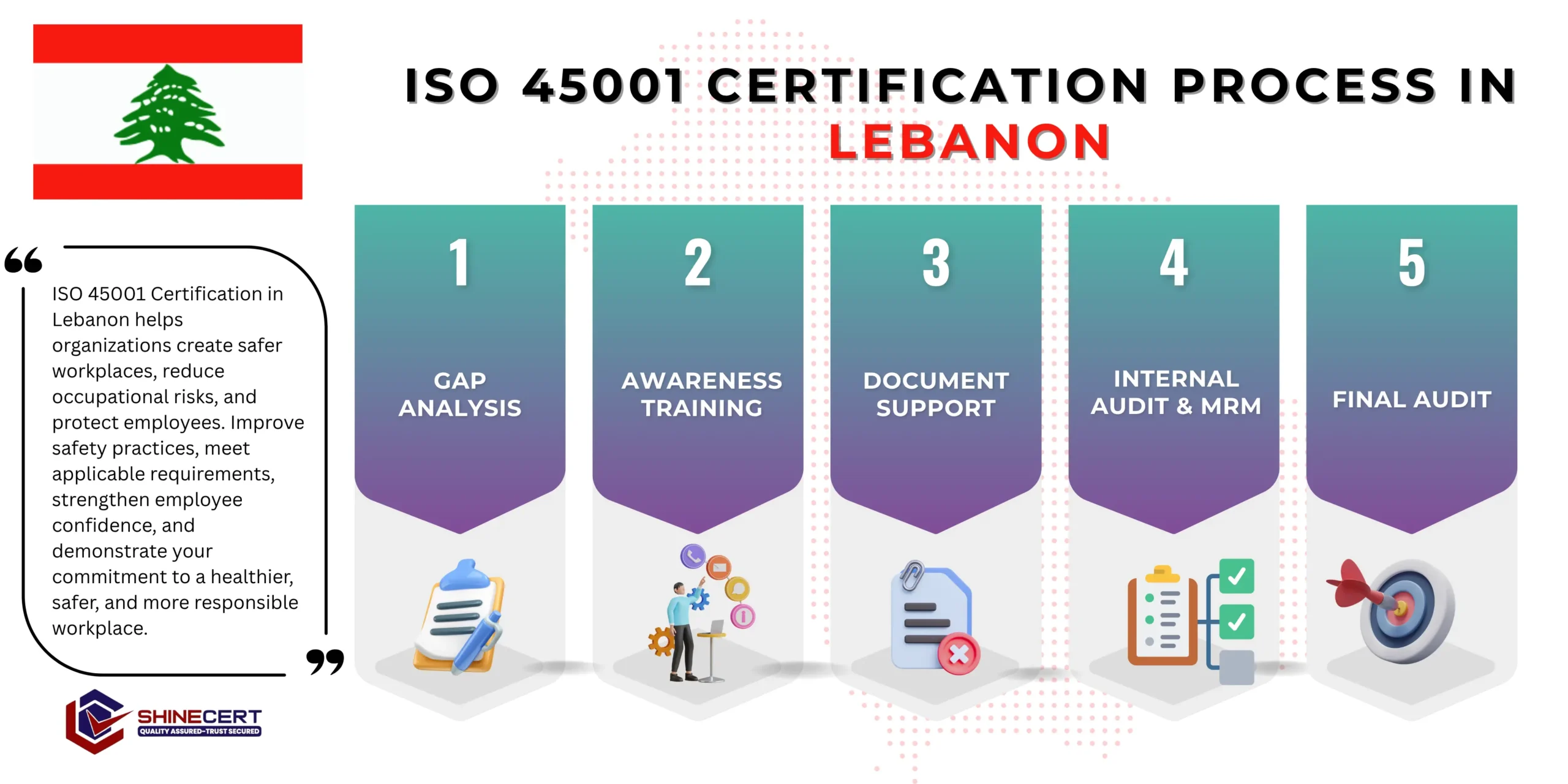
Our Five-Step Certification Process
Gap Assessment
We walk your site to identify actual hazards, review existing safety records and any DLIPS inspection history, and interview workers directly, not just supervisors, since frontline staff often know about hazards management doesn’t see. We map findings against every ISO 45001 clause.
A clause-by-clause gap assessment identifying your genuine hazard profile and where your current practices fall short of the standard.
Documentation
We draft your OHS policy, hazard register, and risk assessments around your actual operations, working directly with workers and supervisors so the documentation reflects real conditions, not assumptions. Worker consultation happens at this stage, not as an afterthought.
A complete, version-controlled OHS documentation set built around your genuine hazard profile.
Implementation
Controls roll out for identified hazards, with role-specific training, a site worker and an office-based manager need genuinely different safety training. Worker participation mechanisms (safety committees, reporting channels) get established and start functioning.
A functioning system with real incident and near-miss reporting happening, plus a workforce that understands its specific role in hazard identification.
Internal Audit and Management Review
We run a full internal audit against every clause, the way a certification auditor would, to surface weaknesses while stakes are low. Findings go to formal management review where leadership makes documented decisions.
An internal audit report, management review minutes with concrete decisions, and closed-out corrective actions.
Certification Audit
Stage 1 confirms documentation readiness; Stage 2 has the auditor observe actual site operations, interview workers, and verify records. We stay involved through both stages.
Your ISO 45001 certificate, valid for three years, plus a surveillance audit schedule.
Gap Assessment
We walk your site to identify actual hazards, review existing safety records and any DLIPS inspection history, and interview workers directly, not just supervisors, since frontline staff often know about hazards management doesn’t see. We map findings against every ISO 45001 clause.
A clause-by-clause gap assessment identifying your genuine hazard profile and where your current practices fall short of the standard.
Documentation
We draft your OHS policy, hazard register, and risk assessments around your actual operations, working directly with workers and supervisors so the documentation reflects real conditions, not assumptions. Worker consultation happens at this stage, not as an afterthought.
A complete, version-controlled OHS documentation set built around your genuine hazard profile.
Implementation
Controls roll out for identified hazards, with role-specific training, a site worker and an office-based manager need genuinely different safety training. Worker participation mechanisms (safety committees, reporting channels) get established and start functioning.
A functioning system with real incident and near-miss reporting happening, plus a workforce that understands its specific role in hazard identification.
Internal Audit and Management Review
We run a full internal audit against every clause, the way a certification auditor would, to surface weaknesses while stakes are low. Findings go to formal management review where leadership makes documented decisions.
An internal audit report, management review minutes with concrete decisions, and closed-out corrective actions.
Certification Audit
Stage 1 confirms documentation readiness; Stage 2 has the auditor observe actual site operations, interview workers, and verify records. We stay involved through both stages.
Your ISO 45001 certificate, valid for three years, plus a surveillance audit schedule.
What Is ISO 45001, and How Does It Actually Help Your Organization?
- Most Lebanese employers genuinely care about worker safety, the issue is rarely intent, it’s structure. Without a formal system, safety tends to be reactive: an incident happens, a fix gets applied to that specific problem, and the underlying pattern that caused it often goes unexamined. ISO 45001 flips that order. It requires proactive hazard identification before something goes wrong, genuine worker participation in identifying risks (since the people doing the work usually spot hazards management never sees), and structured incident investigation that traces problems back to root causes rather than just the immediate trigger.
- Practically, this helps in several concrete ways: it reduces the frequency and severity of workplace incidents through genuine prevention rather than reaction. It gives you defensible documentation if an incident does occur and gets scrutinized by DLIPS or an insurer. It improves worker morale and retention, since employees notice when safety is systematic rather than performative. And for companies bidding on contracts or pursuing international partnerships, it’s independently verified proof of safety management, not just a claim in a proposal.
- The standard shares its Harmonized Structure with ISO 9001 and ISO 14001, meaning businesses that have implemented either of those standards have real infrastructure, leadership commitment, documented processes, internal audit, to build on rather than starting from zero.
Why This Matters So Much in Lebanon Specifically?
- Lebanon’s construction and industrial sectors carry genuine, elevated occupational risk, and the country’s broader infrastructure strain, inconsistent power requiring widespread generators and increasingly solar installation, aging industrial equipment in some sectors, introduces hazard categories that a legally-compliant-but-unstructured safety program often doesn’t formally address. DLIPS inspections check baseline legal compliance, but they don’t substitute for an organization’s own systematic hazard identification and continuous improvement process.
- We’ve seen this pattern directly with Lebanese construction and manufacturing clients: technically compliant with the Labour Code and Decree 11802, genuinely well-intentioned about worker safety, but without any structured process for capturing near-misses or systematically reducing recurring hazard types. ISO 45001 gives that intent a genuine operating system, and for companies bidding on larger contracts or working with international partners who increasingly expect documented safety management, it closes a credibility gap that pure legal compliance doesn’t.
Kafalat Financing: Does It Help With ISO 45001 Costs?
Kafalat’s loan guarantee program can support safety equipment, protective infrastructure, and facility upgrades that often accompany genuine OHS management implementation, for businesses in its five priority sectors. Worth a direct conversation with Kafalat and your bank alongside certification planning.
What Actually Drives Your Cost?
We don’t quote a flat number, because two Lebanese businesses’ actual hazard profile and workforce size can look completely different. Here’s what genuinely drives cost.
A construction site with significant physical hazards needs meaningfully deeper risk assessment than a low-hazard office environment.
Each additional site generally needs its own hazard identification and risk assessment.
Businesses with existing DLIPS-compliant safety programs aren’t starting from zero, those with minimal formal safety documentation face more foundational work.
Pursuing ISO 9001 or ISO 14001 alongside ISO 45001 shares meaningful implementation and audit infrastructure.
A safety officer or EHS staff member who can own documentation and coordination reduces consultant hours needed.
Where support is available, your real out-of-pocket cost can be meaningfully lower.
A compressed timeline tied to a specific tender deadline sometimes needs more concentrated hours in a shorter window.
ISO 45001 Benefits Businesses Don't Expect
Proactive hazard identification and worker participation catch problems before they cause injuries, rather than generating fixes only after something’s already gone wrong.
A functioning OHS management system gives you a real record of prevention efforts, not just a policy binder assembled after the fact.
Certification increasingly factors into evaluation for construction and infrastructure contracts as Public Procurement Law 244/2021’s framework matures.
Employees notice the difference between performative safety measures and a genuinely systematic program, and that difference shows up in retention.
Insurers increasingly view structured OHS management as a genuine risk-reduction signal, which can meaningfully affect terms for construction and industrial operations.
Companies pursuing contracts with international partners or multinational clients increasingly find documented safety management expected as a baseline.
Because ISO 45001 shares the Harmonized Structure with ISO 9001 and ISO 14001, pursuing those standards afterward is meaningfully faster.
Safety equipment and infrastructure investment often qualifies for the broader operational financing Kafalat’s guarantee program supports.
Applicable Standards by Industry
Construction
Contractors bidding on larger infrastructure projects increasingly find certification favored or required in tender evaluation.
Read moreManufacturing and industrial
Facilities with genuine physical, chemical, or equipment-related hazards use ISO 45001 to formalize proactive hazard management.
Read moreLogistics and transport
Companies managing vehicle fleets and warehouse operations use certification to structure hazard identification across distributed sites.
Read moreEnergy and utilities
Businesses managing generator or solar infrastructure, increasingly common given Lebanon’s power situation, use certification to formalize electrical and installation safety.
Read moreHospitality
Hotels and large venues use ISO 45001 to structure safety management across guest-facing and back-of-house operations.
Read moreOccupational Health and Safety Requirements, Clause by Clause, With the Documents Each One Actually Needs
- Context of the Organization (Clause 4) : Understanding your genuine OHS context, the hazards specific to your operations, and the interested parties (workers, DLIPS, insurers, contractors) whose safety-related requirements matter. Document this clause requires: a documented statement of the OHS management system scope, covering which sites, activities, and workers are included.
- Leadership and Worker Participation (Clause 5) : Top management accountability for OHS, plus a specific, genuine requirement for worker consultation and participation in hazard identification and safety decisions. Document this clause requires: an OHS policy signed by top management, and documented evidence of worker consultation mechanisms.
- Planning (Clause 6) : Systematic hazard identification and risk assessment, evaluation of legal compliance obligations under the Labour Code and its decrees, and measurable OHS objectives. Document this clause requires: a hazard identification and risk assessment register, a legal and other requirements register, and documented OHS objectives with targets.
- Support (Clause 7) : Resources, competence, and awareness ensuring workers genuinely understand hazards relevant to their role, plus documented information supporting the system. Document this clause requires: safety training and competence records, and a controlled register of OHS documentation.
- Operation (Clause 8) : Operational controls over identified hazards, management of change procedures, and emergency preparedness and response planning. Document this clause requires: operational control procedures for significant hazards, and an emergency preparedness and response procedure.
- Performance Evaluation (Clause 9) : Monitoring, measurement, and internal audit testing whether the system genuinely reduces incidents, not just whether procedures exist on paper. Document this clause requires: an internal audit program and results, plus management review minutes covering OHS performance and incident trends.
- Improvement (Clause 10) : Structured investigation of incidents and nonconformities, tracing root causes and driving genuine continual improvement in safety performance. Document this clause requires: incident investigation records showing root-cause analysis and corrective actions taken.
What Happens When a Lebanon Business Operates Without Certification?
- Legal compliance under the Labour Code and its decrees doesn’t disappear without ISO 45001, DLIPS inspections and legal obligations remain in force regardless. What’s missing without certification is the proactive, systematic layer that catches hazards before they cause harm, and the independently verified evidence of safety management that increasingly matters in competitive tenders and international partnerships. Businesses that are technically compliant but genuinely reactive on safety tend to discover this gap either through a preventable incident or through losing a tender where certification was a factor.
- We generally recommend Lebanese construction, manufacturing, and industrial businesses treat ISO 45001 as the natural extension of legal compliance rather than a separate undertaking, much of the genuine groundwork, if you’re already operating responsibly, is partly there already.
Common Pitfalls We See in Lebanon ISO 45001 Projects
- Confusing legal compliance with systematic safety management. Meeting Decree 11802’s requirements is a legal floor, not the same as having a genuine, proactive hazard identification and improvement system.
- Treating worker consultation as a formality. The standard requires genuine worker participation in hazard identification, a safety committee that exists on paper but never meets or acts doesn’t satisfy this requirement.
- No cross-site pattern tracking. Businesses with multiple sites sometimes handle incidents locally without connecting recurring hazard types across locations, missing genuine prevention opportunities.
- Underestimating hazards from self-generated power infrastructure. Generators and increasingly solar installations introduce electrical and installation hazards that sometimes fall outside traditional safety programs.
Why ShineCert?
ShineCert brings 10 years of ISO consulting and certification experience to Lebanon, backed by our own dedicated Lebanon office working alongside our Riyadh office. We deliver services remotely or on-site depending on what your project needs, site hazard assessments genuinely benefit from an in-person visit, while documentation work can often run effectively over remote sessions. We’ve guided more than 10,000 organizations through ISO certification globally, and we build every Lebanon OHS engagement around your actual workforce, hazard profile, and best ISO 45001 consultant in Lebanon, existing DLIPS compliance history.
Choosing a Certification Body in Lebanon?
What to Check | Why It Matters |
Accreditation under the GAC framework | Confirms genuine, internationally recognized certification |
Experience with Lebanon’s Labour Code and DLIPS environment | Ensures the auditor understands how your existing legal obligations connect to the OHS system |
Sector-specific audit experience | Construction, manufacturing, and logistics involve genuinely different hazard profiles |
Genuine worker-engagement audit approach | Confirms the auditor actually verifies worker participation, not just documentation |
Ready to Get Started?
Whether you’re formalizing an already-solid safety culture or building systematic hazard management from scratch, we’ll walk through your specific workforce and cost factors before proposing a fixed-scope plan, delivered remotely, on-site, or however genuinely fits your project. Book a free consultation or contact us directly to get started.
Frequently Asked Questions
No, DLIPS enforces Labour Code and decree compliance through inspections, but ISO 45001 certification comes from independent, GAC-accredited certification bodies.
You’re legally compliant, but that’s a floor, not the same as having the proactive, systematic hazard management ISO 45001 requires.
It genuinely depends on workforce size, hazard exposure, and existing safety documentation, we scope every project individually.
Typically three to five months for a first-time certification.
Potentially, particularly for equipment and infrastructure investment in Kafalat’s priority sectors.
Site hazard assessments genuinely benefit from an in-person visit, but documentation and training can often run remotely, we scope this per project.
Yes, Lebanon’s widespread self-generated power infrastructure introduces electrical and installation hazards that traditional safety programs sometimes miss.
Not universally mandatory, but increasingly favored in evaluation criteria for larger infrastructure contracts.
Yes, each site generally needs its own hazard identification and risk assessment.
Yes, ShineCert maintains its own dedicated Lebanon office, with services delivered remotely or on-site depending on your project.