
ISO 50001 Certification in Lebanon
Quick Answer
ISO 50001 is the international standard for energy management systems, and few environments make its value more immediately tangible than Lebanon’s, where businesses have spent years building genuine energy independence out of necessity. Électricité du Liban’s grid supply has been unreliable for years, driving one of the region’s fastest solar adoption curves, installed solar capacity has grown from roughly 78 megawatts to well over 1,300 megawatts in recent years, with continued growth supported by international financing including a World Bank loan of roughly $250 million for renewable energy and grid support. ISO 50001 doesn’t teach Lebanese businesses to value energy management, most already do, intensely. It structures that hard-won expertise into a formal system that reduces genuine cost, tracks performance systematically, and gives lenders and partners independently verified evidence of energy management maturity. Budget three to four months for first-time certification. Cost depends on genuine factors, energy consumption profile, number of facilities, existing solar or generator infrastructure, not a flat figure we quote upfront.
ISO 50001, Explained Simply
Most Lebanese businesses have real, sophisticated energy setups by now, a mix of grid supply, generator backup, and increasingly solar installations, each with its own cost structure and reliability profile. What’s often missing is the systematic measurement behind it: genuine data on how much energy each source actually contributes, what it costs per unit, and where efficiency gains are actually available. ISO 50001 formalizes energy management the way a genuinely well-run finance function formalizes cost control, turning instinct and necessity-driven improvisation into structured, continuously improving practice.
Lebanon at a Glance: What Shapes ISO 50001 Demand Here
Genuine grid unreliability : Électricité du Liban’s supply constraints have made independent energy generation, not a luxury or environmental gesture, but a basic operational necessity for most Lebanese businesses.
A remarkable solar adoption curve : Lebanon’s installed solar capacity has grown from roughly 78 megawatts to over 1,300 megawatts in recent years, representing one of the fastest solar adoption trajectories in the region, driven by necessity rather than policy incentive alone.
International financing supporting the energy transition : A World Bank loan of approximately $250 million supports renewable energy and grid stabilization efforts, reflecting genuine international interest in Lebanon’s energy sector modernization.
Multi-source energy complexity : Most Lebanese businesses now manage a genuine mix of grid, generator, and solar power, creating real complexity in tracking actual energy costs and performance that a structured management system directly addresses.
What are the steps to get ISO 50001 Certification in Lebanon?
our services
- ISO Certification Lebanon
- ISO 9001 Certification Lebanon
- ISO 14001 Certification Lebanon
- ISO 27001 Certification Lebanon
- ISO 22000 Certification Lebanon
- ISO 27701 Certification Lebanon
- ISO 45001 Certification Lebanon
- ISO 20000-1 Certification Lebanon
- ISO 13485 Certification Lebanon
- ISO 17025 Certification Lebanon
- ISO 31000 Certification Lebanon
- ISO 42001 Certification Lebanon
- ISO 37001 Certification Lebanon
- ISO 22301 Certification Lebanon
- ISO 50001 Certification Lebanon
- CE Mark Certification Lebanon
- GDPR Certification Lebanon
- GMP Certification Lebanon
- Halal Certification Lebanon
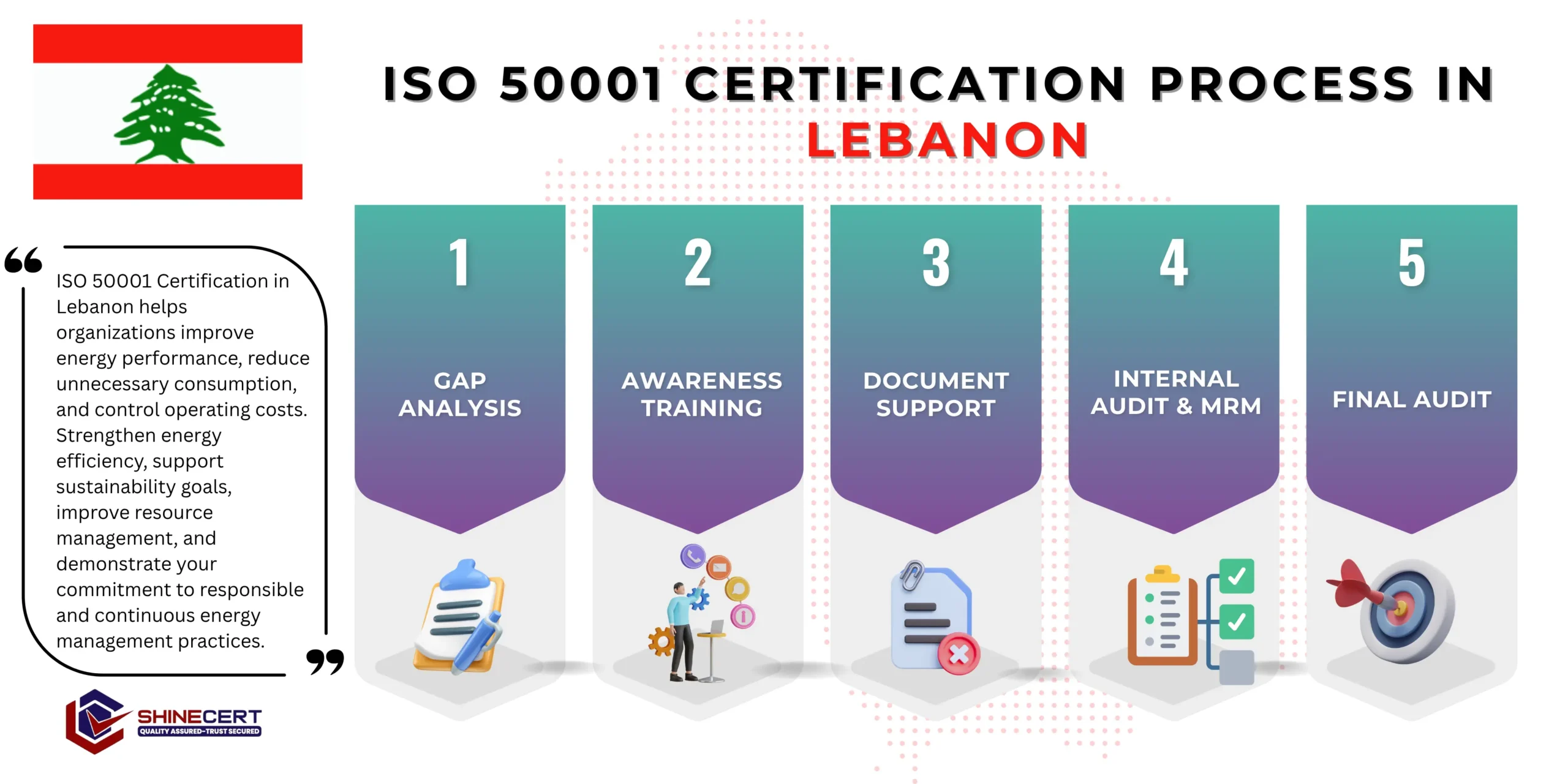
Our Five-Step Certification Process
Gap Assessment
We conduct a genuine energy review of your grid, generator, and solar mix, interview facilities and operations staff about current practices, and review existing energy bills and generator/solar performance data. We map findings against every ISO 50001 clause.
A clause-by-clause gap assessment identifying your genuine energy performance baseline and where measurement is currently missing.
Documentation
We build your energy policy, baseline, and performance indicators around your actual multi-source energy mix, working directly with facilities staff so the system reflects real operating conditions, not assumptions.
A complete, version-controlled energy management documentation set including your energy baseline and performance indicators.
Implementation
Monitoring systems get established across your energy sources, with staff trained on their specific role in tracking and reporting energy performance. Early efficiency findings often surface during this stage.
A functioning energy management system with real performance data being tracked against your baseline.
Internal Audit and Management Review
We run a full internal audit against every clause, surfacing weaknesses while stakes are low. Findings go to formal management review where leadership makes documented decisions on energy investment priorities.
An internal audit report, management review minutes with concrete decisions, and closed-out corrective actions.
Certification Audit
Stage 1 confirms your documentation and baseline are audit-ready; Stage 2 has the auditor verify performance monitoring is genuinely operating and reviewing actual energy data. We stay involved through both stages.
Your ISO 50001 certificate, valid for three years, plus a surveillance audit schedule.
Gap Assessment
We conduct a genuine energy review of your grid, generator, and solar mix, interview facilities and operations staff about current practices, and review existing energy bills and generator/solar performance data. We map findings against every ISO 50001 clause.
A clause-by-clause gap assessment identifying your genuine energy performance baseline and where measurement is currently missing.
Documentation
We build your energy policy, baseline, and performance indicators around your actual multi-source energy mix, working directly with facilities staff so the system reflects real operating conditions, not assumptions.
A complete, version-controlled energy management documentation set including your energy baseline and performance indicators.
Implementation
Monitoring systems get established across your energy sources, with staff trained on their specific role in tracking and reporting energy performance. Early efficiency findings often surface during this stage.
A functioning energy management system with real performance data being tracked against your baseline.
Internal Audit and Management Review
We run a full internal audit against every clause, surfacing weaknesses while stakes are low. Findings go to formal management review where leadership makes documented decisions on energy investment priorities.
An internal audit report, management review minutes with concrete decisions, and closed-out corrective actions.
Certification Audit
Stage 1 confirms your documentation and baseline are audit-ready; Stage 2 has the auditor verify performance monitoring is genuinely operating and reviewing actual energy data. We stay involved through both stages.
Your ISO 50001 certificate, valid for three years, plus a surveillance audit schedule.
What Is ISO 50001, and How Does It Actually Help Your Organization?
- The core value ISO 50001 offers Lebanese businesses isn’t persuading them energy matters, years of grid unreliability have already made that case forcefully. It’s providing the measurement and structure to turn genuine energy investment into genuine energy performance improvement. Without systematic tracking, a business might know it spends significantly on solar, generators, and grid supply combined, without knowing precisely which investments are actually delivering the best return, or where remaining inefficiency sits.
- Practically, this helps in concrete ways. It establishes an energy baseline and genuine performance indicators, so you know exactly how your energy mix is performing, not just what it costs in aggregate. It identifies specific efficiency opportunities, equipment upgrades, operational scheduling changes, better solar-generator-grid balancing, with real data behind the recommendation rather than assumption. It gives lenders and international partners independently verified evidence of energy management maturity, which increasingly matters for financing tied to renewable energy or sustainability criteria. And it creates documented, defensible cost control at a time when energy remains one of the largest and most volatile cost lines for most Lebanese businesses.
- The standard shares the Harmonized Structure with ISO 9001 and ISO 14001, so businesses already holding either certification have real infrastructure, management review, internal audit, documented objectives, to extend into energy management specifically.
Why This Matters So Much in Lebanon Specifically?
- Lebanese businesses have already made the hard, expensive decisions around energy independence, installing solar, investing in generator capacity, managing a genuinely complex multi-source supply. What most haven’t done is build the measurement layer that would tell them whether those investments are performing as well as they could, or where the next efficiency gain actually sits. ISO 50001 is specifically that missing measurement layer, not a case for energy investment Lebanese businesses have already made without being asked.
- We’ve seen this pattern directly: businesses with substantial solar and generator infrastructure, genuinely proud of their energy independence, but with no structured tracking connecting energy investment to actual performance data. ISO 50001 implementation typically surfaces real, actionable findings, a specific piece of equipment consuming disproportionately, or a solar-generator balance that could be optimized, that years of intuitive energy management hadn’t caught because nobody was measuring systematically.
What Actually Drives Your Cost?
We don’t quote a flat number, because two Lebanese businesses’ actual energy mix and consumption profile can look completely different. Here’s what genuinely drives cost.
A business managing grid, generator, and solar sources across multiple facilities needs meaningfully more extensive energy review than a simpler, single-source operation.
Each additional facility generally needs its own energy review and performance indicator tracking.
Businesses with existing metering and monitoring aren’t starting from zero, those relying on estimated or aggregate billing data face more foundational measurement work.
Pursuing ISO 14001 alongside ISO 50001 shares meaningful implementation and audit infrastructure, since both address environmental and resource performance.
A facilities or operations lead who can own energy data collection and coordination reduces consultant hours needed.
A compressed timeline tied to a specific financing application deadline sometimes needs more concentrated hours in a shorter window.
ISO 50001 Benefits Businesses Don't Expect
Systematic measurement identifies specific efficiency gains in equipment already installed, rather than requiring new investment to see improvement.
International lenders and financing programs increasingly favor demonstrable energy management maturity, particularly given the World Bank and other institutional interest in Lebanon’s energy sector.
Structured tracking turns energy from an unpredictable cost into a measured, actively managed one.
Performance data reveals exactly how your energy mix is performing, enabling smarter operational decisions about when to rely on which source.
Identifying inefficient equipment through systematic monitoring often surfaces maintenance needs before they become costly failures.
Shared Harmonized Structure with ISO 14001 and ISO 9001 makes pursuing environmental or quality certification alongside energy management meaningfully faster.
Certification increasingly matters to international clients and partners with their own sustainability reporting requirements.
Real performance data lets leadership prioritize the next efficiency investment based on evidence, not assumption.
Applicable Standards by Industry
Manufacturing and industrial
Facilities with significant equipment energy consumption use ISO 50001 to formalize efficiency gains across grid, generator, and solar mix.
Read moreCommercial real estate and hospitality
Hotels and large commercial buildings use certification to structure energy performance across guest-facing and back-of-house operations.
Read moreSolar and renewable energy installers
Companies in Lebanon’s growing solar sector use certification to demonstrate their own energy management maturity to clients and financiers.
Read moreRetail and logistics
Businesses managing multiple locations use certification to standardize energy performance tracking across a distributed footprint.
Read moreEnergy Management Requirements, Clause by Clause, With the Documents Each One Actually Needs
- Context of the Organization (Clause 4) : Understanding your specific energy mix, grid, generator, solar, and the interested parties (lenders, regulators, partners) whose energy performance expectations matter. Document this clause requires: a documented energy management system scope statement identifying which facilities and energy sources are covered.
- Leadership (Clause 5) : Top management commitment to energy performance, with a documented energy policy and clearly assigned responsibilities. Document this clause requires: an energy policy signed by top management, and a documented energy management team structure.
- Planning (Clause 6) : An energy review identifying significant energy uses across your grid, generator, and solar mix, establishing a genuine energy baseline and measurable energy performance indicators. Document this clause requires: an energy review, a documented energy baseline, and energy performance indicators specific to your operations.
- Support (Clause 7) : Resources, competence, and awareness training ensuring staff understand energy performance factors relevant to their role. Document this clause requires: energy awareness training records and a controlled register of energy management documentation.
- Operation (Clause 8) : Operational controls over significant energy uses, including how grid, generator, and solar sources are managed and balanced day to day. Document this clause requires: operational control procedures for significant energy uses and multi-source energy management.
- Performance Evaluation (Clause 9) : Monitoring, measurement, and internal audit testing whether energy performance is genuinely improving against your baseline. Document this clause requires: energy performance monitoring records against baseline, an internal audit program and results, and management review minutes.
- Improvement (Clause 10) : Structured investigation of energy performance gaps and nonconformities, driving continual improvement in actual energy performance, not just documentation. Document this clause requires: nonconformity and corrective action records tied to energy performance data.
What Happens When a Lebanon Business Operates Without Certification?
- Energy costs and multi-source complexity don’t disappear without ISO 50001, Lebanese businesses have managed both for years without formal certification. What’s missing is the systematic measurement that would tell you whether your existing energy investment is performing as well as it could, and the independently verified credential that increasingly matters for renewable energy financing and international partnership. Businesses relying entirely on intuitive energy management tend to discover the gap either through a financing opportunity requiring demonstrable energy management, or through an inefficiency that systematic tracking would have caught years earlier.
- We generally recommend Lebanese businesses with significant solar, generator, or multi-source energy infrastructure treat ISO 50001 as the natural next step after the hard work of building energy independence, measuring and optimizing what you’ve already invested in.
Common Pitfalls We See in Lebanon ISO 50001 Projects
- Treating solar and generator investment as sufficient on its own : Having significant energy infrastructure isn’t the same as having systematic performance measurement behind it.
- No genuine baseline before making efficiency claims : Without a documented energy baseline, it’s genuinely difficult to prove any subsequent improvement actually happened.
- Underestimating multi-source tracking complexity : Businesses sometimes track grid and generator costs separately from solar performance, missing the integrated view ISO 50001 requires.
- Assuming energy management is purely a facilities function : Genuine energy performance improvement often needs input from operations and finance too, not facilities staff alone.
Why ShineCert?
ShineCert brings 10 years of ISO consulting and certification experience to Lebanon, backed by our own dedicated Lebanon office working alongside our Riyadh office. We deliver services remotely or on-site depending on what your project needs, energy reviews and facility walkthroughs genuinely benefit from an in-person visit, while documentation and performance analysis can often run effectively over remote sessions. We’ve guided more than 10,000 organizations through ISO certification globally, and we build every Lebanon energy management engagement around your actual grid, generator, and solar mix, with ShineCert as the best ISO 50001 consultant in Lebanon, not a generic template.
Choosing a Certification Body in Lebanon?
What to Check | Why It Matters |
Accreditation under the GAC framework | Confirms genuine, internationally recognized certification |
Experience with multi-source energy environments | Lebanon’s grid-generator-solar mix is genuinely more complex than single-source energy environments elsewhere |
Recognition by renewable energy financiers | For businesses pursuing financing tied to energy performance, confirm the certification body is recognized by your target lenders |
Sector-specific audit experience | Manufacturing, hospitality, and commercial real estate involve genuinely different energy profiles |
Ready to Get Started?
Whether you’re optimizing solar and generator investment you’ve already made or building energy management to support a financing application, we’ll walk through your specific energy mix and cost factors before proposing a fixed-scope plan, delivered remotely, on-site, or however genuinely fits your project. Book a free consultation or contact us directly to get started.
Frequently Asked Questions
No, Électricité du Liban is the grid utility, not a certification body. ISO 50001 certification comes from independent, GAC-accredited certification bodies.
Having energy infrastructure isn’t the same as having systematic performance measurement, ISO 50001 adds the structured tracking that tells you whether your existing investment is performing optimally.
It genuinely depends on your energy mix complexity, number of facilities, and existing monitoring infrastructure, we scope every project individually.
Typically three to four months for a first-time certification.
Potentially yes, demonstrable energy management maturity increasingly matters to international lenders and financing programs supporting Lebanon’s energy transition.
Energy reviews and facility walkthroughs genuinely benefit from an in-person visit, but documentation and analysis can often run remotely, we scope this per project.
Any business managing meaningful grid, generator, and solar costs benefits, which in Lebanon’s environment includes most businesses regardless of size.
Yes, each facility generally needs its own energy review and performance indicator tracking.
Efficient equipment is a good starting point, but ISO 50001 requires ongoing measurement and continual improvement, not a one-time investment.
Yes, ShineCert maintains its own dedicated Lebanon office, with services delivered remotely or on-site depending on your project.