
CE Mark Certification in Lebanon
Quick Answer
CE Marking is not a certification issued by a third party, it’s a manufacturer’s own declaration that a product meets the European Union’s relevant health, safety, and environmental protection requirements, allowing it to be legally sold across the European Economic Area. For most product categories, CE Marking is a self-declaration process: the manufacturer conducts or commissions the required conformity assessment, compiles a technical file, and affixes the CE mark themselves. Higher-risk product categories, certain medical devices, specific machinery, some pressure equipment, require involvement from an EU-recognized Notified Body rather than self-declaration alone. ShineCert’s role for Lebanese exporters is advisory: we help you determine which EU directive or regulation applies to your specific product, guide you through the conformity assessment process, and prepare the technical documentation the process genuinely requires. We do not issue CE Marking ourselves, since no private consultancy does, that’s the nature of the self-declaration system. Budget six to twelve weeks for advisory support depending on product complexity and risk category. Cost depends on genuine factors, product category, applicable directive, whether third-party testing is required, not a flat figure we quote upfront.
CE Marking, Explained Simply
CE Marking often gets described casually as a “certification,” but that framing is misleading and worth correcting upfront, since it changes what kind of help actually makes sense. For the large majority of product categories, there’s no external body handing you a CE certificate, the manufacturer determines which EU requirements apply, conducts the necessary testing and risk assessment, documents it all in a technical file, and self-declares conformity by affixing the mark. The genuine risk isn’t failing an audit, it’s misjudging which requirements apply, missing a required test, or building a technical file that wouldn’t hold up if EU market surveillance authorities ever asked to see it.
Lebanon at a Glance: What Shapes CE Marking Demand Here
A genuine EU export relationship : Lebanon’s Association Agreement with the EU and established trade ties mean EU markets represent a real and ongoing export destination for Lebanese manufactured goods.
No Lebanese equivalent system : Lebanon has no domestic marking scheme equivalent to CE Marking, meaning Lebanese exporters approach the EU’s system as an entirely external requirement to navigate, not something with a familiar local parallel.
A genuine manufacturing export base : Lebanese producers of electrical equipment, machinery components, furniture, and various consumer goods pursue EU market access, each falling under different applicable EU directives depending on product category.
Growing regulatory complexity : The EU periodically updates its product regulations (particularly around machinery, electronics, and environmental requirements), meaning Lebanese exporters need genuinely current guidance rather than assuming past compliance approaches remain valid.
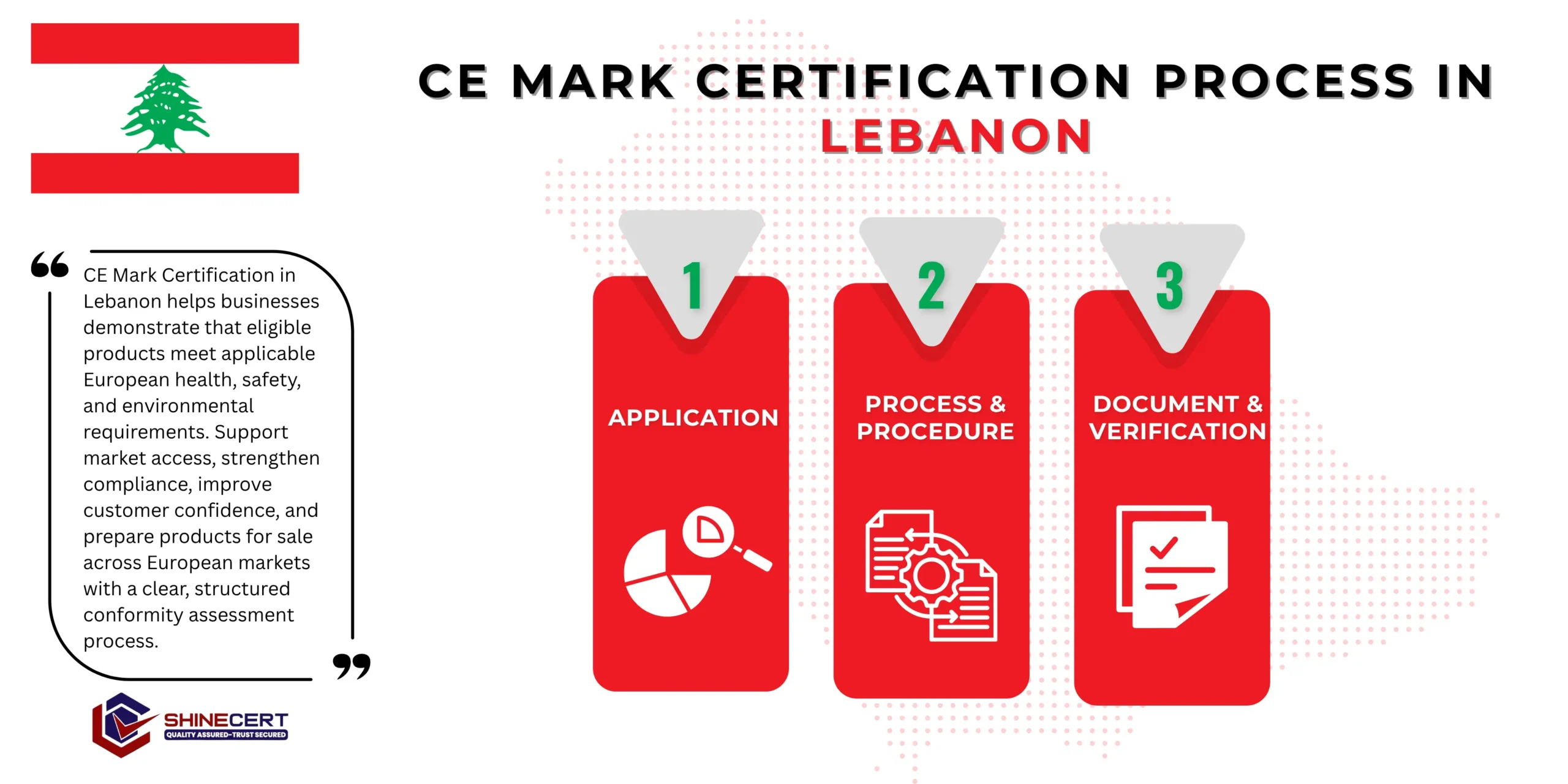
What are the steps to get CE Mark Certification in Lebanon?
our services
- ISO Certification Lebanon
- ISO 9001 Certification Lebanon
- ISO 14001 Certification Lebanon
- ISO 27001 Certification Lebanon
- ISO 22000 Certification Lebanon
- ISO 27701 Certification Lebanon
- ISO 45001 Certification Lebanon
- ISO 20000-1 Certification Lebanon
- ISO 13485 Certification Lebanon
- ISO 17025 Certification Lebanon
- ISO 31000 Certification Lebanon
- ISO 42001 Certification Lebanon
- ISO 37001 Certification Lebanon
- ISO 22301 Certification Lebanon
- ISO 50001 Certification Lebanon
- CE Mark Certification Lebanon
- GDPR Certification Lebanon
- GMP Certification Lebanon
- Halal Certification Lebanon
Our Process: What to Actually Expect
Product and Directive Assessment
We review your product’s design, intended use, and market, and identify exactly which EU directive(s) or regulation(s) genuinely apply, this is the step where most costly misjudgments happen if rushed or handled generically.
A documented directive applicability assessment specific to your actual product.
Essential Requirements Review
We map the specific health, safety, and environmental requirements your product must meet under the applicable directive, identifying any harmonized standards that provide a presumption of conformity.
A documented essential requirements checklist guiding your compliance work.
Conformity Assessment Coordination
We determine whether your product qualifies for self-assessment or requires Notified Body involvement, and if the latter, help coordinate that engagement directly with an accredited body.
A completed conformity assessment appropriate to your product’s actual risk category.
Technical File Compilation
We assemble your complete technical file, design specifications, risk assessments, test results, structured to genuinely withstand EU market surveillance scrutiny if ever requested.
A complete, audit-ready technical file meeting your applicable directive’s specific requirements.
Declaration and Marking Guidance
We help finalize your EU Declaration of Conformity and guide correct application of the CE mark to your product and packaging, plus clarity on your ongoing obligations.
A signed Declaration of Conformity and clear guidance for correctly and legally marking your product.
Product and Directive Assessment
We review your product’s design, intended use, and market, and identify exactly which EU directive(s) or regulation(s) genuinely apply — this is the step where most costly misjudgments happen if rushed or handled generically.
A documented directive applicability assessment specific to your actual product.
Essential Requirements Review
We map the specific health, safety, and environmental requirements your product must meet under the applicable directive, identifying any harmonized standards that provide a presumption of conformity.
A documented essential requirements checklist guiding your compliance work.
Conformity Assessment Coordination
We determine whether your product qualifies for self-assessment or requires Notified Body involvement, and if the latter, help coordinate that engagement directly with an accredited body.
A completed conformity assessment appropriate to your product’s actual risk category.
Technical File Compilation
We assemble your complete technical file, design specifications, risk assessments, test results, structured to genuinely withstand EU market surveillance scrutiny if ever requested.
A complete, audit-ready technical file meeting your applicable directive’s specific requirements.
Declaration and Marking Guidance
We help finalize your EU Declaration of Conformity and guide correct application of the CE mark to your product and packaging, plus clarity on your ongoing obligations.
A signed Declaration of Conformity and clear guidance for correctly and legally marking your product.
What Does CE Marking Advisory Actually Help Your Organization Do?
- The core value of proper CE Marking advisory isn’t obtaining a credential, there isn’t one to obtain from a third party for most products. It’s correctly navigating a genuinely complex self-declaration system where getting it wrong creates real legal and commercial exposure: EU market surveillance authorities can pull products from the market, and a technical file that doesn’t hold up to scrutiny can mean costly rework or shipment rejection after goods have already reached the EU.
- Practically, this helps in concrete ways. It correctly identifies which EU directive or regulation actually applies to your specific product, since misidentifying this is a genuinely common and costly mistake. It structures the conformity assessment process appropriately, determining whether self-assessment suffices or whether your product category requires Notified Body involvement. It builds a technical file that would genuinely hold up if EU authorities requested it, not just a document assembled to look complete. And it helps you understand ongoing obligations, since CE Marking isn’t a one-time achievement, product changes can require reassessment.
- For product categories requiring Notified Body involvement, we help coordinate that engagement, though the Notified Body’s assessment and any certificate it issues comes from that accredited body directly, not from ShineCert.
Why This Matters So Much for Lebanon Specifically?
- Lebanese manufacturers pursuing EU market access face a genuine information gap: without a domestic marking system that mirrors CE Marking’s structure, many exporters approach the process without an intuitive sense of what’s actually required, leading to two common and costly mistakes we see repeatedly, assuming a product needs less documentation than it does, or over-investing in third-party testing for a category that actually permits self-assessment.
- Getting the applicable directive and assessment route right at the outset saves genuine time and cost. We’ve seen Lebanese manufacturers commission expensive third-party testing for products that, once correctly categorized under the relevant EU directive, actually qualified for self-assessment, money and time that could have been avoided with the right guidance from the start.
What Actually Drives Your Cost?
We don’t quote a flat number, because two Lebanese manufacturers’ actual product category and assessment route can look completely different. Here’s what genuinely drives cost.
Higher-risk products requiring Notified Body involvement carry meaningfully different costs than lower-risk products qualifying for self-assessment.
Some products fall under multiple EU directives simultaneously, adding to the essential requirements and technical file scope.
Products requiring physical testing against harmonized standards add cost beyond documentation and advisory work alone.
Manufacturers with existing design and quality documentation aren’t starting from zero, those with minimal formal records face more foundational work.
For higher-risk categories, Notified Body assessment fees are separate from and additional to our advisory fees.
Advisory across multiple distinct product lines generally scales with the number of genuinely different categories involved.
CE Mark Benefits Businesses Don't Expect
Avoiding the common, costly mistake of misjudging which EU requirements actually apply to your product category.
Correctly determining whether your product qualifies for self-assessment can save meaningful cost versus defaulting to Notified Body engagement unnecessarily.
Documentation built to withstand actual EU market surveillance review, not just assembled to appear complete.
Getting conformity assessment right before goods reach the EU avoids the far more expensive scenario of addressing problems after market entry.
Understanding when product changes require reassessment protects you from inadvertently invalidating your declaration of conformity.
Correctly structured conformity assessment from the outset moves considerably faster than iterating after early mistakes.
Understanding the EU’s regulatory logic for one product line often transfers efficiently to related products you may add later.
Genuinely product-specific advisory avoids the real risk of applying generic CE Marking information to a product category with its own particular requirements.
Applicable Sectors for CE Mark Certification
Electrical and electronic equipment manufacturers
Products in this category frequently fall under specific EU directives with well-defined but detailed requirements.
Read moreMachinery and equipment manufacturers
The Machinery Directive carries genuinely detailed essential requirements that benefit significantly from experienced guidance.
Read moreFurniture and consumer goods manufacturers
Products in this category often qualify for self-assessment but still require correctly structured technical files.
Read moreConstruction products manufacturers
Products entering EU construction supply chains face their own specific conformity assessment framework.
Read moreThe CE Marking Process, Step by Step, With the Documents Each One Actually Needs
- Directive and Regulation Identification : Determining exactly which EU directive(s) or regulation(s) apply to your specific product, this single step shapes everything that follows. Document this step requires: a documented applicability assessment identifying the specific EU legal instruments governing your product.
- Essential Requirements Assessment : Identifying the specific health, safety, and environmental requirements your product must meet under the applicable directive. Document this step requires: a documented essential requirements checklist specific to your product category.
- Conformity Assessment : Determining and executing the correct assessment route, self-assessment for lower-risk categories, or Notified Body involvement for higher-risk product categories. Document this step requires: conformity assessment records, including test reports and, where applicable, Notified Body certificates.
- Technical File Compilation : Assembling comprehensive documentation, design specifications, risk assessments, test results, manufacturing quality records, proving conformity. Documenting this step requires: a complete technical file meeting the specific content requirements of your applicable directive.
- Declaration of Conformity and Marking : Drafting the formal EU Declaration of Conformity and correctly affixing the CE mark to your product and packaging. Document this step requires: a signed EU Declaration of Conformity referencing all applicable directives and standards.
What Happens When a Lebanon Exporter Skips Proper Guidance?
- Attempting CE Marking without genuine product-specific guidance creates real risk: misidentifying the applicable directive can mean your entire technical file is built around the wrong requirements, discovered only if EU market surveillance authorities investigate or a shipment gets held. Because CE Marking is self-declared, there’s no external check catching mistakes before your product reaches the EU market, which makes getting it right from the start considerably more important than it might initially seem.
- We generally recommend Lebanese manufacturers pursuing EU market access treat proper directive identification and technical file preparation as foundational, not a step to shortcut with generic online templates that don’t reflect your specific product category’s actual requirements.
Common Pitfalls We See in Lebanon CE Marking Projects
- Misidentifying the applicable directive : This is the single most consequential mistake, since it can invalidate the entire technical file and conformity assessment built around the wrong requirements.
- Defaulting to unnecessary third-party testing : Some manufacturers over-invest in Notified Body engagement for product categories that actually qualify for self-assessment.
- Treating CE Marking as a one-time achievement : Product design changes can require reassessment, and manufacturers sometimes continue using an outdated Declaration of Conformity after a product modification.
- Using generic templates instead of product-specific documentation : A technical file built from a generic online template rarely reflects the specific essential requirements your actual product category faces.
Why ShineCert?
ShineCert brings 10 years of consulting experience to Lebanon, backed by our own dedicated Lebanon office working alongside our Riyadh office. We deliver services remotely or on-site depending on what your project needs, technical file review and directive assessment often run effectively through remote sessions, while product design reviews sometimes benefit from in-person collaboration with your engineering team. We’ve guided organizations globally through EU market entry processes, and as the best CE Mark consultant in Lebanon, we help Lebanese exporters navigate CE Marking’s genuinely self-declared system correctly from the outset, avoiding the costly missteps we’ve seen elsewhere.
Choosing CE Marking Advisory Support for Lebanon Exporters?
What to Check | Why It Matters |
Genuine understanding that CE Marking is self-declared | Avoids confusion about what advisory support can and cannot provide |
Product-category-specific experience | Machinery, electronics, and furniture involve genuinely different directive requirements |
Access to accredited Notified Body relationships | Important for higher-risk product categories requiring third-party assessment |
Experience with Lebanese manufacturing exporters | Ensures practical understanding of your production and documentation starting point |
Ready to Get Started?
Whether you’re entering the EU market for the first time or reassessing a product after design changes, we’ll walk through your specific product and cost factors before proposing a fixed-scope advisory plan, delivered remotely, on-site, or however genuinely fits your project. Book a free consultation or contact us directly to get started.
Frequently Asked Questions
No, CE Marking is a manufacturer self-declaration for most product categories, not a third-party certification. We provide advisory support helping you navigate the process correctly; no private consultancy issues CE Marking itself.
No, most product categories qualify for self-assessment. Only specific higher-risk categories require Notified Body involvement, and we help determine which applies to your product.
It genuinely depends on your product’s risk category, applicable directives, and testing requirements, we scope every project individually.
Typically six to twelve weeks depending on product complexity and whether Notified Body involvement is required.
Your entire technical file and conformity assessment may be built around the wrong requirements, creating real risk if EU authorities investigate or a shipment is held.
Technical file review and directive assessment often run effectively remotely, though product design reviews sometimes benefit from in-person collaboration, we scope this per project.
Any manufacturer targeting EU market entry needs to navigate CE Marking correctly, regardless of company size.
Often yes, meaningful design or material changes can affect conformity, and manufacturers should reassess rather than assume an existing Declaration of Conformity still applies.
Yes, we help identify and coordinate with an appropriate accredited Notified Body, though the assessment and any resulting certificate comes from that body directly.
Yes, ShineCert maintains its own dedicated Lebanon office, with services delivered remotely or on-site depending on your project.