
ISO 22000 Certification in Lebanon
Quick Answer
ISO 22000 is the international standard for food safety management systems, and in Lebanon it operates alongside Food Safety Law No. 35 of 2016, which established a genuinely modern legal framework for food safety and created the Ministry of Public Health’s Food Safety Directorate as the coordinating body across food safety oversight. The law itself sets legal obligations around hygiene, traceability, and hazard control; ISO 22000 is the management system that makes those obligations operational and independently verifiable. For Lebanese food producers and processors targeting export markets, particularly the Gulf, where import requirements are stringent, certification is often the difference between qualifying for a contract and being excluded before pricing is even discussed. Budget three to five months for first-time certification. Cost depends on genuine factors, product complexity, facility size, number of production lines, not a flat figure we quote upfront.
ISO 22000, Explained Simply
Most Lebanese food businesses already do a lot right, clean facilities, trained staff, basic hygiene practices. What’s often missing is the systematic hazard analysis behind it: a documented understanding of exactly where contamination or safety risk could enter your specific process, and controls built deliberately around those points rather than general good practice applied uniformly. ISO 22000 is that missing layer. It builds on HACCP principles (Hazard Analysis and Critical Control Points) but wraps them in a full management system, leadership accountability, documented objectives, internal audit, that HACCP alone doesn’t require.
Lebanon at a Glance: What Shapes ISO 22000 Demand Here
Legal foundation : Food Safety Law No. 35 of 2016 established a modern, risk-based food safety framework for Lebanon, with the Ministry of Public Health’s Food Safety Directorate coordinating oversight across the food supply chain.
A genuine agri-food export sector : Lebanon has real food and beverage export activity, particularly wine, olive oil, processed foods, and confectionery, and destination markets increasingly require internationally recognized food safety certification as an import condition.
Gulf market access : Gulf countries applying GSO food safety standards represent a significant export opportunity for Lebanese food producers, and ISO 22000 certification substantially eases the documentation burden those markets require.
A fragmented domestic food sector : Lebanon’s food production ranges from small family-run producers to larger industrial processors, meaning food safety maturity varies significantly, Law 35/2016 sets the legal floor, but ISO 22000 adoption remains genuinely uneven across the sector.
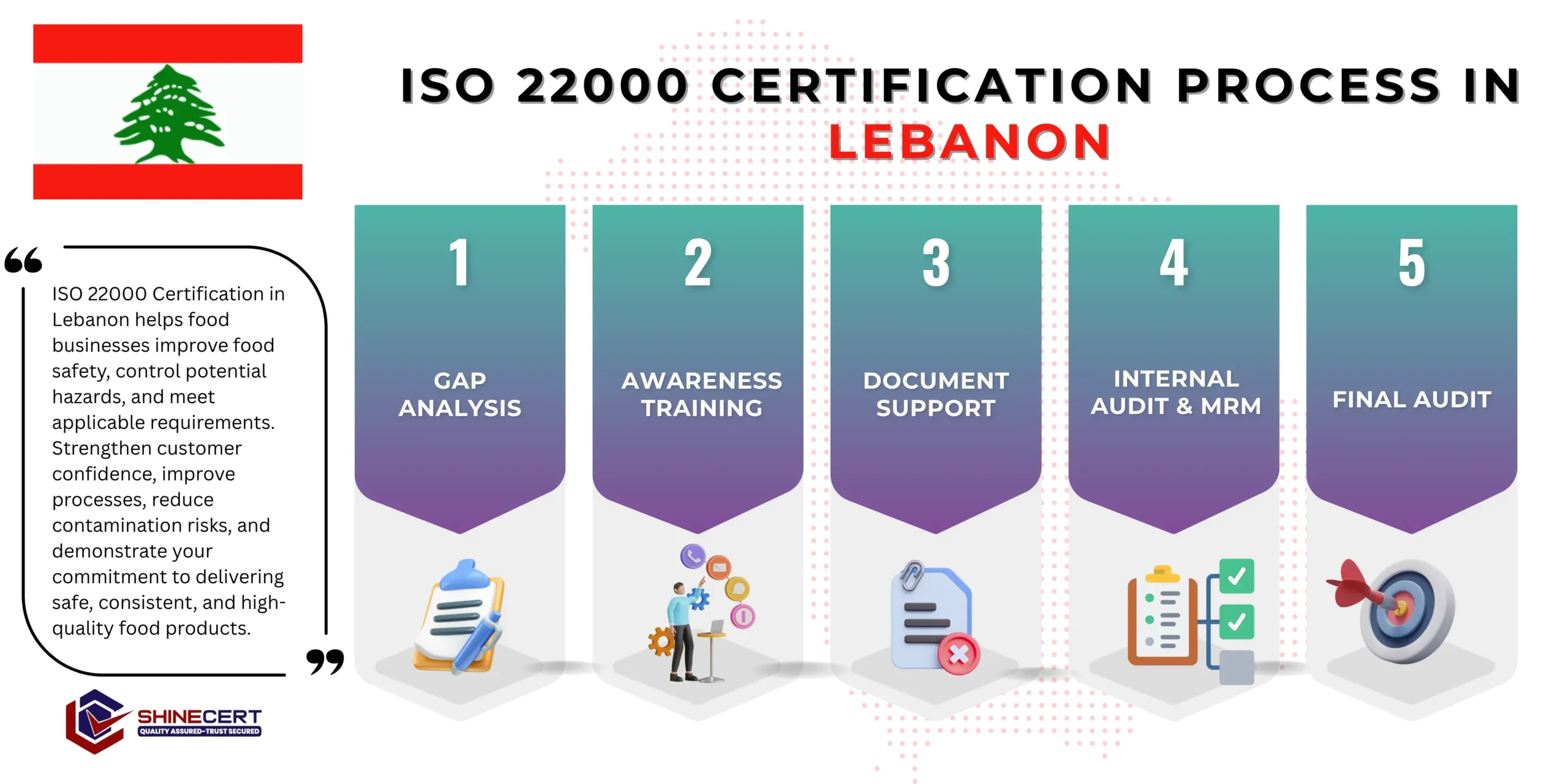
What are the steps to get ISO 22000 Certification in Lebanon?
our services
- ISO Certification Lebanon
- ISO 9001 Certification Lebanon
- ISO 14001 Certification Lebanon
- ISO 27001 Certification Lebanon
- ISO 22000 Certification Lebanon
- ISO 27701 Certification Lebanon
- ISO 45001 Certification Lebanon
- ISO 20000-1 Certification Lebanon
- ISO 13485 Certification Lebanon
- ISO 17025 Certification Lebanon
- ISO 31000 Certification Lebanon
- ISO 42001 Certification Lebanon
- ISO 37001 Certification Lebanon
- ISO 22301 Certification Lebanon
- ISO 50001 Certification Lebanon
- CE Mark Certification Lebanon
- GDPR Certification Lebanon
- GMP Certification Lebanon
- Halal Certification Lebanon
Our Five-Step Certification Process
Gap Assessment
We walk your production facility, review your existing hygiene and safety practices, and conduct structured interviews with production and quality staff to understand your actual process flow. We map every genuine hazard point against ISO 22000’s requirements, not a generic industry checklist.
A clause-by-clause gap assessment identifying your real hazard profile and where current practices fall short.
Documentation
We build your food safety policy and full HACCP-based hazard analysis around your actual product and process, working directly with your production team so critical control points reflect real operations. Prerequisite programs, cleaning, pest control, supplier vetting, get documented around what you genuinely do.
A complete, version-controlled food safety documentation set including your HACCP plan and prerequisite programs.
Implementation
Controls roll out at each identified critical control point, with role-specific training since a production line worker and a receiving-dock staff member face genuinely different food safety responsibilities. Traceability systems get tested with real product batches, not just documented on paper.
A functioning food safety system with real monitoring and verification records being generated at every critical control point.
Internal Audit and Management Review
We run a full internal audit against every clause and every critical control point, the way a certification auditor would, surfacing weaknesses while stakes are low. Findings go to formal management review where leadership makes documented decisions.
An internal audit report, management review minutes with concrete decisions, and closed-out corrective actions.
Certification Audit
Stage 1 confirms your documentation and HACCP plan are audit-ready; Stage 2 has the auditor observe actual production operations, verify monitoring records, and interview staff. We stay involved through both stages.
Your ISO 22000 certificate, valid for three years, plus a surveillance audit schedule.
Gap Assessment
We walk your production facility, review your existing hygiene and safety practices, and conduct structured interviews with production and quality staff to understand your actual process flow. We map every genuine hazard point against ISO 22000’s requirements, not a generic industry checklist.
A clause-by-clause gap assessment identifying your real hazard profile and where current practices fall short.
Documentation
We build your food safety policy and full HACCP-based hazard analysis around your actual product and process, working directly with your production team so critical control points reflect real operations. Prerequisite programs, cleaning, pest control, supplier vetting, get documented around what you genuinely do.
A complete, version-controlled food safety documentation set including your HACCP plan and prerequisite programs.
Implementation
Controls roll out at each identified critical control point, with role-specific training since a production line worker and a receiving-dock staff member face genuinely different food safety responsibilities. Traceability systems get tested with real product batches, not just documented on paper.
A functioning food safety system with real monitoring and verification records being generated at every critical control point.
Internal Audit and Management Review
We run a full internal audit against every clause and every critical control point, the way a certification auditor would, surfacing weaknesses while stakes are low. Findings go to formal management review where leadership makes documented decisions.
An internal audit report, management review minutes with concrete decisions, and closed-out corrective actions.
Certification Audit
Stage 1 confirms your documentation and HACCP plan are audit-ready; Stage 2 has the auditor observe actual production operations, verify monitoring records, and interview staff. We stay involved through both stages.
Your ISO 22000 certificate, valid for three years, plus a surveillance audit schedule.
What Is ISO 22000, and How Does It Actually Help Your Organization?
- The core gap ISO 22000 closes isn’t “we don’t care about food safety”, most food businesses genuinely do. It’s “we don’t have a systematic way of proving where our real risks are and that we’re controlling them consistently.” Without a structured hazard analysis, food safety measures tend to be applied uniformly regardless of where the actual risk sits in your process, meaning you might be over-controlling a low-risk step while under-controlling a genuinely dangerous one. ISO 22000 requires you to identify your actual critical control points first, then build monitoring and verification specifically around them.
- This helps concretely: it gives you a defensible, documented answer if a food safety inspection or a customer complaint raises a question about your process. It creates genuine traceability, so if a contamination issue is ever identified, you can trace it back through your supply chain and forward through distribution quickly, limiting both harm and liability. It gives export-focused producers a credential that Gulf and international buyers recognize immediately, cutting through lengthy bespoke supplier qualification processes. And it gives leadership real data, nonconformity trends, verification results, to make informed decisions about where to invest in process improvement.
- The standard incorporates the same Harmonized Structure as ISO 9001, so food businesses that already hold quality certification have real infrastructure, management review, internal audit, document control, to build the food safety system on top of, rather than starting fresh.
Why This Matters So Much in Lebanon Specifically?
- Lebanon’s food and beverage exports, wine, olive oil, processed and packaged foods, represent one of the country’s more resilient economic sectors even through recent instability, and destination markets are not forgiving on food safety documentation. A shipment held at a Gulf port over inadequate safety documentation is a real, costly, and entirely avoidable problem that ISO 22000 certification substantially reduces the risk of.
- Domestically, Food Safety Law 35/2016 gives the Food Safety Directorate real coordinating authority, but enforcement capacity across a fragmented sector with many small producers means legal compliance alone doesn’t always translate into consistent food safety practice. We’ve seen Lebanese food businesses that are nominally compliant with the law but have no systematic hazard analysis behind their daily operations, ISO 22000 gives that compliance a genuine operational backbone, not just a certificate that predates actual practice.
What Actually Drives Your Cost?
We don’t quote a flat number, because two Lebanese food businesses’ actual product complexity and facility size can look completely different. Here’s what genuinely drives cost.
A multi-ingredient processed food with several production stages needs meaningfully deeper hazard analysis than a single-ingredient product like bottled water or raw agricultural produce.
Each additional production line generally needs its own hazard analysis and critical control point mapping.
Businesses with existing HACCP or hygiene programs aren’t starting from zero, those with minimal formal documentation face more foundational work.
Pursuing ISO 9001 alongside ISO 22000 shares meaningful implementation and audit infrastructure.
A quality assurance or food safety team member who can own documentation and coordination reduces consultant hours needed.
Certification aimed at specific Gulf market entry sometimes needs additional documentation alignment with GSO requirements.
A compressed timeline tied to a specific export contract deadline sometimes needs more concentrated hours in a shorter window.
ISO 22000 Benefits Businesses Don't Expect
Certification substantially eases documentation requirements for GSO-regulated markets and international buyers who recognize ISO 22000 immediately.
Systematic traceability and hazard control reduce the real financial risk of a shipment being held or refused over inadequate documentation.
Structured supply chain and process documentation lets you trace and contain a problem quickly, limiting both consumer harm and business liability.
Larger domestic retailers and hospitality buyers increasingly favor certified suppliers as their own quality assurance simplifies.
Systematic process control catches quality and safety issues earlier, before they result in discarded product or costly recalls.
The shared structure with ISO 9001 makes pursuing quality management certification alongside food safety meaningfully faster.
The standard’s prerequisite programs formalize supplier vetting, reducing risk introduced further up your supply chain.
Verification data and audit findings give management real visibility into where food safety risk actually sits, rather than relying on assumption.
Applicable Standards by Industry
Food and beverage manufacturing
Processors of packaged foods, beverages, and confectionery use ISO 22000 to formalize hazard control across increasingly complex product lines.
Read moreWine and spirits production
Lebanon’s wine industry, a genuine export strength, uses certification to meet international buyer and import documentation requirements.
Read moreOlive oil and agricultural processing
Producers targeting export markets use certification to differentiate premium products and simplify buyer qualification.
Read moreFood service and catering
Larger catering operations and food service providers use ISO 22000 to formalize hygiene and hazard control across high-volume operations.
Read moreCold chain and food logistics
Companies managing food storage and distribution use certification to formalize temperature control and traceability across the supply chain.
Read moreFood Safety Management Requirements, Clause by Clause, With the Documents Each One Actually Needs
- Context of the Organization (Clause 4) : Understanding your specific food safety context, your products, processes, supply chain, and the interested parties (regulators, buyers, consumers) whose food safety expectations matter. Document this clause requires: a documented food safety management system scope statement covering which products, processes, and facilities are included.
- Leadership (Clause 5) : Top management commitment to food safety, with a documented food safety policy and clearly assigned responsibilities across the organization. Document this clause requires: a food safety policy signed by top management, and a documented food safety team structure and responsibilities.
- Planning (Clause 6) : Risk-based planning addressing food safety hazards and legal compliance obligations under Law 35/2016, plus measurable food safety objectives. Document this clause requires: a food safety risk register and documented food safety objectives with targets.
- Support (Clause 7) : Resources, competence, and hygiene training ensuring staff genuinely understand food safety hazards specific to their role, plus infrastructure and work environment controls. Document this clause requires: food safety and hygiene training records, and infrastructure maintenance records.
- Operation (Clause 8) : The core of the standard, hazard analysis identifying your actual critical control points, prerequisite programs (cleaning, pest control, supplier control), and traceability and recall procedures. Documenting this clause requires: a full HACCP-based hazard analysis and critical control point plan, prerequisite program procedures, and a traceability and recall procedure.
- Performance Evaluation (Clause 9) : Monitoring, verification, and internal audit testing whether hazard controls are genuinely working, not just documented. Documenting this clause requires: verification and monitoring records for each critical control point, an internal audit program and results, and management review minutes.
- Improvement (Clause 10) : Structured investigation of nonconformities, corrective actions, and continual improvement of the food safety system. Document this clause requires: nonconformity and corrective action records showing root-cause analysis.
What Happens When a Lebanon Business Operates Without Certification?
- Food Safety Law 35/2016’s obligations remain in force regardless of certification, the legal floor doesn’t move. What’s missing without ISO 22000 is the systematic hazard analysis and traceability that turns legal compliance into consistently managed practice, and for export-focused producers, the internationally recognized credential that Gulf and other buyers increasingly expect as a baseline. Businesses relying on informal food safety practices tend to discover the gap either through a shipment rejection at a destination port, a domestic inspection finding, or losing a contract to a certified competitor.
- We generally recommend Lebanese food producers with any export ambition treat ISO 22000 as core market-access infrastructure rather than a discretionary certification, the cost of not having it tends to show up as a lost shipment or a lost contract, both of which are considerably more expensive than certification itself.
Common Pitfalls We See in Lebanon ISO 22000 Projects
- Treating HACCP as sufficient on its own : A hazard analysis without the full management system around it, leadership commitment, documented objectives, internal audit, doesn’t meet ISO 22000’s requirements.
- Underestimating supplier and ingredient traceability : Businesses often focus entirely on their own production while overlooking that a contamination issue can originate further up the supply chain.
- Generic hazard analysis not reflecting the actual process : A HACCP plan built from a template rather than genuine walkthroughs of your specific process tends to miss the critical control points that actually matter.
- No real testing of recall procedures : Having a documented recall procedure that’s never been tested with an actual product batch tends to fail when it matters most.
Why ShineCert?
ShineCert brings 10 years of ISO consulting and certification experience to Lebanon, backed by our own dedicated Lebanon office working alongside our Riyadh office. We deliver services remotely or on-site depending on what your project needs, hazard analysis and facility walkthroughs genuinely benefit from an in-person visit, while documentation work can often run effectively over remote sessions. We’ve guided more than 10,000 organizations through ISO certification globally, and we build every Lebanon food safety engagement around your actual products, processes, and export ambitions, with ShineCert as the best ISO 22000 consultant in Lebanon.
Choosing a Certification Body in Lebanon?
What to Check | Why It Matters |
Accreditation under the GAC framework | Confirms genuine, internationally recognized certification |
Experience with Lebanon’s Food Safety Law 35/2016 environment | Ensures the auditor understands how legal obligations connect to the management system |
Recognition in your target export markets | Gulf and international buyers vary in which certification bodies they recognize, confirm before committing |
Sector-specific audit experience | Wine, processed foods, and agricultural products involve genuinely different hazard profiles |
Ready to Get Started?
Whether you’re pursuing Gulf export access or formalizing domestic food safety practice, we’ll walk through your specific products and cost factors before proposing a fixed-scope plan, delivered remotely, on-site, or however genuinely fits your project. Book a free consultation or contact us directly to get started.
Frequently Asked Questions
No, the Ministry of Public Health’s Food Safety Directorate coordinates legal food safety oversight under Law 35/2016, but ISO 22000 certification comes from independent, accredited certification bodies.
You’re legally compliant, but that’s a floor, not the same as having the systematic hazard analysis and traceability ISO 22000 requires.
It genuinely depends on product complexity, facility size, and number of production lines, we scope every project individually.
Typically three to five months for a first-time certification.
It increasingly functions as a hard requirement for entry into GSO-regulated markets, though specific requirements vary by country and buyer, worth confirming with your specific destination market.
No, ISO 22000 incorporates HACCP principles but wraps them in a full management system with leadership accountability, documented objectives, and internal audit that HACCP alone doesn’t require.
Hazard analysis and facility walkthroughs genuinely benefit from an in-person visit, but documentation work can often run remotely, we scope this per project.
Export market requirements don’t scale with company size, even small producers pursuing Gulf export often need certification to qualify.
Yes, each production line generally needs its own hazard analysis and critical control point mapping.
Yes, ShineCert maintains its own dedicated Lebanon office, with services delivered remotely or on-site depending on your project.