
CE Mark Certification in Angola
Quick Answer
CE Marking is a European Union conformity mark, not an Angolan certification, confirming a product meets EU health, safety, and environmental requirements. ShineCert provides advisory support helping Angolan manufacturers and exporters navigate the CE Marking process for products entering the EU market. This matters more in Angola right now than it might elsewhere: Angola is set to lose its Least Developed Country trade status in 2027, after which its current duty-free EU market access under Everything But Arms will no longer apply automatically, making export compliance readiness a genuinely time-sensitive issue.
About CE Marking
CE Marking is the European Union’s conformity marking indicating a product meets applicable EU health, safety, and environmental protection standards. It applies to a wide range of product categories, including machinery, electronics, construction products, and certain consumer goods, and is a legal requirement for placing covered products on the EU market, not merely a quality signal.
CE Marking itself isn’t issued by ShineCert or any single certification body; for many product categories, manufacturers can self-declare conformity after testing, while higher-risk categories require assessment by an EU-recognized Notified Body. What ShineCert provides is advisory support: helping you understand which requirements apply to your specific product, preparing technical documentation, and connecting you with the right testing or Notified Body pathway.
Why It Matters in Angola?
The EU is a major and growing trading partner for Angola, and the trade relationship is entering a genuinely different phase : EU exports to Angola reached roughly $3.46 billion in 2025, while EU imports from Angola reached about $6.57 billion in 2024, and the Sustainable Investment Facilitation Agreement, in force since September 2024, is deepening this relationship further. Angola currently benefits from duty-free, quota-free access to the EU market under the Everything But Arms scheme, available to Least Developed Countries.
What changes, and why it matters for exporters specifically : Angola is set to graduate from Least Developed Country status in 2027, after which its automatic duty-free access under Everything But Arms will no longer apply. A new trade framework, likely structured around an Economic Partnership Agreement, is still under negotiation, meaning there’s genuine uncertainty about what tariff and compliance conditions will apply to Angolan exports to the EU after graduation. Products that already meet CE Marking requirements will be far better positioned to adapt smoothly to whatever framework emerges, rather than scrambling once new terms take effect.
Why this is urgent in Angola right now, not just eventually : With 2027 graduation approaching and EPA-framework negotiations still ongoing, Angolan manufacturers exporting or considering exporting to the EU have a limited window to build compliance readiness before the current favorable access terms change, not after.
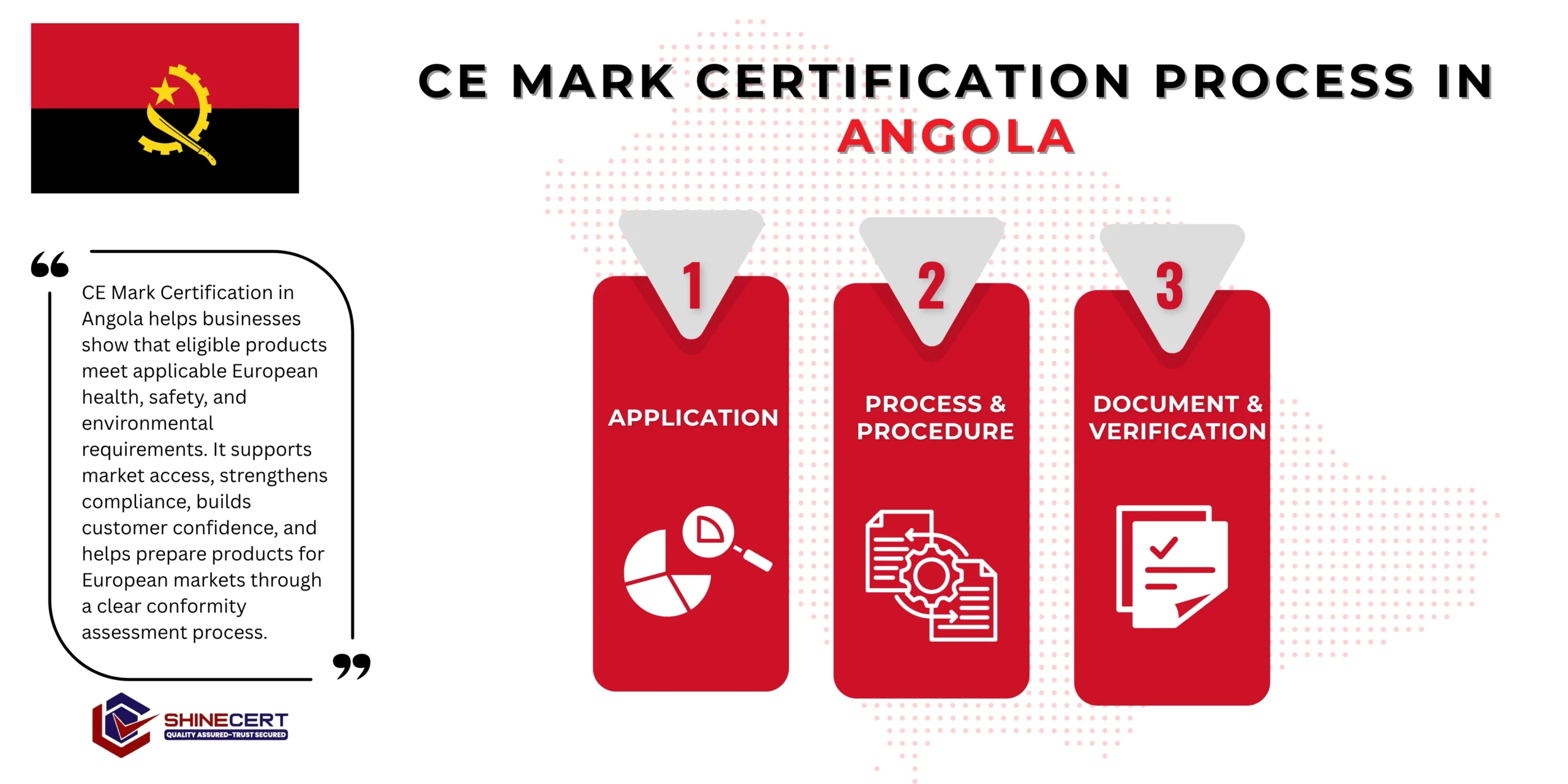
What are the steps to get CE Mark Certification in Angola?
our services
- ISO Certification Angola
- ISO 9001 Certification Angola
- ISO 14001 Certification Angola
- ISO 27001 Certification Angola
- ISO 22000 Certification Angola
- ISO 20000-1 Certification Angola
- ISO 45001 Certification Angola
- ISO 42001 Certification Angola
- ISO 13485 Certification Angola
- ISO 17025 Certification Angola
- ISO 31000 Certification Angola
- ISO 22301 Certification Angola
- ISO 27701 Certification Angola
- ISO 37001 Certification Angola
- ISO 50001 Certification Angola
- CE Mark Certification Angola
- GMP Certification Angola
- GDPR Certification Angola
- Halal Certification Angola
The Advisory Process
Product Classification
Over one to two weeks, we determine exactly which EU directives apply to your specific product, since CE Marking requirements vary significantly by product category, and misclassification is one of the most common early mistakes exporters make.
Gap Assessment
Over one to two weeks, we compare your product's current design, materials, and documentation against the applicable requirements, identifying specifically where testing or design changes might be needed.
Technical Documentation Development
Over three to six weeks, we help build the technical file EU authorities expect, covering design specifications, risk assessments, and test plans specific to your product category.
Testing and Assessment Coordination
Over three to six weeks, we connect you with appropriate testing laboratories or, for higher-risk product categories, an EU-recognized Notified Body, and coordinate the assessment process on your behalf.
Declaration of Conformity
Over one to two weeks, we support you through preparing the formal Declaration of Conformity and applying the CE mark correctly to your product and documentation.
How Long Does Certification Take?
| Product Category | Typical Timeline | Why |
|---|---|---|
| Self-declaration categories, lower risk | 2 months | No Notified Body assessment required |
| Categories requiring testing but not full assessment | 3 months | Testing coordination adds time |
| Higher-risk categories requiring Notified Body assessment | 4 months | Formal third-party assessment process |
- Products in self-declaration categories (around 2 months) : Lower-risk product categories allow manufacturers to self-declare conformity after appropriate testing, without requiring third-party assessment, which moves considerably faster.
- Products requiring testing but not full third-party assessment (around 3 months) : These categories require formal testing evidence but not a full Notified Body review, adding some time for laboratory coordination without the full assessment timeline.
- Higher-risk categories requiring Notified Body assessment (around 4 months) : These products require a formal third-party conformity assessment, which takes meaningfully longer given the Notified Body’s own review and scheduling processes.
- The variable that matters most: how well your product design already anticipates EU safety requirements : A product designed with EU requirements in mind from the outset moves through advisory support considerably faster than one requiring design changes to meet requirements identified late in the process.
- A real example : A machinery manufacturer we advised had a well-built product but had never considered EU electromagnetic compatibility requirements during design; identifying and testing for this added roughly five weeks to the original estimate, a genuinely avoidable delay if EU requirements had been considered earlier in the product development process.
What Affects the Cost?
- Product category and risk classification : Higher-risk categories requiring Notified Body assessment cost meaningfully more than self-declaration categories.
- Current product design compliance : A product already designed with EU requirements in mind needs less remediation than one requiring redesign.
- Testing and Notified Body fees : These are separate from advisory consulting costs and vary by product category and chosen laboratory or Notified Body.
- Number of product variants : Each distinct product variant may require its own technical documentation and testing.
Answering the Objections Every Owner Has
- We’re not exporting to the EU yet, why worry about this now? With LDC graduation approaching in 2027 and trade terms genuinely uncertain afterward, building compliance readiness now, while terms are still favorable, is considerably easier than doing it under time pressure later.
- Isn’t CE Marking just for European manufacturers? No, any manufacturer anywhere placing covered products on the EU market needs CE Marking; it applies to the product’s destination market, not the manufacturer’s location.
- We’re too small an exporter for this to matter : Compliance requirements apply based on product category, not company size; a smaller exporter faces the same legal requirements as a larger one for the same product type.
- Can’t we just handle this ourselves when we actually need it? You can, but CE Marking technical documentation and, for some categories, Notified Body assessment take real time to prepare properly, and starting after an EU buyer requests it puts you in a reactive, weaker negotiating position.
Benefits of CE Marking Advisory Support
- Preparedness for Angola’s 2027 LDC graduation : Products already CE-compliant face less disruption when current duty-free terms change.
- Legal market access to the EU for covered product categories : CE Marking is a legal requirement, not optional, for many products entering the EU market.
- Reduced risk of costly non-compliance discoveries : Identifying gaps now, while trade terms are still favorable, is considerably cheaper than discovering them after a shipment is rejected at an EU port.
- Stronger positioning with EU buyers and distributors : Buyers increasingly expect compliance readiness from exporters, regardless of current tariff status.
- Clearer understanding of which EU requirements actually apply to your specific products : Many exporters overestimate or underestimate their compliance obligations without expert guidance.
- A foundation for pursuing other export-market compliance needs : The documentation discipline built for CE Marking readiness transfers well to other international market requirements.
Required Documentation
The product classification analysis identifies exactly which EU directives and essential requirements apply to your specific product. The technical file documents your product’s design, materials, and safety features in the format EU authorities expect.
Test reports from appropriate laboratories demonstrate your product meets applicable safety and performance requirements. Risk assessment documentation identifies potential hazards and how your product design addresses them.
The Declaration of Conformity is the formal document stating your product meets all applicable requirements, signed by an authorized representative of your company.
User instructions and labeling, often required in specific EU languages depending on target markets, must meet CE Marking format requirements. Quality management documentation, particularly relevant if you’re already ISO 9001 certified, supports demonstrating ongoing conformity for products under self-declaration.
Post-market surveillance records, similar in spirit to those required for medical devices, demonstrate ongoing monitoring for product safety issues after market entry.
Requirements Explained: What CE Marking Actually Covers
- Essential Health and Safety Requirements are the core EU requirements your product must meet, varying by product category but generally covering safety, electromagnetic compatibility, and environmental impact.
- Conformity Assessment Procedure determines whether you can self-declare conformity or require third-party Notified Body assessment, based on your product’s risk classification.
- Technical Documentation must be maintained and available to EU authorities on request, demonstrating your product genuinely meets applicable requirements, not just a general assurance.
- Declaration of Conformity is the formal legal document accompanying your product, stating it meets all applicable EU requirements.
- CE Mark Application must follow specific format and placement requirements on the product itself and its documentation.
- Post-Market Obligations require ongoing monitoring and, if issues arise, corrective action and potentially market withdrawal, treated as an ongoing responsibility, not a one-time achievement.
Case Study: A Machinery Manufacturer Preparing for EU Market Entry
- A machinery manufacturer in Angola wanted to begin exporting to the EU, partly to diversify beyond regional markets and partly in anticipation of changing trade terms after 2027.
- Our product classification review found the manufacturer’s equipment fell into a category requiring Notified Body assessment, and identified an electromagnetic compatibility gap the original design hadn’t addressed.
- Over four months, we helped the manufacturer redesign the affected component, coordinated testing with an appropriate laboratory, and supported the Notified Body assessment process through to a successful Declaration of Conformity.
- The manufacturer secured CE Marking ahead of its first EU shipment and is positioned well ahead of Angola’s 2027 trade status transition.
Common Mistakes We See
- Choosing a certifier without confirming acceptance in your actual target market : Not every halal certificate is recognized in every Muslim-majority market; this is the single most consequential decision in the entire process.
- Weak ingredient traceability, particularly for additives and processing aids : These are exactly what auditors scrutinize most closely, not just the primary ingredients.
- Underestimating cross-contamination risk in shared facilities : Facilities producing both halal and non-halal products need genuinely rigorous segregation procedures, not just good intentions.
- Assuming certification is a one-time task : Ongoing surveillance and periodic renewal are standard requirements across virtually all recognized halal certifiers.
Who Actually Needs This?
Manufacturers exporting or planning to export machinery, electronics, or industrial equipment to the EU.
Manufacturers exporting or planning to export machinery, electronics, or industrial equipment to the EU.
Read moreConstruction product manufacturers
Construction product manufacturers targeting EU markets where CE Marking is a standard legal requirement.
Read moreAny Angolan exporter currently benefiting from Everything But Arms access
Any Angolan exporter currently benefiting from Everything But Arms access who wants to prepare for the 2027 LDC graduation transition proactively.
Read moreBusinesses negotiating new EU distribution or partnership agreements
Businesses negotiating new EU distribution or partnership agreements where compliance readiness is increasingly a discussion point.
Read moreWhich Certification Body Should You Choose?
Confirm the advisor genuinely understands your specific product category’s EU requirements, not generic compliance language. Ask about their experience coordinating with EU-recognized testing labs and Notified Bodies specifically. Be cautious of anyone claiming to “certify” CE Marking themselves, since the mark itself is a manufacturer’s declaration, sometimes backed by third-party assessment, not a certificate issued by a consultancy.
Choosing the Right Partner?
| DIY | Generic Consultant | ShineCert | |
|---|---|---|---|
| Product classification accuracy | Often incomplete | Templated, generic | Specific to your actual product and target EU market |
| Timeline realism | Often underestimated | Sometimes overpromised | Set to your real starting point |
| Angola trade context awareness | Not considered | Rarely integrated | Built with 2027 LDC graduation timeline in mind |
| Testing and Notified Body coordination | Self-managed | Sometimes outsourced entirely | Actively coordinated on your behalf |
Why Businesses Choose ShineCert in Angola?
Across 10 years of ISO and export compliance consulting worldwide, coordinated through our Riyadh and India offices, we help Angolan exporters, with ShineCert as the best CE Mark consultant in Angola, build genuine EU market readiness ahead of the country’s 2027 LDC graduation, not a generic compliance checklist disconnected from Angola’s actual trade timeline.
Ready to Get Started?
Whether you’re already exporting to the EU or preparing for Angola’s changing trade status after 2027, we’ll assess your real situation and give you a clear, honest quote. Book a free consultation or contact us to get started.
Frequently Asked Questions
No, it’s an EU market entry requirement, not an Angolan one, but it’s required for Angolan products entering the EU market in covered categories.
Angola’s current duty-free EU access under Everything But Arms depends on its Least Developed Country status, which ends in 2027; compliance readiness now helps exporters adapt smoothly to whatever trade framework follows.
It depends on product category, risk classification, and current design compliance. We quote individually.
Usually two to four months, depending on whether your product requires Notified Body assessment.
No, ShineCert provides advisory support; the mark itself is a manufacturer’s declaration, sometimes backed by an EU-recognized Notified Body’s assessment.
Machinery, electronics, and construction product manufacturers exporting or planning to export to the EU.