
ISO 9001 Certification in Angola
Quick Answer
ISO 9001 certification is an internationally recognized Quality Management System credential confirming an organization consistently meets customer and regulatory requirements while continually improving its processes. In Angola it’s voluntary, cost varies by business size and complexity, it takes three to six months, and it’s verified through an independent accredited audit, not self-declared.
About ISO 9001
ISO 9001 is the world’s most widely used quality management standard, published by the International Organization for Standardization. It doesn’t specify what your product or service should be; it specifies how consistently and reliably you deliver it, through documented processes, defined responsibilities, risk-based thinking, and a cycle of continual improvement.
Certification means an independent, accredited certification body has audited your actual operations, not just reviewed a policy document, and confirmed they genuinely meet the standard’s requirements. It’s reissued on a three-year cycle with annual surveillance audits in between, so it reflects an ongoing system rather than a one-time achievement.
A brief history of the standard : ISO 9001 was first published in 1987, drawing heavily on BS 5750, a British defense and manufacturing quality standard from the late 1970s that ISO adapted into an international framework. The 1994 revision added more emphasis on preventive action. The 2000 revision was the most significant early rewrite, replacing a rigid, procedure-heavy structure with the process approach still at the standard’s core today, thinking of quality as a connected system of processes rather than a checklist of isolated procedures. The 2008 revision mostly clarified existing requirements. The 2015 revision, the current edition still in use, introduced risk-based thinking as an explicit requirement and adopted the High-Level Structure shared across other ISO management-system standards like ISO 14001 and ISO 27001, making it easier for organizations to run multiple certifications as one integrated system. Nearly four decades after its first publication, the standard is now approaching its next revision, ISO 9001:2026, detailed further down this page.
Why It Matters in Angola?
If you’re weighing whether this is worth your time, here’s the honest framing: it’s not a legal requirement in Angola, but it’s increasingly the deciding factor between winning and losing business you’d otherwise qualify for. Angola’s non-oil economy now accounts for roughly 80% of GDP, and the 2026 budget projects non-oil revenue exceeding oil revenue for the first time in the country’s history. That shift means more Angolan businesses, in agriculture, manufacturing, logistics, are now competing for government tenders and regional SADC contracts where quality credentials are part of how buyers filter candidates before they ever see your price.
- What not being certified actually costs you? You get filtered out before the conversation starts: Angola’s public procurement system now runs through an electronic tendering platform designed to be more transparent and investment-friendly, and buyers using it increasingly screen for quality credentials before evaluating price or capability at all. You’re also the harder “yes” for regional and international buyers, since agriculture’s share of Angola’s GDP has surpassed oil and cold chain investment tied to the Lobito Corridor opens genuine SADC export routes where buyers compare you against certified competitors as a matter of course. And you inherit risk you can’t see: without the standard’s operational controls and internal monitoring, quality problems tend to surface as customer complaints or failed shipments rather than being caught internally.
- Why is this happening in Angola right now? Angola is a corresponding ISO member, not a full one, which means international certification carries real extra weight here specifically: it’s an external, independently verified credibility signal in a market where the domestic system alone doesn’t produce one. IANORQ, Angola’s national standards body, coordinates quality infrastructure aligned with international frameworks, and businesses holding ISO certification get more credibility with IANORQ itself, government procurement, international investors, and SADC partners, not less.
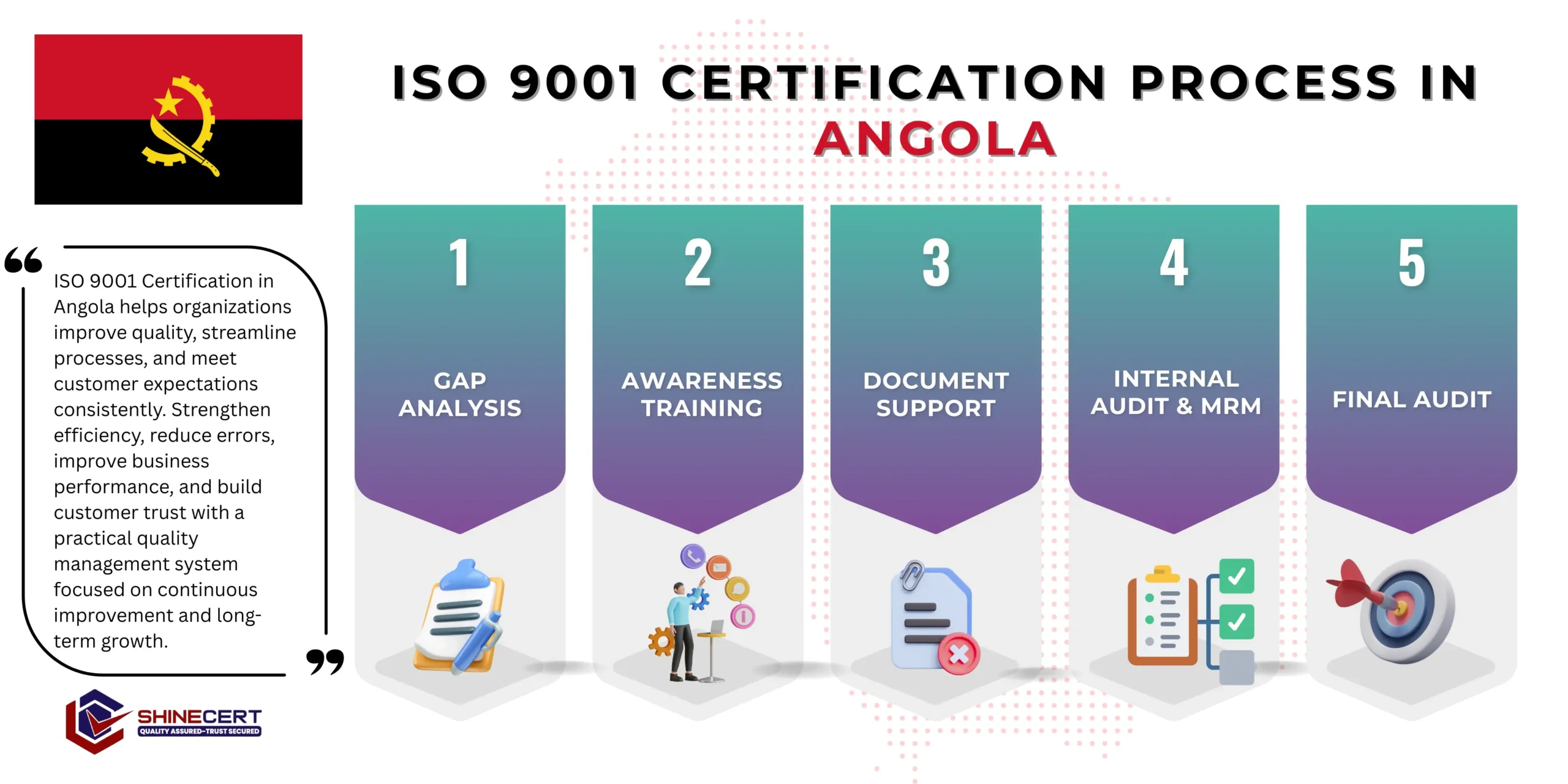
What are the steps to get ISO 9001 Certification in Angola ?
our services
- ISO Certification Angola
- ISO 9001 Certification Angola
- ISO 14001 Certification Angola
- ISO 27001 Certification Angola
- ISO 22000 Certification Angola
- ISO 20000-1 Certification Angola
- ISO 45001 Certification Angola
- ISO 13485 Certification Angola
- ISO 17025 Certification Angola
- ISO 31000 Certification Angola
- ISO 22301 Certification Angola
- ISO 27701 Certification Angola
- ISO 37001 Certification Angola
- ISO 50001 Certification Angola
- CE Mark Certification Angola
- GMP Certification Angola
- GDPR Certification Angola
- Halal Certification Angola
- SOC Certification Angola
The Certification Process
Gap Assessment
We spend one to two weeks walking through your actual operations, floor, office, warehouse, wherever the work happens, and compare what we find against the standard's requirements clause by clause. This isn't a generic checklist exercise; we're looking at your specific processes, your existing informal controls, and where the real gaps are, so the plan that follows is built around your business rather than a template. You get a clear, honest picture of exactly what's missing before any documentation work starts.
Documentation Development
Over three to six weeks, we build the quality manual, procedures, and records the standard requires, but written to reflect how your business actually operates, not aspirational language nobody will follow. This is the stage where the risk and opportunity register, quality objectives, and operational procedures take shape. We write documentation your team will genuinely use day to day, because documentation nobody follows is the single most common reason certification audits find problems later.
Implementation and Training
Over four to eight weeks, the system goes live. Staff are trained not just on what the procedures say, but on why they matter and how they connect to the work they already do. This is usually the longest phase because it involves genuine behavior change, not just paperwork, and rushing it is where most DIY attempts fall short.
Internal Audit and Management Review
Over two to three weeks, we run a structured internal audit against the same criteria the real certification auditor will use, and complete a formal management review with your leadership team. This step exists to catch problems while they're still cheap to fix, before an external auditor finds them and delays your certificate.
Certification Audit
Over two to four weeks, an accredited, independent certification body audits your actual operations, not just your documentation, and issues the certificate once satisfied you meet the standard's requirements. This typically happens in two stages: a documentation review, followed by an on-site audit of how the system actually runs.
Gap Assessment
We spend one to two weeks walking through your actual operations, floor, office, warehouse, wherever the work happens, and compare what we find against the standard's requirements clause by clause. This isn't a generic checklist exercise; we're looking at your specific processes, your existing informal controls, and where the real gaps are, so the plan that follows is built around your business rather than a template. You get a clear, honest picture of exactly what's missing before any documentation work starts.
Documentation Development
Over three to six weeks, we build the quality manual, procedures, and records the standard requires, but written to reflect how your business actually operates, not aspirational language nobody will follow. This is the stage where the risk and opportunity register, quality objectives, and operational procedures take shape. We write documentation your team will genuinely use day to day, because documentation nobody follows is the single most common reason certification audits find problems later.
Implementation and Training
Over four to eight weeks, the system goes live. Staff are trained not just on what the procedures say, but on why they matter and how they connect to the work they already do. This is usually the longest phase because it involves genuine behavior change, not just paperwork, and rushing it is where most DIY attempts fall short.
Internal Audit and Management Review
Over two to three weeks, we run a structured internal audit against the same criteria the real certification auditor will use, and complete a formal management review with your leadership team. This step exists to catch problems while they're still cheap to fix, before an external auditor finds them and delays your certificate.
Certification Audit
Over two to four weeks, an accredited, independent certification body audits your actual operations, not just your documentation, and issues the certificate once satisfied you meet the standard's requirements. This typically happens in two stages: a documentation review, followed by an on-site audit of how the system actually runs.
What Affects the Cost?
- Business size and structure : More employees, departments, and locations mean more processes to document and more staff to train.
- Current documentation maturity : A business with organized informal processes starts from a stronger position than one with none.
- Industry complexity : Agriculture and manufacturing typically involve more operational controls than a straightforward service business.
- Certification body fees : Separate from consulting fees and worth comparing across providers rather than accepting the first quote.
Answering the Objections Every Owner Has
- “Isn’t this just paperwork?” Only if implemented badly Done properly, the documentation reflects decisions you’re already making, just written down consistently enough that someone new can follow them and an auditor can verify them. This is the process approach the standard is built around, not bureaucracy for its own sake.
- “We’re too small for this.” Size affects how long certification takes, not whether it’s worth pursuing.
- “Won’t this slow us down?” Implementation takes a few months, but a working quality system usually reduces time spent firefighting quality problems afterward.
- “Can’t we just do this ourselves?” You can attempt it, but most first-time businesses underestimate how much of the standard’s risk-based thinking and internal audit requirements need genuine, working documentation rather than a downloaded template.
Benefits of ISO 9001 Certification
- Direct eligibility for government tenders that filter for it : Certification removes the barrier that excludes uncertified bidders before price is even considered.
- Faster trust-building with SADC and international buyers : Certification acts as a pre-qualification shortcut buyers increasingly expect by default.
- Fewer quality failures reaching customers : Internal monitoring and audit requirements catch problems before they become complaints or failed shipments.
- A genuine management tool, not just a certificate : Businesses that take the risk-planning and improvement requirements seriously get a system that actually helps them run better.
- A structured way to onboard new staff : Documented processes mean new hires learn a known standard rather than relying on informal knowledge transfer.
- Reduced long-term firefighting costs : Catching problems internally is consistently cheaper than managing them after a customer or buyer finds them first.
- A foundation for pursuing other standards later : ISO 14001, ISO 45001, and industry-specific standards build on the same underlying management-system structure.
Migrating from ISO 9001:2015 to ISO 9001:2026
In 2024, ISO formally amended ISO 9001:2015’s Clause 4.1 and 4.2 to require organizations to consider climate change as a relevant factor in their organizational context and to determine whether climate change is a relevant issue for interested parties. This amendment applies immediately to every currently certified organization; there is no separate transition period and no new audit cycle required specifically for it. In practice, this means your next scheduled surveillance or recertification audit will expect to see climate change genuinely considered in your context analysis and interested parties documentation, even though your certificate still says “ISO 9001:2015.”
As of July 2026, ISO 9001:2026 has passed its Final Draft International Standard ballot, with final approval received in mid-July 2026, and publication is firmly expected around September 2026. Once published, certified organizations will have an approximately three-year transition period, to roughly September 2029, to move from the 2015 edition to the 2026 edition. Unlike the climate amendment, this is a genuine new edition of the standard with its own transition audit requirements.
Based on the finalized draft, the changes are moderate rather than a full overhaul, more editorial clarification than a structural rewrite, but there are specific, real updates to plan around. Clause 4 formally folds the 2024 climate amendment language into the core standard text, so what’s currently a bolt-on amendment becomes a native part of Clause 4.1 and 4.2. Clause 5.1.1 adds an explicit requirement for top management to promote and demonstrate a genuine quality culture and ethical behavior, going beyond the 2015 edition’s more procedural leadership language. Clause 3’s terminology becomes more self-contained, reducing how often you need to cross-reference external ISO vocabulary documents. Clauses 6 through 10 receive amended notes and clarifying language rather than substantially new requirements. The most structurally significant addition is a new Annex A, roughly 15 pages of supplementary guidance, the first time ISO 9001 has included an annex, intended to help organizations interpret and apply the standard’s clauses more consistently.
If you’re newly pursuing certification now, in mid-to-late 2026, you have a genuine choice: certify against the 2015 edition today and transition later within the three-year window, or wait a few months and certify directly against the 2026 edition once your chosen certification body has updated its audit criteria. For organizations already certified, expect three practical documentation updates once the transition period opens: updating your context analysis (Clause 4.1/4.2) to explicitly and formally address climate change if your current documentation only references the amendment loosely; adding or strengthening documented evidence of leadership’s quality culture and ethical behavior commitment under Clause 5.1.1, which may mean new management review agenda items or policy language, not necessarily entirely new documents; and reviewing your procedures against the new Annex A guidance to identify where your existing interpretation of a clause differs from ISO’s clarified intent, correcting drift before your transition audit rather than during it. None of this requires rebuilding your quality management system from scratch; it requires a focused review and update of existing documents against the finalized 2026 text once it publishes.
If you’re not yet certified, don’t wait for the 2026 edition to start; begin now against the 2015 edition (already incorporating the 2024 climate amendment, which auditors are already checking for) and plan your transition audit within the three-year window once ISO 9001:2026 is published. If you’re already certified, use your next scheduled surveillance audit as the natural checkpoint to start reviewing your documentation against the finalized 2026 changes, rather than waiting until the transition deadline is close.
Common Mistakes We See
- Treating certification as a one-time project instead of an ongoing system : The certificate requires surveillance audits over a three-year cycle; businesses that stop maintaining the system after the initial audit often struggle at renewal.
- Documenting an idealized process instead of the real one : Auditors interview staff directly, and a quality manual describing a process nobody actually follows is one of the most common findings that delays certification.
- Skipping the internal audit step to save time : This is consistently where undiscovered gaps surface; skipping it just moves that discovery to the real audit, where it costs more.
- Choosing a certification body based on speed or price alone : An unusually fast or cheap offer is often a sign of a shortcut on accreditation or audit rigor, not genuine efficiency.
Standards and Clauses: What ISO 9001 Actually Requires
- Context of the Organization (Clause 4) : requires identifying internal and external issues affecting quality, understanding what customers and regulators expect, and defining the scope of your quality management system clearly enough that everyone, staff and auditors alike, knows exactly what’s covered and what isn’t. This clause is where you document who your interested parties are and what they actually need from you, which shapes every other requirement that follows.
- Leadership (Clause 5) : requires top management to set a quality policy and take visible, genuine ownership, not delegate it entirely to a compliance officer and step away. Auditors specifically look for evidence that leadership is actively involved: attending management reviews, communicating the quality policy, and allocating real resources to the system, not just signing off on a document once a year.
- Planning (Clause 6) : requires identifying risks and opportunities relevant to your operations and setting measurable objectives to address them. This is the clause that operationalizes risk-based thinking: instead of reacting to problems after they occur, you’re expected to have thought through what could go wrong and planned for it in advance.
- Support (Clause 7) : covers the resources, competence, awareness, communication, and documented information needed to actually run the system: making sure the right people have the right training, the right documents are controlled and current, and staff understand how their work connects to quality objectives.
- Operation (Clause 8) : is the largest requirement area, covering production and service planning, understanding and meeting customer requirements, controlling suppliers and outsourced processes, and handling nonconforming output when something doesn’t meet specification. This is where most of your day-to-day operational documentation lives, and where auditors spend the most time verifying that documented procedures match actual practice.
- Performance Evaluation (Clause 9) : requires monitoring and measuring actual performance against your objectives, conducting internal audits at planned intervals, and holding formal management reviews where leadership examines whether the system is working and what needs to change.
- Improvement (Clause 10) : requires acting on nonconformities when they occur, addressing their root causes so they don’t recur, and continually improving the system over time rather than treating certification as a fixed, one-time achievement.
Case Study: A Luanda Agricultural Processing Company
- An agricultural processing company near Luanda, part of Angola’s push to boost domestic food production, needed ISO 9001 certification to satisfy a SADC regional buyer’s supplier qualification requirement before confirming a long-term supply contract.
- Our gap assessment found the company’s processing floor ran reasonably disciplined operations informally, but nothing was documented against the standard’s operational control requirements, and there was no internal audit process in place.
- Over four months, we documented the company’s existing production discipline into a proper quality manual, built an internal audit schedule, and ran its first management review. The certification audit found only minor nonconformities, corrected before the certificate was issued.
- The company secured the SADC supply contract, and has since used the same documented system to pass two subsequent buyer quality reviews without additional consulting support.
How Long Does Certification Take?
With one location and a smaller team, there are simply fewer processes to map and document, and fewer people who need training on the new system. A single-site business also avoids the coordination overhead of aligning multiple locations to one documented approach. This is why smaller businesses, even ones that feel behind on formal documentation, often move through certification faster than they expect.
Once you have several departments, production, sales, quality, maybe logistics, each with its own way of doing things, the documentation work expands to cover each function and how they hand off to one another. Training also takes longer because more people across more roles need to understand not just their own responsibilities but how their work connects to the next department’s. This middle tier is where the timeline most depends on how aligned departments already are before you start.
With multiple sites, you’re not just documenting one version of a process; you’re reconciling however many slightly different versions currently exist across locations into one consistent, certifiable system. This typically requires more site visits during the gap assessment, more rounds of review during documentation development, and a longer implementation phase simply because more people, spread across more locations, need to adopt the same practices at roughly the same time.
A small business with genuinely disciplined informal processes can sometimes move faster than the ranges above suggest, because there’s less to build from scratch, just more to formalize and write down. A larger business with scattered, undocumented practices across multiple departments or sites usually needs the full five to six months, because each site or department may be doing things slightly differently, and getting everyone aligned to one documented system takes real coordination time, not just paperwork time.
Writing documentation is comparatively fast; genuinely changing how people work day to day, so the system reflects reality rather than sitting unused, takes real weeks of practice, not a single training session. Businesses that rush this step are consistently the ones who hit findings during the certification audit itself, which then adds delay rather than saving it.
Two Angolan businesses of similar size can have genuinely different timelines. One agricultural processor we worked with had informal but consistent shift-handover practices already in place; documenting what staff were already doing correctly took weeks, not months, and the business certified in just over three months. A separate manufacturer of similar size had three different production shifts each handling quality checks differently, with no shared documentation between them; reconciling those differences into one system, and getting all three shifts trained and genuinely following it, took closer to five months, not because the business was larger, but because there was more real alignment work to do before the system was ready for an external audit.
Required Documentation
The scope statement defines precisely what the certification covers, which locations, products, or services are included, and matters because an unclear scope is one of the first things an auditor will question. The quality policy sets out top management’s genuine commitment to quality objectives, not a generic mission statement, and needs to actually connect to how the business operates. The interested parties analysis identifies who your quality system needs to satisfy, customers, regulators, IANORQ, SADC buyers, and what each expects, so the rest of the documentation is built around real requirements rather than guesswork.
The risk and opportunity register is where the standard’s risk-based thinking becomes concrete: a documented list of what could go wrong in your operations and what you’re doing about it, reviewed and updated over time rather than written once and forgotten. Quality objectives tied to measurable targets give you something an auditor, and your own management team, can actually check progress against, rather than vague aspirations.
Competence and training records prove staff performing quality-critical tasks are genuinely qualified to do so, which matters both for the audit and for your own operational reliability. The document control procedure governs how procedures are created, reviewed, and updated, so outdated versions don’t circulate and cause confusion on the floor.
Operational control procedures describe how production or service delivery actually happens step by step, which is what auditors compare against what they observe on-site. Supplier evaluation records demonstrate you’re managing quality risk that originates outside your own walls, a requirement many first-time applicants underestimate. The nonconforming output procedure documents what happens when something doesn’t meet requirements, catching and correcting problems is part of the standard, not a sign of failure.
The internal audit program and reports prove you’re checking your own system before the external auditor does. Management review minutes show leadership is genuinely engaged with the system’s performance, not just delegating it. Corrective action records document how you respond when something goes wrong, which auditors treat as evidence the system actually functions, not just exists on paper.
Who Actually Needs This?
Manufacturers and processors
Suppliers to government contracts or export markets find certified quality management systems are the first thing procurement teams check. ISO 9001 demonstrates process discipline and buyer confidence.
Read moreAgricultural producers and processors
Those targeting SADC regional buyers through the Lobito Corridor export corridor use ISO 9001 to formalize production consistency and meet regional quality standards for competitive market access.
Read moreConstruction and infrastructure contractors
Bidders on public tenders through Angola's modernized e-tendering platform increasingly compete on documented quality processes. ISO 9001 strengthens tender proposals and project delivery credibility.
Read moreLogistics and service providers
Clients—especially regional or international ones—expect process consistency. Certification demonstrates credible operational maturity and reliability that's difficult to claim without verified systems.
Read moreGrowing SMEs scaling beyond founders
Businesses planning to scale beyond founder-led operations use ISO 9001 to formalize quality control and establish repeatable processes. Certification supports professional growth and organizational credibility.
Read moreChoosing the Right Partner?
| DIY | Generic Consultant | ShineCert | |
|---|---|---|---|
| Clause coverage | Frequently incomplete, especially risk planning and internal audit | Templated, often disconnected from your real operations | Mapped specifically to how your business actually runs |
| Timeline realism | Often underestimated | Sometimes overpromised for a quick sale | Set based on your actual starting point |
| Cost transparency | Hidden in wasted time and rework | Sometimes bundled and unclear | Separated and explained upfront |
| Post-certification support | None | Often ends at the certificate | Built to support your ongoing surveillance audits |
Which Certification Body Should You Choose?
Confirm the certification body issuing your certificate is accredited through a recognized international or regional accreditation framework, since Angola’s corresponding ISO status makes this matter more here than in many countries. Be genuinely skeptical of any timeline that sounds too fast. Ask whether the consultant can explain what a specific requirement means for your business, not just hand you a document pack. And confirm the certification audit includes an actual site visit, not documentation review alone.
Why Businesses Choose ShineCert in Angola?
We’ve spent 10 years helping more than 10,000 businesses worldwide get certified, coordinated through our Riyadh and India offices with work delivered remotely or on-site as needed. Our consultants work directly with your team to map every requirement to your actual operations, explain each one in plain language before asking you to document anything against it, and quote based on your real business rather than a flat rate. We only work with accredited certification bodies, never unaccredited shortcuts, and we build systems designed to survive your ongoing surveillance audits, and the upcoming ISO 9001:2026 transition, not just your first audit.
Ready to Get Started?
Whether you’re bidding on a government tender, preparing for a SADC regional buyer’s supplier review, or planning your transition to ISO 9001:2026, we’ll walk through exactly what your business needs and give you a clear, honest quote. ShineCert is the best ISO consultant in Angola. Book a free consultation or contact us to get started.
Frequently Asked Questions
No, but it’s increasingly the deciding factor in government tenders and SADC regional trade, where buyers filter for it before evaluating price.
Mainly lost opportunities, tender exclusion, slower trust-building with regional buyers, and quality issues surfacing externally rather than being caught internally.
It depends on your business size, current documentation maturity, and industry. We quote individually.
Usually three to six months, though your actual starting documentation maturity and how quickly your team adapts during implementation matter more than business size alone.
Manufacturers and processors, agricultural exporters, construction contractors bidding on public tenders, and logistics providers serving regional or international clients.
No, IANORQ is Angola’s national standards body; the certificate is issued by an accredited certification body.
Check accreditation through a recognized international or regional framework, be cautious of unusually fast timelines, and confirm the audit includes a genuine site visit.
If you’re not yet certified, certify now against the 2015 edition, which already incorporates the 2024 climate amendment, and plan your transition within the three-year window once the 2026 edition publishes around September 2026.
In 1987, based partly on the British BS 5750 standard. It was revised in 1994, 2000, 2008, and 2015, with the 2026 edition next in line.