
ISO 27001 Certification in Angola
Quick Answer
ISO 27001 certification is an internationally recognized Information Security Management System credential confirming an organization systematically identifies information security risks and controls them. In Angola it’s voluntary, verified through independent accredited audit, typically takes three to six months, and gives you a structured, auditable way to demonstrate compliance with Law 22/11, Angola’s data protection law.
About ISO 27001
ISO 27001 is the world’s leading information security management standard. It doesn’t dictate specific security software or tools; it specifies how systematically you identify information security risks, put controls in place, and improve them over time, through documented processes and a defined risk treatment approach.
Certification means an independent, accredited certification body has audited your actual security controls, not just reviewed a policy, and confirmed they genuinely meet the standard’s requirements. It’s reissued on a three-year cycle with annual surveillance audits in between.
A brief history of the standard : ISO 27001’s roots trace back to BS 7799, a British information security standard first published in 1995. ISO adopted and formalized it as ISO/IEC 27001 in 2005, then significantly revised it in 2013 to align with the newer High-Level Structure shared across ISO management standards. The most recent major revision, in 2022, restructured the standard’s Annex A control set from twelve categories into four broader themes, organizational, people, physical, and technological, and reduced the total control count from 114 to 93 by consolidating overlapping controls, reflecting how security practice has evolved since 2013.
Why It Matters in Angola?
Angola has had a data protection law in force since 2011, and enforcement is maturing : Law 22/11 established data protection obligations for organizations processing personal data, and the APD (Agência de Proteção de Dados) oversees compliance. An ISO 27001-certified information security system gives you structured, documented evidence you’re managing information security risk systematically, which directly supports demonstrating Law 22/11 compliance.
The price of staying uncertified shows up quietly : A data breach without documented security controls is far more costly to respond to and far harder to defend against regulatory scrutiny or client claims. Banks, telecom operators, and fintech companies increasingly require certified information security as a condition of partnership. And without a structured risk assessment process, security gaps tend to go unnoticed until an incident forces the issue.
Why is this picking up momentum in Angola now? As digital banking, mobile money, and fintech expand rapidly across Angola, more organizations are handling larger volumes of sensitive personal and financial data than the older regulatory environment anticipated, and the APD’s oversight role is becoming more active as a result.
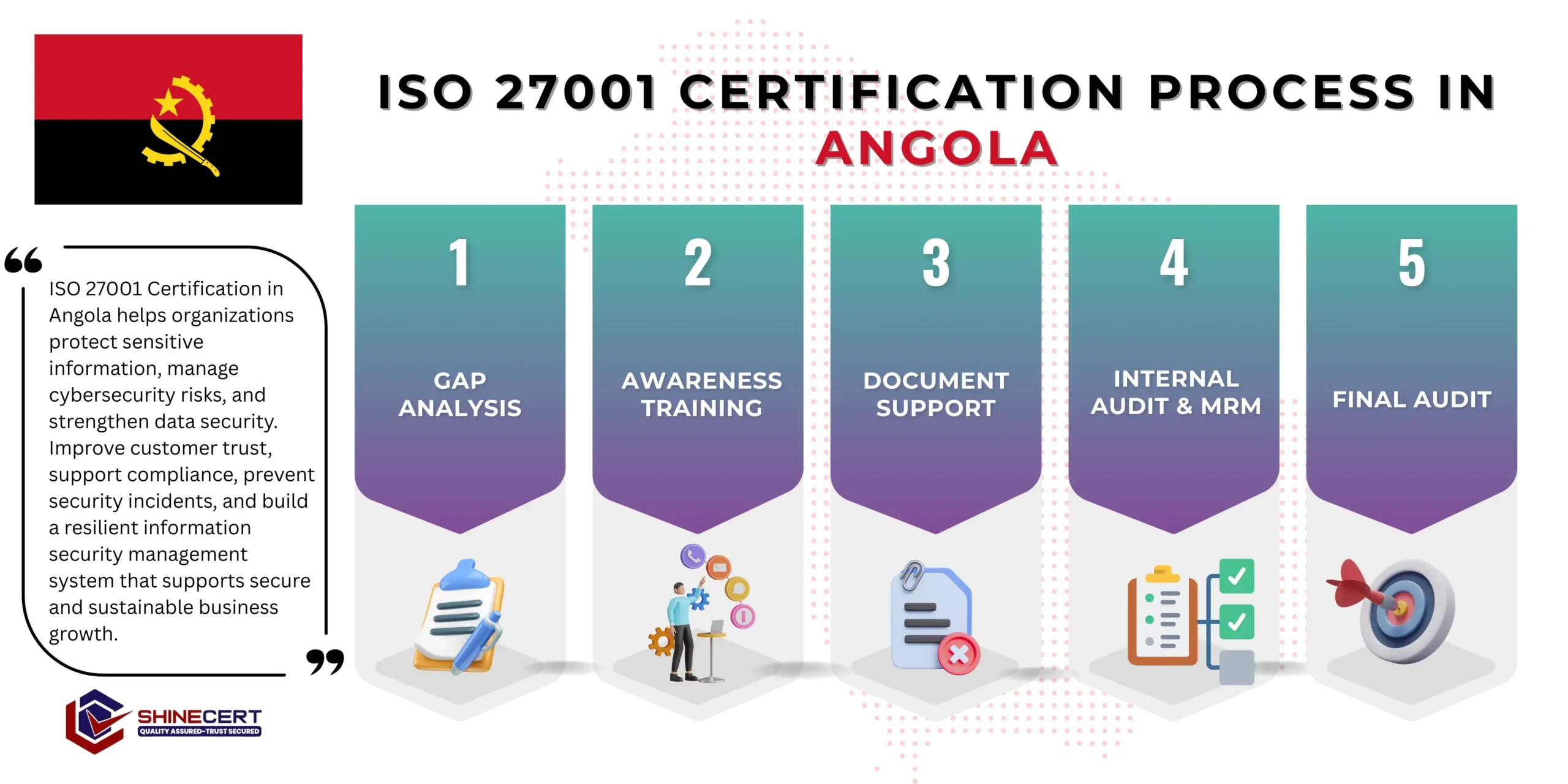
What are the steps to get ISO 27001 Certification in Angola ?
our services
- ISO Certification Angola
- ISO 9001 Certification Angola
- ISO 14001 Certification Angola
- ISO 27001 Certification Angola
- ISO 22000 Certification Angola
- ISO 20000-1 Certification Angola
- ISO 45001 Certification Angola
- ISO 13485 Certification Angola
- ISO 17025 Certification Angola
- ISO 31000 Certification Angola
- ISO 22301 Certification Angola
- ISO 27701 Certification Angola
- ISO 37001 Certification Angola
- ISO 50001 Certification Angola
- CE Mark Certification Angola
- GMP Certification Angola
- GDPR Certification Angola
- Halal Certification Angola
- SOC Certification Angola
The Certification Process
Gap Assessment
Over one to two weeks, we map your actual IT systems, data flows, and existing security practices against the standard's 93 Annex A controls, identifying which are already in place informally, which are partially implemented, and which are missing entirely. You get an honest, specific picture of your security posture before any documentation begins.
Documentation Development
Over three to six weeks, we build the information security policy, risk assessment methodology, and the Statement of Applicability, the document justifying which controls apply to your business and why. This stage is where your actual risk register takes shape, grounded in your real systems and data, not a generic control list.
Implementation and Training
Over four to eight weeks, security controls go live and staff are trained on their specific responsibilities, access management, incident reporting, acceptable use, not just handed a policy to sign. This is typically the longest phase because it requires genuine changes to how people handle data day to day.
Internal Audit and Management Review
Over two to three weeks, we run an internal audit against the same criteria the real auditor will use and complete a formal management review. This step catches documentation and control gaps while they're still inexpensive to fix, before the external audit does.
Certification Audit
Over two to four weeks, an accredited certification body reviews your documentation and audits your actual security controls, and issues the certificate once satisfied you genuinely meet the standard's requirements.
Gap Assessment
Over one to two weeks, we map your actual IT systems, data flows, and existing security practices against the standard's 93 Annex A controls, identifying which are already in place informally, which are partially implemented, and which are missing entirely. You get an honest, specific picture of your security posture before any documentation begins.
Documentation Development
Over three to six weeks, we build the information security policy, risk assessment methodology, and the Statement of Applicability, the document justifying which controls apply to your business and why. This stage is where your actual risk register takes shape, grounded in your real systems and data, not a generic control list.
Implementation and Training
Over four to eight weeks, security controls go live and staff are trained on their specific responsibilities, access management, incident reporting, acceptable use, not just handed a policy to sign. This is typically the longest phase because it requires genuine changes to how people handle data day to day.
Internal Audit and Management Review
Over two to three weeks, we run an internal audit against the same criteria the real auditor will use and complete a formal management review. This step catches documentation and control gaps while they're still inexpensive to fix, before the external audit does.
Certification Audit
Over two to four weeks, an accredited certification body reviews your documentation and audits your actual security controls, and issues the certificate once satisfied you genuinely meet the standard's requirements.
How Long Does Certification Take?
- Small businesses with limited data processing (around 3 months). Fewer IT systems and a narrower data footprint mean a smaller risk register and a shorter Statement of Applicability, so certification typically moves faster.
- Medium businesses with moderate data volume (4 to 5 months). More systems, more data types, and more staff with access to sensitive information mean a broader risk assessment and more training coordination across departments.
- Banks, telecoms, and large fintechs (5 to 6 months). These organizations typically have the most extensive IT infrastructure and the highest-stakes data to protect, requiring a more thorough risk assessment and a longer implementation phase to embed controls across every relevant system and team.
- The variable that matters most: your existing IT security maturity. An organization with established access controls, patch management, and incident response practices, even informal ones, starts from a meaningfully stronger position than one building information security governance from scratch, regardless of size.
- A real example. A fintech client came to us with strong technical security, firewalls, encryption, access logging, but nothing formally documented as a risk assessment or Statement of Applicability. Because the technical foundation was already solid, we moved through documentation and implementation in about ten weeks; a comparable fintech with weaker technical controls we worked with separately needed closer to five months, since technical gaps had to be closed before the documentation could honestly reflect a working system.
What Affects the Cost?
- Volume and sensitivity of data processed : More systems and more sensitive data mean more controls to document and test.
- Current security maturity : An organization with existing IT security practices starts from a stronger position.
- Number of systems and locations : Complex IT environments require more extensive risk assessment.
- Certification body fees, separate from consulting costs.
Answering the Objections Every Owner Has
- We already comply with Law 22/11, why do we need this too? Compliance is the legal floor; certification gives you a systematic, independently audited framework that makes demonstrating that compliance far easier and far more credible.
- Isn’t this just IT’s problem? Information security governance touches HR, legal, operations, and leadership, not just IT. The standard is built around that reality.
- “We’re too small to be a target : Smaller organizations are frequently targeted precisely because they tend to have weaker controls, and the certification process scales down to match your actual size and risk profile.
- Can’t our IT team just handle this internally? Technical controls are only part of the standard. Risk assessment methodology, documented policies, and independent audit evidence are what an internal IT team rarely has bandwidth to build alone.
Benefits of ISO 27001 Certification
- Structured evidence of Law 22/11 compliance : Certification gives you documented, systematic proof of your information security posture, not an ad-hoc response to a data protection inquiry.
- Reduced risk and cost of data breaches : Systematic risk assessment catches vulnerabilities before they’re exploited.
- Access to banking, telecom, and fintech partnerships : These sectors increasingly require certified information security as a baseline requirement.
- Stronger client and partner trust : Certification is a credible, independently verified signal in a market where data protection expectations are rising.
- Reduced liability if an incident does occur : Documented controls and incident response processes matter significantly under regulatory and contractual scrutiny.
- A foundation for pursuing ISO 27701 or ISO 42001 later : These standards build directly on the same information security management structure.
Required Documentation
The scope statement defines exactly what the certification covers, which systems, locations, and data types are included. The information security policy sets top management’s genuine commitment to security, not a generic IT policy. The Statement of Applicability is arguably the most scrutinized document in the entire system, listing all 93 Annex A controls and justifying which apply to your organization and which don’t, and why.
The risk assessment and treatment methodology documents how you identify and evaluate security risks systematically. The risk register lists specific risks relevant to your data processing activities, including those tied to Law 22/11 obligations, and how each is being treated.
Competence and awareness training records prove staff understand their security responsibilities, particularly relevant given how many security incidents originate from human error. The document control procedure keeps outdated security procedures from circulating.
Access control procedures document who can access what data and why, one of the most commonly tested areas during an audit. Incident response and business continuity plans document how you’d respond to a breach or major security event, closely scrutinized given the real financial stakes.
The internal audit program and reports and management review minutes demonstrate ongoing oversight of the security system, not a one-time implementation.
Standards and Clauses: What ISO 27001 Actually Requires
- Context of the Organization (Clause 4) : requires identifying information security issues relevant to your operations and understanding interested-party expectations, including data protection obligations under Law 22/11.
- Leadership (Clause 5) : requires top management to set an information security policy and take visible ownership, with auditors looking for evidence leadership is genuinely engaged, not just delegating security entirely to IT.
- Planning (Clause 6) : requires identifying information security risks and planning treatment actions, documented in a Statement of Applicability, the clause where your specific control choices get justified.
- Support (Clause 7) : covers competence, awareness, and documented information needed to run the system, including making sure staff genuinely understand security policies relevant to their roles.
- Operation (Clause 8) : covers operational controls, risk treatment execution, and management of security-relevant changes, the clause where most day-to-day security documentation lives.
- Performance Evaluation (Clause 9) : requires monitoring security performance, internal audits, and management review, checking whether controls are actually reducing risk over time.
- Improvement (Clause 10) : requires acting on nonconformities and continually improving the security management system, closing the loop between incidents and actual changes.
Case Study: A Fintech Company in Luanda
- A fintech company processing mobile money transactions in Luanda needed ISO 27001 certification to secure a partnership with an international payment processor.
- Our gap assessment found the company had strong technical security controls but no documented risk assessment methodology, no formal Statement of Applicability, and no structured incident response plan. Over four months, we built the risk assessment framework, documented the Statement of Applicability with genuine justification for each control, and established incident response procedures. The certification audit found no major nonconformities.
- The company secured its certificate in time to finalize the payment processor partnership.
Common Mistakes We See
- Assuming Law 22/11 compliance and ISO 27001 certification are the same thing : They’re related but distinct; certification demonstrates the systematic process behind the compliance.
- Buying security software instead of building a management system : Tools support the standard; they don’t replace the risk assessment and governance structure it requires.
- Skipping the Statement of Applicability’s real justification : Auditors expect a genuine rationale for included and excluded controls, not a checklist copied from a template.
- Choosing a certifier based on speed alone : An unusually fast timeline is often a shortcut on rigor, not efficiency.
Who Actually Needs This?
Banks and financial services providers
Information security expectations are highest and regulatory scrutiny is most active. ISO 27001 demonstrates institutional commitment to protecting customer data, accounts, and transaction integrity.
Read moreTelecommunications and mobile money operators
Handling large volumes of sensitive customer data daily requires verifiable security controls. ISO 27001 certification protects subscriber information and mobile money transactions against evolving cyber threats.
Read moreFintech and payment technology companies
Security failures carry immediate financial and reputational consequences. ISO 27001 demonstrates due diligence in protecting payment systems, customer funds, and transaction data from compromise.
Read moreBusinesses processing sensitive data
Healthcare providers, insurers, and e-commerce platforms operating in Angola handling customer data need credible information security frameworks. ISO 27001 certifies systematic protection of confidential information and regulatory compliance.
Read moreWhich Certification Body Should You Choose?
Verify the certification body’s accreditation is recognized internationally before committing. Treat an unusually short timeline as a warning sign rather than a convenience. Ask how the consultant’s approach accounts for your specific data flows and systems, not a one-size-fits-all package. Confirm the audit process includes genuine evidence review, not a paper exercise.
Choosing the Right Partner?
| DIY | Generic Consultant | ShineCert | |
|---|---|---|---|
| Risk assessment | Often incomplete | Templated, generic | Mapped to your actual data flows |
| Timeline realism | Often underestimated | Sometimes overpromised | Set to your real starting point |
| Law 22/11 alignment | Not considered | Rarely integrated | Built to support your data protection position |
| Post-certification support | None | Ends at the certificate | Supports ongoing surveillance audits |
Why Businesses Choose ShineCert in Angola?
With 10 years of ISO consulting experience and more than 10,000 organizations certified worldwide, coordinated through our Riyadh and India offices, we build information security systems that speak directly to Angola’s data protection landscape under Law 22/11, not a generic security framework disconnected from local regulatory reality.
Ready to Get Started?
Whether you’re demonstrating Law 22/11 compliance or securing a partnership that requires certified information security, we’ll assess your real situation and give you a clear, honest quote. ShineCert is the best ISO consultant in Angola. Book a free consultation or contact us to get started.
Frequently Asked Questions
No, but Law 22/11 and APD oversight create a strong regulatory foundation certification that demonstrates compliance more credibly.
It depends on data volume, system complexity, and current security maturity. We quote individually.
Usually three to six months, depending heavily on your existing IT security maturity.
No, it strengthens your compliance position with systematic, documented evidence, but the legal obligations remain separate requirements.
Banking, telecommunications, mobile money, fintech, and any business processing sensitive customer data.
Most of the process can happen remotely; the certification audit may include a site visit depending on the certification body.
ISO adopted it in 2005 based on the British BS 7799 standard, revised it in 2013, and most recently restructured its control set in 2022.