
ISO 22301 Certification in Angola
Quick Answer
ISO 22301 certification is an internationally recognized Business Continuity Management System credential confirming an organization can keep critical operations running, or recover quickly, when disruption strikes. In Angola it’s voluntary, typically takes three to six months, and speaks directly to real, documented risks like the April 2026 flooding that halted Lobito Corridor rail freight and forced costly rerouting for exporters and logistics operators.
About ISO 22301
ISO 22301 is the world’s leading business continuity management standard. It doesn’t specify particular backup systems or recovery technology; it specifies how systematically you identify critical business functions, plan for their disruption, and recover them, through a documented business impact analysis and tested continuity plans.
Certification means an independent, accredited certification body has audited your actual continuity planning and testing, not just a written plan sitting in a drawer, and confirmed it genuinely meets the standard’s requirements. It’s reissued on a three-year cycle with annual surveillance audits in between.
A brief history of the standard : ISO 22301 was first published in 2012, formalizing internationally what had previously existed as the British Standard BS 25999, developed in the mid-2000s partly in response to widespread business disruption following events like the 2001 September 11 attacks and various natural disasters that exposed how unprepared many organizations were. The 2019 revision streamlined the standard and aligned it more closely with ISO’s Harmonized Structure, making it easier to integrate with other management systems like ISO 27001, while keeping its core business impact analysis and exercise-testing requirements largely intact.
Why It Matters in Angola?
Angola’s logistics infrastructure has already demonstrated real fragility : Severe flooding in April 2026 damaged bridges along the Lobito Corridor near Cubal, Caimbambo, and Benguela, halting copper and cobalt freight movement entirely and forcing shippers onto alternative routes costing 15 to 30% more depending on commodity and destination. Security conditions along key transit zones are also expected to remain a live operational concern over the next two years. A certified business continuity system gives you a documented, tested plan for exactly this kind of disruption, rather than reacting from scratch when it happens.
What not being prepared actually costs you : The cost differential between the Lobito Corridor and alternative transport routes shows how little redundancy exists in regional export logistics, meaning disruption translates directly into higher costs and delayed shipments for unprepared businesses. International partners and financiers increasingly expect documented continuity planning as a condition of supply agreements. And without a tested plan, organizations tend to discover their continuity gaps during an actual crisis, not before one.
Why is this urgent in Angola right now? With climate data pointing to increasing frequency and severity of extreme precipitation events in the region, and the Lobito Corridor central to Angola’s mining and export economy, the kind of disruption seen in April 2026 is a recurring risk businesses need to plan around, not a one-time event.
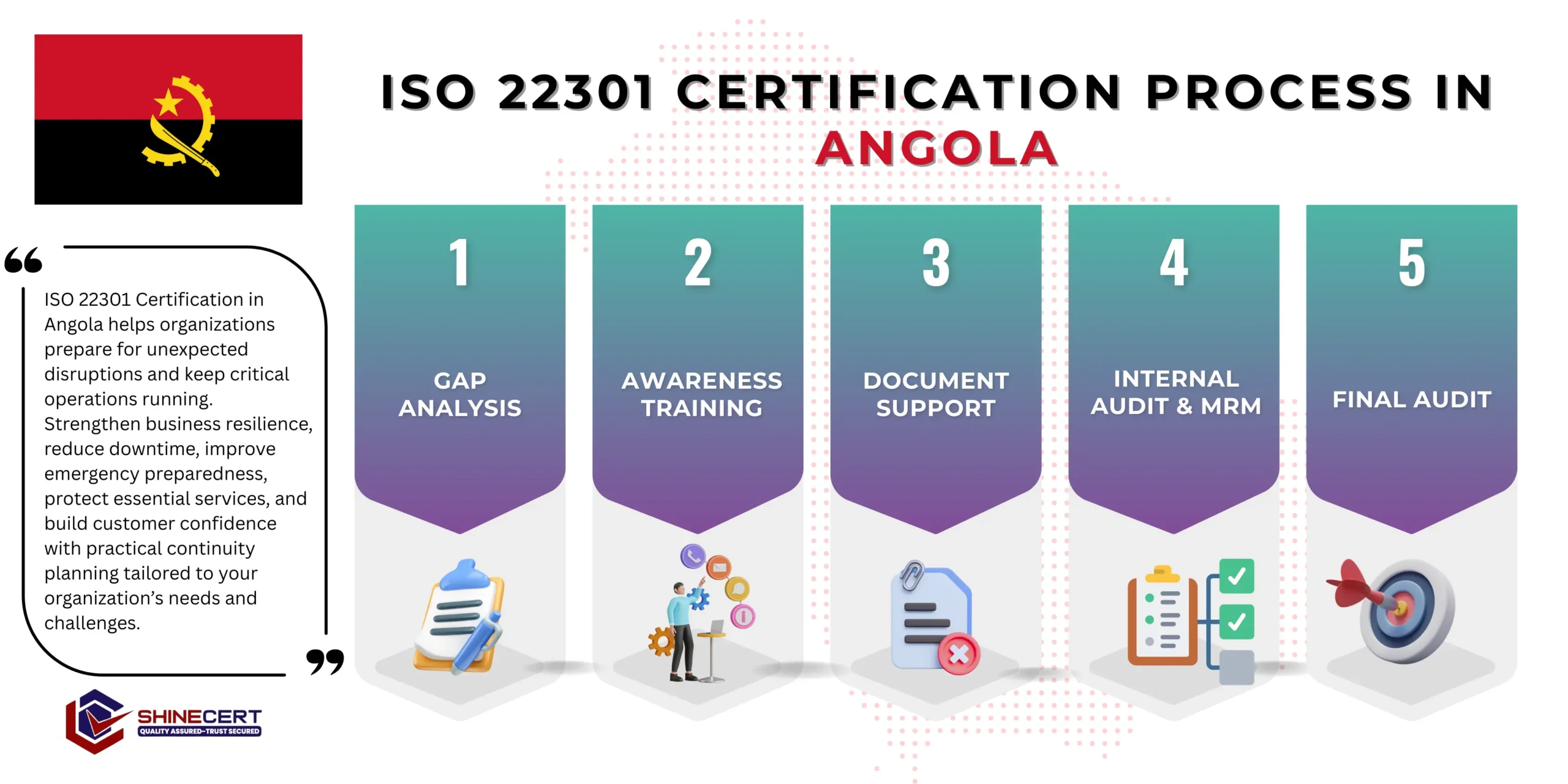
What are the steps to get ISO 22301 Certification in Angola ?
our services
- ISO Certification Angola
- ISO 9001 Certification Angola
- ISO 14001 Certification Angola
- ISO 27001 Certification Angola
- ISO 22000 Certification Angola
- ISO 20000-1 Certification Angola
- ISO 45001 Certification Angola
- ISO 42001 Certification Angola
- ISO 13485 Certification Angola
- ISO 17025 Certification Angola
- ISO 31000 Certification Angola
- ISO 22301 Certification Angola
- ISO 27701 Certification Angola
- ISO 37001 Certification Angola
- ISO 50001 Certification Angola
- CE Mark Certification Angola
- GMP Certification Angola
- GDPR Certification Angola
- Halal Certification Angola
The Certification Process
Gap Assessment
Over one to two weeks, we review your current continuity arrangements, often limited to IT backups, against the standard’s full scope, which includes physical infrastructure, supply chain, and logistics disruption. Most businesses are surprised how much of the standard their existing arrangements don’t yet cover.
Business Impact Analysis
Over three to five weeks, we identify which business functions are genuinely critical, how quickly disruption to each becomes damaging, and what dependencies, like the Lobito Corridor for exporters, create concentrated risk. This is the analytical core the rest of the plan is built on.
Continuity Plan Development and Testing
Over four to seven weeks, we build continuity plans for each critical process and, critically, exercise them through drills, not just document them on paper. This is usually the longest phase because a plan that hasn’t been tested against a realistic scenario often reveals gaps only the exercise itself surfaces.
Internal Audit and Management Review
Over two to three weeks, we run an internal audit against the same criteria the real auditor will use and complete a formal management review, catching remaining gaps before the external audit does.
Certification Audit
Over two to four weeks, an accredited certification body reviews your business impact analysis, continuity plans, and evidence of actual testing, and issues the certificate once satisfied the system genuinely functions.
Gap Assessment
Over one to two weeks, we review your current continuity arrangements, often limited to IT backups, against the standard’s full scope, which includes physical infrastructure, supply chain, and logistics disruption. Most businesses are surprised how much of the standard their existing arrangements don’t yet cover.
Business Impact Analysis
Over three to five weeks, we identify which business functions are genuinely critical, how quickly disruption to each becomes damaging, and what dependencies, like the Lobito Corridor for exporters, create concentrated risk. This is the analytical core the rest of the plan is built on.
Continuity Plan Development and Testing
Over four to seven weeks, we build continuity plans for each critical process and, critically, exercise them through drills, not just document them on paper. This is usually the longest phase because a plan that hasn’t been tested against a realistic scenario often reveals gaps only the exercise itself surfaces.
Internal Audit and Management Review
Over two to three weeks, we run an internal audit against the same criteria the real auditor will use and complete a formal management review, catching remaining gaps before the external audit does.
Certification Audit
Over two to four weeks, an accredited certification body reviews your business impact analysis, continuity plans, and evidence of actual testing, and issues the certificate once satisfied the system genuinely functions.
How Long Does Certification Take?
| Organization Type | Typical Timeline | Why |
|---|---|---|
| Small business, limited critical processes | 3 months | Fewer processes to analyze and test |
| Medium business, moderate complexity | 4–5 months | More processes and dependencies to align |
| Large exporter or logistics operator | 5–6 months | Extensive supply chain and infrastructure dependencies to document |
- Small businesses with limited critical processes (around 3 months) : Fewer critical functions mean a shorter business impact analysis and fewer continuity plans to build and test.
- Medium businesses with moderate complexity (4 to 5 months) : More critical processes and departmental dependencies mean a broader business impact analysis and more coordination required to test plans realistically.
- Large exporters or logistics operators (5 to 6 months) : These organizations typically have the most concentrated single-route dependencies, like reliance on the Lobito Corridor specifically, requiring more extensive alternative-routing planning and more thorough testing.
- The variable that matters most: whether your plan gets genuinely tested, not just written : Organizations that commit to a real disruption drill during implementation move through certification more smoothly than those that treat testing as a formality, since auditors specifically look for evidence of genuine exercises, not just a plan sitting untested.
- A real example : A logistics operator we worked with initially wanted to skip a full-scale drill to save time; when we ran a simulated corridor disruption exercise anyway, it revealed their alternative supplier contact list was over a year out of date, a gap that would have gone undiscovered until an actual disruption. Fixing this added about three weeks but meant the plan genuinely worked when tested for real months later.
What Affects the Cost?
- Number and complexity of critical business processes : More critical functions mean more business impact analysis to complete.
- Supply chain and infrastructure dependency : Organizations exposed to Lobito Corridor or similar single-route risk require more extensive continuity planning.
- Current continuity planning maturity : An organization with existing informal disaster recovery plans starts from a stronger position.
- Certification body fees, separate from consulting costs.
Answering the Objections Every Owner Has
- We already have a backup plan for IT : IT disaster recovery is one piece of business continuity; the standard covers your full critical operations, including logistics, supply chain, and physical infrastructure disruption.
- Isn’t this just paperwork? Only if it’s never tested. A properly built plan is exercised through drills, not just written and forgotten, so it actually works when disruption hits.
- We’re too small for this : Scope and cost scale with your critical processes, not the other way around, and a smaller organization’s continuity plan is proportionately simpler.
- Can’t we just handle disruption as it comes? Reactive handling is exactly what turned the April 2026 flooding into a costly, drawn-out problem for unprepared shippers; a tested plan converts that into a faster, cheaper recovery.
Benefits of ISO 22301 Certification
- A tested plan for logistics and infrastructure disruption : Certification means your continuity plan has actually been exercised, not just written and filed away.
- Reduced financial impact from disruption events : Documented alternative routing and recovery plans reduce the cost and delay of events like the April 2026 flooding.
- Stronger standing in supply agreements : International partners increasingly require documented continuity planning as a contract condition.
- Faster recovery and reduced downtime : A tested plan means less time spent figuring out the response after disruption hits.
- Credibility with lenders and insurers : Certification is a recognized signal of operational resilience in risk assessments.
- A foundation for integrating with ISO 27001 or ISO 31000 : These standards share complementary risk assessment structures.
Required Documentation
The scope statement defines exactly which operations and locations the certification covers. The business continuity policy sets top management’s genuine commitment to continuity planning. The interested parties analysis identifies what customers, lenders, and regulators expect from your continuity arrangements.
The business impact analysis is the technical core of the system, documenting which functions are critical and how quickly disruption becomes damaging. The risk assessment, covering logistics, infrastructure, and supply chain disruption specifically, identifies what could actually go wrong and how likely it is.
Competence and training records prove staff understand their roles during a disruption event. The document control procedure keeps outdated continuity plans from being used during an actual crisis.
Business continuity plans and procedures document exactly how each critical process would be recovered. Incident response and communication plans document how you’d communicate internally and with customers and partners during a disruption.
Exercise and testing records prove your plans have actually been drilled, not just written, the single most scrutinized evidence category during a certification audit. The internal audit program and reports and management review minutes demonstrate ongoing oversight.
Standards and Clauses: What ISO 22301 Actually Requires
- Context of the Organization (Clause 4) : requires identifying continuity-related issues relevant to your operations, including supply chain and infrastructure dependencies like the Lobito Corridor.
- Leadership (Clause 5) : requires top management to set a business continuity policy and take visible ownership, with auditors expecting genuine engagement in continuity planning, not delegation alone.
- Planning (Clause 6) : requires business impact analysis and risk assessment to determine continuity objectives, the clause underpinning your entire continuity strategy.
- Support (Clause 7) : covers competence, awareness, and documented information needed to run the system, including making sure staff know their specific roles during a disruption.
- Operation (Clause 8) : covers business continuity plan development, implementation, and exercising, the clause where most of the standard’s practical weight sits, and where auditors verify plans have actually been tested.
- Performance Evaluation (Clause 9) : requires monitoring continuity performance, internal audits, and management review, checking whether the system would genuinely work if disruption occurred.
- Improvement (Clause 10) : requires acting on nonconformities and continually improving the continuity management system, closing the loop between what exercises reveal and what actually changes.
Case Study: A Mineral Export Company Near Benguela
- A mineral export company operating near Benguela needed ISO 22301 certification after the April 2026 Lobito Corridor flooding exposed how unprepared it was for a route disruption.
- Our business impact analysis found the company had no documented alternative routing plan, no formal supplier communication protocol during disruption, and no tested recovery procedure.
- Over five months, we built a business continuity plan covering alternative routing, supplier communication, and recovery procedures, and ran a live exercise simulating a corridor disruption. The certification audit found no major nonconformities.
- The company’s next weather-related disruption was handled through its documented plan rather than an ad-hoc scramble, with measurably faster rerouting.
Common Mistakes We See
- Writing a continuity plan and never testing it : An untested plan often fails in exactly the way the April 2026 flooding tested unprepared shippers.
- Focusing only on IT disaster recovery : Physical infrastructure, supply chain, and logistics disruption require their own documented continuity planning.
- Underestimating single-route dependency risk : Organizations relying entirely on one corridor or supplier without an alternative plan are especially exposed.
- Choosing a certifier based on speed alone : An unusually fast timeline is often a shortcut on rigor, not efficiency.
Who Actually Needs This?
Logistics and Transport Operators
Managing the operational reality of rerouting and delay.
Read moreManufacturers
Dependent on imported inputs or export routes, exposed to the same infrastructure fragility.
Read moreBanks and Financial Institutions
Needing continuity plans for their own critical operations and often required to assess client continuity planning too.
Read moreWhich Certification Body Should You Choose?
Confirm the certification body holds recognized international accreditation. Ask whether your plan will actually be tested through a drill, not just reviewed on paper. Be skeptical of unusually fast timelines given how much genuine testing the standard requires. Confirm the audit process reviews evidence of actual exercises, not just documentation.
Choosing the Right Partner?
| DIY | Generic Consultant | ShineCert | |
|---|---|---|---|
| Business impact analysis | Often incomplete | Templated, generic | Mapped to your actual critical processes |
| Timeline realism | Often underestimated | Sometimes overpromised | Set to your real starting point |
| Angola infrastructure risk awareness | Not considered | Rarely integrated | Built around documented Lobito Corridor and climate risk |
| Post-certification support | None | Ends at the certificate | Supports ongoing plan testing and surveillance audits |
Why Businesses Choose ShineCert in Angola?
Across 10 years of ISO consulting and more than 10,000 organizations certified worldwide, coordinated through our Riyadh and India offices, ShineCert builds continuity plans as the best ISO 22301 consultant in Angola, grounded in Angola’s actual documented disruption risks, including Lobito Corridor infrastructure fragility, not a generic continuity template.
Ready to Get Started?
Whether you’re responding to documented Lobito Corridor risk or strengthening your standing with lenders and partners, we’ll assess your real situation and give you a clear, honest quote. Book a free consultation or contact us to get started.
Frequently Asked Questions
No, but documented infrastructure and climate risk, including the April 2026 Lobito Corridor flooding, make it a practical priority for exposed businesses.
It depends on the number of critical processes and your supply chain complexity. We quote individually.
Usually three to six months, depending heavily on whether continuity plans are genuinely tested through drills during implementation.
No, it ensures you have a tested plan to recover faster and at lower cost when disruption occurs.
Mining and mineral exporters, logistics operators, manufacturers dependent on import or export routes, and banks.
Documentation and planning can happen remotely; exercises and the certification audit typically require on-site participation.
In 2012, formalizing the earlier British Standard BS 25999, with a streamlined revision in 2019.