
ISO 42001 Certification in Angola
Quick Answer
ISO 42001 certification is the world’s first internationally recognized Artificial Intelligence Management System credential, confirming an organization governs its AI systems responsibly across their full lifecycle. In Angola it’s voluntary but forward-looking, typically takes three to six months, and positions your organization ahead of the country’s emerging AI governance framework under LBTIC and the draft AI law.
About ISO 42001
ISO 42001 is the first management-system standard dedicated to artificial intelligence. It doesn’t dictate which AI models or vendors to use; it specifies how you govern the AI systems you build or deploy, covering risk management, data quality, transparency, and human oversight throughout the AI lifecycle.
Certification means an independent, accredited certification body has audited your actual AI governance practices, not just a policy document, and confirmed they genuinely meet the standard’s requirements. It’s reissued on a three-year cycle with annual surveillance audits in between.
A brief history of the standard : ISO 42001 was published in December 2023, making it one of the newest management-system standards ISO has released, developed specifically in response to the rapid growth of AI adoption across industries worldwide. Unlike most ISO standards, which formalize decades of established practice, ISO 42001 was written while AI governance norms were still actively forming, drawing on emerging regulatory frameworks like the EU AI Act rather than a long history of prior practice. Because of this, it’s one of the least mature standards in terms of global certification body experience, which is worth factoring into how you choose a certification partner.
Why It Matters in Angola?
Angola’s AI policy landscape is being actively built right now : LBTIC, the national broadband and ICT strategy running through 2027, sets ambitious digital transformation targets, and a draft AI law modeled partly on international frameworks is under development, alongside a reported $50 million government commitment to AI investment. Organizations adopting AI tools today are doing so ahead of the formal governance rules that will eventually apply to them.
The risk of moving fast without governance : Organizations deploying AI without documented oversight face growing reputational and operational risk if a model produces biased, inaccurate, or harmful outputs, with no internal process to catch or correct it. As Angola’s regulatory framework develops, undocumented AI use becomes harder to retroactively bring into compliance.
Why is this relevant in Angola right now? With the government targeting 80% digital service delivery by 2028 and actively investing in AI infrastructure, banks, telecoms, and government-adjacent service providers are adopting AI tools faster than internal governance structures are being built to manage them.
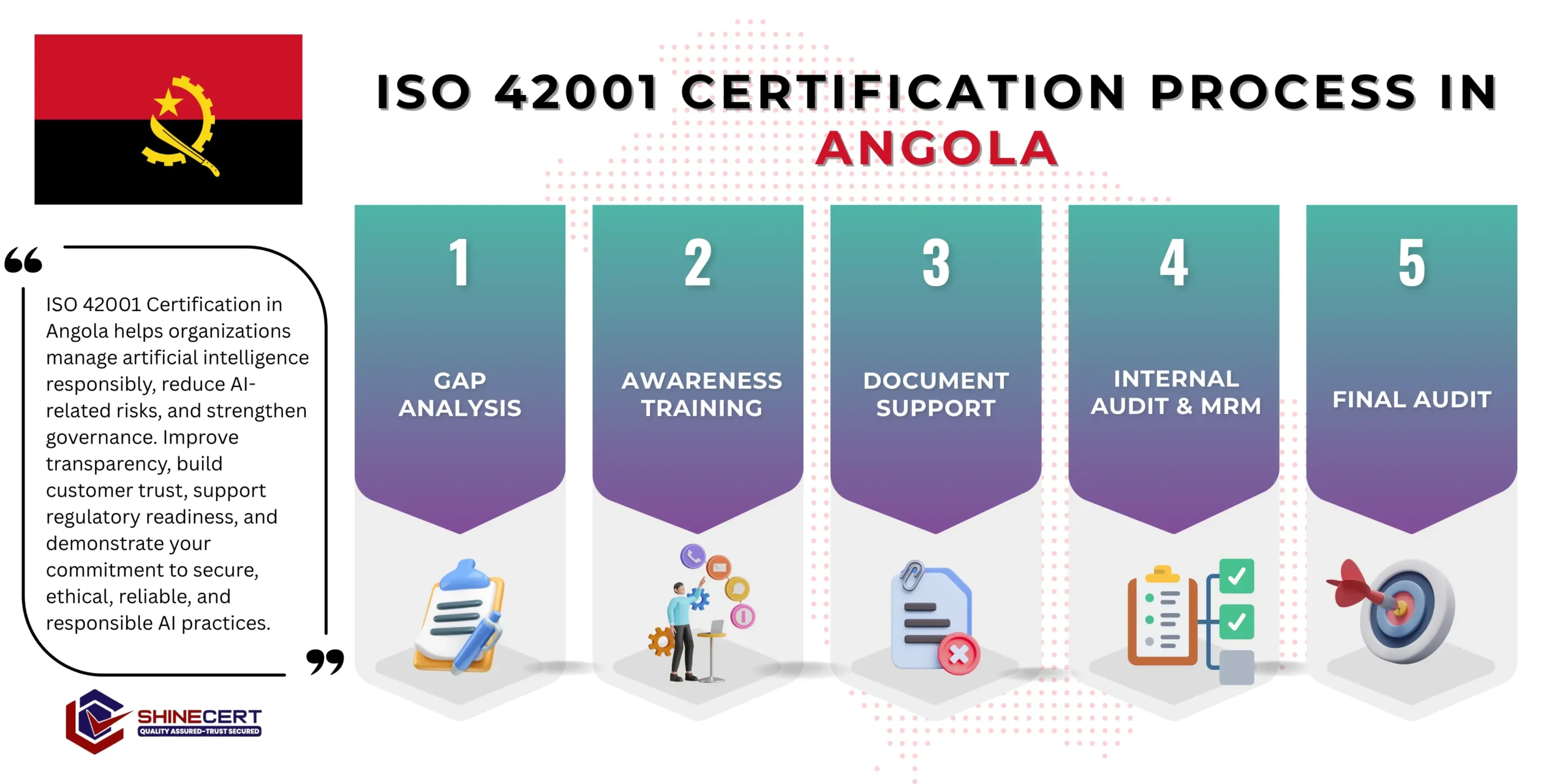
What are the steps to get ISO 42001 Certification in Angola ?
our services
- ISO Certification Angola
- ISO 9001 Certification Angola
- ISO 14001 Certification Angola
- ISO 27001 Certification Angola
- ISO 22000 Certification Angola
- ISO 20000-1 Certification Angola
- ISO 45001 Certification Angola
- ISO 42001 Certification Angola
- ISO 13485 Certification Angola
- ISO 17025 Certification Angola
- ISO 31000 Certification Angola
- ISO 22301 Certification Angola
- ISO 27701 Certification Angola
- ISO 37001 Certification Angola
- ISO 50001 Certification Angola
- CE Mark Certification Angola
- GMP Certification Angola
- GDPR Certification Angola
- Halal Certification Angola
The Certification Process
Gap Assessment
Over one to two weeks, we build a complete inventory of every AI system you use or deploy, whether built in-house or sourced from vendors, and assess current governance practices against the standard. Since this standard is still new, many organizations are surprised by how many AI tools are already in use informally across departments without any central oversight.
Documentation Development
Over three to six weeks, we build the AI policy, risk assessment methodology, and impact assessments for your significant AI use cases, grounded in your actual deployments rather than generic AI ethics language. This is where roles and responsibilities for AI oversight get formally assigned.
Implementation and Training
Over four to eight weeks, governance controls go live and relevant staff, not just IT, but legal, compliance, and business unit leads, are trained on their AI oversight responsibilities. This phase often takes longer than expected because AI governance is genuinely cross-functional.
Internal Audit and Management Review
Over two to three weeks, we test the governance system against the same criteria the real auditor will use and complete a formal management review, catching gaps in documentation or oversight before the external audit does.
Certification Audit
Over two to four weeks, an accredited certification body audits your actual AI governance practices, and issues the certificate once satisfied. Because this standard is new, confirming your chosen certifier has genuine ISO 42001 audit experience matters more here than for more established standards.
Gap Assessment
Over one to two weeks, we build a complete inventory of every AI system you use or deploy, whether built in-house or sourced from vendors, and assess current governance practices against the standard. Since this standard is still new, many organizations are surprised by how many AI tools are already in use informally across departments without any central oversight.
Documentation Development
Over three to six weeks, we build the AI policy, risk assessment methodology, and impact assessments for your significant AI use cases, grounded in your actual deployments rather than generic AI ethics language. This is where roles and responsibilities for AI oversight get formally assigned.
Implementation and Training
Over four to eight weeks, governance controls go live and relevant staff, not just IT, but legal, compliance, and business unit leads, are trained on their AI oversight responsibilities. This phase often takes longer than expected because AI governance is genuinely cross-functional.
Internal Audit and Management Review
Over two to three weeks, we test the governance system against the same criteria the real auditor will use and complete a formal management review, catching gaps in documentation or oversight before the external audit does.
Certification Audit
Over two to four weeks, an accredited certification body audits your actual AI governance practices, and issues the certificate once satisfied. Because this standard is new, confirming your chosen certifier has genuine ISO 42001 audit experience matters more here than for more established standards.
How Long Does Certification Take?
| Organization Type | Typical Timeline | Why |
|---|---|---|
| Limited AI use, few systems | 3 months | Fewer systems and risks to document |
| Moderate AI use across departments | 4–5 months | More use cases and stakeholders to align |
| Extensive AI deployment (banking, telecom) | 5–6 months | Complex risk assessment across many use cases |
- Organizations with limited AI use (around 3 months) : Fewer AI systems mean a shorter inventory and a narrower set of impact assessments, so certification tends to move quickly once governance roles are assigned.
- Organizations with moderate AI use across departments (4 to 5 months) : More departments using AI independently mean more stakeholders to coordinate and more use cases requiring individual impact assessment, which adds real cross-functional coordination time.
- Organizations with extensive AI deployment, including banks and telecoms (5 to 6 months) : These organizations typically have the widest range of AI use cases, often including higher-stakes applications like credit scoring, requiring more thorough risk and impact assessment before certification.
- The variable that matters most: whether you already know every AI system in use : Organizations that complete a genuinely thorough AI inventory early move faster than those that discover additional shadow AI tools mid-project, which happens more often than most leadership teams expect.
- A real example : A telecom client believed it had three AI systems in active use; our inventory process uncovered eleven, including AI features embedded in third-party customer service software that nobody had formally evaluated for governance purposes. Bringing all eleven into scope added roughly six weeks to the original estimate, but avoided a much larger gap being discovered during the certification audit itself.
What Affects the Cost?
- Number and complexity of AI systems in use. More AI use cases mean more risk assessments and controls to document.
- Whether AI is built in-house or sourced from vendors. Vendor-sourced AI still requires governance documentation, though scoped differently.
- Current governance maturity. An organization with existing data governance practices starts from a stronger position.
- Certification body fees, separate from consulting costs.
Answering the Objections Every Owner Has
- “There’s no AI law yet, why bother?” Getting governance right before the law is finalized is far cheaper than retrofitting it under regulatory pressure later, and certification demonstrates responsible practice regardless of what’s legally mandated today.
- “We don’t build AI, we just use commercial tools.” The standard covers organizations that deploy AI systems, not just those that build them from scratch. Using third-party AI tools without oversight carries the same governance gap.
- “This sounds like it’s only for tech companies.” Any organization using AI for decisions that affect customers, employees, or the public, including banks and telecoms, falls within scope.
- “Can’t our IT team handle this internally?” AI governance requires cross-functional input from legal, compliance, and business units, not just technical implementation. Few internal teams have bandwidth to build this structure alone.
Benefits of ISO 42001 Certification
- A head start on Angola’s emerging AI governance framework : Certification builds the internal structure that a future formal AI law will likely require anyway.
- Reduced risk from AI failures : Structured oversight catches biased or harmful AI outputs before they reach customers or the public.
- Credibility with international partners and investors : Certification is a recognized signal of responsible AI governance in a market where formal regulation is still developing.
- Clearer internal accountability for AI decisions : The standard requires defined roles and responsibilities for AI oversight, reducing ambiguity when something goes wrong.
- Stronger position for government and enterprise contracts : Organizations increasingly expect documented AI governance as a contract condition.
- A foundation for pursuing ISO 27001 alongside AI governance : These standards share complementary risk management structures.
Required Documentation
The scope statement defines exactly which AI systems and business units are covered. The AI policy sets top management’s genuine commitment to responsible AI governance. The AI system inventory lists every significant AI use case in the organization, the foundation the rest of the documentation builds on.
The AI risk assessment methodology documents how you evaluate risks specific to AI, bias, data quality, transparency, distinct from general IT risk. The AI impact assessment for each significant use case documents the specific risks and mitigations for that particular application.
Competence and awareness training records prove staff involved in AI oversight, not just data scientists, understand their responsibilities. The document control procedure keeps outdated AI governance documents from circulating.
Data governance procedures document how data feeding your AI systems is managed and quality-checked. Human oversight and intervention procedures document how humans can review, override, or halt AI decisions, a core requirement auditors scrutinize closely.
The internal audit program and reports and management review minutes demonstrate ongoing oversight of AI governance, not a one-time policy exercise.
Standards and Clauses: What ISO 42001 Actually Requires
- Context of the Organization (Clause 4) : requires identifying AI-related issues relevant to your operations and understanding interested-party expectations, including emerging regulatory expectations under Angola’s developing AI framework.
- Leadership (Clause 5) : requires top management to set an AI policy and take visible ownership of AI governance, not delegate it entirely to a technical team.
- Planning (Clause 6) : requires identifying AI risks and opportunities and planning AI impact assessments for significant use cases, the clause where your risk methodology and use-case-specific assessments take shape.
- Support (Clause 7) : covers competence, awareness, and documented information needed to run the system, including ensuring non-technical staff understand AI governance relevant to their roles.
- Operation (Clause 8) : covers operational controls, AI system lifecycle management, and human oversight mechanisms, the clause where most day-to-day AI governance documentation lives.
- Performance Evaluation (Clause 9) : requires monitoring AI system performance, internal audits, and management review, checking whether governance is actually catching problems, not just existing on paper.
- Improvement (Clause 10) : requires acting on nonconformities and continually improving AI governance as your AI use evolves.
Case Study: A Bank in Luanda Deploying AI Credit Scoring
- A bank in Luanda deploying an AI-driven credit scoring tool needed to demonstrate responsible governance to its board and an international regulator ahead of a planned expansion.
- Our gap assessment found the bank had a functioning AI model but no documented risk assessment, no impact assessment for the credit-scoring use case, and no human oversight mechanism for edge-case decisions.
- Over five months, we built the AI risk and impact assessment framework, documented human oversight procedures for contested credit decisions, and established an AI governance committee. The certification audit found no major nonconformities.
- The bank secured its certificate ahead of its planned expansion and now cites it in investor and regulator conversations.
Common Mistakes We See
- Assuming governance only applies to custom-built AI : Commercial AI tools deployed without oversight carry the same governance gap the standard addresses.
- Writing an AI policy without an actual system inventory : Auditors expect to see every significant AI use case mapped, not a generic policy statement.
- Skipping impact assessments for AI used in customer-facing decisions : These are exactly where AI governance failures cause the most damage.
- Choosing a certifier unfamiliar with a genuinely new standard : ISO 42001 is recent; ask specifically about the consultant’s experience with it.
Who Actually Needs This?
Banks and financial institutions
deploying AI for credit scoring, fraud detection, or customer service.
Read moreTelecommunications and mobile money operators
using AI for network optimization, fraud detection, or customer analytics.
Read moreTechnology companies and software providers
building or integrating AI tools into their products.
Read moreGovernment-adjacent service providers
supporting Angola’s digital transformation targets under LBTIC.
Read moreWhich Certification Body Should You Choose?
Confirm the certification body has genuine, verifiable ISO 42001 audit experience, since the standard is still new and not every certifier has built this capability yet. Ask the consultant to name specific AI use cases they’d expect to see in your risk assessment. Be wary of anyone offering certification without discussing your actual AI systems in detail first.
Choosing the Right Partner?
| DIY | Generic Consultant | ShineCert | |
|---|---|---|---|
| AI use case mapping | Often incomplete | Templated, generic | Mapped to your actual AI deployments |
| Timeline realism | Often underestimated | Sometimes overpromised | Set to your real starting point |
| Angola regulatory awareness | Not considered | Rarely integrated | Built with LBTIC and draft AI law context in mind |
| Post-certification support | None | Ends at the certificate | Supports ongoing surveillance audits |
Why Businesses Choose ShineCert in Angola?
Across 10 years of ISO consulting and more than 10,000 organizations served worldwide, coordinated from our Riyadh and India offices, we’ve built AI governance systems with ShineCert, the best ISO 42001 consultant in Angola, grounded in Angola’s actual regulatory trajectory under LBTIC, not a generic AI ethics checklist copied from elsewhere.
Ready to Get Started?
Whether you’re getting ahead of Angola’s emerging AI regulation or reassuring partners about your AI governance, we’ll assess your real situation and give you a clear, honest quote. Book a free consultation or contact us to get started.
Frequently Asked Questions
No, but Angola’s developing AI governance framework under LBTIC and the draft AI law makes early adoption a meaningful advantage.
It depends on the number and complexity of AI systems in use. We quote individually.
Usually three to six months, depending heavily on whether you already have a complete inventory of your AI systems.
No, organizations deploying third-party AI tools for significant decisions are within scope too.
Banking, telecommunications, technology companies, and government-adjacent digital service providers.
Most of the process can happen remotely; the certification audit may include a site visit depending on the certification body.
In December 2023, making it one of ISO’s newest management-system standards.