
ISO 31000 Certification in Angola
Quick Answer
ISO 31000 is an internationally recognized risk management framework, not a certifiable management system standard. There is no ISO 31000 certificate to earn. What organizations in Angola actually pursue is an Independent Conformity Review, an expert assessment confirming your risk management practices genuinely align with the framework’s principles, useful for board reporting, lender due diligence, and demonstrating risk maturity given Angola’s exposure to kwanza volatility and oil price swings.
About ISO 31000
ISO 31000 provides principles and generic guidelines on risk management. Unlike ISO 9001 or ISO 27001, it is not a management-system standard with auditable requirements; it’s guidance describing how organizations should approach risk, structured around Principles, a Framework, and a Process for managing risk of any kind, financial, operational, strategic, or external.
Because there’s nothing to audit against in the way there is for a certifiable standard, no accredited body issues an “ISO 31000 certificate.” What ShineCert and similarly positioned consultancies offer instead is implementation support followed by an Independent Conformity Review, an expert-led assessment against the framework’s principles, useful evidence for boards, lenders, and partners even without a formal certificate.
A brief history of the standard : ISO 31000 was first published in 2009, consolidating a range of national and industry-specific risk management standards, most notably Australia and New Zealand’s AS/NZS 4360, into a single international framework. It was revised in 2018, the current edition, which simplified the structure and placed much greater emphasis on integrating risk management into organizational leadership and decision-making, rather than treating it as a standalone technical exercise run by a risk department in isolation.
Why It Matters in Angola?
Angola’s economy carries genuine, well-documented risk exposure. Oil still accounts for roughly 94% of exports and 60% of fiscal revenue, even as non-oil revenue is projected to surpass petroleum receipts for the first time in decades. The kwanza has been actively defended by the National Bank of Angola against the dollar, with limited devaluation still possible if oil revenues underperform, and the 2026 budget itself assumes an oil price near $61 a barrel, a planning assumption that can shift quickly.
What operating without a structured risk framework actually costs you. Businesses without documented risk processes tend to react to currency swings and commodity price shifts rather than anticipating them, which shows up in poor budgeting, missed hedging opportunities, and reactive rather than planned decision-making. Lenders and international partners increasingly expect to see a genuine risk management framework, not just a finance team’s informal judgment calls.
Why this is especially relevant in Angola right now. With the country in the middle of a genuine, still-uneven transition toward non-oil revenue sources, businesses across manufacturing, trade, and banking are navigating currency, commodity, and diversification-related risks simultaneously, and a structured framework helps separate the risks worth acting on from routine volatility.
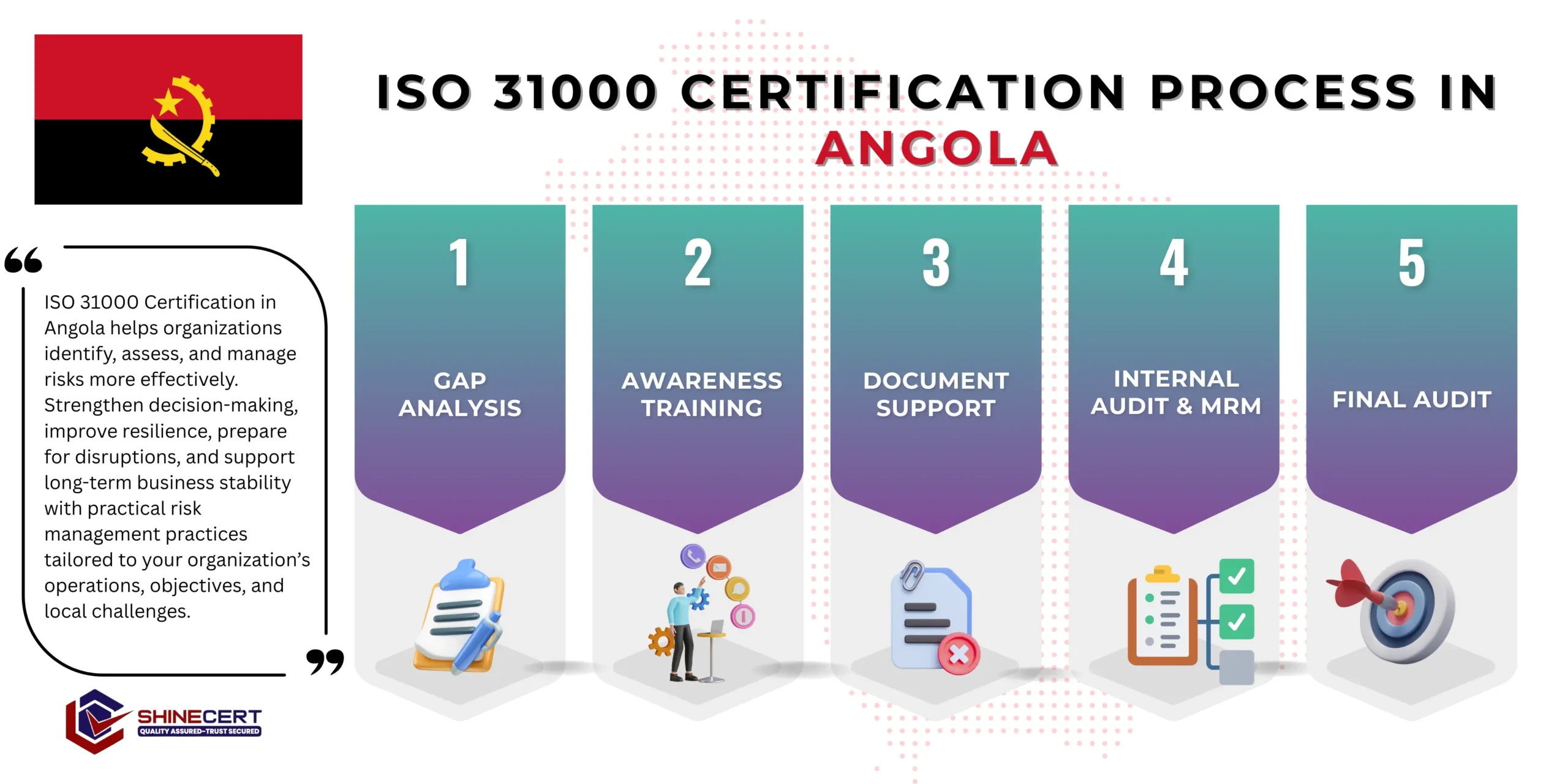
What are the steps to get ISO 31000 Certification in Angola ?
our services
- ISO Certification Angola
- ISO 9001 Certification Angola
- ISO 14001 Certification Angola
- ISO 27001 Certification Angola
- ISO 22000 Certification Angola
- ISO 20000-1 Certification Angola
- ISO 45001 Certification Angola
- ISO 42001 Certification Angola
- ISO 13485 Certification Angola
- ISO 17025 Certification Angola
- ISO 31000 Certification Angola
- ISO 22301 Certification Angola
- ISO 27701 Certification Angola
- ISO 37001 Certification Angola
- ISO 50001 Certification Angola
- CE Mark Certification Angola
- GMP Certification Angola
- GDPR Certification Angola
- Halal Certification Angola
The Implementation Process
Risk Context Assessment
Over one to two weeks, we map exactly how your organization is exposed to currency movement, commodity price shifts, and other relevant risk categories, grounded in your actual balance sheet and operations rather than generic risk language.
Framework Development
Over two to four weeks, we build your risk management policy and framework structure, defining roles, risk appetite, and how risk information flows to leadership and the board.
Risk Process Implementation
Over three to five weeks, risk identification, assessment, and treatment processes go live across the organization, with relevant staff trained on how to feed real risk information into the register rather than treating it as a one-time exercise.
Internal Review
Over one to two weeks, we test whether the framework is actually being used and producing genuine risk insight, correcting gaps before the independent review.
Independent Conformity Review
Over one to two weeks, an expert assessor evaluates your framework against ISO 31000’s principles and provides a report you can share with your board, lenders, or partners, distinct from a certification audit since no certificate is issued.
Risk Context Assessment
Over one to two weeks, we map exactly how your organization is exposed to currency movement, commodity price shifts, and other relevant risk categories, grounded in your actual balance sheet and operations rather than generic risk language.
Framework Development
Over two to four weeks, we build your risk management policy and framework structure, defining roles, risk appetite, and how risk information flows to leadership and the board.
Risk Process Implementation
Over three to five weeks, risk identification, assessment, and treatment processes go live across the organization, with relevant staff trained on how to feed real risk information into the register rather than treating it as a one-time exercise.
Internal Review
Over one to two weeks, we test whether the framework is actually being used and producing genuine risk insight, correcting gaps before the independent review.
Independent Conformity Review
Over one to two weeks, an expert assessor evaluates your framework against ISO 31000’s principles and provides a report you can share with your board, lenders, or partners, distinct from a certification audit since no certificate is issued.
How Long Does Implementation Take?
| Organization Type | Typical Timeline | Why |
|---|---|---|
| Small business, limited risk exposure | 2 months | Fewer risk categories to document |
| Medium business, moderate exposure | 3 months | More risk categories and stakeholders to align |
| Bank or large trading company | 4 months | Extensive currency, credit, and market risk to document |
- Small businesses with limited risk exposure (around 2 months) : Fewer risk categories, often just currency exposure on a handful of transactions, mean a shorter risk context assessment and a simpler framework.
- Medium businesses with moderate exposure (around 3 months) : More departments and risk categories, currency, credit, operational, mean more stakeholder input needed to build a framework that genuinely reflects the business.
- Banks or large trading companies (around 4 months) : These organizations typically carry the widest range of risk categories, currency, credit, market, operational, requiring more extensive framework development and stakeholder alignment across departments.
- The variable that matters most: how much genuine board-level engagement exists from the start : Organizations where leadership is actively involved in defining risk appetite move through implementation faster than those where risk management is delegated entirely to a single finance staffer, regardless of size.
- A real example : A trading company we worked with had a finance director who track currency risk closely but had never formally briefed the board on it; building the framework took only about six weeks once the board was engaged directly, compared to a similar-sized company where board buy-in had to be built from scratch, adding roughly five extra weeks to reach the same point.
What Affects the Cost?
- Organizational complexity and risk exposure. More risk categories, currency, commodity, credit, operational, mean more analysis to document.
- Current risk management maturity. An organization with existing informal risk practices starts from a stronger position.
- Whether an Independent Conformity Review is included. This is typically a separate, optional add-on to implementation support.
- Consulting fees, since there is no certification body fee for a non-certifiable framework.
Answering the Objections Every Owner Has
- There’s no certificate, so why pay for this? The value isn’t a wall certificate, it’s a structured process that makes your risk decisions defensible and your board reporting credible, backed by an Independent Conformity Review if you want third-party validation.
- Doesn’t our finance team already manage risk? Informal risk judgment is valuable but undocumented, which makes it hard to demonstrate consistency to a board or lender, and hard to transfer when key people leave.
- We’re too small for a formal risk framework. The framework scales to your size; a smaller organization’s risk register is simply shorter, not a different process.
- Isn’t this just for finance? ISO 31000 covers operational, strategic, and external risk as well as financial risk, relevant to functions well beyond finance.
Benefits of Implementing ISO 31000
- A structured way to think about currency and commodity exposure : Rather than reacting to kwanza or oil price moves, you have a documented process for identifying and responding to them.
- Stronger board and lender reporting : An Independent Conformity Review gives boards and lenders credible, external evidence of risk management maturity.
- Better-informed strategic decisions : Structured risk assessment surfaces risks and opportunities leadership might otherwise miss.
- Improved resilience to external shocks : A documented framework helps organizations respond faster when oil prices or the currency move unexpectedly.
- Credibility with international partners and investors : Demonstrated risk management maturity is a meaningful signal in a market still building its non-oil economy.
- A foundation for integrating with ISO 9001, ISO 27001, or ISO 22301 : These standards’ risk-based thinking builds naturally on an ISO 31000 framework.
Required Documentation
The risk management policy sets out leadership’s genuine commitment to structured risk management, not a generic statement. The risk management framework description documents how risk information flows through your organization, from identification to board reporting.
The risk register, covering currency, commodity, credit, and operational risk, is the practical core of the system, a living document rather than something written once. The risk criteria and appetite statement defines what level of risk your organization is actually willing to accept, giving the register real decision-making value.
Risk management roles and responsibilities clarify who owns which risk category, avoiding the common failure mode of risk management being “everyone’s job and no one’s job.” The risk communication plan documents how risk information reaches the board and other stakeholders.
Risk treatment plans document specific actions taken to address identified risks, whether hedging currency exposure or diversifying suppliers. Risk monitoring procedures keep the register current rather than static.
Internal review records and the Independent Conformity Review report, if commissioned, demonstrate the framework is genuinely functioning, not just documented.
Principles, Framework, and Process: What ISO 31000 Actually Covers
- Principles describe what effective risk management looks like: integrated into decision-making, structured, customized to the organization, inclusive, dynamic, and based on the best available information. These aren’t abstract ideals; they’re the criteria an Independent Conformity Review actually assesses against.
- Framework covers leadership commitment, integration of risk management into organizational processes, and continual improvement of the framework itself over time, ensuring risk management isn’t a one-time project but an evolving part of how the organization operates.
- Process covers the practical steps: establishing context, risk identification, risk analysis, risk evaluation, risk treatment, and ongoing monitoring and review, the operational cycle your risk register and treatment plans are built around.
Case Study: A Trading Company in Luanda
- A trading company in Luanda importing goods priced in foreign currency needed a structured way to manage kwanza volatility risk for its board and its bank.
- Our assessment found the company managed currency risk informally through its finance director’s judgment, with no documented risk register, no defined risk appetite, and no structured review process.
- Over three months, we built a risk management framework covering currency, credit, and supply chain risk, and completed an Independent Conformity Review confirming alignment with ISO 31000 principles.
- The company presented the review to its bank as part of a credit facility renewal, which proceeded without the additional risk-related conditions the bank had initially proposed.
Common Mistakes We See
- Expecting a certificate that doesn’t exist : Confusing ISO 31000 with certifiable standards like ISO 9001 leads to disappointment; the deliverable is a framework and, optionally, an Independent Conformity Review.
- Building a risk register once and never updating it : Kwanza and oil price conditions shift; a static risk register quickly becomes outdated.
- Treating risk management as finance’s job alone : Operational and strategic risks fall outside finance’s usual scope but still belong in the framework.
- Skipping the context-setting step : A generic risk framework that ignores your specific currency and commodity exposure misses the point of the exercise.
Who Actually Needs This?
Banks and financial institutions
Banks and financial institutions, managing currency, credit, and market risk daily.
Read moreManufacturers and importers
Manufacturers and importers, exposed to kwanza volatility on foreign-denominated input costs.
Read moreTrade and logistics companies
Trade and logistics companies, navigating both currency risk and Angola’s broader economic transition.
Read moreBoards and executive teams
Boards and executive teams seeking a credible, structured way to demonstrate risk oversight to lenders or investors.
Read moreWho Should Conduct Your Independent Conformity Review?
Choose an assessor who explains clearly that this is not a certification audit and won’t claim otherwise. Ask for their specific experience with ISO 31000 rather than general risk consulting. Be skeptical of anyone offering an “ISO 31000 certificate,” since no accredited body issues one.
Choosing the Right Partner?
| DIY | Generic Consultant | ShineCert | |
|---|---|---|---|
| Risk context mapping | Often incomplete | Templated, generic | Mapped to Angola’s specific currency and commodity exposure |
| Timeline realism | Often underestimated | Sometimes overpromised | Set to your real starting point |
| Understanding of non-certifiable nature | Often confused with certification | Sometimes oversold as “certification” | Explained honestly from the start |
| Post-implementation support | None | Ends at delivery | Supports ongoing framework review |
Why Businesses Choose ShineCert in Angola?
Across 10 years of ISO and risk management consulting worldwide, coordinated from our Riyadh and India offices, we’re upfront that ISO 31000 isn’t certifiable, and as the best ISO 31000 consultant in Angola, we focus instead on building a risk framework genuinely suited to Angola’s currency and commodity exposure, backed by an honest Independent Conformity Review if you want third-party validation.
Ready to Get Started?
Whether you’re building board-level risk credibility or preparing for lender due diligence, we’ll give you an honest assessment of what ISO 31000 implementation actually involves for your organization. Book a free consultation or contact us to get started.
Frequently Asked Questions
No. ISO 31000 is a guidance framework, not a certifiable management-system standard. What’s available is implementation support and an optional Independent Conformity Review.
It depends on organizational complexity and whether an Independent Conformity Review is included. We quote individually.
Usually two to four months, depending heavily on how engaged leadership is from the outset.
No, the framework scales to your size and risk exposure.
Banking, manufacturing, trade, and logistics, given the country’s currency and commodity exposure.
Most of the process, including framework development, can happen remotely.
In 2009, revised in 2018 to place greater emphasis on leadership integration.