
ISO 50001 Certification in Angola
Quick Answer
ISO 50001 certification is an internationally recognized Energy Management System credential confirming an organization systematically tracks and improves its energy performance. In Angola it’s voluntary, typically takes three to five months, and directly addresses a genuinely live cost pressure: industrial electricity tariffs rose 15 to 25% as subsidy reductions have continued under the General Electricity Law framework, making documented energy efficiency a real financial issue, not just an environmental one.
About ISO 50001
ISO 50001 is the world’s leading energy management standard. It doesn’t dictate specific energy technologies or equipment; it specifies how systematically you track energy use, set performance targets, and improve efficiency over time, through documented processes and continual improvement built into the system itself.
Certification means an independent, accredited certification body has audited your actual energy management practices, not just reviewed a policy, and confirmed they genuinely meet the standard’s requirements. It’s reissued on a three-year cycle with annual surveillance audits in between.
A brief history of the standard : ISO 50001 was first published in 2011, developed to give organizations worldwide a consistent framework for energy management as energy costs and efficiency concerns became increasingly central to industrial competitiveness. The 2018 revision aligned the standard with ISO’s High-Level Structure and clarified requirements around energy performance indicators and energy baselines, making it easier to demonstrate measurable, year-over-year energy performance improvement rather than just documenting good intentions.
Why It Matters in Angola?
Angola’s industrial electricity pricing has moved sharply in recent years : Industrial tariff subsidies that kept electricity artificially cheap ended in mid-2025, and tariffs rose a further 15 to 25% into 2026, under the framework established by the General Electricity Law (14/96) and its second amendment enacted in January 2025. Natural gas used for power generation has also historically been underpriced relative to its real cost, a gap the government has been gradually closing. A certified energy management system gives you a documented, systematic way to reduce consumption and manage this rising cost exposure, rather than absorbing higher tariffs passively.
What not managing energy systematically actually costs you : Facilities without structured energy monitoring typically don’t know where their genuine efficiency opportunities are, meaning rising tariffs hit the bottom line directly with no internal process working to offset them. International lenders and partners increasingly view energy management maturity as a signal of broader operational discipline. And the government’s own targets, including a push toward 10GW of generation capacity, suggest continued attention to energy costs and efficiency as a national priority, not a temporary phase.
Why is this urgent in Angola right now? With tariff increases already in effect and natural gas pricing continuing to move toward real cost recovery, industrial and manufacturing facilities are facing a genuinely new cost environment compared to just a few years ago, and certified energy management is one of the clearest ways to respond systematically rather than reactively.
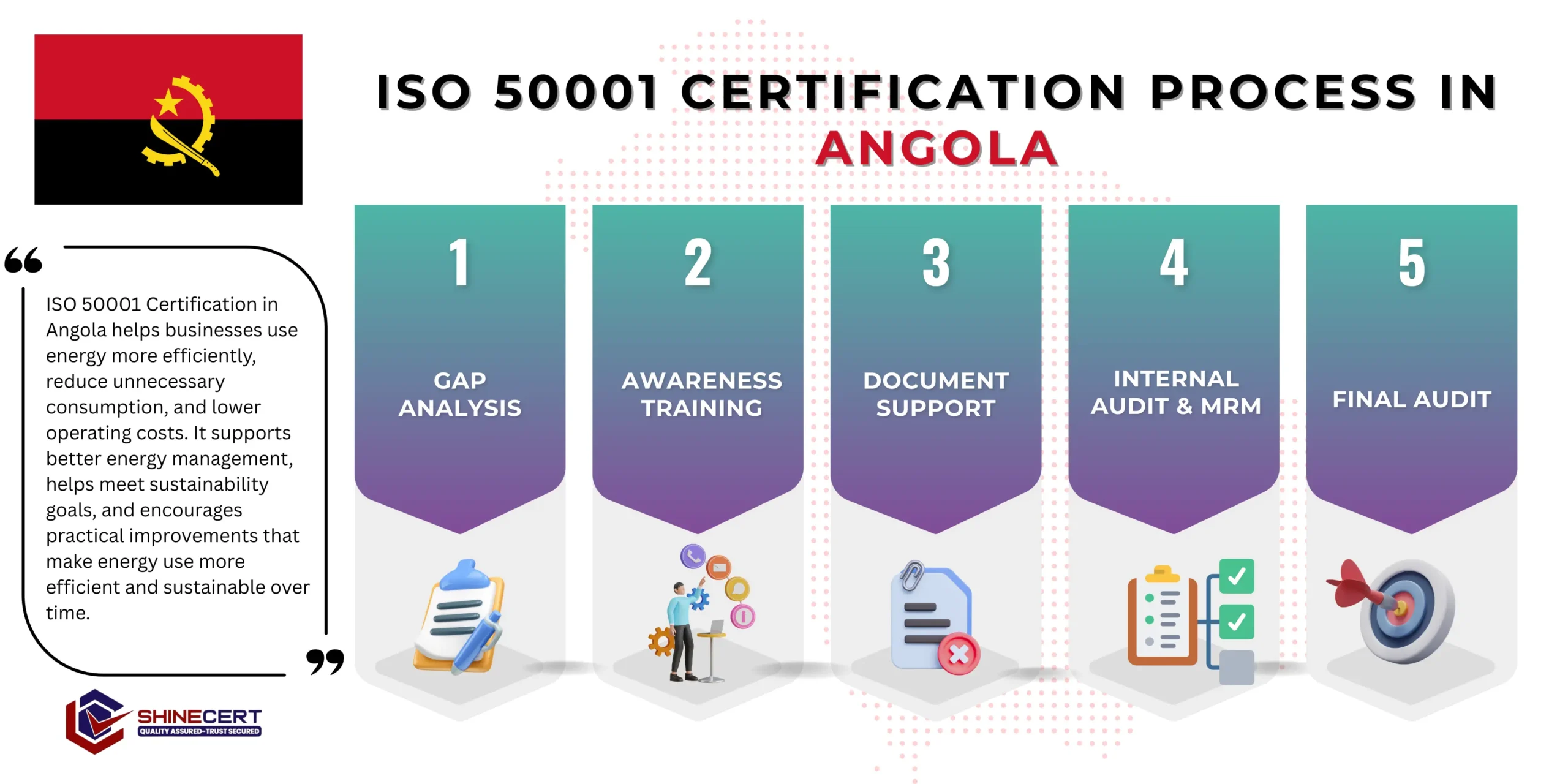
What are the steps to get ISO 50001 Certification in Angola?
our services
- ISO Certification Angola
- ISO 9001 Certification Angola
- ISO 14001 Certification Angola
- ISO 27001 Certification Angola
- ISO 22000 Certification Angola
- ISO 20000-1 Certification Angola
- ISO 45001 Certification Angola
- ISO 42001 Certification Angola
- ISO 13485 Certification Angola
- ISO 17025 Certification Angola
- ISO 31000 Certification Angola
- ISO 22301 Certification Angola
- ISO 27701 Certification Angola
- ISO 37001 Certification Angola
- ISO 50001 Certification Angola
- CE Mark Certification Angola
- GMP Certification Angola
- GDPR Certification Angola
- Halal Certification Angola
The Certification Process
Gap Assessment
Over one to two weeks, we review your facility's actual energy consumption data, equipment, and any existing informal efficiency practices against the standard's requirements. This step typically surfaces genuine, previously unnoticed inefficiencies simply by looking closely at consumption patterns for the first time.
Documentation Development
Over three to five weeks, we build your energy policy, establish an energy baseline reflecting your actual historical consumption, and define energy performance indicators specific to your operations, not generic industry benchmarks.
Implementation and Training
Over three to six weeks, energy monitoring and management practices go live, and relevant staff, facilities, operations, and sometimes procurement, are trained on their specific roles in tracking and improving energy performance.
Internal Audit and Management Review
Over two to three weeks, we run an internal audit against the same criteria the real auditor will use and complete a formal management review, confirming your energy performance indicators are genuinely being tracked before the external audit does.
Certification Audit
Over two to four weeks, an accredited certification body audits your actual energy management practices and issues the certificate once satisfied that your system genuinely tracks and improves energy performance.
How Long Does Certification Take?
| Facility Type | Typical Timeline | Why |
|---|---|---|
| Small facility, limited energy complexity | 3 months | Fewer energy uses to baseline and monitor |
| Medium facility, moderate energy use | 4 months | More equipment and processes to document |
| Large industrial or mining facility | 5 months | Extensive energy-intensive processes to baseline |
- Small facilities with limited energy complexity (around 3 months) : Fewer major energy uses mean a simpler baseline and a shorter list of performance indicators to establish and start tracking.
- Medium facilities with moderate energy use (around 4 months) : More equipment and processes typically mean a broader baseline exercise and more staff coordination to embed monitoring into daily operations.
- Large industrial or mining facilities (around 5 months) : These facilities typically have the most energy-intensive processes and the most complex baseline to establish accurately, given how much historical consumption data needs to be gathered and analyzed.
- The variable that matters most: how much historical energy consumption data you already have in a usable form : Facilities with existing utility billing records organized by area or process move through the baseline-setting stage considerably faster than those with only aggregate, facility-wide billing data.
- A real example : A manufacturing facility we worked with had years of utility bills but only as facility-wide totals, with no breakdown by production line; building a genuine energy baseline meant installing sub-metering on major equipment first, which added roughly five weeks to the original timeline but made the resulting performance indicators considerably more useful for identifying where the real savings actually were.
What Affects the Cost?
- Facility energy profile and complexity : More energy-intensive processes mean a more extensive baseline and monitoring system to establish.
- Current data availability : A facility with granular, existing energy data starts from a stronger position than one with only aggregate billing.
- Number of sites : Multi-site operations require baselines established per location.
- Certification body fees, separate from consulting costs.
Answering the Objections Every Owner Has
- We already try to save energy informally, isn’t that enough? Informal efforts catch obvious waste but rarely identify the systematic opportunities a proper energy baseline and performance indicators reveal, and they don’t demonstrate anything to lenders or partners.
- Isn’t this just paperwork? Only if it’s treated that way. Done properly, it documents energy tracking and target-setting practices that directly translate into cost savings, not compliance theater.
- We’re too small for this : Scope and cost scale with your energy profile and facility size, not the other way around, and smaller facilities often see proportionally larger savings relative to certification cost.
- Can’t our facilities team just track this internally? Tracking consumption is only part of the standard; establishing a genuine energy baseline, setting measurable targets, and structuring an improvement process are what auditors and, more importantly, real savings depend on.
Benefits of ISO 50001 Certification
- Direct, measurable reduction in energy costs : Systematic monitoring identifies real efficiency opportunities that informal management typically misses.
- Better resilience against continued tariff increases : A documented energy baseline and improvement plan help you absorb further cost pressure more effectively than competitors without one.
- Credibility with lenders and international partners : Certification signals broader operational discipline, not just environmental intent.
- Structured data for capital investment decisions : Energy performance indicators give you a genuine basis for deciding where efficiency investments pay off fastest.
- Reduced exposure to future regulatory or tariff shifts : A documented system adapts more easily to further changes in Angola’s energy pricing environment than ad-hoc management.
- A foundation for integrating with ISO 14001 : These standards share complementary environmental and resource-efficiency structures.
Required Documentation
The scope statement defines exactly which facilities and energy uses the certification covers. The energy policy sets top management’s genuine commitment to energy performance improvement, not generic sustainability language.
The energy baseline documents your facility’s historical energy consumption pattern, the foundation everything else measures against. Energy performance indicators give you specific, trackable metrics tied to your actual operations rather than generic industry averages.
Competence and training records prove staff involved in energy monitoring understand their responsibilities. The document control procedure keeps outdated energy procedures from circulating.
Operational controls for significant energy uses document how major energy-consuming equipment and processes are managed day to day. Energy data collection and monitoring procedures keep the tracking system genuinely functioning rather than a one-time exercise.
The internal audit program and reports and management review minutes demonstrate ongoing oversight of energy performance, checking whether real improvement is happening year over year.
Standards and Clauses: What ISO 50001 Actually Requires
- Context of the Organization (Clause 4) : requires identifying energy-related issues relevant to your operations and understanding interested-party expectations, including rising tariff pressures specific to Angola’s current energy pricing environment.
- Leadership (Clause 5) : requires top management to set an energy policy and take visible ownership, with auditors looking for genuine engagement in energy performance, not just a signed document.
- Planning (Clause 6) : requires establishing your energy baseline and performance indicators and planning actions to improve energy performance, the clause underpinning the entire measurement system.
- Support (Clause 7) : covers competence, awareness, and documented information needed to run the system, including training staff to genuinely understand energy performance indicators relevant to their roles.
- Operation (Clause 8) : covers operational controls for significant energy uses and energy-efficient design and procurement considerations, the clause where most day-to-day energy management documentation lives.
- Performance Evaluation (Clause 9) : requires monitoring energy performance against the baseline, internal audits, and management review, checking whether energy use is actually improving over time.
- Improvement (Clause 10) : requires acting on nonconformities and continually improving energy performance, closing the loop between what monitoring reveals and what actually changes operationally.
Case Study: A Manufacturing Facility Facing Rising Tariffs
- A manufacturing facility saw its electricity costs rise sharply as industrial tariff subsidies ended in mid-2025, and needed a systematic way to identify and act on genuine efficiency opportunities.
- Our gap assessment found the facility had only facility-wide utility billing data, no equipment-level energy tracking, and no defined energy performance indicators.
- Over four months, we installed sub-metering on major production equipment, established a genuine energy baseline, and defined performance indicators tied to specific production lines. The certification audit found no major nonconformities.
- The facility identified and implemented efficiency measures on its two most energy-intensive production lines, meaningfully offsetting the impact of the tariff increases within the first year of certification.
Common Mistakes We See
- Setting a baseline using incomplete or aggregated data : A baseline built on facility-wide totals rather than granular consumption data produces performance indicators too vague to act on.
Treating certification as a one-time energy audit : The standard requires ongoing monitoring and improvement, not a single efficiency assessment.
Underinvesting in sub-metering where it’s genuinely needed : Some facilities need better data infrastructure before meaningful performance indicators are even possible. - Choosing a certifier based on speed alone : An unusually fast timeline is often a shortcut on rigor, not efficiency.
Who Actually Needs This?
Manufacturing and industrial facilities
directly exposed to the recent tariff increases and natural gas price adjustments.
Read moreMining and extractive operators
typically among the highest energy consumers in Angola’s economy.
Read moreLarge commercial and logistics facilities
including cold storage and warehousing operations with significant energy footprints.
Read moreWhich Certification Body Should You Choose?
Confirm the certification body holds recognized international accreditation. Be skeptical of unusually fast timelines given the baseline development work the standard requires. Ask whether the consultant can explain how your specific energy performance indicators will be established, not a generic industry template. Confirm the audit reviews actual consumption data and monitoring records.
Choosing the Right Partner?
| DIY | Generic Consultant | ShineCert | |
|---|---|---|---|
| Energy baseline development | Often incomplete | Templated, generic | Mapped to your actual consumption data |
| Timeline realism | Often underestimated | Sometimes overpromised | Set to your real starting point |
| Angola tariff context awareness | Not considered | Rarely integrated | Built around current tariff and pricing pressures |
| Post-certification support | None | Ends at the certificate | Supports ongoing surveillance audits |
Why Businesses Choose ShineCert in Angola?
Across 10 years of ISO consulting and more than 10,000 organizations certified worldwide, coordinated through our Riyadh and India offices, we build energy management systems with ShineCert as the best ISO 50001 consultant in Angola, grounded in Angola’s actual tariff environment and your facility’s real consumption data, not a generic efficiency checklist.
Ready to Get Started?
Whether you’re responding to rising tariffs or building a systematic case for efficiency investment, we’ll assess your real situation and give you a clear, honest quote. Book a free consultation or contact us to get started.
Frequently Asked Questions
No, but rising industrial electricity tariffs under the General Electricity Law framework make it a genuine financial priority for energy-intensive businesses.
It depends on facility energy profile, current data availability, and site count. We quote individually.
Usually three to five months, depending heavily on how much usable historical energy data you already have.
No, but it gives you a systematic process for identifying and acting on genuine efficiency opportunities, which most facilities without one are leaving on the table.
Manufacturing, mining, and any energy-intensive facility facing materially higher electricity costs than in recent years.
Documentation development can happen remotely; the certification audit requires a site visit.
In 2011, revised in 2018 to clarify energy performance indicators and baseline requirements.