
ISO 13485 Certification in Angola
Quick Answer
ISO 13485 certification is an internationally recognized Medical Device Quality Management System credential confirming an organization systematically controls the quality and safety of medical devices across their lifecycle. In Angola, ARMED requires an ISO 9001 or equivalent quality certificate for device import registration, and ISO 13485 goes further, giving manufacturers and distributors a dedicated, internationally credible quality system built specifically for medical devices.
About ISO 13485
ISO 13485 is the world’s leading quality management standard specifically for medical devices. It doesn’t dictate device design or manufacturing methods; it specifies how systematically you control quality, risk, and regulatory compliance across the device lifecycle, from design and production through distribution and post-market surveillance.
Certification means an independent, accredited certification body has audited your actual quality controls, not just reviewed a policy, and confirmed they genuinely meet the standard’s requirements. It’s reissued on a three-year cycle with annual surveillance audits in between.
A brief history of the standard : ISO 13485 was first published in 1996, originally closely aligned with ISO 9001’s structure but tailored for medical device regulatory requirements. It was revised in 2003, and then substantially rewritten in 2016, the current edition, which deliberately moved away from strict alignment with ISO 9001’s structure to focus more heavily on risk management and regulatory compliance across the entire product lifecycle, reflecting how medical device regulation globally had matured well beyond general quality management expectations. Unlike most ISO management standards, ISO 13485:2016 did not adopt ISO’s newer High-Level Structure, a deliberate choice to keep the standard stable for regulators worldwide who reference it directly in device approval processes.
Why It Matters in Angola?
- ARMED oversees medical device regulation in Angola, and registration already expects quality certification : ARMED, Angola’s medicines and health products regulatory agency, requires evidence of a quality management certificate, commonly ISO 9001, as part of device import registration. ISO 13485 is purpose-built for medical devices specifically, giving manufacturers and distributors a stronger, more directly relevant quality credential than a general quality certificate alone.
- What not having a dedicated system actually costs you : Relying only on a general ISO 9001 certificate can mean gaps in the device-specific risk management, traceability, and post-market surveillance controls that ARMED and international distributors increasingly expect. Device recalls or quality incidents without documented controls carry serious reputational and regulatory consequences. And weaker documentation slows down ARMED registration and renewal processes.
- Why is this becoming more relevant in Angola now? As ARMED’s oversight of the local authorized representative requirement has tightened, manufacturers and distributors bringing devices into Angola are finding that a device-specific quality system smooths the registration and renewal process more reliably than general quality certification alone.
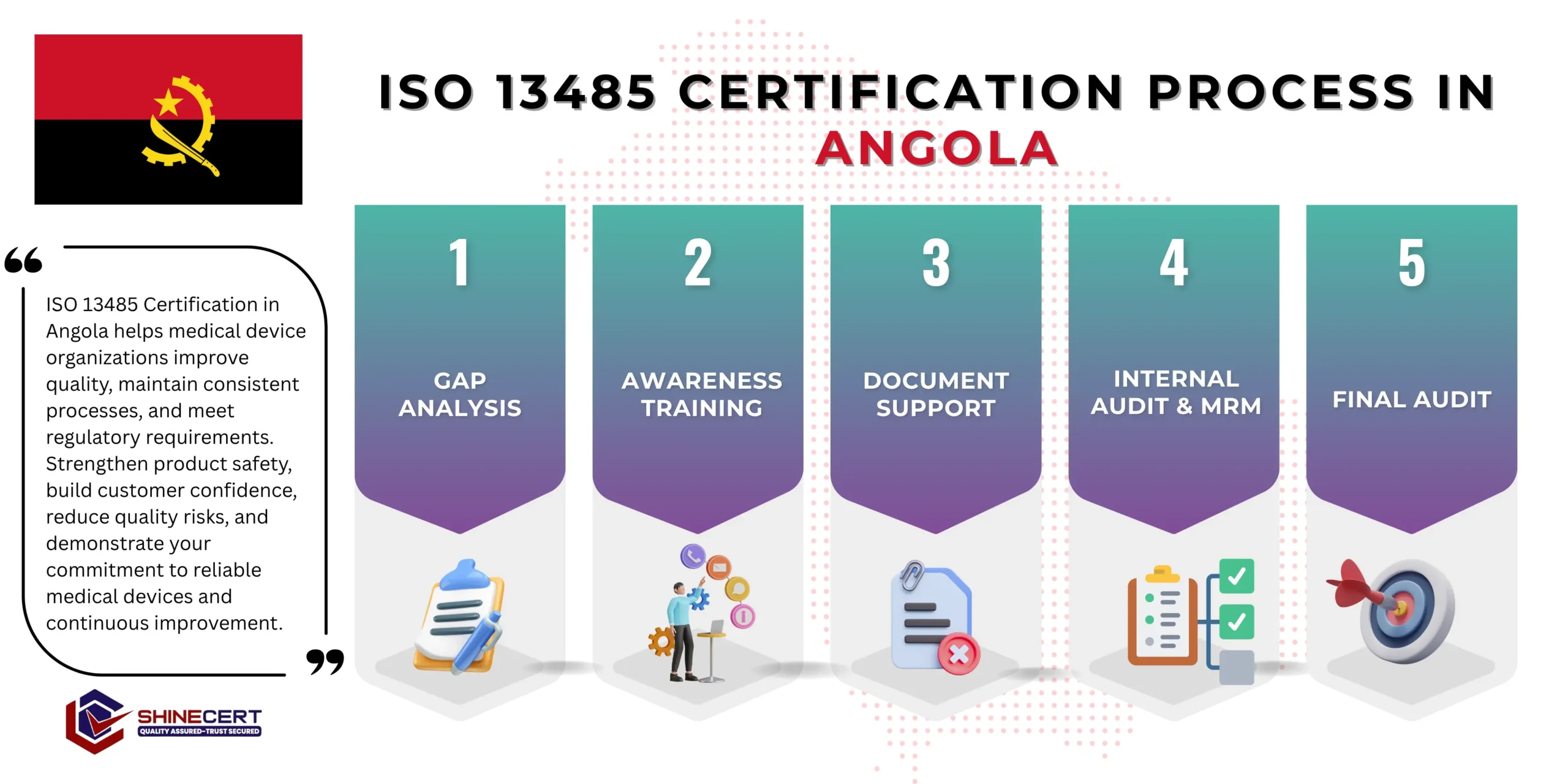
What are the steps to get ISO 13485 Certification in Angola ?
our services
- ISO Certification Angola
- ISO 9001 Certification Angola
- ISO 14001 Certification Angola
- ISO 27001 Certification Angola
- ISO 22000 Certification Angola
- ISO 20000-1 Certification Angola
- ISO 45001 Certification Angola
- ISO 42001 Certification Angola
- ISO 13485 Certification Angola
- ISO 17025 Certification Angola
- ISO 31000 Certification Angola
- ISO 22301 Certification Angola
- ISO 27701 Certification Angola
- ISO 37001 Certification Angola
- ISO 50001 Certification Angola
- CE Mark Certification Angola
- GMP Certification Angola
- GDPR Certification Angola
- Halal Certification Angola
The Certification Process
Gap Assessment
Over one to two weeks, we review your device portfolio, classification, and current quality practices against the standard's requirements, whether you manufacture, distribute, or both. This step identifies specifically where risk management documentation and traceability controls are genuinely missing.
Documentation Development
Over three to six weeks, we build the quality manual and, critically, the risk management file for each device or device family, along with traceability and complaint-handling procedures tailored to your actual product range rather than a generic template.
Implementation and Training
Over four to eight weeks, quality controls go live and staff involved in device handling, whether production, warehousing, or distribution, are trained on their specific responsibilities. This phase often takes longer for manufacturers than distributors, given the added complexity of production controls.
Internal Audit and Management Review
Over two to three weeks, we run an internal audit against the same criteria the real auditor will use and complete a formal management review, catching documentation gaps, especially in the risk management file, before the external audit does.
Certification Audit
Over two to four weeks, an accredited certification body audits your actual quality controls and issues the certificate once satisfied, with particular scrutiny on your risk management file and traceability records.
Gap Assessment
Over one to two weeks, we review your device portfolio, classification, and current quality practices against the standard's requirements, whether you manufacture, distribute, or both. This step identifies specifically where risk management documentation and traceability controls are genuinely missing.
Documentation Development
Over three to six weeks, we build the quality manual and, critically, the risk management file for each device or device family, along with traceability and complaint-handling procedures tailored to your actual product range rather than a generic template.
Implementation and Training
Over four to eight weeks, quality controls go live and staff involved in device handling, whether production, warehousing, or distribution, are trained on their specific responsibilities. This phase often takes longer for manufacturers than distributors, given the added complexity of production controls.
Internal Audit and Management Review
Over two to three weeks, we run an internal audit against the same criteria the real auditor will use and complete a formal management review, catching documentation gaps, especially in the risk management file, before the external audit does.
Certification Audit
Over two to four weeks, an accredited certification body audits your actual quality controls and issues the certificate once satisfied, with particular scrutiny on your risk management file and traceability records.
How Long Does Certification Take?
| Organization Type | Typical Timeline | Why |
|---|---|---|
| Distributor, lower-risk devices | 3 months | Fewer processes to document |
| Distributor or small manufacturer, moderate risk devices | 4–5 months | More controls to align |
| Manufacturer, complex or higher-risk devices | 5–6 months | Extensive design and production controls to document |
- Distributors handling lower-risk devices (around 3 months) : Without design and production controls to document, distributors typically have a narrower scope, focused on traceability, storage, and complaint handling, which moves faster.
- Distributors or small manufacturers with moderate-risk devices (4 to 5 months) : A broader device range or some in-house assembly work adds documentation complexity beyond straightforward distribution.
- Manufacturers of complex or higher-risk devices (5 to 6 months) : Full production control documentation, design controls, and a more extensive risk management file take considerably longer to build properly than distribution-focused documentation.
- The variable that matters most: whether your risk management file already reflects real device-specific analysis : A generic risk assessment copied across device types is one of the most common reasons certification timelines extend, since auditors expect genuine, device-specific risk analysis, not boilerplate language.
- A real example : A distributor we worked with imported both simple diagnostic strips and a more complex imaging device under one registration; because the risk profile of these two device types was completely different, we had to build two genuinely separate risk management approaches rather than one shared document, which added about four weeks to the original estimate but held up cleanly during the certification audit.
What Affects the Cost?
- Device classification and risk level. Higher-risk devices require more extensive risk management documentation.
- Manufacturer vs. distributor scope. Manufacturers require design and production controls that distributors don’t.
- Current quality system maturity. An organization with existing ISO 9001 certification starts from a stronger position.
- Certification body fees, separate from consulting costs.
Answering the Objections Every Owner Has
- We already have ISO 9001, isn’t that enough for ARMED? ISO 9001 satisfies the baseline registration requirement, but ISO 13485 adds device-specific risk management and post-market surveillance controls that increasingly matter for smoother long-term registration and stronger standing with international partners.
- Isn’t this just paperwork? Only if it’s treated that way. Done properly, it documents the quality and risk controls you should already have in place, structured so an auditor and a new employee can both follow them.
- We’re too small a distributor for this : Scope and cost scale with your device classification and operations, not the other way around, and distributors often have a simpler path than manufacturers.
- Can’t we just rely on our supplier’s certification? A supplier’s certification covers their operations, not your distribution and post-market activities, which carry their own documentation requirements.
Benefits of ISO 13485 Certification
- A stronger, more directly relevant credential for ARMED registration : Device-specific quality controls speak more precisely to what ARMED and international partners expect than general quality certification.
- Reduced risk of device quality incidents and recalls : Systematic risk management catches issues before devices reach patients.
- Smoother registration and renewal with ARMED : Documented, auditable evidence supports faster processing.
- Access to international distribution partnerships : Global medical device buyers frequently require ISO 13485 as a baseline requirement.
- Stronger traceability for post-market surveillance : This matters significantly if a device issue is ever investigated.
- A foundation for combining with ISO 9001 or entering new export markets : These standards share much of the same underlying documentation structure.
Required Documentation
The scope statement defines exactly which devices and activities the certification covers. The quality manual documents your overall quality management approach. The regulatory requirements register tracks ARMED obligations specific to your device portfolio.
The risk management file, built per device or device family, is the most heavily scrutinized document in the entire system, documenting specific risks and mitigations for each product. Quality objectives and planning give you measurable targets to track.
Competence and training records prove staff handling devices are properly qualified. Document and record control procedures keep outdated versions from circulating.
Device realization and traceability procedures document how devices are tracked from receipt or production through to the end user, essential for any recall scenario. Complaint handling and vigilance procedures document how device-related complaints or adverse events are managed and reported.
The internal audit program and reports, management review minutes, and post-market surveillance records demonstrate ongoing oversight of device quality, not a one-time certification exercise.
Standards and Clauses: What ISO 13485 Actually Requires
- Context of the Organization (Clause 4) : requires identifying quality and regulatory issues relevant to your operations, including ARMED requirements specific to your device classification.
- Leadership (Clause 5) : requires top management to set a quality policy and take visible ownership, with auditors expecting genuine engagement, not delegation alone.
- Planning (Clause 6) : requires risk-based planning specific to device quality and regulatory compliance, the clause underpinning your risk management file.
- Support (Clause 7) : covers competence, infrastructure, and documented information needed to run the system, including specialized training for device-handling staff.
- Operation (Clause 8) : covers device realization, traceability, and control of nonconforming products, the clause where most day-to-day quality documentation lives.
- Performance Evaluation (Clause 9) : requires monitoring quality performance, complaint handling, internal audits, and management review, checking whether device quality controls are actually working.
- Improvement (Clause 10) : requires corrective action and continual improvement of the quality management system, closing the loop between complaints or incidents and actual changes.
Case Study: A Medical Device Distributor in Luanda
- A medical device distributor in Luanda importing diagnostic equipment needed ISO 13485 certification to strengthen its ARMED registration position and satisfy an international manufacturer’s distribution agreement requirement.
- Our gap assessment found the distributor had a general ISO 9001 certificate but no device-specific risk management file, no formal complaint handling procedure, and no post-market surveillance system.
- Over four months, we built the risk management documentation, established a complaint handling and vigilance procedure, and set up post-market surveillance tracking. The certification audit found no major nonconformities.
- The distributor secured its certificate and finalized the international distribution agreement.
Common Mistakes We See
- Assuming ISO 9001 alone fully satisfies device-specific expectations : ARMED’s baseline requirement doesn’t replace the value of device-specific risk management and traceability.
- Weak traceability from device to end user : This is exactly what auditors and ARMED scrutinize most closely during an incident review.
- Underdeveloped post-market surveillance : A documented system for monitoring devices after distribution is a core, frequently underestimated requirement.
- Choosing a certifier based on speed alone : An unusually fast timeline is often a shortcut on rigor, not efficiency.
Who Actually Needs This?
Medical device distributors and importers
registering devices with ARMED and needing a local authorized representative relationship.
Read moreDiagnostic equipment suppliers
where quality and traceability failures carry direct patient safety consequences.
Read moreHospital and clinical equipment providers
supplying devices into Angola’s healthcare system.
Read moreWhich Certification Body Should You Choose?
Confirm the certification body’s accreditation is internationally recognized and specifically covers medical devices. Be cautious of unusually short timelines given the risk management depth the standard requires. Ask whether the consultant, as the best ISO 13485 consultant in Angola, understands ARMED’s registration process specifically, not just general quality management. Confirm the audit includes genuine review of your risk management file.
Choosing the Right Partner?
| DIY | Generic Consultant | ShineCert | |
|---|---|---|---|
| Risk management documentation | Often incomplete | Templated, generic | Mapped to your actual device portfolio |
| Timeline realism | Often underestimated | Sometimes overpromised | Set to your real starting point |
| ARMED alignment | Not considered | Rarely integrated | Built to support your registration position |
| Post-certification support | None | Ends at the certificate | Supports ongoing surveillance audits |
Why Businesses Choose ShineCert in Angola?
Across 10 years of ISO consulting and more than 10,000 organizations certified worldwide, coordinated through our Riyadh and India offices, we build quality systems that speak directly to ARMED’s registration expectations and your specific device portfolio, not a generic quality template.
Ready to Get Started?
Whether you’re strengthening your ARMED registration position with ShineCert or meeting an international distribution partner’s requirement, we’ll assess your real situation and give you a clear, honest quote. Book a free consultation or contact us to get started.
Frequently Asked Questions
Not by itself, but ARMED’s registration requirements expect quality certification, and ISO 13485 is the more directly relevant, device-specific option.
It depends on device classification, whether you’re a manufacturer or distributor, and current quality system maturity. We quote individually.
Usually three to six months, depending heavily on how genuinely device-specific your existing risk documentation already is.
No, it strengthens your registration position with more directly relevant documented evidence, but ARMED registration remains a separate legal requirement.
Medical device manufacturers, distributors, importers, and clinical equipment suppliers.
Documentation development can happen remotely; the certification audit requires a site visit.
In 1996, revised in 2003, with the current 2016 edition marking a substantial rewrite focused on risk management and regulatory alignment.