
ISO 22000 Certification in Angola
Quick Answer
ISO 22000 certification is an internationally recognized Food Safety Management System credential confirming an organization systematically controls food safety hazards across production and supply. In Angola it’s voluntary, builds directly on HACCP principles, typically takes three to six months, and strengthens your standing with ANSA and with export buyers who expect internationally recognized food safety evidence.
About ISO 22000
ISO 22000 is the world’s leading food safety management standard, built around HACCP hazard analysis principles combined with a broader management-system structure. It doesn’t specify particular recipes or production methods; it specifies how systematically you identify food safety hazards, control them, and improve over time, through documented processes covering the full food chain.
Certification means an independent, accredited certification body has audited your actual food safety controls on-site, not just a paper HACCP plan, and confirmed they genuinely meet the standard’s requirements. It’s reissued on a three-year cycle with annual surveillance audits in between.
A brief history of the standard : ISO 22000 was first published in 2005, building on HACCP principles originally developed in the 1960s for NASA’s food safety program and later formalized internationally through the Codex Alimentarius Commission, a joint FAO and WHO body. The 2005 edition combined these established hazard analysis principles with a formal management-system structure for the first time. The 2018 revision was a substantial rewrite, adopting ISO’s High-Level Structure and, notably, introducing a clearer distinction between operational-level PDCA cycles for hazard control and organization-level PDCA cycles for the broader management system, a structural clarification that had caused confusion under the original 2005 edition.
Why It Matters in Angola?
Angola’s food safety oversight runs through ANSA. ANSA, the national food safety authority, is responsible for food safety regulation and inspection. A certified food safety management system gives you documented, auditable evidence of systematic hazard control that supports smoother inspections and stronger standing with ANSA, beyond what an informal HACCP plan alone provides.
What skipping certification actually costs you. Food safety incidents without documented preventive controls carry real reputational and financial damage, and can trigger production shutdowns. International buyers, particularly in agricultural export markets, increasingly require certified food safety systems as a condition of purchase. And without structured hazard monitoring, safety gaps tend to surface during a customer complaint or inspection rather than being caught internally first.
Why is this gaining urgency in Angola now? As Angola’s non-oil economy grows and agriculture becomes a larger share of output, more food producers and processors are pursuing export markets where certified food safety is a baseline requirement, not a differentiator.
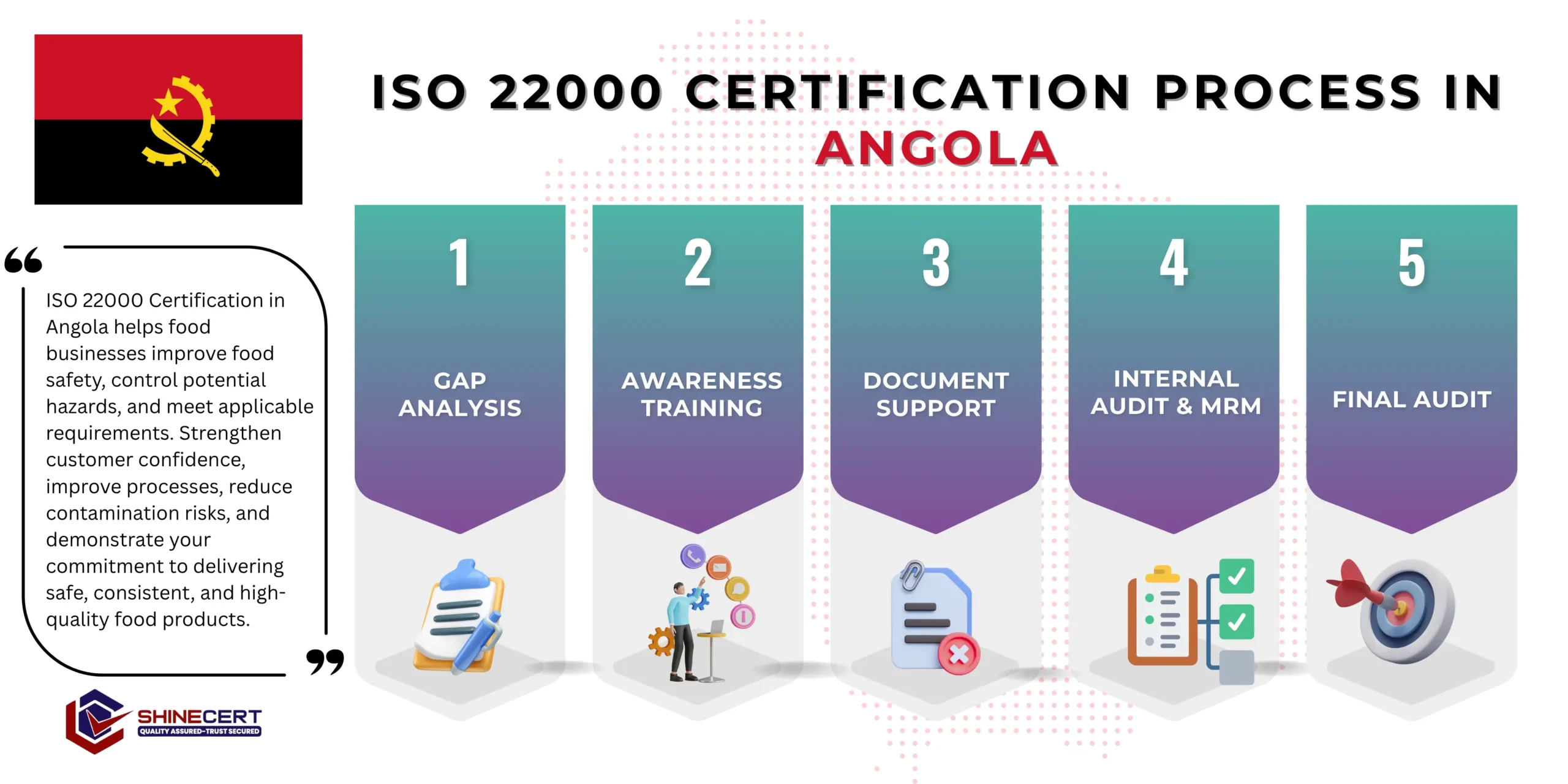
What are the steps to get ISO 22000 Certification in Angola ?
our services
- ISO Certification Angola
- ISO 9001 Certification Angola
- ISO 14001 Certification Angola
- ISO 27001 Certification Angola
- ISO 22000 Certification Angola
- ISO 20000-1 Certification Angola
- ISO 45001 Certification Angola
- ISO 42001 Certification Angola
- ISO 13485 Certification Angola
- ISO 17025 Certification Angola
- ISO 31000 Certification Angola
- ISO 22301 Certification Angola
- ISO 27701 Certification Angola
- ISO 37001 Certification Angola
- ISO 50001 Certification Angola
- CE Mark Certification Angola
- GMP Certification Angola
- GDPR Certification Angola
- Halal Certification Angola
The Certification Process
Gap Assessment
Over one to two weeks, we walk your actual production floor, from raw material intake through packaging and dispatch, and compare current hazard controls against the standard's requirements. Many facilities already have solid informal hygiene practices; the gap assessment identifies exactly where documentation and formal hazard analysis are genuinely missing.
Documentation Development
Over three to six weeks, we build your food safety policy, hazard analysis and critical control point documentation, and prerequisite program procedures, reflecting your specific production process rather than a generic HACCP template.
Implementation and Training
Over four to eight weeks, controls go live and staff, from floor workers to quality supervisors, are trained on hazard control points relevant to their specific role. This phase typically takes the longest because it requires consistent behavior change across every shift.
Internal Audit and Management Review
Over two to three weeks, we run an internal audit against the same criteria the real auditor will use and complete a formal management review, catching gaps in traceability or documentation before the external audit does.
Certification Audit
Over two to four weeks, an accredited certification body audits your actual production floor and documentation, and issues the certificate once satisfied that your hazard controls genuinely function as documented.
Gap Assessment
Over one to two weeks, we walk your actual production floor, from raw material intake through packaging and dispatch, and compare current hazard controls against the standard's requirements. Many facilities already have solid informal hygiene practices; the gap assessment identifies exactly where documentation and formal hazard analysis are genuinely missing.
Documentation Development
Over three to six weeks, we build your food safety policy, hazard analysis and critical control point documentation, and prerequisite program procedures, reflecting your specific production process rather than a generic HACCP template.
Implementation and Training
Over four to eight weeks, controls go live and staff, from floor workers to quality supervisors, are trained on hazard control points relevant to their specific role. This phase typically takes the longest because it requires consistent behavior change across every shift.
Internal Audit and Management Review
Over two to three weeks, we run an internal audit against the same criteria the real auditor will use and complete a formal management review, catching gaps in traceability or documentation before the external audit does.
Certification Audit
Over two to four weeks, an accredited certification body audits your actual production floor and documentation, and issues the certificate once satisfied that your hazard controls genuinely function as documented.
How Long Does Certification Take?
| Facility Type | Typical Timeline | Why |
|---|---|---|
| Small processor, single product line | 3 months | Fewer hazards and processes to document |
| Medium processor, multiple product lines | 4–5 months | More hazard categories to align |
| Large exporter or multi-site operation | 5–6 months | Extensive supply chain controls to document |
- Small processors with a single product line (around 3 months) : Fewer hazard categories and a simpler production process mean a shorter hazard analysis and less training coordination across roles.
- Medium processors with multiple product lines (4 to 5 months) : Each additional product line typically introduces its own hazard profile, meaning the hazard analysis has to be repeated with genuine rigor for each line, not copy-pasted across products.
- Large exporters or multi-site operations (5 to 6 months) : These operations usually have the most extensive traceability requirements, tracking product from multiple suppliers through multiple facilities to export, which extends both documentation and implementation time.
- The variable that matters most: the strength of your existing traceability system : A facility that can already trace a batch from raw material to finished product moves through certification meaningfully faster than one building traceability from scratch, regardless of size.
- A real example : A beverage producer we worked with had strong hygiene practices on the floor but no formal traceability system linking finished product batches back to specific raw material lots; building that traceability system properly, so a recall could genuinely be executed if ever needed, took an additional five weeks beyond the standard documentation timeline, but this piece is exactly what the certification audit and export buyers scrutinize most closely.
What Affects the Cost?
- Production complexity and number of product lines. More hazard categories mean more controls to document and test.
- Current food safety practices. A facility with an existing HACCP plan starts from a stronger position.
- Number of sites. Multi-site operations require hazard analysis documented per location.
- Certification body fees, separate from consulting costs.
Answering the Objections Every Owner Has
- We already have a HACCP plan, isn’t that enough? HACCP principles are built into ISO 22000, but certification adds the management-system structure, an auditable process, documented reviews, and continual improvement, that a standalone plan usually lacks.
- Isn’t this just paperwork? Only if it’s treated that way. Done properly, it documents food safety practices you should be running anyway, just consistently enough for an auditor and a new employee alike to follow.
- We’re too small for this. Scope and cost scale with your production volume and complexity, not the other way around, and smaller producers often move through certification faster.
- Can’t we just do this ourselves? You can attempt it, but the hazard analysis methodology and ongoing monitoring records the standard requires are exactly what auditors scrutinize most closely, and a generic template rarely holds up.
Benefits of ISO 22000 Certification
- Stronger standing during ANSA inspections : Certification gives inspectors documented evidence of systematic hazard control, not a one-time HACCP plan.
- Access to export markets requiring certified food safety : International buyers increasingly require this as a purchase condition.
- Reduced risk of product recalls and contamination incidents : Systematic hazard monitoring catches issues before they reach consumers.
- Stronger consumer and retailer trust : Certification is an independently verified signal in a market where food safety awareness is growing.
- Reduced liability if a food safety incident does occur : Documented preventive controls matter significantly under regulatory and legal scrutiny.
- A foundation for pursuing ISO 9001 or Halal certification alongside food safety : These standards share complementary documentation structures.
Required Documentation
The scope statement defines exactly what products and processes the certification covers. The food safety policy sets top management’s genuine commitment. Prerequisite programs documentation covers the baseline hygiene and sanitation conditions the hazard analysis builds on top of.
The hazard analysis and critical control point determination is the technical core of the system, documenting each identified hazard and how it’s controlled at each stage of production. The legal and regulatory requirements register tracks ANSA obligations so nothing is missed.
Competence and hygiene training records prove staff handling food are properly trained, one of the most commonly checked items during an audit. The document control procedure keeps outdated food safety procedures from circulating on the floor.
Operational prerequisite programs document day-to-day hygiene and sanitation practices. Traceability and recall procedures prove you can trace product from raw material to finished goods and execute a recall if ever needed, closely scrutinized by both auditors and export buyers.
The internal audit program and reports and management review minutes demonstrate ongoing oversight of food safety performance, not a one-time setup exercise.
Standards and Clauses: What ISO 22000 Actually Requires
- Context of the Organization (Clause 4) : requires identifying food safety issues relevant to your operations and understanding interested-party expectations, including ANSA and export buyer requirements.
- Leadership (Clause 5) : requires top management to set a food safety policy and take visible ownership, with auditors looking for genuine engagement, not just a signed document.
- Planning (Clause 6) : requires identifying food safety risks and opportunities and planning hazard control actions, the clause underpinning your hazard analysis work.
- Support (Clause 7) : covers competence, awareness, and documented information needed to run the system, including hygiene training specific to each role on the floor.
- Operation (Clause 8) : covers hazard analysis, prerequisite programs, and traceability and recall procedures, the clause where most day-to-day food safety documentation lives and where auditors spend the most time verifying practice matches paperwork.
- Performance Evaluation (Clause 9) : requires monitoring food safety performance, internal audits, and management review, checking whether hazard controls are actually working over time.
- Improvement (Clause 10) : requires acting on nonconformities and continually improving food safety performance, closing the loop between what monitoring reveals and what actually changes.
Case Study: A Bank in Luanda Deploying AI Credit Scoring
- An agricultural processor in Huambo needed ISO 22000 certification to secure a supply agreement with a regional export buyer requiring internationally recognized food safety evidence.
- Our gap assessment found the processor had informal hygiene practices but no documented hazard analysis, no formal traceability system, and no structured internal audit process.
- Over five months, we built the hazard analysis and critical control point documentation, established a traceability and recall system, and ran the facility’s first internal audit. The certification audit found no major nonconformities.
- The processor secured its certificate and finalized the export supply agreement on schedule.
Common Mistakes We See
- Treating an existing HACCP plan as sufficient on its own : Certification requires the broader management-system structure around it, not just the hazard analysis.
- Documenting idealized processes instead of real ones : Auditors verify against actual production conditions, not what the policy claims.
- Weak traceability and recall procedures : These are exactly what auditors and export buyers scrutinize most closely.
- Choosing a certifier based on speed alone : An unusually fast timeline is often a shortcut on rigor, not efficiency.
Who Actually Needs This?
Food processors and manufacturers
converting raw agricultural output into packaged or processed food products.
Read moreAgricultural exporters
seeking access to international markets where certified food safety is a purchase condition.
Read moreFood service distributors and cold chain operators
where handling and storage controls are critical to food safety.
Read moreWhich Certification Body Should You Choose?
Confirm the certification body’s accreditation is internationally recognized, particularly if you’re targeting export markets. Treat unusually fast timelines with skepticism. Ask the best ISO 22000 consultant in Angola to walk through your specific production process rather than handing you a generic HACCP template. Confirm the audit includes an in-person facility inspection.
Choosing the Right Partner?
| DIY | Generic Consultant | ShineCert | |
|---|---|---|---|
| Hazard analysis | Often incomplete | Templated, generic | Mapped to your actual production process |
| Timeline realism | Often underestimated | Sometimes overpromised | Set to your real starting point |
| ANSA alignment | Not considered | Rarely integrated | Built to support your regulatory position |
| Post-certification support | None | Ends at the certificate | Supports ongoing surveillance audits |
Why Businesses Choose ShineCert in Angola?
Across 10 years of ISO consulting and more than 10,000 organizations certified worldwide, coordinated through our Riyadh and India offices, we build food safety systems with ShineCert around your actual production process and Angola’s ANSA oversight structure, not a generic food safety template.
Ready to Get Started?
Whether you’re strengthening your ANSA standing or securing an export supply agreement, we’ll assess your real situation and give you a clear, honest quote. Book a free consultation or contact us to get started.
Frequently Asked Questions
No, but ANSA’s food safety oversight and export buyer requirements create a strong practical foundation certification that demonstrates compliance more credibly.
It depends on production complexity, site count, and current food safety practices. We quote individually.
Usually three to six months, depending heavily on how strong your existing traceability system already is.
No, it strengthens your regulatory standing with documented evidence, but ANSA’s requirements remain separate legal obligations.
Food processors, agricultural exporters, beverage producers, and cold chain operators.
Documentation development can happen remotely; the certification audit requires a site visit.
In 2005, building on HACCP principles first developed in the 1960s, with a substantial revision in 2018.