
GDPR Certification in Angola
Quick Answer
GDPR, the EU’s General Data Protection Regulation, is not Angolan law, but its extraterritorial scope under Article 3 means it can apply to Angolan businesses that process personal data of individuals in the EU, whether by offering goods or services to them or monitoring their behavior. Angola has its own data protection law, Law 22/11, and GDPR compliance is a separate, additional consideration specifically for businesses with EU-facing operations, most commonly outsourcing, technology, and fintech companies serving European clients.
About GDPR
GDPR is the European Union’s data protection regulation, one of the most comprehensive privacy frameworks in the world, governing how personal data of individuals in the EU is collected, processed, and protected. It applies not just to organizations based in the EU, but, under its extraterritorial scope in Article 3, to any organization anywhere that offers goods or services to individuals in the EU or monitors their behavior, regardless of where the organization itself is located.
For Angolan businesses, this means GDPR isn’t automatically relevant, most purely domestic operations serving only Angolan customers fall outside its scope, but it becomes directly relevant the moment your business processes personal data belonging to individuals in the EU, commonly through outsourcing relationships, software services sold to EU clients, or e-commerce operations with EU customers.
Why It Matters in Angola?
Angola’s outsourcing and technology sector is the primary trigger for GDPR applicability : As Angola’s IT services market grows, and as more Angolan businesses take on outsourcing, software development, or business process work for European clients, GDPR’s extraterritorial reach becomes a genuine, practical compliance question rather than an abstract one. Any Angolan company processing personal data on behalf of an EU client, even as a subcontractor, is very likely bound by GDPR obligations through that client relationship.
How this differs from Angola’s own Law 22/11 : Law 22/11 governs data protection for activities within Angola’s own jurisdiction, overseen by the APD. GDPR is a separate, additional framework that applies specifically when EU individuals’ data is involved, regardless of Law 22/11 compliance. Businesses can be fully compliant with Angola’s domestic law while still having GDPR obligations for their EU-facing activities, since the two frameworks address different jurisdictional triggers, not the same requirement twice.
What not addressing this actually costs you : EU clients increasingly build GDPR compliance verification directly into vendor contracts, meaning Angolan outsourcing and technology providers without demonstrable compliance risk losing contracts to competitors who can prove it. GDPR penalties are also genuinely significant, among the highest of any data protection framework globally, and apply regardless of where the processing organization is based, if EU individuals’ data is involved.
Why is this relevant in Angola right now? As Angola’s outsourcing and technology sector actively grows and pursues international, including European, clients as part of the country’s broader economic diversification, GDPR compliance is becoming a genuine competitive factor in winning and retaining that specific client base.
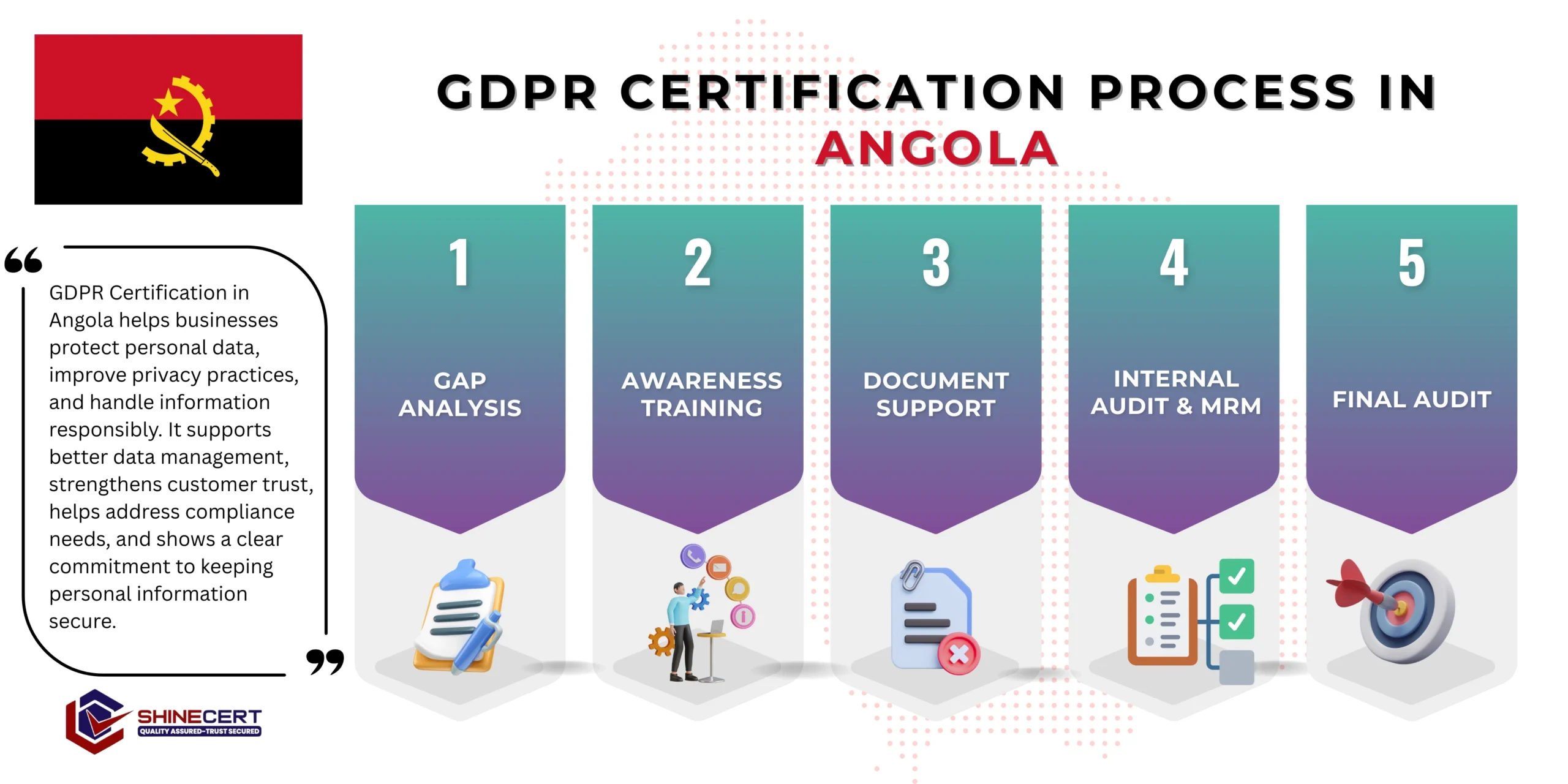
What are the steps to get GDPR Certification in Angola?
our services
- ISO Certification Angola
- ISO 9001 Certification Angola
- ISO 14001 Certification Angola
- ISO 27001 Certification Angola
- ISO 22000 Certification Angola
- ISO 20000-1 Certification Angola
- ISO 45001 Certification Angola
- ISO 42001 Certification Angola
- ISO 13485 Certification Angola
- ISO 17025 Certification Angola
- ISO 31000 Certification Angola
- ISO 22301 Certification Angola
- ISO 27701 Certification Angola
- ISO 37001 Certification Angola
- ISO 50001 Certification Angola
- CE Mark Certification Angola
- GMP Certification Angola
- GDPR Certification Angola
- Halal Certification Angola
The Advisory Process
Applicability Assessment
Over one to two weeks, we determine precisely whether and how GDPR applies to your specific operations, examining your client relationships, data flows, and whether you process data as a controller or processor for EU-related activities. This step often clarifies genuine confusion about whether GDPR applies at all.
Gap Assessment
Over one to two weeks, we compare your current data handling practices against GDPR's specific requirements, distinct from Law 22/11's requirements, identifying exactly where genuine gaps exist.
Documentation Development
Over three to five weeks, we build data processing records, privacy notices, and data subject rights procedures specific to your EU-related processing activities, grounded in your actual client relationships rather than generic templates.
Implementation and Training
Over three to five weeks, procedures go live and staff involved in EU client data handling are trained on their specific responsibilities under GDPR, distinct from any general data protection training already in place for Law 22/11 compliance.
Verification Review
Over one to two weeks, we confirm your practices genuinely align with GDPR requirements, giving you documented evidence to share with EU clients or in response to a contractual compliance request.
How Long Does Certification Take?
| Business Type | Typical Timeline | Why |
|---|---|---|
| Limited EU data processing, single client relationship | 2 months | Narrower scope to document |
| Multiple EU client relationships | 3 months | More data flows and contracts to align |
| Extensive EU-facing operations (outsourcing, tech) | 4 months | Complex data processing across many activities |
- Businesses with limited EU data processing through a single client relationship (around 2 months) : A narrower scope means less data mapping and fewer processing activities requiring documentation.
- Businesses with multiple EU client relationships (around 3 months) : More client relationships typically mean more distinct data processing activities, each requiring its own documentation and contractual alignment.
- Businesses with extensive EU-facing operations, particularly outsourcing and technology providers (around 4 months) : These businesses typically have the widest range of data processing activities tied to European clients, requiring the most comprehensive documentation and staff training.
- The variable that matters most: how clearly you already understand your role, controller or processor, for each EU client relationship : Businesses that have never formally examined this distinction need meaningfully more time in the early assessment stages than those with existing contractual clarity.
- A real example : An outsourcing provider we worked with had five different European clients but had never formally mapped which data processing activities involved EU individuals’ personal data versus purely business data; this mapping exercise alone took an additional three weeks, but it was essential before any meaningful compliance documentation could begin.
What Affects the Cost?
- Number of EU client relationships and data processing activities : More relationships mean more distinct processing activities to document.
- Whether you act as a controller, processor, or both : This shapes which specific General Data Protection Regulation (GDPR) obligations apply to each relationship.
- Current data governance maturity : A business with existing Law 22/11 compliance practices starts from a stronger position, though GDPR-specific gaps still need addressing.
- Advisory fees, since GDPR compliance itself isn’t a certifiable credential in the way ISO standards are.
Answering the Objections Every Owner Has
- We’re an Angolan company, why would EU law apply to us? GDPR’s extraterritorial scope under Article 3 specifically covers non-EU organizations processing EU individuals’ data, regardless of where the organization itself is based; this is a deliberate, well-established feature of the regulation, not an edge case.
- We already comply with Law 22/11, isn’t that enough? No, Law 22/11 and GDPR address different jurisdictional triggers; compliance with Angola’s domestic law doesn’t automatically satisfy GDPR obligations that arise specifically from processing EU individuals’ data.
- Our EU client hasn’t asked about this yet : Many EU clients build GDPR compliance requirements into contracts without a separate explicit conversation; it’s worth confirming rather than assuming it hasn’t come up.
- Isn’t this only relevant to large companies? GDPR applies based on what data you process and whose it is, not your company size; a small outsourcing provider handling EU client data has the same obligations as a larger one.
Benefits of GDPR Compliance Advisory
- Ability to win and retain EU client contracts : Demonstrable GDPR compliance is increasingly a contractual requirement for European outsourcing and technology clients.
- Reduced risk of significant regulatory penalties : GDPR fines are among the most severe of any global data protection framework, and apply regardless of the processing organization’s location.
- Clear separation of Law 22/11 and GDPR obligations : Advisory support helps you understand exactly which framework applies to which of your data processing activities, avoiding both under- and over-compliance.
- Stronger competitive positioning in Angola’s growing outsourcing sector : Compliance readiness is a genuine differentiator as more Angolan providers compete for the same European client base.
- A structural improvement to overall data governance : GDPR-driven documentation often strengthens data handling practices that benefit the business generally, not just EU-facing activities.
- A foundation for pursuing ISO 27001 or ISO 27701 alongside GDPR readiness : These frameworks share substantial documentation overlap.
Required Documentation
The applicability assessment documents exactly which of your activities trigger GDPR obligations and why, the foundational analysis everything else builds on. The data protection policy extends beyond Law 22/11 compliance to address EU-specific requirements.
The record of processing activities documents what personal data you process, for whom, and why, specifically for EU-related activities, a core GDPR requirement. The data processing agreements with EU clients formalize your respective responsibilities as controller or processor.
Staff training records prove employees handling EU client data understand GDPR-specific requirements, distinct from general data protection training. Document control procedures keep processing documentation current as client relationships evolve.
Data subject rights procedures document how you’d handle access, correction, or deletion requests from EU individuals, even if such requests are rare in practice. Data breach notification procedures document how you’d respond to a breach involving EU individuals’ data, given GDPR’s strict notification timelines.
Periodic review records demonstrate ongoing compliance monitoring as client relationships and data flows change over time.
Requirements Explained: What GDPR Actually Covers
- Lawful Basis for Processing requires identifying a valid legal basis, consent, contract, legitimate interest, for each instance of processing EU individuals’ personal data.
- Data Subject Rights require honoring EU individuals’ rights to access, correct, delete, or transfer their personal data, and to object to certain processing.
- Data Processing Agreements require formal contracts between controllers and processors clarifying respective responsibilities, particularly relevant for outsourcing relationships.
- Data Breach Notification requires notifying relevant authorities and affected individuals within strict timelines if a breach involving EU individuals’ data occurs.
- Privacy by Design requires building data protection considerations into new processes and systems from the outset, not retrofitting them afterward.
- Accountability and Documentation require maintaining records demonstrating genuine compliance, not just a stated policy, since GDPR places the burden of proof on the processing organization.
Case Study: An Outsourcing Provider Serving European Client
- An outsourcing provider in Luanda serving several European clients needed to demonstrate GDPR compliance after one client’s procurement team specifically requested documented evidence as part of a contract renewal.
- Our applicability assessment found the provider processed EU customer data for two of its five client relationships, but had never formally mapped which activities specifically triggered GDPR obligations versus purely domestic Law 22/11 considerations.
- Over three months, we built data processing records and data subject rights procedures specific to the two EU-facing client relationships, and formalized data processing agreements clarifying the provider’s role as processor for each.
- The provider successfully renewed its contract with documented evidence satisfying the client’s procurement requirement.
Common Mistakes We See
- Assuming GDPR doesn’t apply because the business is based in Angola : Extraterritorial scope under Article 3 makes location irrelevant if EU individuals’ data is involved.
- Conflating Law 22/11 compliance with GDPR compliance : The two frameworks address different jurisdictional triggers and aren’t automatically satisfied by each other.
- Underestimating data processing agreement requirements with EU clients : These contracts carry specific, non-negotiable clauses many businesses overlook until a client raises them.
- Treating this as a one-time exercise : As client relationships and data flows evolve, GDPR compliance documentation needs periodic review, not a single setup.
Who Actually Needs This?
Outsourcing and business process providers
Outsourcing and business process providers serving European clients, where GDPR obligations frequently flow through client contracts.
Read moreSoftware and technology companies
Software and technology companies selling products or services to individuals or businesses in the EU.
Read moreE-commerce businesses
E-commerce businesses with EU customers, where GDPR applies directly to the customer relationship.
Read moreAny Angolan business processing personal data on behalf of an EU-based client or partner
Any Angolan business processing personal data on behalf of an EU-based client or partner, even as a subcontractor several steps removed from the end customer.
Read moreWhich Advisory Partner Should You Choose?
Confirm the advisor genuinely understands both Law 22/11 and GDPR, and can explain clearly how they differ for your specific business, rather than treating them as interchangeable. Ask about their experience with outsourcing or technology sector clients specifically, given how common EU-facing data relationships are in that space. Be cautious of anyone offering to “certify” GDPR compliance, since GDPR itself has no certification scheme; this is genuinely a documented compliance posture, not a certificate.
Choosing the Right Partner?
| DIY | Generic Consultant | ShineCert | |
|---|---|---|---|
| Applicability determination | Often uncertain | Templated, generic | Specific to your actual EU client relationships |
| Law 22/11 vs. GDPR clarity | Often conflated | Sometimes overlooked | Explained clearly and addressed separately |
| Timeline realism | Often underestimated | Sometimes overpromised | Set to your real starting point |
| Post-advisory support | None | Ends at delivery | Supports ongoing review as client relationships evolve |
Why Businesses Choose ShineCert in Angola?
Across 10 years of ISO and data protection compliance consulting worldwide, coordinated through our Riyadh and India offices, we help Angolan businesses, with ShineCert as the best GDPR consultant in Angola, clearly separate their Law 22/11 obligations from their GDPR obligations, addressing each properly rather than assuming one covers the other.
Ready to Get Started?
Whether an EU client has specifically requested compliance evidence or you want to proactively assess your exposure, we’ll give you an honest assessment of whether and how GDPR applies to your business. Book a free consultation or contact us to get started.
Frequently Asked Questions
Only when processing personal data of individuals in the EU, through offering goods or services to them or monitoring their behavior; purely domestic Angolan operations generally fall outside its scope.
They’re separate frameworks with different jurisdictional triggers; Law 22/11 governs data protection within Angola’s own jurisdiction, while GDPR applies specifically to processing EU individuals’ data, regardless of where the processing organization is based.
It depends on the number of EU client relationships and data processing activities involved. We quote individually.
Usually two to four months, depending heavily on how many EU client relationships and distinct processing activities are involved.
Outsourcing and business process providers, software and technology companies, and e-commerce businesses with EU customers.
Yes, most of this advisory work can be conducted remotely.