
GMP Certification in Angola
Quick Answer
GMP, Good Manufacturing Practice, certification confirms a pharmaceutical manufacturing facility systematically controls production quality to prevent contamination, mix-ups, and errors. In Angola, ARMED specifically requires a WHO-GMP certificate for imported sterile injectables as part of its registration dossier, alongside the five-year CAIM certificate that governs market authorization. Certification typically takes three to six months and directly supports registration under Angola’s recently simplified pharmaceutical licensing framework.
About GMP
Good Manufacturing Practice, or GMP, is a set of quality standards governing pharmaceutical and healthcare product manufacturing, covering facility design, equipment qualification, process validation, and quality control testing. Unlike a single global ISO standard, GMP requirements are typically issued by national or regional regulatory bodies and international organizations like the World Health Organization, with WHO-GMP being one of the most widely recognized frameworks for markets like Angola.
Certification means an independent, accredited inspection body or regulatory authority has audited your actual manufacturing facility and processes, not just reviewed documentation, and confirmed they genuinely meet GMP requirements. Ongoing compliance is verified through periodic re-inspection, similar in spirit to the surveillance audit cycle used by ISO management standards.
Why It Matters in Angola?
ARMED specifically requires WHO-GMP certification for imported sterile injectables, and the broader registration process is becoming more structured : Imported sterile injectables must be supported by a WHO-GMP certificate and filed in Common Technical Document format as part of ARMED’s registration dossier, which includes evaluation of the product file, inspection of the manufacturing site, and laboratory testing of samples before a five-year CAIM certificate, the Certificate of Authorization for Market Introduction, is issued.
What not being certified actually costs you : Without WHO-GMP certification, sterile injectable products simply cannot clear ARMED’s registration process for the Angolan market, a hard requirement rather than a competitive advantage. Manufacturers and distributors without this certification face registration delays or outright rejection, translating directly into lost market access. And ARMED’s broader push toward international regulatory maturity means scrutiny in this area is increasing, not relaxing.
Why this is relevant in Angola right now : Presidential Decree 41/24, issued in January 2024, simplified pharmaceutical sector licensing to attract foreign investment and reduce bureaucratic barriers, and ARMED’s own Institutional Development Plan, running through 2027, targets WHO Maturity Level 3, the internationally recognized benchmark for a fully functional regulatory system. Both signal a market becoming more structured and more serious about GMP compliance, not less.
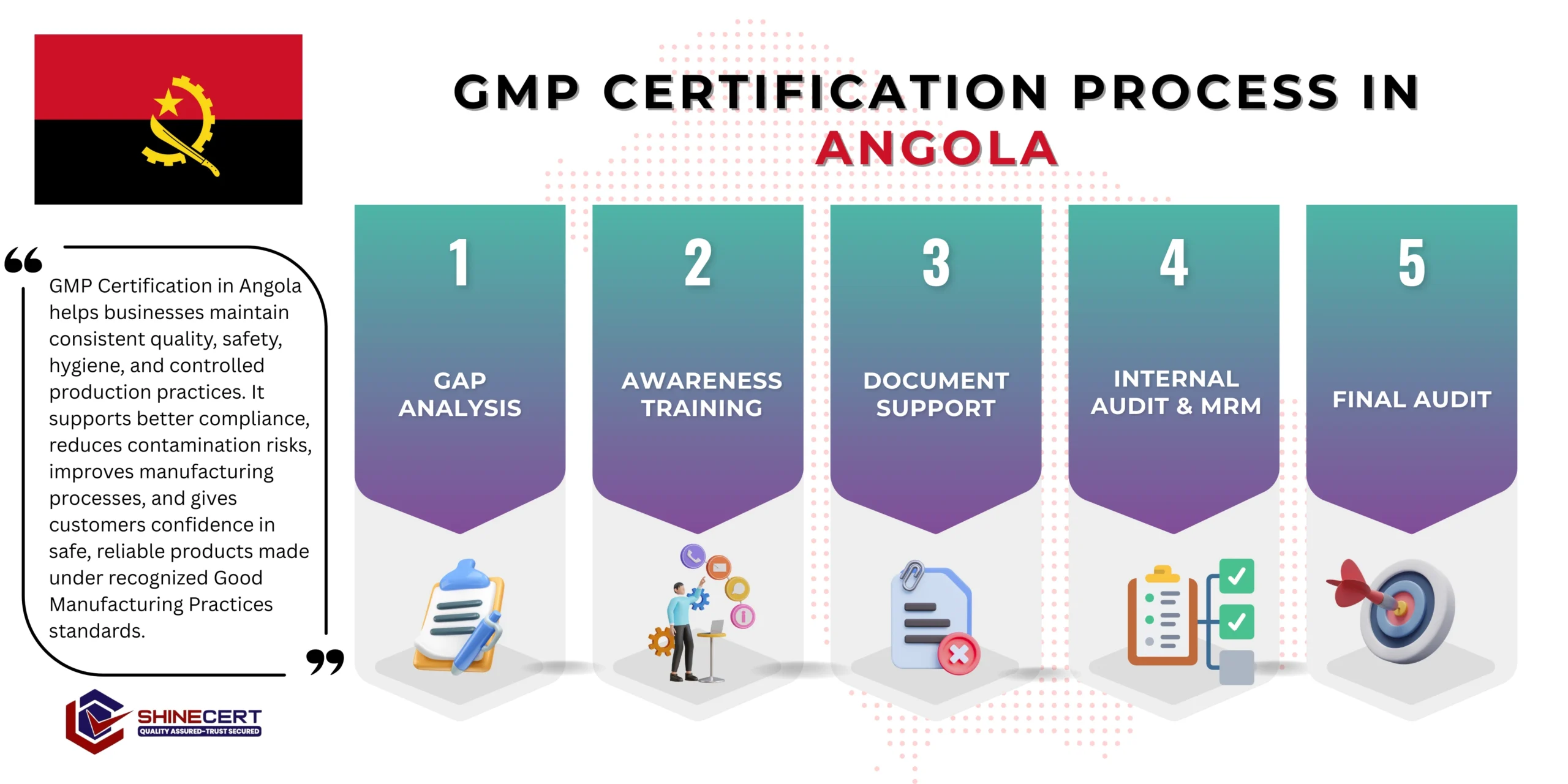
What are the steps to get GMP Certification in Angola?
our services
- ISO Certification Angola
- ISO 9001 Certification Angola
- ISO 14001 Certification Angola
- ISO 27001 Certification Angola
- ISO 22000 Certification Angola
- ISO 20000-1 Certification Angola
- ISO 45001 Certification Angola
- ISO 42001 Certification Angola
- ISO 13485 Certification Angola
- ISO 17025 Certification Angola
- ISO 31000 Certification Angola
- ISO 22301 Certification Angola
- ISO 27701 Certification Angola
- ISO 37001 Certification Angola
- ISO 50001 Certification Angola
- CE Mark Certification Angola
- GMP Certification Angola
- GDPR Certification Angola
- Halal Certification Angola
The Certification Process
Gap Assessment
Over one to two weeks, we review your facility design, equipment, and current manufacturing controls against WHO-GMP requirements, identifying specifically where contamination risk, validation gaps, or documentation weaknesses exist before any remediation begins.
Documentation Development
Over four to eight weeks, we build your quality manual, process validation protocols, and batch record templates, reflecting your actual production process rather than a generic pharmaceutical template. This stage often takes longer than other certifications because validation documentation genuinely requires demonstrating your process works consistently, not just describing it.
Implementation and Training
Over four to eight weeks, manufacturing controls go live and staff across production, quality control, and quality assurance are trained on their specific responsibilities. This phase typically requires the most significant behavior change of any certification, given how central consistent execution is to pharmaceutical manufacturing.
Internal Audit and Management Review
Over two to three weeks, we run an internal audit against the same criteria the real inspection will use and complete a formal management review, catching documentation and process gaps before the external inspection does.
Certification Inspection
Over two to four weeks, an accredited inspection body audits your actual manufacturing facility, including a physical site inspection and review of validation and batch records, and issues the certificate once satisfied.
How Long Does Certification Take?
| Facility Type | Typical Timeline | Why |
|---|---|---|
| Simple formulation, single product line | 3 months | Fewer processes to validate |
| Multiple product lines, moderate complexity | 4–5 months | More validation protocols needed |
| Sterile injectable manufacturing | 5–6 months | Most extensive validation and contamination control requirements |
- Facilities with simple formulation and a single product line (around 3 months) : Fewer manufacturing processes mean a shorter validation exercise and less documentation overall.
- Facilities with multiple product lines of moderate complexity (4 to 5 months) : Each product line typically requires its own validation protocol, meaning genuine, repeated validation work rather than one shared document.
- Sterile injectable manufacturing facilities (5 to 6 months) : These facilities face the most extensive contamination control and validation requirements of any pharmaceutical category, given the direct patient safety stakes of injectable products specifically.
- The variable that matters most: whether your facility already has genuine process validation data, not just standard operating procedures : Facilities with real validation runs already documented move through certification considerably faster than those that have only ever documented intended processes without validating them in practice.
- A real example : A manufacturer we worked with had detailed standard operating procedures but had never formally validated its sterilization process with genuine test runs and documented results; running proper validation studies added roughly six weeks beyond the original estimate, but this exact evidence is what ARMED’s inspection process scrutinizes most closely for injectable products.
What Affects the Cost?
- Product classification and manufacturing complexity : Sterile injectables require the most extensive validation and contamination control documentation.
- Number of product lines. Each product line typically requires its own validation protocol.
- Current facility and process maturity : A facility with existing validation data starts from a meaningfully stronger position.
- Inspection body fees, separate from consulting costs.
Answering the Objections Every Owner Has
- We already have ISO 9001, isn’t that close enough? ISO 9001 is a general quality management standard; GMP is specifically focused on pharmaceutical manufacturing controls, contamination prevention, validation, and testing, that ARMED’s registration process explicitly requires for certain product categories.
- Isn’t this just paperwork? Only if implemented badly. Done properly, it documents manufacturing controls that directly prevent contamination and quality failures, matters of genuine patient safety, not compliance theater.
- We’re a smaller manufacturer, does this really apply to us? If you’re manufacturing sterile injectables for the Angolan market, WHO-GMP certification is a registration requirement regardless of your size; for other product categories, scope and cost scale with your operations.
- Can’t we just rely on our raw material supplier’s certification? A supplier’s certification covers their operations; your own manufacturing, packaging, and quality control processes require their own GMP compliance.
Benefits of GMP Certification
- Direct eligibility to register sterile injectable products with ARMED : This is a hard registration requirement, not optional documentation.
- Smoother CAIM certificate processing : Documented GMP compliance supports faster movement through ARMED’s evaluation, inspection, and testing process.
- Reduced risk of product quality incidents : Systematic manufacturing controls catch contamination and quality issues before products reach patients.
- Stronger positioning as ARMED pursues WHO Maturity Level 3 : Manufacturers already GMP-compliant are better positioned as Angola’s regulatory environment continues maturing.
- Access to international distribution partnerships : Global pharmaceutical buyers and distributors routinely require GMP compliance as a baseline expectation.
- A foundation for pursuing ISO 13485 alongside GMP : These standards share complementary quality and risk management structures for healthcare-related manufacturing.
Required Documentation
The scope statement defines exactly which products and manufacturing lines the certification covers. The quality manual documents your overall manufacturing quality approach specific to pharmaceutical production.
Process validation protocols and reports prove your manufacturing process consistently produces the intended result, the most heavily scrutinized documentation category in any GMP inspection. Equipment qualification records prove your equipment performs as required before it’s used in production.
Personnel training records prove staff understand GMP requirements specific to their roles. Document control procedures keep outdated manufacturing procedures from circulating on the production floor.
Batch manufacturing and packaging records document every step of actual production for every batch, essential both for quality control and for any investigation if an issue arises. Deviation and corrective action records document how manufacturing deviations are handled and resolved.
Internal audit reports and management review minutes demonstrate ongoing oversight of manufacturing quality, not a one-time certification exercise.
Standards and Requirements: What GMP Actually Covers
- Facility and Equipment Design requires manufacturing environments and equipment specifically designed to prevent contamination and mix-ups, verified through physical inspection, not just documentation review.
- Personnel and Hygiene requires trained staff following documented hygiene and gowning procedures appropriate to the manufacturing environment, particularly stringent for sterile production.
- Process Validation requires demonstrating, through genuine test runs and documented results, that your manufacturing process consistently produces products meeting specification, not just describing the intended process.
- Quality Control Testing requires laboratory testing of raw materials, in-process samples, and finished products against defined specifications before release.
- Documentation and Batch Records require complete, contemporaneous records of every manufacturing step for every batch, enabling full traceability if an issue is ever investigated.
- Deviation Management requires a documented process for identifying, investigating, and correcting manufacturing deviations, treated as evidence the quality system functions, not a sign of failure.
Case Study: A Sterile Injectable Manufacturer Registering with ARMED
- A pharmaceutical manufacturer preparing to register a sterile injectable product with ARMED needed WHO-GMP certification as part of its CAIM application.
- Our gap assessment found the manufacturer had solid standard operating procedures but no formally validated sterilization process and incomplete batch record templates.
- Over five months, we ran proper process validation studies, rebuilt batch record documentation to meet CTD filing requirements, and prepared the facility for its WHO-GMP inspection. The inspection found no major nonconformities.
- The manufacturer secured its certificate and successfully progressed its CAIM registration with ARMED.
Common Mistakes We See
- Documenting intended processes without genuine validation data : Inspectors expect to see actual test runs and results, not just procedures describing what should happen.
- Underestimating contamination control requirements for sterile products : These carry the most stringent facility and process requirements of any pharmaceutical category.
- Incomplete batch records : Gaps or inconsistencies in batch documentation are among the most common findings during a GMP inspection.
- Choosing an inspection body without confirming WHO-GMP recognition specifically : Confirm the certification is genuinely accepted by ARMED for your specific registration purpose before committing.
Who Actually Needs This?
Manufacturers of sterile injectable pharmaceutical products
Where WHO-GMP certification is a specific ARMED registration requirement.
Read moreBroader pharmaceutical manufacturers and distributors
Where GMP compliance strengthens overall registration and market credibility even outside the sterile injectable category.
Read moreCompanies entering Angola’s pharmaceutical sector
Under the more accessible licensing framework established by Decree 41/24.
Read moreInternational pharmaceutical companies
Seeking to register products for the Angolan market through local distribution partners.
Read moreWhich Certification Body Should You Choose?
Confirm the inspection body’s WHO-GMP recognition is genuinely accepted by ARMED for your specific product registration. Be cautious of unusually fast timelines given how much genuine validation work the standard requires. Ask whether the consultant can explain your specific validation requirements, not a generic pharmaceutical checklist. Confirm the inspection includes a genuine physical facility visit.
Choosing the Right Partner?
| DIY | Generic Consultant | ShineCert | |
|---|---|---|---|
| Validation documentation | Often incomplete | Templated, generic | Built from genuine validation runs on your process |
| Timeline realism | Often underestimated | Sometimes overpromised | Set to your real starting point |
| ARMED and CAIM alignment | Not considered | Rarely integrated | Built to support your specific registration pathway |
| Post-certification support | None | Ends at the certificate | Supports ongoing surveillance and re-inspection |
Why Businesses Choose ShineCert in Angola?
Across 10 years of ISO and pharmaceutical quality consulting worldwide, coordinated through our Riyadh and India offices, we build GMP systems with ShineCert as the best GMP consultant in Angola, grounded in ARMED’s actual registration requirements and CAIM process, not a generic pharmaceutical quality template.
Ready to Get Started?
Whether you’re registering a sterile injectable product with ARMED or strengthening your broader pharmaceutical manufacturing quality position, we’ll assess your real situation and give you a clear, honest quote. Book a free consultation or contact us to get started.
Frequently Asked Questions
For sterile injectable imports specifically, yes, ARMED requires a WHO-GMP certificate as part of registration. For other pharmaceutical categories, it strengthens your registration position significantly even where not strictly mandated.
It depends on product classification, manufacturing complexity, and current validation maturity. We quote individually.
Usually three to six months, depending heavily on whether genuine process validation data already exists.
No, it’s typically a required supporting document within the broader CAIM registration process, not a replacement for it.
Manufacturers and distributors of sterile injectables specifically, and pharmaceutical manufacturers more broadly seeking stronger ARMED registration positioning.
Documentation development can happen remotely; the certification inspection requires a physical site visit.