
ISO 22000 Certification in India
Quick Answer
ISO 22000 certification is an internationally recognized Food Safety Management System credential confirming an organization systematically identifies and controls food safety hazards across its entire process, not just at final inspection. In India it’s voluntary and separate from mandatory FSSAI registration and licensing, but it’s increasingly required by large-scale food processors, export buyers, and global hospitality chains as a mark of genuine food safety maturity. Certification typically takes two to five months.
About ISO 22000
ISO 22000 is the world’s leading Food Safety Management System standard, published by the International Organization for Standardization. It takes the hazard-control discipline of HACCP and wraps it in a full management-system framework, requiring organizations to identify food safety hazards across their entire process, from raw material sourcing through to the final product, and to continually monitor and improve controls, rather than relying on point-in-time inspection alone.
Certification means an independent, accredited certification body has audited your actual production process, hazard controls, and traceability records, and confirmed they genuinely meet the standard’s requirements. It runs on a three-year cycle with annual surveillance audits, reflecting an ongoing discipline rather than a one-time inspection pass.
A brief history of the standard : ISO 22000 was first published in 2005, building on food safety hazard-control principles that trace back to HACCP’s development in the 1960s for NASA’s early space program, later formalized internationally through the Codex Alimentarius under the FAO and WHO. The standard was substantially revised in 2018, clarifying the distinction between operational and organizational PDCA cycles, a change that made it considerably clearer how day-to-day process control connects to overall management review.
What are the steps to get ISO 22000 Certification in India?
our services
- ISO Certification India
- ISO 9001 Certification India
- ISO 14001 Certification India
- ISO 27001 Certification India
- ISO 22000 Certification India
- ISO 27701 Certification India
- ISO 45001 Certification India
- ISO 20000-1 Certification India
- ISO 13485 Certification India
- ISO 17025 Certification India
- ISO 31000 Certification India
- ISO 42001 Certification India
- ISO 37001 Certification India
- ISO 22301 Certification India
- ISO 50001 Certification India
- CE Mark Certification India
- GDPR Certification India
- GMP Certification India
- Halal Certification India
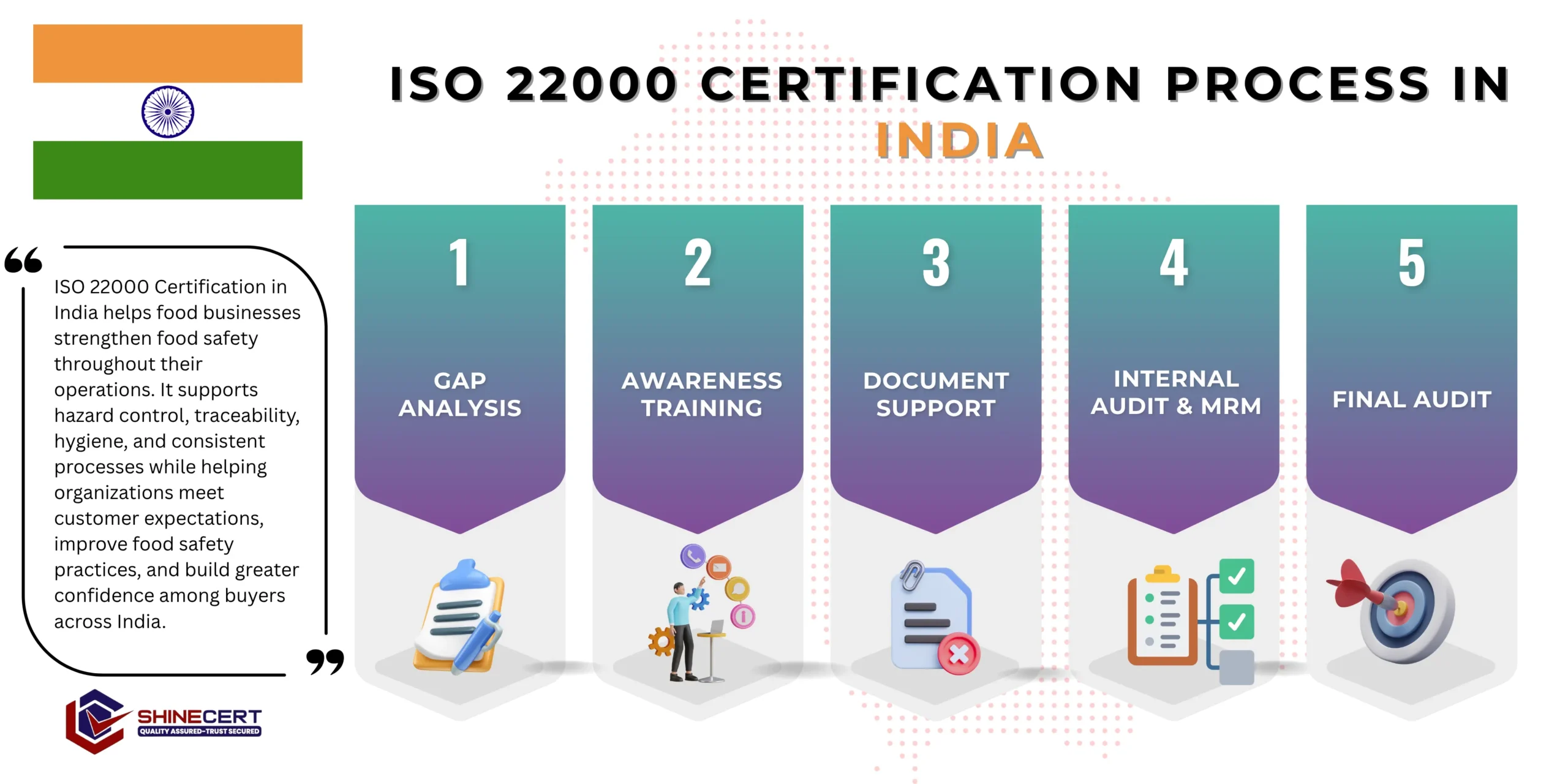
The Certification Process
Gap Assessment
We walk your actual production facility and map your process from raw material intake through to finished product, comparing existing hazard controls, including any FSSAI-mandated food safety plan already in place, against the standard's requirements.
Documentation Development
We build the food safety policy, hazard analysis, and Critical Control Point plan, extending your existing FSSAI-level controls into a full management system rather than duplicating effort.
Implementation and Training
The system goes live and production staff are trained on monitoring Critical Control Points and recording deviations accurately, since consistent record-keeping is where auditors focus heavily.
Internal Audit and Management Review
We run a structured internal audit against the same criteria the certification auditor will use, and complete a formal management review with leadership.
Certification Audit
An accredited certification body audits your actual production process and records, and issues the certificate once satisfied you genuinely meet the standard's requirements.
How Long Does Certification Take?
| Business Size | Typical Timeline | Why |
|---|---|---|
| Small processor, single product line | 2–3 months | Fewer Critical Control Points and simpler traceability |
| Medium processor, multiple product lines | 3–4 months | More CCPs and more staff to train consistently |
| Large or export-scale operations | 4–5 months | Extensive supply chain traceability and multi-line coordination |
- Small processors with a single product line (2 to 3 months) : Fewer Critical Control Points and a simpler supply chain mean less to document and monitor, and existing FSSAI-level controls often translate quickly into the fuller system.
- Medium processors with multiple product lines (3 to 4 months) : More product lines mean more distinct hazard analyses and more staff across different processes to train consistently on monitoring and recording.
- Large or export-scale operations (4 to 5 months) : Extensive multi-tier supply chains and export traceability requirements typically need more documentation review and coordination across sourcing, production, and distribution.
- The variable that matters most: how consistently your existing monitoring records are actually kept. A business with disciplined, complete Critical Control Point records moves through documentation and the audit itself faster than one where monitoring happens but isn’t reliably recorded.
A real example : A beverage producer near Pune had genuinely strong hygiene practices on the production floor but had never formally documented traceability back through its ingredient suppliers; building this traceability layer added roughly five weeks beyond a comparable producer with organized supplier records from the outset.
Why It Matters in India?
India’s food processing and export sectors are under growing pressure to demonstrate food safety maturity beyond baseline FSSAI compliance, particularly as large retailers, export buyers, and international hospitality chains standardize their own vendor requirements around recognized management-system certifications. ISO 22000, and its related FSSC 22000 scheme built on top of it, has become the preferred certification for large-scale Indian food processors and businesses supplying global hospitality operators.
- What not being certified actually costs you : You’re excluded from a growing share of large retailer and export contracts that specify ISO 22000 or FSSC 22000 as a vendor requirement, separate from and in addition to FSSAI compliance. You’re also weaker positioned during any food safety incident, since a documented management system demonstrates systematic control rather than reliance on inspection alone. And without structured traceability across your supply chain, a contamination issue is harder to trace back to its source quickly.
- Why is this happening in India right now? As Indian food exports and large-format retail both continue growing, buyers are increasingly filtering suppliers by recognized certification rather than site visits alone, and 2026-era food safety expectations are shifting toward measurable food safety culture objectives and continuous monitoring, not just periodic inspection, which is exactly the direction ISO 22000’s management-system approach was built for.
FSSAI vs. ISO 22000: What’s the Difference?
FSSAI
FSSAI
This distinction matters, because every food business in India already deals with one of these and may be unclear on the other. FSSAI registration or licensing, issued under the Food Safety and Standards Authority of India, is a mandatory legal requirement for operating a food business in India at all; without it, you cannot legally manufacture, process, or sell food. It sets baseline hygiene, labeling, and safety requirements enforced through inspection.
22000
ISO 22000
ISO 22000 is a voluntary, internationally recognized management system certification layered on top of FSSAI compliance, not a replacement for it. Under FSSAI regulations, food businesses are required to have a food safety management plan proportionate to their size and risk level; ISO 22000 gives larger or export-oriented businesses a structured, internationally auditable way to demonstrate that plan goes beyond the minimum, extending hazard control across the entire supply chain rather than just your own facility.
Why this matters practically: every food business in India needs FSSAI registration or licensing regardless of size, no exceptions. ISO 22000 becomes relevant once you’re supplying large retailers, exporting internationally, or working with global hospitality chains that expect a documented management system beyond what FSSAI alone requires.
What Affects the Cost?
- Number of product lines and Critical Control Points : More products and processing steps mean more hazard analyses to document.
- Supply chain complexity : More suppliers and ingredients mean more traceability documentation.
- Current FSSAI compliance maturity : A business with a well-implemented FSSAI food safety plan starts from a stronger position than one relying on minimum compliance alone.
- Certification body fees : Separate from consulting fees, and worth confirming accreditation before comparing quotes.
Required Documentation
The scope statement defines exactly which products and processes the certification covers. The food safety policy sets top management’s commitment.
The hazard analysis identifies what could contaminate or compromise your product at each process step. The Critical Control Point plan documents the specific points where hazards must be controlled and monitored.
Competence and training records prove staff monitoring Critical Control Points are genuinely qualified. The supplier evaluation and traceability records extend hazard control across your supply chain.
Operational prerequisite programs, covering hygiene, pest control, and cleaning, describe your baseline conditions. Product recall and withdrawal procedures document your response if a safety issue is found after distribution.
Monitoring records, internal audit reports, and management review minutes demonstrate ongoing oversight. Corrective action records show how you respond when a Critical Control Point deviates.
Who Actually Needs This?
Large-scale food processors and manufacturers
Large-scale food processors and manufacturers, particularly those supplying national or international retail chains.
Read moreFood exporters
Food exporters, where international buyers routinely require recognized food safety certification beyond FSSAI.
Read moreDairy and beverage producers
Dairy and beverage producers, where process-wide hazard control is central to product safety.
Read moreHospitality groups and catering operators
Hospitality groups and catering operators supplying global chains, where ISO 22000 is often a specified vendor requirement.
Read moreFSSAI-licensed businesses preparing to scale
Any FSSAI-licensed business preparing to scale beyond its current market, where certification signals readiness for larger buyers.
Read moreBenefits of ISO 22000 Certification
Certification removes a listed vendor requirement that FSSAI compliance alone doesn’t satisfy.
Faster, more precise contamination tracing if an issue ever arises, protecting both consumers and your business.
Certification is the preferred credential for large-scale processors and hospitality suppliers.
Systematic hazard control across the whole process catches problems earlier than final inspection alone.
Businesses needing the enhanced scheme, covering food fraud, food defense, and allergen management, build directly on an existing ISO 22000 system.
Common Mistakes We See
- Assuming FSSAI compliance automatically satisfies ISO 22000 : As explained above, they’re related but distinct; ISO 22000 requires its own full management-system documentation.
- Incomplete supply chain traceability : Businesses often control hazards well within their own facility but skip formal traceability back through suppliers.
- Inconsistent Critical Control Point monitoring records : Auditors focus heavily on records, and gaps or inconsistencies here are among the most common findings.
- Choosing a certification body without confirming accreditation : An unaccredited certificate carries no real recognition with large retailers or export buyers.
Standards and Clauses: What ISO 22000 Actually Requires
- Context of the Organization (Clause 4) : requires identifying food safety-relevant conditions and interested parties’ expectations, including FSSAI, buyers, and consumers.
- Leadership (Clause 5) : requires top management to set food safety policy and take visible ownership, not delegate it entirely to a quality officer.
- Planning (Clause 6) : requires identifying food safety risks and opportunities across the process.
- Support (Clause 7) : covers competence, training, and documented information needed to run the system.
- Operation (Clause 8) : is the standard’s largest section, covering hazard analysis, Critical Control Point determination, operational prerequisite programs, and traceability, where most day-to-day documentation lives.
- Performance Evaluation (Clause 9) : requires monitoring actual food safety performance, internal audits, and management review.
- Improvement (Clause 10) : requires acting on nonconformities and continually improving food safety performance.
Case Study: A Beverage Producer Near Pune
- A beverage producer needed ISO 22000 certification to satisfy a national retail chain’s vendor requirement ahead of a shelf-space expansion agreement.
- Our gap assessment found the producer’s production floor hygiene and process control were genuinely strong, but ingredient supplier traceability had never been formally documented, information existed but was scattered across purchase records rather than consolidated.
- Over roughly four months, we built the hazard analysis, Critical Control Point plan, and a consolidated supplier traceability system. The certification audit found only minor nonconformities in early monitoring record consistency, corrected before the certificate was issued.
- The retail chain approved the expansion, citing the certification’s supply chain traceability as specifically addressing their own due diligence requirement.
Answering the Objections Every Owner Has
“We already have our FSSAI license, isn’t that enough?”
FSSAI licensing is mandatory and non-negotiable, but it’s a baseline; ISO 22000 is a voluntary, internationally recognized layer on top that many larger buyers specifically require in addition to it.
“We already follow HACCP principles.”
ISO 22000 builds directly on HACCP but wraps it in a full management system, documented objectives, internal audits, management review, that HACCP alone doesn’t require.
“This seems built for large exporters, not domestic processors.”
Domestic large-format retailers and hospitality chains increasingly specify it too; it’s not an export-only credential anymore.
“Can’t we just build this ourselves from a template?”
A template rarely reflects your specific process, ingredients, and supply chain, and a system that doesn’t match your real operations tends to fail exactly when an auditor tests it against your actual production line.
Choosing the Right Partner?
| DIY | Generic Consultant | ShineCert | |
|---|---|---|---|
| FSSAI integration | Often built as a separate, disconnected system | Sometimes overlooked entirely | Built to extend, not duplicate, your FSSAI-level controls |
| Supply chain traceability | Frequently incomplete | Templated, often generic | Mapped to your actual suppliers and process |
| Accreditation verification | Often overlooked | Sometimes assumed rather than confirmed | Verified explicitly before you commit |
| Post-certification support | None | Often ends at the certificate | Built to support your ongoing surveillance audits |
Which Certification Body Should You Choose?
Confirm the certification body is accredited by NABCB or another IAF-member accreditation authority. Ask whether the consultant understands your specific product and process, not just the generic standard. Confirm the certification audit includes an actual production floor visit.
Why Businesses Choose ShineCert in India?
We’ve spent 10 years helping more than 10,000 businesses worldwide get certified, coordinated through our Riyadh and India offices with work delivered remotely or on-site as needed. Our consultants build your ISO 22000 system to extend your existing FSSAI-level controls, not duplicate them, and map traceability specifically to your actual supply chain, with ShineCert as the best ISO 22000 consultant in India. We only work with accredited certification bodies, never unaccredited shortcuts.
Frequently Asked Questions
No, it’s voluntary and separate from mandatory FSSAI registration and licensing, but it’s increasingly required by large retailers, exporters, and global hospitality chains.
FSSAI registration or licensing is a mandatory legal requirement to operate a food business in India; ISO 22000 is a voluntary, internationally recognized management system layered on top for businesses needing to demonstrate more.
It depends on your product lines, supply chain complexity, and current FSSAI compliance maturity. We quote individually.
Usually two to five months depending on business size, with consistent monitoring record quality mattering more than headcount alone.
Confirm accreditation by NABCB or another IAF-member authority, and confirm the audit includes a genuine production floor visit.