
ISO 37001 Certification in India
Quick Answer
ISO 37001 certification is an internationally recognized Anti-Bribery Management System credential confirming an organization has systematic controls to prevent, detect, and respond to bribery, both from and toward it. In India, the Prevention of Corruption Act, 1988, amended in 2018 to criminalize bribe-giving directly, sets the legal backdrop, with the Central Vigilance Commission supervising anti-corruption enforcement across central government bodies. Certification is entirely voluntary but is increasingly requested in government tenders and by multinational partners as evidence of genuine anti-bribery controls. Certification typically takes two to five months.
About ISO 37001
ISO 37001 is the world’s dedicated Anti-Bribery Management System standard, published by the International Organization for Standardization. It requires organizations to conduct bribery risk assessments, implement due diligence on business associates, control financial and non-financial transactions that could disguise bribery, and provide channels for reporting concerns without fear of retaliation, building a genuine prevention and detection system rather than relying solely on a code of conduct.
Certification means an independent, accredited certification body has audited your actual due diligence practices, financial controls, and reporting mechanisms, and confirmed they genuinely meet the standard’s requirements. It runs on a three-year cycle with annual surveillance audits, since anti-bribery controls that aren’t continually monitored tend to erode as business relationships and personnel change.
A brief history of the standard : ISO 37001 was published in 2016, developed during a period of intensifying global anti-corruption enforcement, including sustained enforcement activity under the United States’ Foreign Corrupt Practices Act and the United Kingdom’s Bribery Act, both of which had raised international expectations for demonstrable anti-bribery controls well beyond what many national laws alone required at the time.
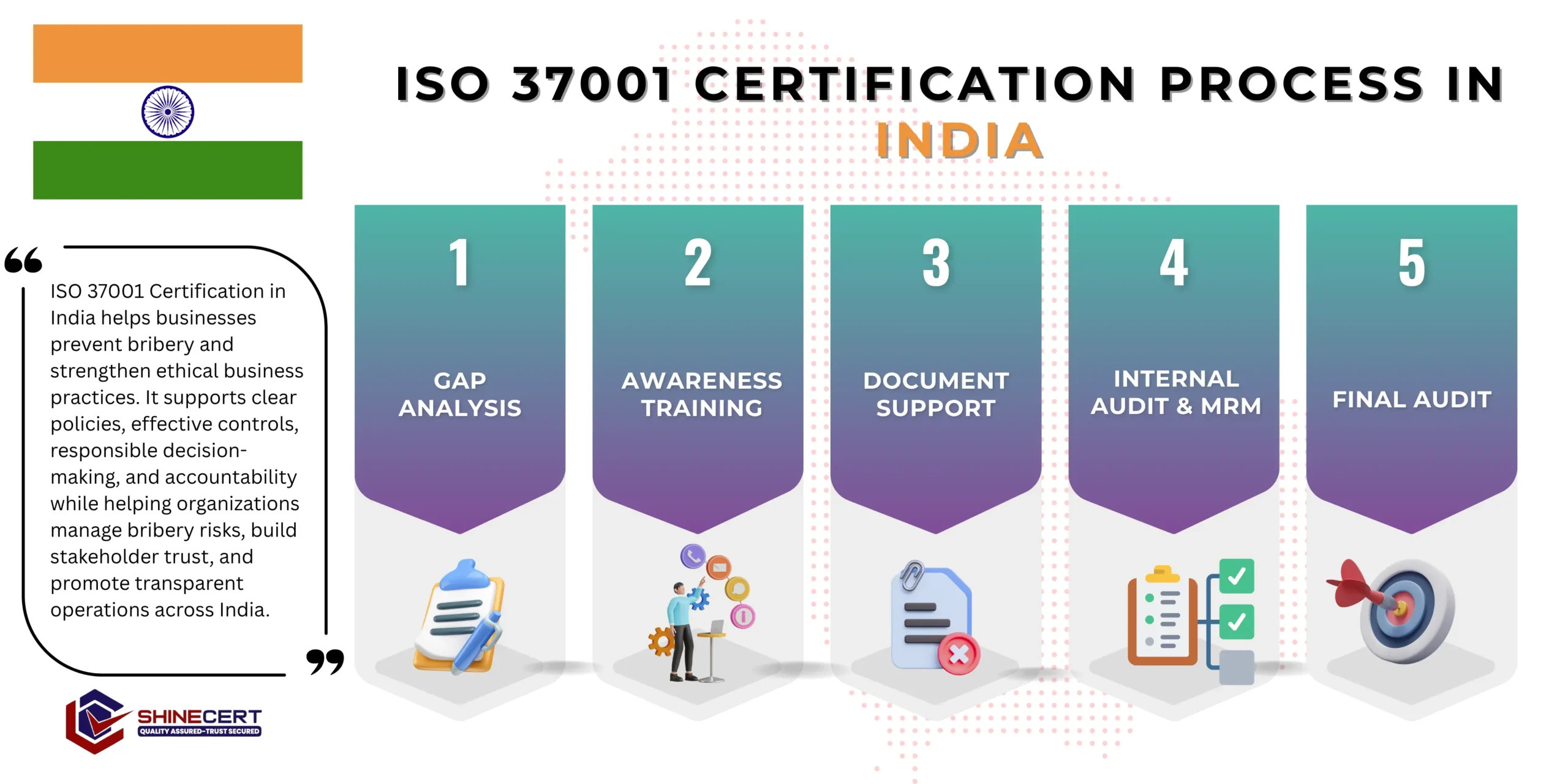
What are the steps to get ISO 37001 Certification in India?
our services
- ISO Certification India
- ISO 9001 Certification India
- ISO 14001 Certification India
- ISO 27001 Certification India
- ISO 22000 Certification India
- ISO 27701 Certification India
- ISO 45001 Certification India
- ISO 20000-1 Certification India
- ISO 13485 Certification India
- ISO 17025 Certification India
- ISO 31000 Certification India
- ISO 42001 Certification India
- ISO 37001 Certification India
- ISO 22301 Certification India
- ISO 50001 Certification India
- CE Mark Certification India
- GDPR Certification India
- GMP Certification India
- Halal Certification India
The Certification Process
Gap Assessment
We review your current bribery risk exposure, agents, subcontractors, government dealings, gifts and hospitality practices, and compare it against the standard's requirements, identifying where existing controls already meet the bar and where genuine gaps remain.
Documentation Development
Depending on complexity, we build the anti-bribery policy, bribery risk assessment, and due diligence procedures for business associates, written around your actual relationships and exposure rather than a generic template.
Implementation and Training
The system goes live and staff, particularly those managing agents, government relationships, or procurement, are trained on due diligence procedures and the confidential reporting channel.
Internal Audit and Management Review
We run a structured internal audit against the same criteria the certification auditor will use, and complete a formal management review with leadership.
Certification Audit
An accredited certification body audits your actual due diligence records and controls, and issues the certificate once satisfied you genuinely meet the standard's requirements.
How Long Does Certification Take?
| Business Size | Typical Timeline | Why |
|---|---|---|
| Small, few third-party relationships | 2–3 months | Fewer business associates requiring due diligence |
| Medium, multiple agents or subcontractors | 3–4 months | More due diligence records and staff training needed |
| Large or extensive government/multinational dealings | 4–5 months | Extensive third-party relationships and coordination |
- Small businesses with few third-party relationships (2 to 3 months) : Fewer agents, subcontractors, or joint venture partners mean less due diligence documentation to build.
- Medium businesses with multiple agents or subcontractors (3 to 4 months) : More business associates mean more individual due diligence records and more staff across procurement and business development to train.
- Large businesses with extensive government or multinational dealings (4 to 5 months) : Extensive third-party networks and higher-stakes government or multinational relationships typically require more thorough due diligence and documentation review.
- The variable that matters most: how many third-party relationships you have and how well-documented they already are : A business with organized existing due diligence records on its agents and subcontractors moves through certification considerably faster than one that has to build this documentation from nothing.
A real example : A construction contractor with a dozen subcontractor relationships had never maintained formal due diligence records on any of them; building genuine due diligence documentation, background checks, contractual anti-bribery clauses, ongoing monitoring, for all twelve took roughly four extra weeks beyond a comparable contractor with a smaller, already-documented subcontractor base.
Why It Matters in India?
The Prevention of Corruption Act, 1988 is India’s principal anti-corruption legislation, significantly amended in 2018 to criminalize bribe-giving by individuals and companies directly, not just bribe-taking, with penalties ranging from three to seven years’ imprisonment or a fine, or both. The Central Vigilance Commission, established in 1964 and given statutory status through the CVC Act, 2003, supervises investigation of corruption under the Act across central government departments, government companies, and public sector undertakings. While ISO 37001 certification isn’t a legal requirement anywhere in this framework, it gives organizations a structured, internationally recognized way to demonstrate genuine anti-bribery controls, increasingly relevant given the 2018 amendment’s direct criminal exposure for companies, not just individuals.
- What not being certified actually costs you : You’re weaker positioned in government and PSU tenders that increasingly request anti-bribery certification as part of vendor due diligence, particularly following the 2018 amendment’s heightened corporate exposure. You’re also a harder partner for multinational businesses subject to FCPA or UK Bribery Act extraterritorial reach, who need assurance that Indian partners and subsidiaries carry genuine anti-bribery controls. And without structured due diligence on business associates, exposure to bribery risk through agents, subcontractors, or joint venture partners often goes unmanaged until an incident forces the issue.
- Why is this happening in India right now? As the 2018 amendment’s direct corporate criminal exposure for bribe-giving becomes better understood across Indian business, and as government procurement and multinational partnership due diligence both continue tightening, organizations, particularly those in construction, infrastructure, and government contracting, are formalizing anti-bribery controls that previously existed only as informal codes of conduct or occasional compliance training.
What Affects the Cost?
- Number of business associates requiring due diligence : More agents, subcontractors, and joint venture partners mean more individual due diligence records to build.
- Government and multinational exposure : Businesses with extensive government tender or multinational partnership dealings typically need more detailed documentation.
- Existing due diligence maturity : A business with some organized due diligence records starts from a stronger position than one with none.
- Certification body fees : Separate from consulting fees, and worth confirming accreditation before comparing quotes.
Required Documentation
The scope statement defines exactly what the certification covers. The anti-bribery policy sets top management’s commitment and applies across the organization and its business associates.
The bribery risk assessment documents where your organization is genuinely exposed to bribery risk, government dealings, agents, gifts and hospitality. The due diligence procedures document how business associates are vetted and monitored.
Competence and training records prove staff in higher-risk roles genuinely understand their responsibilities. The gifts, hospitality, and donations procedure sets clear boundaries and approval requirements.
Financial and non-financial controls describe how transactions that could disguise bribery are prevented or detected. Business associate contracts include anti-bribery clauses and audit rights.
Confidential reporting channel records, internal audit reports, and management review minutes demonstrate ongoing oversight. Investigation and corrective action records show how concerns are actually handled.
Who Actually Needs This?
Construction and infrastructure contractors bidding on government and PSU tenders
Construction and infrastructure contractors bidding on government and PSU tenders, where anti-bribery due diligence is increasingly a stated requirement.
Read moreBusinesses partnering with multinational companies
Businesses partnering with multinational companies, particularly those subject to FCPA or UK Bribery Act extraterritorial enforcement.
Read moreCompanies operating through agents, distributors, or joint ventures
Companies operating through agents, distributors, or joint ventures, where third-party bribery risk is hardest to manage without formal due diligence.
Read morePublic sector undertakings and their major suppliers
Public sector undertakings and their major suppliers, where CVC-supervised anti-corruption expectations run directly through vendor relationships.
Read moreOrganizations affected by the 2018 amendment
Any organization affected by the 2018 amendment’s direct corporate criminal exposure for bribe-giving, seeking demonstrable reasonable prevention measures.
Read moreBenefits of ISO 37001 Certification
Certification addresses due diligence requirements increasingly built into public procurement processes.
Demonstrable due diligence and controls support a genuine defense that reasonable prevention measures were in place.
Certification gives international partners independent assurance rather than relying on your own assurance alone.
Third-party bribery risk is often the largest and least visible exposure, and the standard specifically addresses it.
A genuine, retaliation-free reporting mechanism catches issues before they escalate into criminal exposure.
Common Mistakes We See
- Treating the anti-bribery policy as a signed acknowledgment rather than an operating system : Auditors specifically probe whether due diligence and controls are genuinely practiced, not just documented.
- Skipping due diligence on long-standing business associates : Businesses often diligence new relationships carefully while assuming established ones don’t need the same scrutiny, exactly the gap our case study illustrates.
- Underestimating the confidential reporting channel’s independence : A reporting mechanism that isn’t genuinely confidential or protected from retaliation won’t surface real concerns.
- Choosing a certification body without confirming accreditation : An unaccredited certificate carries no real recognition in government tenders or multinational due diligence processes.
Standards and Clauses: What ISO 37001 Actually Requires
- Context of the Organization (Clause 4) : requires identifying bribery risk factors relevant to your operations, including government dealings and business associate relationships.
- Leadership (Clause 5) : requires top management, and specifically a designated anti-bribery compliance function with genuine independence, to take visible ownership.
- Planning (Clause 6) : requires a formal bribery risk assessment, operationalizing risk-based anti-bribery controls rather than a generic code of conduct.
- Support (Clause 7) : covers competence, training, and communication needed to run the system, including the confidential reporting channel.
- Operation (Clause 8) : covers due diligence on business associates, financial and non-financial controls, and specific procedures for gifts, hospitality, and facilitation payments.
- Performance Evaluation (Clause 9) : requires monitoring anti-bribery performance, internal audits, and management review.
- Improvement (Clause 10) : requires investigating reported concerns and continually improving controls over time.
Case Study: A Construction Contractor with a Dozen Subcontractor Relationships
- A construction contractor needed ISO 37001 certification to satisfy a government infrastructure tender’s anti-bribery due diligence requirement.
- Our gap assessment found the contractor had a dozen active subcontractor relationships, several going back years, but had never maintained formal due diligence records on any of them, background checks, anti-bribery contract clauses, or ongoing monitoring.
- Over roughly four and a half months, we built genuine due diligence documentation for all twelve relationships and established a confidential reporting channel with real independence from management. The certification audit found only minor administrative nonconformities.
- The contractor secured the tender, with the evaluation panel specifically citing the completeness of the due diligence documentation as satisfying their anti-corruption compliance requirement.
Answering the Objections Every Owner Has
“We already have a code of conduct against bribery.”
A code of conduct states intent; ISO 37001 requires demonstrable due diligence, financial controls, and reporting mechanisms that prove the intent is actually operating in practice, which is what a tender evaluator or a prosecutor examining reasonable prevention measures will actually look for.
“This feels like it’s for large multinationals, not us.”
Any business dealing with agents, subcontractors, or government contracts carries bribery risk regardless of size; the standard scales its due diligence expectations to your actual risk exposure.
“We’re worried this implies we have a bribery problem.”
Certification demonstrates prevention, not confession; it’s a forward-looking control system, and increasingly a competitive differentiator in tenders and partnerships that explicitly value it.
“Can’t we handle due diligence on partners ourselves, informally?”
Informal due diligence rarely produces the documented, consistent records an auditor, or a prosecutor assessing reasonable prevention measures under the 2018 amendment, actually expects to see.
Choosing the Right Partner?
| DIY | Generic Consultant | ShineCert | |
|---|---|---|---|
| Business associate due diligence | Often incomplete, especially for existing relationships | Templated, rarely comprehensive | Built for every associate, new and existing |
| Prevention of Corruption Act alignment | Rarely considered explicitly | Sometimes mentioned, rarely integrated | Directly reconciled with 2018 amendment exposure |
| Accreditation verification | Often overlooked | Sometimes assumed rather than confirmed | Verified explicitly before you commit |
| Post-certification support | None | Often ends at the certificate | Built to support your ongoing surveillance audits |
Which Certification Body Should You Choose?
Confirm the certification body is accredited by NABCB or another IAF-member accreditation authority. Ask whether the consultant understands the Prevention of Corruption Act’s 2018 amendment and its corporate exposure implications, not just the generic standard. Confirm the certification audit reviews genuine due diligence records, not just policy documents.
Why Businesses Choose ShineCert in India?
We’ve spent 10 years helping more than 10,000 businesses worldwide get certified, coordinated through our Riyadh and India offices with work delivered remotely or on-site as needed. Our consultants build due diligence documentation for every business associate relationship, including long-standing ones businesses often assume don’t need scrutiny, and reconcile your system directly with the Prevention of Corruption Act’s 2018 amendment exposure, with ShineCert as the best ISO 37001 consultant in India. We only work with accredited certification bodies, never unaccredited shortcuts.
Frequently Asked Questions
No, it’s entirely voluntary, but the Prevention of Corruption Act’s 2018 amendment created direct corporate criminal exposure for bribe-giving, making demonstrable prevention measures increasingly valuable.
It depends on your number of business associates and current due diligence maturity. We quote individually.
Usually two to five months depending on business size, with existing due diligence documentation quality mattering more than headcount alone.
It doesn’t grant legal immunity, but demonstrable due diligence and controls support a genuine defense that reasonable prevention measures were in place.
Confirm accreditation by NABCB or another IAF-member authority, and confirm the audit reviews genuine due diligence records, not just policy documents.