
ISO 20000-1 Certification in India
Quick Answer
ISO 20000-1 certification is an internationally recognized IT Service Management System credential confirming an organization delivers IT services through structured, consistent, continually improved processes rather than ad-hoc technical support. In India, with a large, globally competitive IT services and BPO sector represented by NASSCOM and supported by STPI infrastructure, ISO 20000-1 has become an increasingly standard vendor pre-qualification requirement for enterprise clients, particularly those in North America, Europe, and other markets accustomed to formal ITSM frameworks. Certification typically takes two to five months.
About ISO 20000-1
ISO 20000-1 is the world’s leading IT Service Management System standard, published by the International Organization for Standardization. It requires organizations delivering IT services, whether internally or to external clients, to establish structured processes for incident management, problem management, change management, and service level management, ensuring IT services are delivered consistently and improve over time rather than depending on individual technicians’ informal expertise.
Certification means an independent, accredited certification body has audited your actual service delivery processes, incident records, and service level performance, and confirmed they genuinely meet the standard’s requirements. It runs on a three-year cycle with annual surveillance audits, reflecting an ongoing service management discipline rather than a point-in-time technical review.
A brief history of the standard : ISO/IEC 20000-1 was first published in 2005, based on the British BS 15000 standard, itself closely aligned with the ITIL framework’s best-practice service management principles that had been developing since the 1980s. It was substantially rewritten in 2018, the current edition, simplifying requirements considerably to make certification more accessible for smaller IT service providers, not just large enterprise IT departments, which had been a genuine barrier under the earlier, more complex version of the standard.
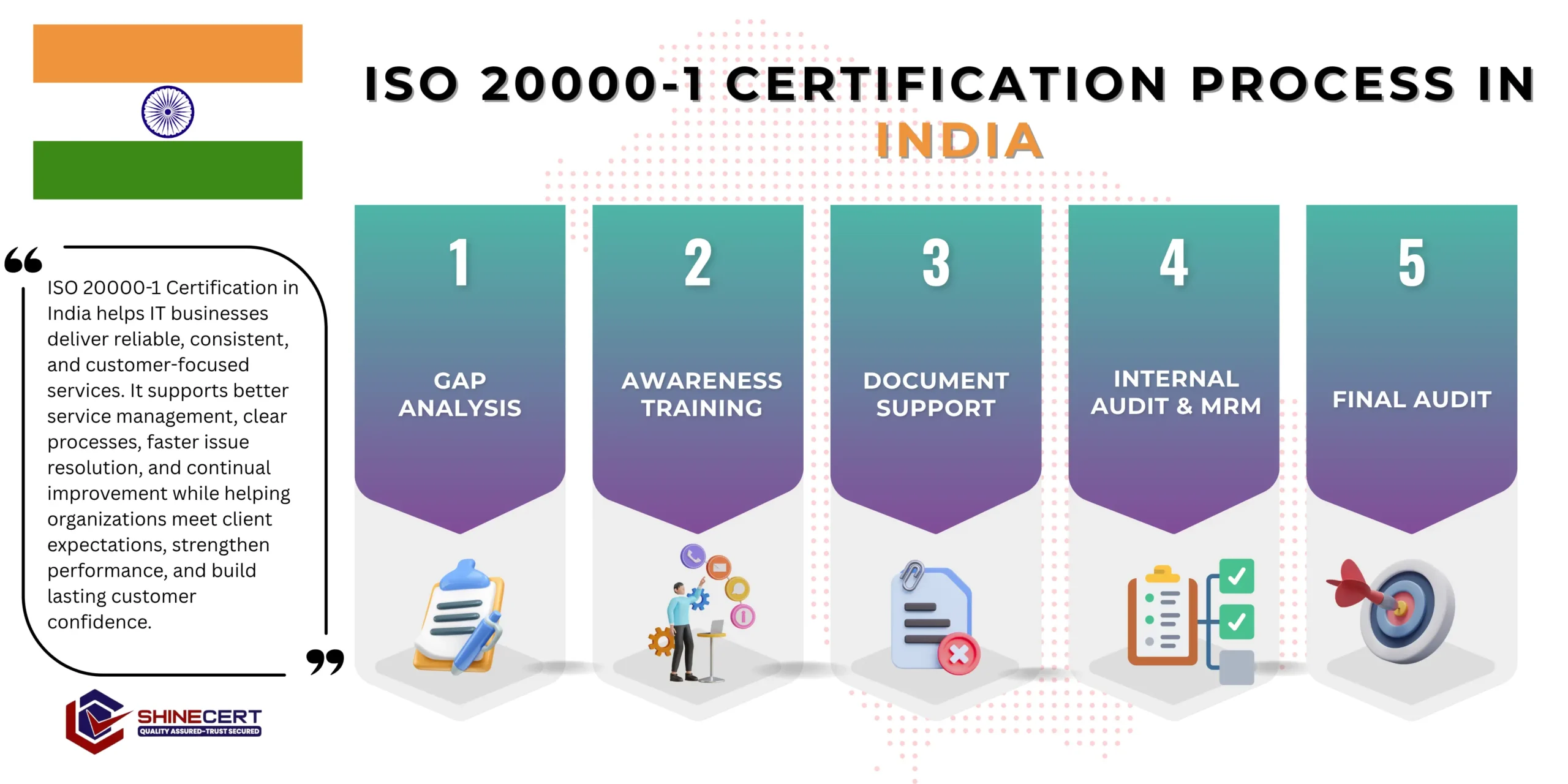
What are the steps to get ISO 20000-1 Certification in India?
our services
- ISO Certification India
- ISO 9001 Certification India
- ISO 14001 Certification India
- ISO 27001 Certification India
- ISO 22000 Certification India
- ISO 27701 Certification India
- ISO 45001 Certification India
- ISO 20000-1 Certification India
- ISO 13485 Certification India
- ISO 17025 Certification India
- ISO 31000 Certification India
- ISO 42001 Certification India
- ISO 37001 Certification India
- ISO 22301 Certification India
- ISO 50001 Certification India
- CE Mark Certification India
- GDPR Certification India
- GMP Certification India
- Halal Certification India
The Certification Process
Gap Assessment
We review your current incident handling, change management, and service level tracking, comparing existing practices, however informal, against the standard's requirements, identifying where genuine gaps remain.
Documentation Development
We build the service management policy, incident and problem management procedures, and service level agreement framework, written around your actual client relationships and service scope rather than a generic template.
Implementation and Training
Processes go live and staff across service delivery, support, and operations are trained on incident classification, escalation procedures, and consistent record-keeping.
Internal Audit and Management Review
We run a structured internal audit against the same criteria the certification auditor will use, and complete a formal management review with leadership.
Certification Audit
An accredited certification body audits your actual service delivery processes and records, and issues the certificate once satisfied you genuinely meet the standard's requirements.
How Long Does Certification Take?
| Business Size | Typical Timeline | Why |
|---|---|---|
| Small, single service line | 2–3 months | Fewer processes and clients to document and align |
| Medium, multiple service lines or clients | 3–4 months | More processes and staff coordination across service teams |
| Large or multi-client enterprise IT operations | 4–5 months | Extensive service scope and client-specific SLA coordination |
- Small IT companies with a single service line (2 to 3 months) : With a narrower service scope and fewer clients, incident and problem management processes are considerably faster to document and roll out.
- Medium companies with multiple service lines or clients (3 to 4 months) : More distinct services and client relationships mean more individual SLA frameworks and more staff across different teams to train consistently.
- Large or multi-client enterprise IT operations (4 to 5 months) : Extensive service portfolios and multiple enterprise client relationships, each with their own SLA expectations, typically require more documentation review and coordination.
- The variable that matters most: how consistently incidents are already being classified and recorded, even informally : A company with disciplined, if informal, incident logging moves through documentation and the audit itself faster than one where incident handling exists but isn’t reliably recorded.
A real example : A managed service provider had a genuinely responsive help desk with good first-response times, but no formal problem management process connecting recurring incidents back to root causes; building this connection, and the documentation behind it, took roughly four extra weeks beyond a comparable provider that already tracked incident patterns systematically.
Why It Matters in India?
India’s IT services and BPO sector, represented by NASSCOM as its key industry body, along with infrastructure support through Software Technology Parks of India, continues to grow as a globally competitive destination for outsourced IT services, managed services, and technology support. As Indian IT companies increasingly serve enterprise clients in markets accustomed to formal ITSM frameworks, ISO 20000-1 has moved from a differentiator to close to a baseline expectation in vendor evaluation processes, particularly for managed service and outsourcing contracts.
- What not being certified actually costs you : You’re excluded from a growing share of enterprise outsourcing and managed service contracts that specify ISO 20000-1 as a vendor pre-qualification requirement, particularly from clients in markets where formal ITSM frameworks are already standard practice. You’re also a harder sell against certified competitors in India’s genuinely crowded and competitive IT services market, where certification is an increasingly common way for enterprise buyers to filter vendors efficiently. And without structured incident and problem management, service disruptions tend to repeat rather than being permanently resolved at the root cause.
- Why is this happening in India right now? As India’s IT services sector continues competing globally for enterprise outsourcing and managed service contracts, and as international buyers increasingly standardize their vendor evaluation criteria around recognized certifications rather than site visits or reference checks alone, certification has become a practical necessity for Indian IT and BPO companies competing for larger, more sophisticated client relationships.
What Affects the Cost?
- Number of service lines and clients : More distinct services and client relationships mean more individual process documentation and SLA frameworks.
- Current service management maturity : A company with disciplined informal incident tracking starts from a stronger position than one relying purely on ad-hoc technician judgment.
- Client-specific contractual requirements : More detailed enterprise client SLAs mean more documentation to reconcile.
- Certification body fees : Separate from consulting fees, and worth confirming accreditation before comparing quotes.
Required Documentation
The scope statement defines exactly which services and clients the certification covers. The service management policy sets top management’s commitment.
The service management plan documents how services will be delivered, monitored, and improved. The risk and opportunity register documents what could disrupt service delivery and how it’s managed.
Competence and training records prove staff delivering services are genuinely qualified. The service catalog clearly defines what services are offered and to what standard.
Incident and problem management procedures describe how issues are detected, classified, escalated, and resolved back to root cause. Change management procedures control how changes to services are assessed and implemented. Service level agreements define measurable performance commitments to clients.
Service performance reports, internal audit reports, and management review minutes demonstrate ongoing oversight. Corrective action records show how you respond when service level commitments aren’t met.
Who Actually Needs This?
IT services and managed service providers
Particularly those serving enterprise clients in North America, Europe, or other markets expecting formal ITSM frameworks.
Read moreBPO companies delivering IT-adjacent services
Where service consistency and escalation discipline are central to client satisfaction.
Read moreSaaS companies with dedicated client support and service delivery functions
Where structured incident and problem management directly affects client retention.
Read moreAny IT company competing for larger enterprise contracts
Where certification is an increasingly standard vendor evaluation filter.
Read moreBenefits of ISO 20000-1 Certification
Certification removes a listed vendor pre-qualification barrier before pricing or capability is even discussed.
Certification distinguishes structured service delivery from informal, technician-dependent support.
Root cause analysis, not just incident resolution, prevents the same issues from recurring.
Structured service level management gives both you and your clients an objective, auditable view of performance.
ISO 20000-1 shares considerable structural overlap with ISO 27001, making combined certification efficient for IT services businesses pursuing both.
Common Mistakes We See
- Treating incident resolution as the end goal rather than root cause elimination : As our case study shows, resolving individual incidents without connecting them to recurring problems means the same issues keep coming back.
- Building a service catalog that doesn’t match what’s actually delivered : Auditors compare documented services against actual client relationships, and mismatches are a common finding.
- Underestimating change management discipline : Businesses often manage planned changes well but skip formal assessment for smaller, seemingly low-risk changes that still affect service delivery.
- Choosing a certification body without confirming accreditation : An unaccredited certificate carries no real recognition with enterprise clients evaluating vendors.
Standards and Clauses: What ISO 50001 Actually Requires
- Context of the Organization (Clause 4) : requires identifying service-relevant conditions and interested parties’ expectations, including client SLA requirements.
- Leadership (Clause 5) : requires top management to set service management policy and take visible ownership, not delegate it entirely to a technical operations lead.
- Planning (Clause 6) : requires the service management plan and risk assessment, operationalizing structured service delivery rather than reactive technical support.
- Support of the Service Management System (Clause 7) : covers competence, awareness, and documented information needed to run the system.
- Planning and Operation of the Service Management System (Clause 8) : is the standard’s core, covering service delivery, relationship and supplier management, resolution processes, and control processes like change management.
- Performance Evaluation (Clause 9) : requires monitoring service performance against SLAs, internal audits, and management review.
- Improvement (Clause 10) : requires acting on nonconformities and continually improving service delivery over time.
Case Study: A Managed Service Provider
- A managed service provider needed ISO 20000-1 certification to satisfy an enterprise client’s vendor pre-qualification requirement ahead of a multi-year managed services contract renewal.
- Our gap assessment found the provider’s help desk was genuinely responsive, with strong first-response times, but there was no formal problem management process linking recurring incidents back to their underlying root causes.
- Over roughly four months, we built the missing problem management layer, connecting incident patterns to root cause analysis for the first time, alongside the standard’s other required processes. The certification audit found only minor nonconformities in early service level reporting consistency.
- The provider secured the contract renewal, with the client specifically citing the certification’s evidence of structured problem management as addressing a recurring frustration from the previous contract period.
Answering the Objections Every Owner Has
“Our technicians already handle incidents well informally.”
Individual technician skill doesn’t scale or survive staff turnover the way documented, structured processes do, and it’s exactly the documented process an enterprise client’s vendor evaluation will ask to see evidence of.
“This seems like it’s only relevant for large IT companies.”
The 2018 revision specifically simplified the standard to make certification accessible for smaller providers, not just large enterprise IT departments; the standard scales its documentation to your actual service scope.
“We already meet our service level agreements.”
Meeting SLAs and having a structured, auditable management system behind that performance are different things; certification demonstrates the system, not just the outcome, which is what enterprise vendor evaluations increasingly require.
“Can’t our operations team build this internally?”
Operations teams often manage day-to-day service delivery well but rarely have experience structuring the formal process documentation, incident classification, and service level reporting an ISO 20000-1 auditor specifically expects.
Choosing the Right Partner?
| DIY | Generic Consultant | ShineCert | |
|---|---|---|---|
| Problem management depth | Often limited to incident resolution alone | Templated, rarely root-cause focused | Built to connect incidents back to root causes |
| Client SLA alignment | Frequently generic | Templated, disconnected from real contracts | Mapped to your actual client agreements |
| Accreditation verification | Often overlooked | Sometimes assumed rather than confirmed | Verified explicitly before you commit |
| Post-certification support | None | Often ends at the certificate | Built to support your ongoing surveillance audits |
Which Certification Body Should You Choose?
Confirm the certification body is accredited by NABCB or another IAF-member accreditation authority. Ask whether the consultant understands enterprise ITSM expectations in your target client markets, not just the generic standard. Confirm the certification audit reviews genuine incident and service performance records, not a policy-document check alone.
Why Businesses Choose ShineCert in India?
We’ve spent 10 years helping more than 10,000 businesses worldwide get certified, coordinated through our Riyadh and India offices with work delivered remotely or on-site as needed. Our consultants build problem management that genuinely connects incidents back to root causes, not just document resolution, and align your service catalog and SLAs with what you actually deliver to real clients, with ShineCert as the best ISO 20000-1 consultant in India. We only work with accredited certification bodies, never unaccredited shortcuts.
Frequently Asked Questions
No, but it’s increasingly a standard vendor pre-qualification requirement for enterprise IT outsourcing and managed service contracts.
It depends on your number of service lines, clients, and current service management maturity. We quote individually.
Usually two to five months depending on business size, with existing incident-tracking discipline mattering more than headcount alone.
No, the standard’s 2018 revision specifically simplified requirements to make certification accessible for smaller IT service providers as well.
Confirm accreditation by NABCB or another IAF-member authority, and confirm the audit reviews genuine incident and service performance records.