
ISO 27001 Certification in India
Quick Answer
ISO 27001 certification is an internationally recognized Information Security Management System credential confirming an organization systematically identifies, controls, and monitors information security risk. In India it isn’t legally mandatory on its own, but the Digital Personal Data Protection Rules, 2025, notified 14 November 2025 with compliance phased over roughly 18 months, give it direct practical relevance, since organizations need genuinely demonstrable security controls to meet the Rules’ data-fiduciary obligations. Certification typically takes two to six months and is routinely required by enterprise clients in IT, BPO, and fintech.
About ISO 27001
ISO 27001 is the world’s leading Information Security Management System standard, published by the International Organization for Standardization. It requires organizations to identify information assets, assess security risks, implement controls proportionate to those risks, and continually monitor and improve the system, rather than relying on a fixed set of technical tools alone.
Certification means an independent, accredited certification body has audited your actual security practices, risk assessments, and control implementation, and confirmed they genuinely meet the standard’s requirements. It runs on a three-year cycle with annual surveillance audits, reflecting an ongoing discipline rather than a point-in-time technical review.
A brief history of the standard : ISO 27001 traces back to BS 7799, a British information security standard first published in 1995. ISO formally adopted and published it as ISO/IEC 27001 in 2005, revised it in 2013, and most recently revised it again in 2022, which restructured Annex A’s control set from 114 controls down to 93, reorganized into four themes, organizational, people, physical, and technological, reflecting how security practice has evolved since the previous edition.
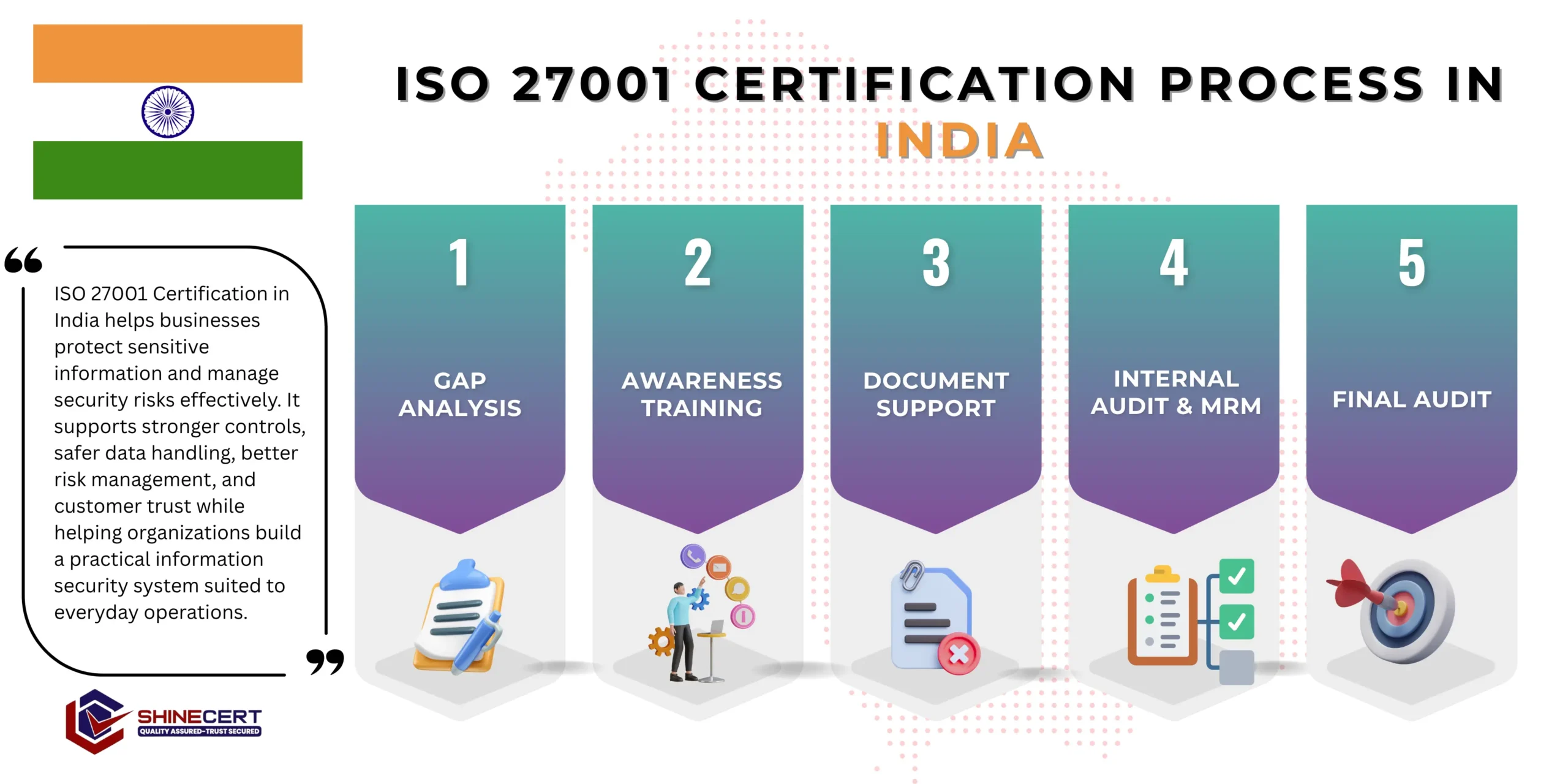
What are the steps to get ISO 27001 Certification in India?
our services
- ISO Certification India
- ISO 9001 Certification India
- ISO 14001 Certification India
- ISO 27001 Certification India
- ISO 22000 Certification India
- ISO 27701 Certification India
- ISO 45001 Certification India
- ISO 20000-1 Certification India
- ISO 13485 Certification India
- ISO 17025 Certification India
- ISO 31000 Certification India
- ISO 42001 Certification India
- ISO 37001 Certification India
- ISO 22301 Certification India
- ISO 50001 Certification India
- CE Mark Certification India
- GDPR Certification India
- GMP Certification India
- Halal Certification India
The Certification Process
Gap Assessment
We map your actual information assets, systems, data flows, and third-party dependencies, and compare your current controls against the standard's 93 Annex A controls, identifying where existing practices already meet the bar and where genuine gaps remain.
Documentation Development
We build the risk assessment methodology, risk register, and Statement of Applicability, the document justifying which Annex A controls apply to your specific business and why, written to reflect your actual systems rather than a generic checklist.
Implementation and Training
Security controls go live, and staff are trained not just on policy but on why specific practices, access restrictions, incident reporting, matter to the business's actual risk exposure.
Internal Audit and Management Review
We run a structured internal audit against the same criteria the certification auditor will use, and complete a formal management review with leadership.
Certification Audit
An accredited certification body audits your actual security practices and documentation, and issues the certificate once satisfied you genuinely meet the standard's requirements.
How Long Does Certification Take?
| Business Size | Typical Timeline | Why |
|---|---|---|
| Small, single system environment | 2–3 months | Fewer information assets and simpler risk assessment |
| Medium, multiple systems or client contracts | 3–5 months | More assets, third parties, and controls to document |
| Large or multi-site enterprise operations | 5–6 months | Extensive systems and stakeholder coordination |
- Small businesses with a simple system environment (2 to 3 months) : With fewer applications, servers, and third-party integrations, the risk assessment and Statement of Applicability are considerably faster to build and easier for staff to genuinely absorb.
- Medium businesses with multiple systems or client contracts (3 to 5 months) : More information assets and more client-specific security obligations mean a more detailed risk assessment and more coordination across teams handling different systems.
- Large or multi-site enterprise operations (5 to 6 months) : Reconciling security practices across multiple teams, systems, and sometimes multiple office locations into one certifiable system typically requires more documentation review rounds and stakeholder alignment.
- The variable that matters most: how well you already understand your own information asset inventory : A business that can clearly list its systems, data flows, and third-party dependencies moves through the risk assessment phase considerably faster than one that has to first discover what it actually has before assessing the risk to it.
A real example : A Bengaluru-based fintech had genuinely strong technical security controls, encryption, access logging, but had never formally documented a risk assessment methodology or a Statement of Applicability; building this foundational documentation took roughly ten weeks, while a comparable fintech with weaker underlying controls took closer to five months, since technical remediation had to happen before documentation could even be finalized.
Why It Matters in India?
The Digital Personal Data Protection Rules, 2025 were notified on 14 November 2025, completing the operationalization of the DPDP Act 2023 and translating its principles into concrete compliance steps, with obligations phasing in over roughly 18 months. Under the Rules, organizations handling personal data as data fiduciaries carry direct responsibility for its security, with penalties for serious violations reaching roughly Rs 250 crore. ISO 27001’s systematic approach to risk assessment, access control, and incident management gives organizations a structured, auditable way to demonstrate the security posture the Rules increasingly expect, even though the Rules don’t name ISO 27001 specifically as a required certification.
What not being certified actually costs you. You’re a harder sell to enterprise clients in IT, BPO, and fintech, where ISO 27001 has become close to a standard vendor pre-qualification requirement rather than a differentiator. You’re also less prepared to demonstrate genuine security discipline if the DPDP Rules’ phased obligations trigger a data breach notification or regulatory inquiry. And without structured risk assessment, security gaps tend to surface as incidents rather than being caught during routine internal review.
Why is this happening in India right now? As the DPDP Rules’ 18-month phased compliance timeline plays out through 2026 and into 2027, and as India’s IT and BPO sectors continue handling growing volumes of international client data, enterprise buyers are tightening vendor security requirements faster than smaller and mid-sized Indian service providers can meet them informally, making structured certification an increasingly practical necessity rather than an optional upgrade.
What Affects the Cost?
- Number of systems and information assets : More applications, servers, and data flows mean a more extensive risk assessment.
- Existing security maturity : A business with genuinely strong technical controls starts from a stronger position than one needing both remediation and documentation.
- Third-party and client contractual obligations : More client-specific security requirements mean more documentation to reconcile.
- Certification body fees : Separate from consulting fees, and worth confirming accreditation before comparing quotes.
Required Documentation
The scope statement defines exactly which systems and locations the certification covers. The information security policy sets top management’s commitment.
The risk assessment methodology and risk register document what could go wrong and how likely and severe it would be. The Statement of Applicability justifies which of the 93 Annex A controls apply to your business and why.
Competence and awareness training records prove staff genuinely understand their security responsibilities. The document control procedure governs how policies are created and updated.
Access control procedures describe how system access is granted and reviewed. Incident response procedures document how security events are detected and handled. Third-party and supplier security agreements extend controls beyond your own systems.
Internal audit reports and management review minutes demonstrate ongoing oversight. Corrective action records show how you respond when something goes wrong.
Who Actually Needs This?
IT services and software companies
IT services and software companies, particularly those handling client data or code under enterprise contracts.
Read moreBPO and call center operators
BPO and call center operators, where handling personal data at scale is central to the business model.
Read moreFintech and payments companies
Fintech and payments companies, where security failures carry both regulatory and reputational consequences.
Read moreSaaS providers
SaaS providers, where enterprise buyers routinely require ISO 27001 as a contractual condition.
Read moreData fiduciaries under the DPDP Rules
Any data fiduciary under the DPDP Rules seeking a structured, auditable way to demonstrate security discipline.
Read moreBenefits of ISO 27001 Certification
Certification builds exactly the risk assessment, access control, and incident-response documentation that data-fiduciary obligations increasingly expect.
Particularly in IT services, BPO, and fintech, where ISO 27001 is now close to a baseline requirement rather than a differentiator.
Systematic risk assessment catches vulnerabilities before they become breaches.
Demonstrable, audited security controls matter considerably in how regulators and clients assess an incident’s severity.
The privacy-specific extension builds directly on an existing ISO 27001 system, making a later expansion considerably more efficient.
Businesses that take the risk assessment process seriously often catch operational security gaps they didn’t know existed.
Common Mistakes We See
- Treating the Statement of Applicability as a formality rather than a genuine risk-based decision document : Auditors specifically probe why certain controls were excluded, and a weak justification is a common finding.
- Confusing technical security tools with a management system : Firewalls and antivirus are necessary, but the standard is about the documented process behind them, not the tools themselves.
- Underestimating third-party and supplier security requirements : Businesses often secure their own systems well but skip formal security agreements with vendors handling their data.
- Choosing a certification body without confirming accreditation : An unaccredited certificate carries no real recognition with enterprise clients or during DPDP Rules-related scrutiny.
Standards and Clauses: What ISO 27001 Actually Requires
- Context of the Organization (Clause 4) : requires identifying information security-relevant conditions and interested parties’ expectations, including clients and regulators under the DPDP Rules.
- Leadership (Clause 5) : requires top management to set information security policy and take visible ownership, not delegate it entirely to an IT department.
- Planning (Clause 6) : requires a formal risk assessment process and the Statement of Applicability, operationalizing risk-based security rather than ad-hoc technical fixes.
- Support (Clause 7) : covers competence, awareness, and documented information needed to run the system.
- Operation (Clause 8) : covers implementing the risk treatment plan and operational security controls.
- Performance Evaluation (Clause 9) : requires monitoring security performance, internal audits, and management review.
- Improvement (Clause 10) : requires acting on nonconformities and incidents and continually improving the system.
- Annex A (93 controls across four themes) : covers organizational controls like access policies, people controls like security awareness training, physical controls like equipment security, and technological controls like encryption and network security, with auditors checking not just that controls exist but that your Statement of Applicability genuinely justifies your choices.
Case Study: A Bengaluru-Based Fintech Company
- A fintech company needed ISO 27001 certification to satisfy an international payments partner’s vendor security requirement ahead of an integration agreement.
- Our gap assessment found the company’s technical security controls, encryption, access logging, intrusion detection, were genuinely strong, but there was no formal risk assessment methodology, no documented Statement of Applicability, and no structured incident response procedure.
- Over roughly ten weeks, we built the foundational risk assessment and documentation around the company’s existing strong technical base, rather than starting from scratch on the controls themselves. The certification audit confirmed the controls matched the documentation, with only minor nonconformities in incident-response record-keeping.
- The company secured the integration agreement, with the partner specifically citing the certification as satisfying a previously outstanding due diligence requirement.
Answering the Objections Every Owner Has
“We already have firewalls and antivirus, isn’t that enough?”
Technical tools are necessary but not sufficient; ISO 27001 requires a documented risk assessment and management process behind those tools, which is exactly what a client’s security questionnaire or a regulator will actually ask to see.
“This seems built for large enterprises, not us.”
The standard scales its documentation expectations to your actual information assets and risk profile; a smaller business with fewer systems typically has a lighter, faster path to certification, not a disproportionate one.
“Can’t our IT team handle this internally?”
IT teams often manage technical controls well but rarely have experience structuring the risk assessment methodology and Statement of Applicability an auditor expects to see, which is where most DIY attempts stall.
“We’re worried this exposes weaknesses we’d rather not document.”
Every organization has security gaps; the standard’s value is in catching and controlling them before an incident does it for you, not in the illusion of not having any.
Choosing the Right Partner?
| DIY | Generic Consultant | ShineCert | |
|---|---|---|---|
| DPDP Rules alignment | Rarely considered explicitly | Sometimes mentioned, rarely integrated | Directly reconciled with data-fiduciary obligations |
| Statement of Applicability | Often generic or copied | Templated, weakly justified | Built around your actual risk assessment |
| Accreditation verification | Often overlooked | Sometimes assumed rather than confirmed | Verified explicitly before you commit |
| Post-certification support | None | Often ends at the certificate | Built to support your ongoing surveillance audits |
Which Certification Body Should You Choose?
Confirm the certification body is accredited by NABCB or another IAF-member accreditation authority. Ask whether the consultant understands the DPDP Rules’ data-fiduciary obligations, not just the generic standard. Confirm the certification audit includes a genuine technical review, not a paperwork-only assessment.
Why Businesses Choose ShineCert in India?
We’ve spent 10 years helping more than 10,000 businesses worldwide get certified, coordinated through our Riyadh and India offices with work delivered remotely or on-site as needed. Our consultants build your Statement of Applicability around your actual risk assessment, not a generic template, and align your system directly with DPDP Rules obligations rather than treating them as separate concerns, with ShineCert as the best ISO 27001 consultant in India. We only work with accredited certification bodies, never unaccredited shortcuts.
Frequently Asked Questions
No, but it directly supports demonstrating the security discipline the DPDP Rules, 2025 increasingly expect from data fiduciaries, and is a standard requirement for enterprise clients in IT, BPO, and fintech.
It depends on your number of systems, existing security maturity, and client obligations. We quote individually.
Usually two to six months depending on business size, with your existing information asset clarity mattering more than headcount alone.
No, it doesn’t replace legal obligations under the Rules; it gives you a structured, auditable system that directly supports demonstrating and maintaining that compliance.
Confirm accreditation by NABCB or another IAF-member authority, and confirm the audit includes a genuine technical review, not just a documentation check.