
ISO 9001 Certification in India
Quick Answer
ISO 9001 certification is an internationally recognized Quality Management System credential confirming an organization consistently meets customer and regulatory requirements while continually improving its processes. In India it’s voluntary under law but frequently a specified requirement in GeM portal tenders, CPWD contracts, and PSU procurement categories, cost varies by business size, it takes two to nine months depending on complexity, and MSMEs registered under Udyam can recover a meaningful share of certification cost through government subsidy schemes.
About ISO 9001
ISO 9001 is the world’s most widely used quality management standard, published by the International Organization for Standardization. It doesn’t specify what your product or service should be; it specifies how consistently and reliably you deliver it, through documented processes, defined responsibilities, risk-based thinking, and a cycle of continual improvement.
Certification means an independent, accredited certification body has audited your actual operations, not just reviewed a policy document, and confirmed they genuinely meet the standard’s requirements. It’s reissued on a three-year cycle with annual surveillance audits in between, so it reflects an ongoing system rather than a one-time achievement.
A brief history of the standard : ISO 9001 was first published in 1987, drawing heavily on BS 5750, a British defense and manufacturing quality standard from the late 1970s. India has been a full member of ISO since the organization’s founding in 1947, through the Bureau of Indian Standards, giving Indian businesses a genuinely long-standing, direct relationship with the international standards system rather than a more recent or indirect one. The standard’s own major revisions followed in 1994, 2000 (the process approach still at its core today), 2008, and 2015 (the current edition, adding risk-based thinking and the High-Level Structure shared with ISO 14001 and ISO 27001), with ISO 9001:2026 next in line, detailed further down this page.
What are the steps to get ISO 9001 Certification in India?
our services
- ISO Certification India
- ISO 9001 Certification India
- ISO 14001 Certification India
- ISO 27001 Certification India
- ISO 22000 Certification India
- ISO 27701 Certification India
- ISO 45001 Certification India
- ISO 20000-1 Certification India
- ISO 13485 Certification India
- ISO 17025 Certification India
- ISO 31000 Certification India
- ISO 42001 Certification India
- ISO 37001 Certification India
- ISO 22301 Certification India
- ISO 50001 Certification India
- CE Mark Certification India
- GDPR Certification India
- GMP Certification India
- Halal Certification India
The Certification Process
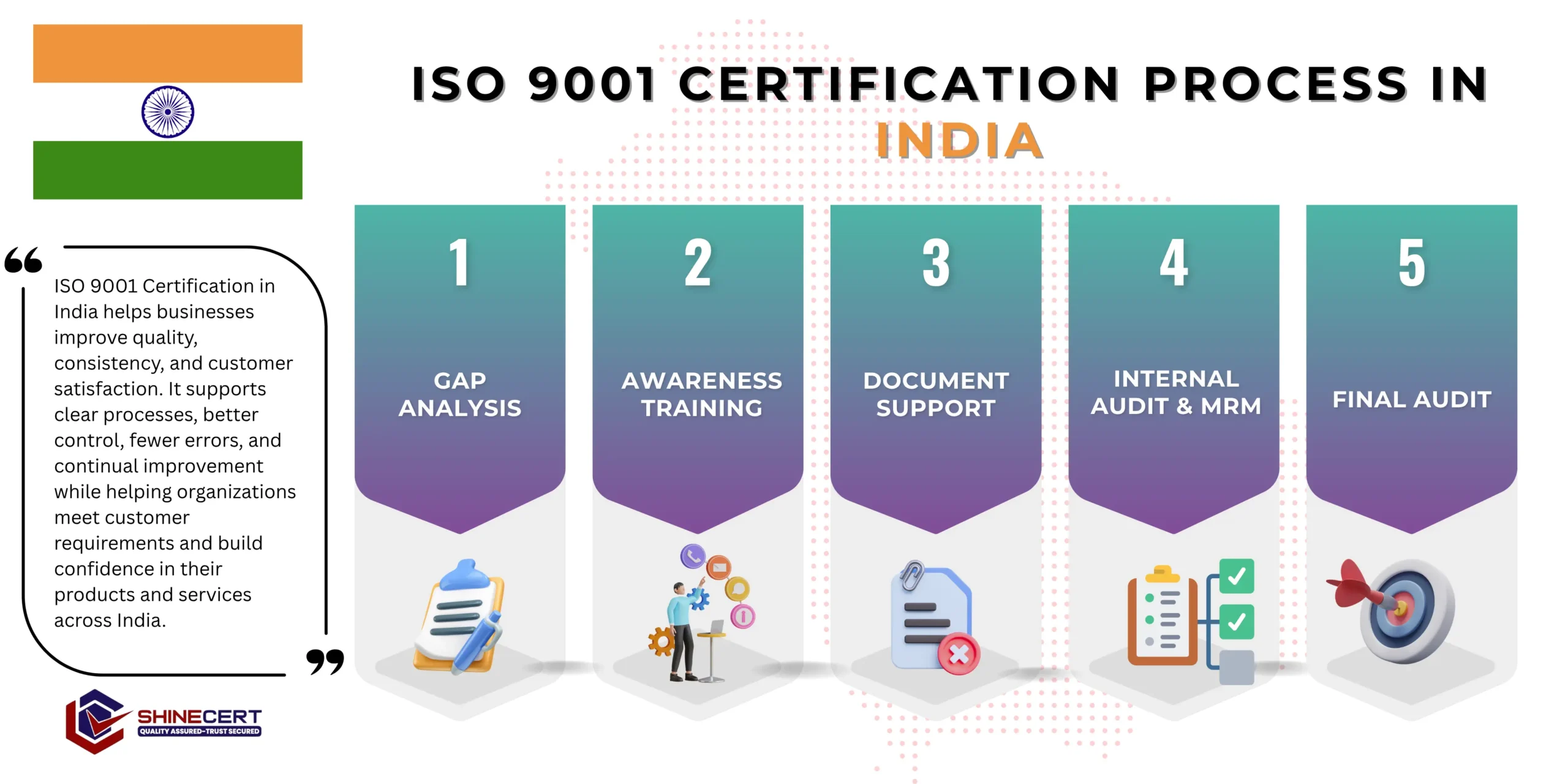
Gap Assessment
We walk your actual operations, factory floor, service delivery process, or office, and compare what we find against the standard's requirements clause by clause. This isn't a generic checklist; we're identifying where your existing informal controls already meet the standard and where genuine gaps remain, so the plan that follows reflects your real starting point.
Documentation Development
We build the quality manual, procedures, and records the standard requires, written to reflect how your business actually operates rather than aspirational language nobody will follow. Larger or multi-site Indian businesses typically sit at the higher end of this range given the greater documentation coordination involved.
Implementation and Training
The system goes live and staff are trained not just on what procedures say, but on why they matter. This is usually the longest phase because it requires genuine behavior change, and it's where DIY attempts most often fall short.
Internal Audit and Management Review
We run a structured internal audit against the same criteria the real certification auditor will use, and complete a formal management review with your leadership team, catching gaps while they're still inexpensive to fix.
Certification Audit
A NABCB-accredited certification body, or another IAF-member accreditation authority, audits your actual operations and issues the certificate once satisfied that you genuinely meet the standard's requirements.
How Long Does Certification Take?
| Business Size | Typical Timeline | Why |
|---|---|---|
| Small MSME, single site | 2–4 months | Fewer processes to document, subsidy-eligible |
| Medium business, multiple departments | 4–6 months | More processes and training coordination needed |
| Large or multi-site operations | 6–9 months | Extensive sites and processes to align across a large organization |
- Small MSMEs with a single site (2 to 4 months) : With fewer employees, departments, and locations, there’s simply less to document and less staff training coordination required, and Udyam-registered MSMEs benefit from subsidy support that often makes this the fastest and most cost-effective tier to certify in.
- Medium businesses with multiple departments (4 to 6 months) : Once several departments, production, sales, quality, logistics, each run somewhat differently, documentation has to cover each function and how they hand off to each other, and training takes longer as more roles need to understand not just their own responsibilities but how their work connects downstream.
- Large or multi-site operations (6 to 9 months) : India’s larger manufacturers and enterprises often operate across multiple states or facilities, each with its own informal variations in practice; reconciling these into one certifiable system typically requires more site visits, more documentation review rounds, and a longer implementation phase than a single-site business ever needs.
- The variable that matters more than size: how consistent your practices already are across locations or departments : A large business with genuinely standardized practices across all its sites can sometimes move faster than a smaller, less organized one; it’s consistency, not headcount, that most shapes the real timeline.
A real example : An IT services company we worked with in Pune had three delivery teams, each following its own informal quality-check process for client handoffs; reconciling these into one documented, consistent system took an additional five weeks beyond a comparable single-team business, but the resulting consistency was exactly what its next enterprise client’s procurement team wanted to see during due diligence.
ISI Mark vs. ISO 9001: Clearing Up a Genuinely Common Confusion
This is worth addressing directly, because it trips up more first-time applicants in India than almost any other question. The ISI mark, issued by the Bureau of Indian Standards, and ISO 9001 certification are not the same thing, not competitors, and not interchangeable, even though both involve BIS in some form.
ISO
The ISI mark
The ISI mark certifies a specific product against a specific Indian Standard. It’s mandatory for certain product categories under BIS Quality Control Orders, electrical appliances, cement, LPG cylinders, and similar goods, and each product, manufacturing unit, and applicable Indian Standard requires its own separate BIS licence. It has nothing to do with your management processes; it confirms a physical product meets a defined technical specification.
9001
ISO 9001
ISO 9001 certifies your organization’s quality management system, not a product. It applies to manufacturers, service providers, IT companies, healthcare organizations, and government bodies alike, and it’s recognized internationally, not just within India. A business can hold an ISI mark for a specific product and still have no documented quality management system at all, and vice versa; they answer genuinely different questions.
Why this matters practically: if you’re manufacturing a BIS-regulated product for the Indian market, you likely need the ISI mark regardless of ISO 9001 status. If you’re bidding on a GeM tender, working with international buyers, or building a genuine internal management system, ISO 9001 is the relevant credential. Many businesses need both, for different reasons, not one instead of the other.
Why It Matters in India?
India’s public procurement landscape increasingly filters ISO 9001 before evaluating price. GeM, the Government e-Marketplace, along with CPWD contracts and a wide range of PSU procurement categories, specifies ISO 9001 as a listed requirement across many tender documents, even though no single national law makes certification universally mandatory. Without it, businesses are frequently excluded from these categories before their pricing or capability is even considered.
- What not being certified actually costs you : You’re filtered out of a large share of government and PSU business before the conversation starts, since GeM and CPWD tender screening increasingly happens algorithmically against listed certification requirements. You’re also a harder sell to international buyers and larger domestic enterprise clients who use certification as a standard vendor pre-qualification step. And without the standard’s internal monitoring and audit requirements, quality problems tend to surface as customer complaints rather than being caught internally first.
- Why this is happening in India right now? As India’s manufacturing and services sectors both expand under Production Linked Incentive schemes and broader Make in India momentum, procurement volumes are rising fast enough that buyers, government and private alike, are relying more heavily on certification as an efficient way to filter credible suppliers from a genuinely large and growing vendor pool.
Benefits of ISO 9001 Certification
Certification removes a listed exclusion criterion before price is even considered.
Certification acts as a pre-qualification shortcut increasingly expected by default.
Government schemes specifically reimburse a share of ISO 9001 certification expenses for registered MSMEs.
Internal monitoring and audit requirements catch problems before they become complaints.
Businesses that take the risk-planning and improvement requirements seriously get a system that actually helps them run better.
Documented processes mean new hires learn a known standard rather than relying on informal knowledge transfer.
ISO 14001, ISO 27001, and industry-specific standards build on the same underlying management-system structure.
Common Mistakes We See
- Treating certification as a one-time project instead of an ongoing system : Businesses that stop maintaining the system after the initial audit often struggle at the three-year renewal.
- Confusing the ISI mark with ISO 9001, or assuming one replaces the need for the other : As covered above, they answer genuinely different questions.
- Documenting an idealized process instead of the real one : Auditors interview staff directly, and a quality manual describing a process nobody actually follows is one of the most common findings that delays certification.
- Choosing a certification body without confirming NABCB or equivalent IAF-member accreditation : An unaccredited “certificate” carries no real recognition with GeM, PSU buyers, or international clients, regardless of how official it looks.
Who Actually Needs This?
Manufacturers and exporters
Manufacturers and exporters supplying government contracts or international markets, where a documented quality management system is often the first thing a buyer’s procurement team checks.
Read moreIT and BPO service providers
IT and BPO service providers, particularly those with enterprise or international clients expecting process consistency as standard.
Read morePharmaceutical and healthcare-adjacent businesses
Pharmaceutical and healthcare-adjacent businesses, where quality documentation increasingly overlaps with regulatory expectations.
Read moreMSMEs registered under Udyam
MSMEs registered under Udyam, where subsidy support meaningfully changes the cost calculation of pursuing certification.
Read moreConstruction and infrastructure contractors
Construction and infrastructure contractors bidding on CPWD and PSU tenders that specify certification.
Read moreWhat Affects the Cost, and MSME Subsidy Support
- Business size and structure : More employees, departments, and locations mean more processes to document and more staff to train.
- Current documentation maturity : A business with organized informal processes starts from a stronger position than one with none.
- Industry complexity : Manufacturing and pharmaceutical operations typically involve more operational controls than a straightforward service business.
- Certification body fees : Separate from consulting fees, and it’s worth confirming NABCB accreditation before comparing quotes, since unaccredited “certificates” carry no real recognition.
- MSME subsidy support meaningfully changes the calculation for eligible businesses : Udyam-registered MSMEs can access subsidy support through schemes like the NSIC Subsidy Scheme and the Zero Defect Zero Effect (ZED) Programme, which can cover a substantial share of certification-related costs, and the Ministry of MSME separately offers a reimbursement scheme covering a meaningful portion of ISO 9001, ISO 14001, and ISO 50001 certification expenses. We help eligible clients navigate this application process alongside the certification work itself, since the subsidy paperwork has its own requirements distinct from the certification process.
Required Documentation
- Core System Documents : The scope statement defines exactly what the certification covers. The quality policy sets top management’s commitment. The interested parties analysis identifies what customers, regulators, and, where relevant, GeM or PSU buyers expect.
- Planning Documents : The risk and opportunity register documents what could go wrong in your operations and what you’re doing about it, reviewed and updated over time. Quality objectives give you measurable targets to track progress against.
- Support Documents : Competence and training records prove staff are genuinely qualified. The document control procedure governs how procedures are created and updated so outdated versions don’t circulate.
- Operational Documents : Operational control procedures describe how production or service delivery actually happens. Supplier evaluation records demonstrate you’re managing quality risk beyond your own walls. The nonconforming output procedure documents how you catch and correct problems.
- Evaluation Documents : The internal audit program and reports and management review minutes demonstrate ongoing oversight, not a one-time setup. Corrective action records show how you respond when something goes wrong.
Standards and Clauses: What ISO 9001 Actually Requires
- Context of the Organization (Clause 4) : requires identifying internal and external issues affecting quality and understanding what customers, regulators, and procurement bodies like GeM expect from you specifically.
- Leadership (Clause 5) : requires top management to set a quality policy and take visible, genuine ownership, not delegate it entirely to a compliance officer.
- Planning (Clause 6) : requires identifying risks and opportunities and setting measurable objectives to address them, operationalizing risk-based thinking rather than purely reactive quality management.
- Support (Clause 7) : covers competence, training, and documented information needed to run the system.
- Operation (Clause 8) : is the largest requirement area, covering production planning, customer requirements, supplier control, and nonconforming output handling, where most day-to-day documentation lives.
- Performance Evaluation (Clause 9) : requires monitoring actual performance, internal audits, and management review.
- Improvement (Clause 10) : requires acting on nonconformities and continually improving the system over time.
Case Study: A Pune-Based IT Services Company
- An IT services company in Pune needed ISO 9001 certification to satisfy an enterprise client’s vendor qualification requirement ahead of a multi-year contract renewal.
- Our gap assessment found the company’s three delivery teams each followed their own informal quality-check process for client handoffs, with no shared documentation and no internal audit process in place.
- Over five months, we consolidated the three teams’ practices into one documented quality manual, built an internal audit schedule, and ran the company’s first management review. The certification audit found only minor nonconformities, corrected before the certificate was issued.
- The company secured the contract renewal, and cited the consistency demonstrated across all three delivery teams as a specific factor in the client’s decision.
Migrating from ISO 9001:2015 to ISO 9001:2026
There are genuinely two separate things happening here, worth understanding before planning around either.
- The first is already in force: the 2024 climate amendment : In 2024, ISO formally amended ISO 9001:2015’s Clause 4.1 and 4.2 to require organizations to consider climate change as a relevant factor in their organizational context. This applies immediately to every currently certified organization; there’s no separate transition period for it specifically, and your next scheduled surveillance or recertification audit will expect to see it genuinely reflected in your context analysis.
- The second is the full ISO 9001:2026 revision, now effectively locked : The Final Draft International Standard ballot closed on 9 July 2026 and received final approval on 15 July 2026, which means the technical content of ISO 9001:2026 is now settled; formal publication is expected around September 2026, but nothing substantive will change between now and then. Certified organizations will have an approximately three-year transition period, to roughly September 2029, to move from the 2015 edition once it publishes.
- What’s actually changing : The revision is moderate rather than a full overhaul. Clause 4 formally folds the 2024 climate amendment into the core text. Clause 5.1.1 adds an explicit requirement for top management to demonstrate a genuine quality culture and ethical behavior. Clause 3’s terminology becomes more self-contained. Clauses 6 through 10 receive clarifying notes rather than substantially new requirements. The most structurally significant addition is a new Annex A, roughly 15 pages of supplementary guidance, the first time ISO 9001 has included one.
How to Migrate: A Step-by-Step Plan?
Since the FDIS content is now final in substance, Indian businesses don’t need to wait for the September publication date to start preparing. Here’s the practical sequence we recommend.
- Step 1: Confirm the 2024 climate amendment is already genuinely reflected in your system : Before touching anything 2026-specific, check that your context analysis under Clause 4.1 and 4.2 actually discusses climate change as a relevant factor, not just a token sentence added to pass an audit. NABCB-accredited auditors are already checking for this on current 2015-edition audits, so this step has no waiting period at all.
- Step 2: Update your leadership documentation for the new Clause 5.1.1 requirement : Draft or revise a statement of top management’s commitment to quality culture and ethical behavior, and make sure it’s something leadership can actually demonstrate in an interview, not just a line in the quality manual. This is the single largest new expectation in the revision and the one auditors will probe hardest.
- Step 3: Review your terminology against the tightened Clause 3 definitions : The 2026 edition makes Clause 3 more self-contained, so cross-check your quality manual’s glossary and definitions section against the finalized wording once it’s available, and correct any terms your documentation currently borrows loosely from older editions.
- Step 4: Walk Clauses 6 through 10 for the clarifying notes, not new requirements : These clauses aren’t gaining new obligations, but the added clarifying notes are worth a read-through against your existing procedures to catch any place your interpretation has drifted from what the standard now spells out more explicitly.
- Step 5: Read the new Annex A and decide what, if anything, to adopt : Annex A is guidance, not a requirement, so nothing here is mandatory, but it’s worth reviewing for practical clarification on how auditors are likely to interpret ambiguous areas of the standard once it’s in circulation.
- Step 6: Time your transition audit inside the three-year window, not at the deadline : Once ISO 9001:2026 formally publishes, talk to your certification body about scheduling your transition audit earlier in the roughly three-year window rather than in the final months, when certification bodies are typically at their busiest with every other certified organization trying to do the same thing at once.
Our recommendation for Indian businesses : If you’re not yet certified, don’t wait for publication to begin; certify now against the 2015 edition, already incorporating the 2024 climate amendment and the leadership expectations above, since the certification you build today will carry directly into the transition rather than needing to be redone. If you’re already certified, use your next scheduled surveillance audit as the natural checkpoint to work through the six steps above.
Answering the Objections Every Owner Has
“Isn’t this just paperwork?”
Only if implemented badly. Done properly, the documentation reflects decisions you’re already making, just written down consistently enough that someone new can follow them and an auditor can verify them.
“We’re too small for this, we’re barely an MSME.”
Size affects timeline, not whether it’s worth pursuing, and MSME status specifically unlocks subsidy support that makes certification considerably more affordable than larger businesses pay.
“We already have a BIS ISI mark, isn’t that enough?”
No, as explained above, the two credentials answer different questions; an ISI mark says nothing about your management system.
“Can’t we just do this ourselves?”
You can attempt it, but most first-time businesses underestimate how much of the standard’s risk-based thinking and internal audit requirements need genuine, working documentation rather than a downloaded template, and a poorly built system won’t survive a NABCB-accredited body’s audit.
Choosing the Right Partner?
| DIY | Generic Consultant | ShineCert | |
|---|---|---|---|
| Clause coverage | Frequently incomplete, especially risk planning and internal audit | Templated, often disconnected from your real operations | Mapped specifically to how your business actually runs |
| NABCB accreditation verification | Often overlooked | Sometimes assumed rather than confirmed | Verified explicitly before you commit |
| MSME subsidy navigation | Handled alone, if at all | Rarely offered as part of the service | Coordinated alongside certification for eligible businesses |
| Post-certification support | None | Often ends at the certificate | Built to support your ongoing surveillance audits |
Which Certification Body Should You Choose?
Confirm the certification body is accredited by NABCB under the Quality Council of India, or by another IAF-member accreditation authority; this is the single most important check in India specifically, given how many unaccredited “certificate mills” operate here. Be genuinely skeptical of unusually fast or unusually cheap offers. Ask whether the consultant can explain what a specific requirement means for your business, not just hand you a document pack. Confirm the certification audit includes an actual site visit.
Why Businesses Choose ShineCert in India?
We’ve spent 10 years helping more than 10,000 businesses worldwide get certified, coordinated through our Riyadh and India offices with work delivered remotely or on-site as needed. Our consultants map every requirement to your actual operations, explain each one in plain language before asking you to document anything, and help eligible MSMEs navigate Udyam subsidy support alongside the certification process itself, with ShineCert as the best ISO 9001 consultant in India. We only work with NABCB-accredited or equivalent IAF-recognized certification bodies, never unaccredited shortcuts.
Frequently Asked Questions
No, but it’s frequently a specified requirement in GeM, CPWD, and PSU tender documents, which functions as a practical barrier to entry for uncertified businesses.
The ISI mark certifies a specific product against an Indian Standard; ISO 9001 certifies your organization’s quality management system. Many businesses need both for different reasons.
It depends on business size, documentation maturity, and industry, though Udyam-registered MSMEs can offset a meaningful share of this through government subsidy schemes. We quote individually.
Usually two to nine months depending on business size, with consistency across departments or sites mattering more than headcount alone.
Yes, Udyam-registered MSMEs can access support through schemes like the NSIC Subsidy Scheme and the ZED Programme, plus a separate Ministry of MSME reimbursement scheme.
No, ISO 9001 certificates are issued by accredited certification bodies; BIS operates its own separate certification schemes, some of which are themselves NABCB-accredited.
Confirm NABCB accreditation, under the Quality Council of India, or accreditation from another IAF-member authority, be cautious of unusually fast timelines, and confirm the audit includes a genuine site visit.