
ISO 22301 Certification in India
Quick Answer
ISO 22301 certification is an internationally recognized Business Continuity Management System credential confirming an organization can genuinely detect, respond to, and recover from disruptive incidents, not just describe a plan on paper. In India, banks and financial institutions face increasingly specific RBI expectations around operational resilience, while businesses across sectors contend with disruptions ranging from monsoon flooding to cyberattacks to supply chain shocks. Certification typically takes two to five months and is increasingly requested by enterprise clients and financial regulators alike.
About ISO 22301
ISO 22301 is the world’s leading Business Continuity Management System standard, published by the International Organization for Standardization. It requires organizations to conduct a genuine business impact analysis, identify their most critical activities and the maximum tolerable disruption they can withstand, and build tested, workable plans to maintain or quickly recover those activities during disruption, whether from natural disasters, cyberattacks, supply chain failure, or infrastructure loss.
Certification means an independent, accredited certification body has audited your actual continuity plans, and critically, evidence that you’ve tested them through genuine exercises, not just written them and filed them away. It runs on a three-year cycle with annual surveillance audits, since a continuity plan that isn’t regularly tested tends to fail exactly when a real disruption arrives.
A brief history of the standard : ISO 22301 was first published in 2012, formalizing the British BS 25999 business continuity standard into an international framework, developed against the backdrop of heightened global awareness of large-scale operational disruption following major infrastructure and security incidents in the preceding decade. It was revised in 2019, the current edition, streamlining its structure and aligning it with ISO’s Harmonized Structure shared by other management-system standards, making integrated audits with ISO 27001 or ISO 9001 considerably more practical.
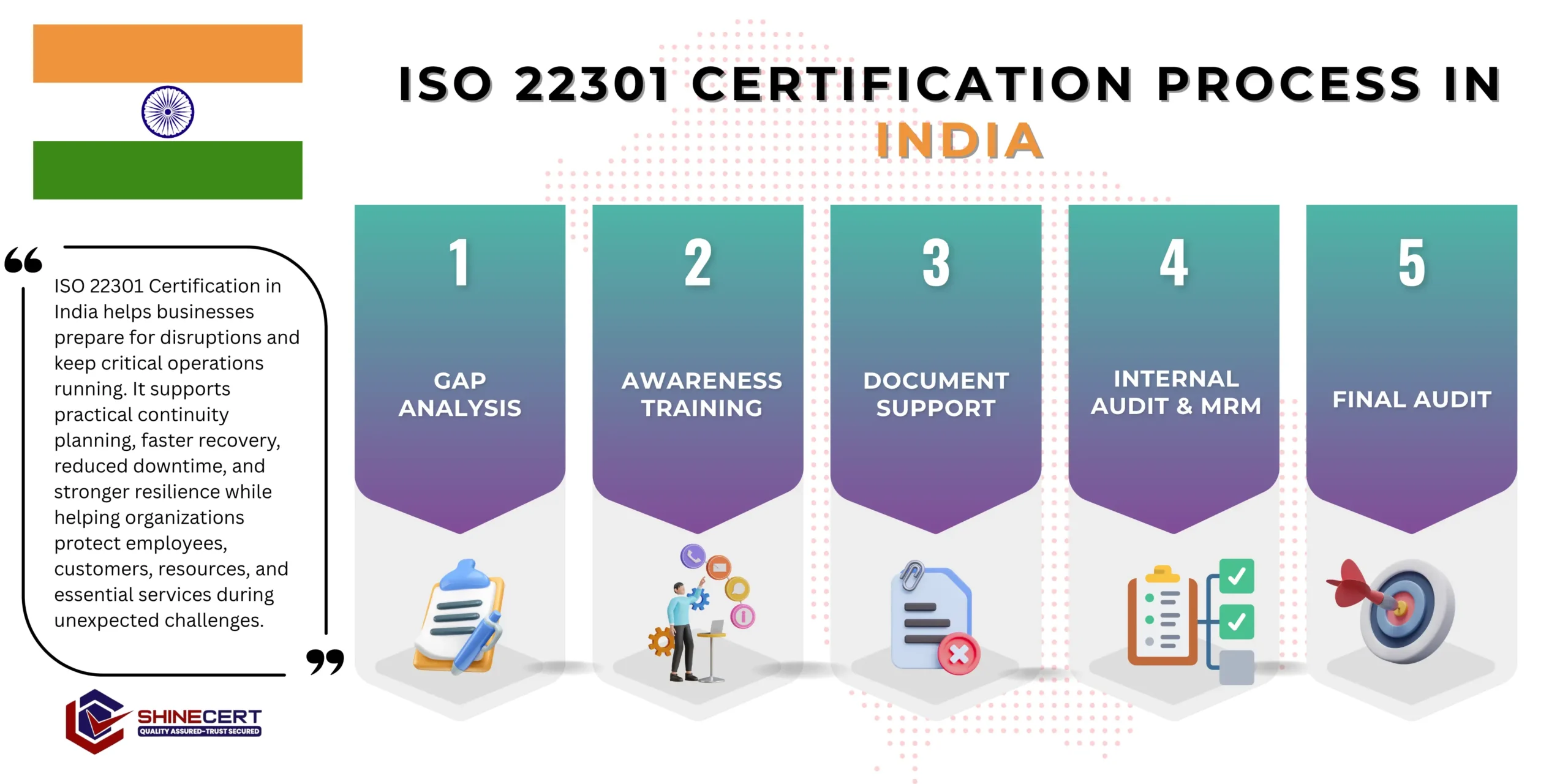
What are the steps to get ISO 22301 Certification in India?
our services
- ISO Certification India
- ISO 9001 Certification India
- ISO 14001 Certification India
- ISO 27001 Certification India
- ISO 22000 Certification India
- ISO 27701 Certification India
- ISO 45001 Certification India
- ISO 20000-1 Certification India
- ISO 13485 Certification India
- ISO 17025 Certification India
- ISO 31000 Certification India
- ISO 42001 Certification India
- ISO 37001 Certification India
- ISO 22301 Certification India
- ISO 50001 Certification India
- CE Mark Certification India
- GDPR Certification India
- GMP Certification India
- Halal Certification India
The Certification Process
Gap Assessment
We identify your organization's critical activities and existing contingency arrangements, comparing them against the standard's requirements to determine what genuinely exists already versus what needs to be built.
Documentation Development
We build the business impact analysis, identifying maximum tolerable disruption periods for each critical activity, and the continuity plans themselves, written around your actual operations rather than generic templates.
Implementation and Training
Plans go live and staff with continuity roles are trained specifically on their responsibilities during an actual disruption, not just handed a document to read.
Internal Audit and Exercise
We run a structured internal audit and, critically, a genuine tabletop or simulation exercise testing the plans in practice, since this is exactly what the certification auditor will expect evidence of.
Certification Audit
An accredited certification body audits your actual plans and exercise records, and issues the certificate once satisfied you genuinely meet the standard's requirements.
How Long Does Certification Take?
| Business Size | Typical Timeline | Why |
|---|---|---|
| Small, few critical activities | 2–3 months | Fewer processes to analyze and simpler exercises |
| Medium, multiple critical functions | 3–4 months | More business impact analysis and coordination across functions |
| Large or multi-site operations | 4–5 months | Extensive critical activities and multi-site exercise coordination |
- Small businesses with few critical activities (2 to 3 months) : With a narrower set of genuinely critical processes, the business impact analysis and continuity plans are considerably faster to build and test.
- Medium businesses with multiple critical functions (3 to 4 months) : More critical activities across different departments mean a more detailed business impact analysis and more coordination to build coherent, cross-functional continuity plans.
- Large or multi-site operations (4 to 5 months) : Coordinating continuity planning and genuine exercises across multiple sites or business units typically requires more documentation review and logistical coordination.
- The variable that matters most: whether leadership treats the required exercise as a genuine test, not a formality : An organization that takes the tabletop exercise seriously surfaces real gaps and fixes them before certification; one that treats it as a checkbox often finds those same gaps during an actual disruption instead.
A real example : A logistics operator initially wanted to skip a full continuity exercise, confident its supplier contact procedures were current; running the exercise anyway revealed the supplier contact list was over a year out of date, a gap that would have caused real delay during an actual disruption and that we corrected before certification rather than after an incident.
Why It Matters in India?
The Reserve Bank of India has steadily increased its focus on operational resilience for banks and financial institutions, expecting demonstrable business continuity capability rather than a static disaster recovery document reviewed once a year. Beyond banking, Indian businesses across sectors face genuine, recurring disruption risk, monsoon-related flooding and infrastructure disruption in many regions, increasing cyberattack frequency across industries, and supply chain shocks affecting logistics and manufacturing, none of which respect sector boundaries.
- What not being certified actually costs you : You’re weaker positioned during RBI supervisory reviews if you’re a regulated financial entity, since a documented, tested system carries considerably more weight than an assurance that plans exist. You’re also a harder sell to enterprise clients who increasingly require business continuity evidence as part of vendor risk assessments, particularly for IT services and data-handling businesses. And without regularly tested plans, an actual disruption tends to reveal gaps in real time rather than being caught safely during a planned exercise.
- Why is this happening in India right now? As both regulatory expectations and genuine operational risk, from climate-related disruption to cyber threats, continue rising, Indian businesses across banking, IT services, and logistics are moving from informal contingency planning toward structured, tested continuity systems, and certification gives them a credible, internationally recognized way to demonstrate this shift to regulators, clients, and their own boards.
What Affects the Cost?
- Number of critical activities : More business functions requiring continuity planning mean a more extensive business impact analysis.
- Number of sites or locations : More locations mean more coordination for both planning and exercise logistics.
- Regulatory context : Banks and financial institutions typically need more detailed documentation aligned to RBI operational resilience expectations.
- Certification body fees : Separate from consulting fees, and worth confirming accreditation before comparing quotes.
Required Documentation
The scope statement defines exactly which activities and locations the certification covers. The business continuity policy sets top management’s commitment.
The business impact analysis identifies critical activities and maximum tolerable disruption periods. The risk assessment identifies threats to those critical activities.
Competence and training records prove staff with continuity roles are genuinely prepared. The communication plan documents how stakeholders are informed during a disruption.
Business continuity plans describe exactly how each critical activity is maintained or recovered. Incident response procedures document the immediate steps taken when disruption begins.
Exercise and testing records prove the plans have actually been tested, not just written. Internal audit reports and management review minutes demonstrate ongoing oversight. Corrective action records show how gaps found during exercises are addressed.
Who Actually Needs This?
Banks, NBFCs, and financial institutions
Banks, NBFCs, and financial institutions, where RBI’s operational resilience expectations are direct and increasingly specific.
Read moreIT services and data center operators
IT services and data center operators, where enterprise clients routinely require business continuity evidence as part of vendor risk assessment.
Read moreLogistics and supply chain operators
Logistics and supply chain operators, where disruption risk, from infrastructure to weather, is a routine operational reality.
Read moreManufacturing businesses in flood-prone or infrastructure-constrained regions
Manufacturing businesses in flood-prone or infrastructure-constrained regions, where genuine continuity planning protects against real, recurring risk.
Read moreAny business holding ISO 27001
Any business holding ISO 27001 and looking to extend resilience planning into a formal, integrated continuity system.
Read moreBenefits of ISO 22301 Certification
For regulated financial entities, a certified, tested continuity system carries considerably more weight than an assurance that plans exist.
The standard’s emphasis on regular exercises means your organization has actually practiced its response, not just written about it.
Business continuity evidence is an increasingly standard part of vendor risk assessments, particularly in IT services and data handling.
Organizations with tested plans recover measurably faster than those improvising during a real incident.
Business continuity and information security planning overlap substantially, making combined certification efficient for many organizations.
Common Mistakes We See
- Confusing a disaster recovery plan with a full business continuity management system : IT recovery is one piece; the standard covers people, processes, suppliers, and facilities as well.
- Skipping or minimizing the required exercise : As our own case study shows, exercises surface real gaps that documentation review alone won’t catch.
- Letting supplier and contact information go stale : Continuity plans depend on accurate, current contact details; outdated information is a common and entirely avoidable gap.
- Choosing a certification body without confirming accreditation : An unaccredited certificate carries no real recognition with RBI reviewers or enterprise clients.
Standards and Clauses: What ISO 22301 Actually Requires
- Context of the Organization (Clause 4) : requires identifying critical activities and interested parties’ expectations, including regulators like RBI for financial institutions.
- Leadership (Clause 5) : requires top management to set continuity policy and take visible ownership, not delegate it entirely to an IT or facilities team.
- Planning (Clause 6) : requires identifying continuity objectives and risks, operationalizing proactive resilience planning.
- Support (Clause 7) : covers competence, awareness, and communication needed to run the system.
- Operation (Clause 8) : is the standard’s core, covering business impact analysis, risk assessment, continuity strategies, plans, and critically, exercising and testing.
- Performance Evaluation (Clause 9) : requires monitoring continuity performance, internal audits, and management review.
- Improvement (Clause 10) : requires acting on nonconformities, including gaps found during exercises, and continually improving the system.
Case Study: A Logistics Operator
- A logistics operator needed ISO 22301 certification to satisfy an enterprise client’s vendor risk assessment ahead of a multi-year distribution contract.
- The operator initially wanted to skip a full continuity exercise, confident that its supplier contact procedures were current and well-managed.
- We ran the exercise anyway, and it revealed the supplier contact list was over a year out of date, exactly the kind of gap that would have caused real delay during an actual disruption rather than a planned test. We corrected this and several related documentation gaps before the certification audit.
- The operator secured the distribution contract, with the client specifically citing the certification’s evidence of genuine, tested continuity capability as satisfying their vendor risk requirement.
Answering the Objections Every Owner Has
“We already have a disaster recovery plan.”
A disaster recovery plan usually covers IT systems specifically; ISO 22301 covers the whole business, critical processes, people, suppliers, facilities, and crucially requires you to actually test the plan, not just write it.
“This seems like it’s only relevant to banks.”
Every business has activities critical enough that disruption would cause real harm; the standard scales its scope to your organization’s actual critical activities, whatever sector you’re in.
“We’re worried testing will disrupt normal operations.”
Tabletop and structured exercises are designed to be low-disruption while still surfacing genuine gaps; the risk of not testing, discovering gaps during an actual crisis, is considerably higher.
“Can’t we just document our existing informal contingency arrangements?”
Informal arrangements rarely survive contact with an actual disruption if they’ve never been tested, and a document without genuine practice behind it tends to fail exactly when it matters most.
Choosing the Right Partner?
| DIY | Generic Consultant | ShineCert | |
|---|---|---|---|
| RBI alignment | Rarely considered for financial entities | Sometimes mentioned, rarely integrated | Directly reconciled with operational resilience expectations |
| Exercise rigor | Often skipped or minimal | Templated, sometimes superficial | Built as a genuine test, gaps surfaced and fixed |
| Accreditation verification | Often overlooked | Sometimes assumed rather than confirmed | Verified explicitly before you commit |
| Post-certification support | None | Often ends at the certificate | Built to support your ongoing surveillance audits and exercises |
Which Certification Body Should You Choose?
Confirm the certification body is accredited by NABCB or another IAF-member accreditation authority. Ask whether the consultant understands your specific regulatory context, particularly if you’re RBI-regulated. Confirm the certification audit reviews genuine exercise records, not just written plans.
Why Businesses Choose ShineCert in India?
We’ve spent 10 years helping more than 10,000 businesses worldwide get certified, coordinated through our Riyadh and India offices with work delivered remotely or on-site as needed. Our consultants insist on genuine exercises, not checkbox drills, because that’s where the real value of business continuity planning actually shows up, with ShineCert as the best ISO 22301 consultant in India. We only work with accredited certification bodies, never unaccredited shortcuts.
Frequently Asked Questions
Not universally, but RBI’s operational resilience expectations for banks and financial institutions increasingly align with it, and enterprise clients across sectors increasingly require it.
It depends on your number of critical activities, sites, and regulatory context. We quote individually.
Usually two to five months depending on business size, with genuine exercise rigor mattering more than headcount alone.
No, it doesn’t replace specific regulatory requirements; it gives you a structured, tested system that directly supports demonstrating operational resilience.
Confirm accreditation by NABCB or another IAF-member authority, and confirm the audit reviews genuine exercise records, not just written plans.