
CE Mark Certification in India
Quick Answer
CE Marking is not a certification ShineCert issues; it’s a European Union conformity marking that manufacturers self-declare, or in some cases have verified by an EU-recognized Notified Body, confirming a product meets applicable EU health, safety, and environmental requirements. ShineCert provides advisory support to help Indian exporters understand and prepare for CE Marking requirements ahead of shipping to the EU. This has genuine new urgency: India and the EU concluded a landmark Free Trade Agreement in January 2026, expected to come into effect around February-March 2027, granting duty-free access to roughly 99% of Indian exports by value, making EU market entry, and therefore CE Marking readiness, newly accessible for many Indian exporters who previously found EU market entry impractical.
Why It Matters in India Right Now?
India and the European Union concluded a landmark Free Trade Agreement in January 2026, with the Ministry of Commerce and Industry confirming the deal on 27 January 2026 and the agreement expected to come into effect around February-March 2027. The agreement is genuinely significant in scale: roughly 93% of Indian exports will get duty-free access to the European market, with India securing unprecedented market access for more than 99% of Indian exports by trade value. The sectors expected to benefit most include textiles, apparel, leather, footwear, marine products, gems and jewellery, handicrafts, engineering goods, and automobiles, several of which fall squarely within CE Marking’s applicable product categories, particularly engineering goods, machinery, and electronics.
Why this creates genuine urgency, not just opportunity : Duty-free access removes the tariff barrier that previously made EU market entry uneconomical for many Indian exporters; it does not remove non-tariff barriers like CE Marking, which remains mandatory regardless of tariff status. This means a considerable number of Indian manufacturers who are newly evaluating the EU market for the first time because of the FTA’s tariff benefits may not yet have CE Marking readiness in place at all, creating a real risk of missing the practical benefit of the trade deal due to a compliance gap that has nothing to do with tariffs.
What not being CE Marking-ready actually costs you : You cannot legally place applicable products on the EU market regardless of tariff status, meaning the FTA’s duty-free access delivers no practical benefit to your business until CE Marking readiness is in place. You also risk a slower, more expensive path to market entry if you begin preparing only once the FTA takes effect and demand from Indian exporters for Notified Body capacity and technical documentation support increases simultaneously. And exporters who treat CE Marking as an afterthought often discover mid-negotiation with a European buyer that their product design itself needs modification to meet EU requirements, a considerably more expensive fix than addressing it during initial product development.
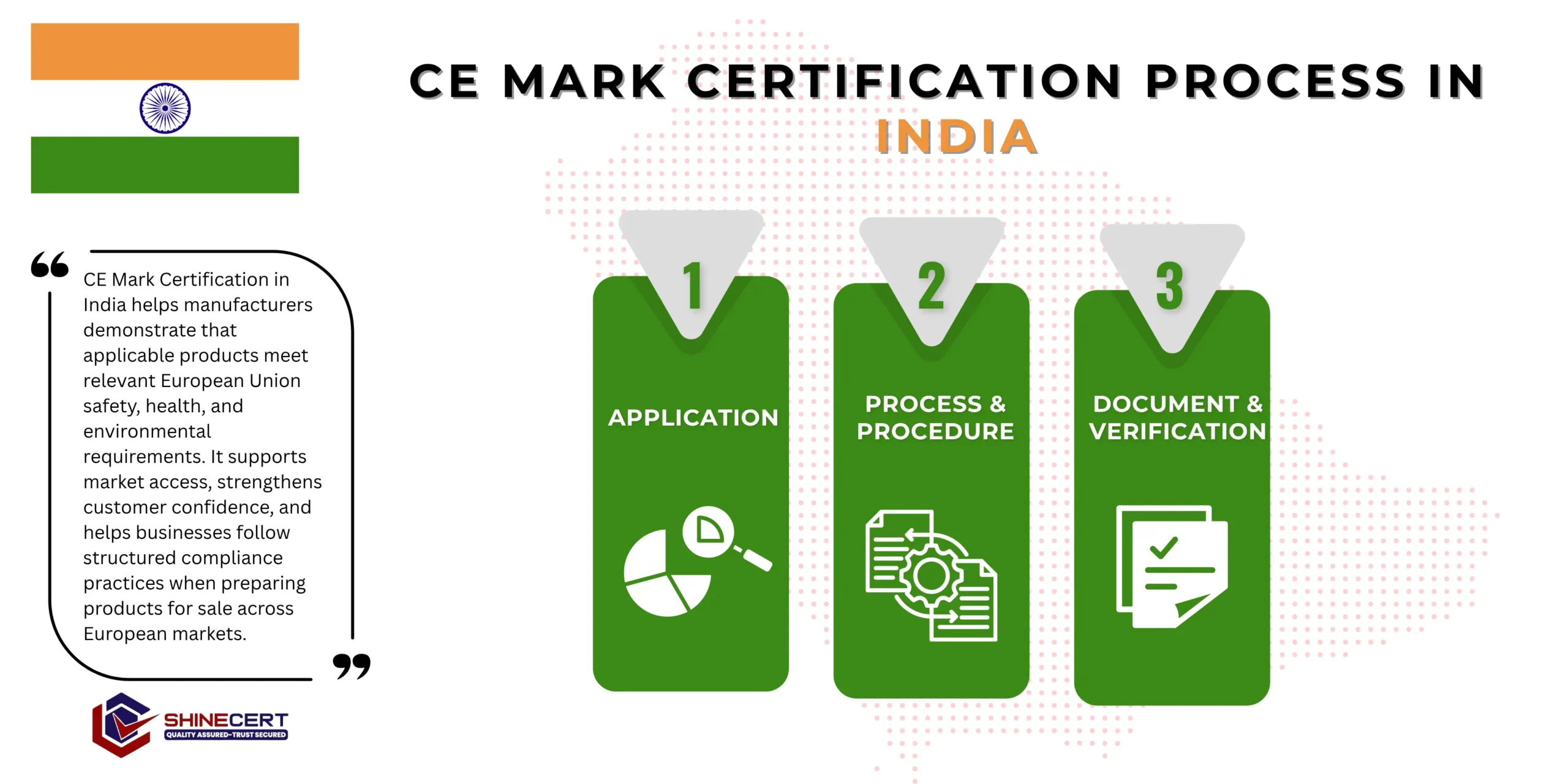
What are the steps to get CE Mark Certification in India?
our services
- ISO Certification India
- ISO 9001 Certification India
- ISO 14001 Certification India
- ISO 27001 Certification India
- ISO 22000 Certification India
- ISO 27701 Certification India
- ISO 45001 Certification India
- ISO 20000-1 Certification India
- ISO 13485 Certification India
- ISO 17025 Certification India
- ISO 31000 Certification India
- ISO 42001 Certification India
- ISO 37001 Certification India
- ISO 22301 Certification India
- ISO 50001 Certification India
- CE Mark Certification India
- GDPR Certification India
- GMP Certification India
- Halal Certification India
The Advisory Process
Product and Directive Assessment
We assess your specific product against the range of EU directives that could apply, machinery, low voltage, electromagnetic compatibility, and others, since many exporters initially assume the wrong directive applies or miss an additional one that also does.
Gap Assessment
We compare your current product design, safety features, and existing documentation against what the applicable directives actually require.
Technical Documentation Preparation
Depending on product complexity, we help you build the technical file, risk assessment, and, for self-declaration categories, the declaration of conformity itself.
Notified Body Coordination, if required
For higher-risk product categories requiring third-party verification, we help you identify and engage an appropriate EU-recognized Notified Body, an increasingly important step to begin early given anticipated rising demand as the FTA approaches effect.
Final Readiness Review
We confirm your documentation, and where applicable your Notified Body engagement, are genuinely ready to support EU market entry.
How Long Does Advisory Preparation Take?
| Business Size | Typical Timeline | Why |
|---|---|---|
| Small exporter, single product, self-declaration category | 2–3 months | Simpler technical file and no Notified Body involvement |
| Medium exporter, multiple products or a Notified Body category | 3–4 months | More technical documentation and possible third-party coordination |
| Large exporter or complex, higher-risk product category | 4–6 months | Extensive documentation and Notified Body engagement |
- Small exporters with a single self-declaration product (2 to 3 months) : Without Notified Body involvement required, the process centers on building a solid technical file and declaration of conformity.
- Medium exporters with multiple products or a Notified Body category (3 to 4 months) : More products mean more individual technical files, and Notified Body categories add coordination time beyond self-declaration alone.
- Large exporters or complex, higher-risk product categories (4 to 6 months) : Extensive product ranges or genuinely high-risk categories requiring rigorous Notified Body verification typically need more documentation depth and longer third-party engagement.
- The variable that matters most: whether your product design already meets EU safety requirements, or needs modification : A product that already incorporates EU-equivalent safety features moves through documentation considerably faster than one requiring genuine design changes discovered during the gap assessment.
A real example : A machinery manufacturer preparing for the EU market for the first time had not considered electromagnetic compatibility requirements during the product’s original design; addressing this properly, rather than treating it as a documentation formality, added roughly five weeks to incorporate genuine design considerations before the technical file could be finalized.
About CE Marking
- CE Marking indicates a product complies with European Union health, safety, and environmental protection requirements for the specific product category it falls under. Depending on the product, compliance is either self-declared by the manufacturer following an internal conformity assessment, or verified by an EU-recognized Notified Body for higher-risk product categories. It applies to a wide range of products including machinery, electronics, toys, medical devices, and construction products, among others, and is mandatory for these categories to be legally sold within the European Economic Area.
- Important: ShineCert does not issue CE Marking : No consultancy does; CE Marking is a manufacturer self-declaration or Notified Body verification process defined entirely by EU regulation. What ShineCert provides is advisory support, helping you understand which EU directives apply to your specific product, preparing the required technical documentation, and where needed, connecting you with an appropriate EU-recognized Notified Body for products requiring third-party verification.
What Affects the Cost?
- Number of products and applicable directives : More products, or a product falling under multiple directives, mean more individual technical files.
- Whether your product requires self-declaration or Notified Body verification : Notified Body categories add third-party fees beyond ShineCert’s advisory fees.
- Current product design maturity relative to EU requirements : A product already incorporating EU-equivalent safety features starts from a stronger position than one requiring design changes.
- Notified Body fees, where applicable, are separate from ShineCert’s advisory fees and vary by the specific body and product category.
Required Documentation
The technical file consolidates product design information, risk assessment, and evidence of conformity with applicable directives. The declaration of conformity, for self-declaration categories, is the manufacturer’s formal statement of compliance.
The risk assessment identifies hazards specific to your product and how they’re addressed in design. The directive applicability assessment documents which EU directives apply and why.
Product design specifications and drawings demonstrate how safety requirements are incorporated. Test reports, where applicable, provide evidence of compliance with specific technical standards.
where required, include the type examination certificate or equivalent verification issued by the Notified Body following their assessment.
Who Actually Needs This?
Machinery and engineering goods manufacturers
A sector specifically named as a major beneficiary of the EU-India FTA, where CE Marking is mandatory for market entry.
Read moreElectronics manufacturers and exporters
Another category where CE Marking compliance is a legal requirement for EU sales.
Read moreTextile and apparel exporters are considering the EU market for the first time
Given the sector’s prominent place among FTA beneficiaries, even though CE Marking applies more narrowly within this category than in machinery or electronics.
Read moreAutomotive component manufacturers
Named among the FTA’s expected beneficiary sectors, where relevant EU product safety directives apply.
Read moreAny Indian exporter newly evaluating the EU market because of the FTA’s tariff benefits
Who has not previously assessed CE Marking applicability to their specific product.
Read moreBenefits of Early CE Marking Preparation
Advisory preparation now means you’re positioned to act the moment the trade agreement’s practical benefits become available, rather than starting the compliance process from scratch.
Understanding applicable EU requirements during product development, rather than after a European buyer’s inquiry, avoids expensive retrofitting.
As FTA-driven interest in the EU market grows among Indian exporters, securing Notified Body engagement early avoids potential queuing as demand increases.
European buyers routinely request technical files as part of their own procurement due diligence, and having this ready in advance speeds deal-making.
Many exporters discover, once properly assessed, that their product falls under different or additional directives than they assumed.
Common Mistakes We See
- Assuming compliance with Indian or other market standards satisfies EU requirements : CE Marking requirements are specific to the EU and genuinely distinct from other markets’ standards, even where overlap exists.
- Treating CE Marking as a documentation exercise rather than a design consideration : As our case study shows, genuine product design gaps, not just paperwork gaps, are common and require actual engineering attention, not just better records.
- Waiting until a European buyer specifically asks about CE Marking : Discovering the requirement mid-negotiation is a considerably more expensive and slower position than being prepared in advance.
- Missing an additional applicable directive beyond the obvious one : Many products fall under more than one EU directive simultaneously, and missing one creates a genuine compliance gap even if the primary directive is addressed.
What CE Marking Actually Covers?
- Applicable EU directives vary by product category, machinery, low voltage equipment, electromagnetic compatibility, and others, each with its own specific safety and performance requirements.
- Risk assessment requires identifying hazards specific to your product and demonstrating how design addresses them, not just describing intended use.
- Technical documentation requires a complete, organized file demonstrating conformity, available for EU market surveillance authorities to review on request.
- Self-declaration versus Notified Body verification depends on your product’s risk category; lower-risk products typically allow manufacturer self-declaration, while higher-risk categories require independent third-party verification.
Case Study: A Machinery Manufacturer Preparing for First EU Export
- A machinery manufacturer, motivated by the EU-India FTA’s newly announced duty-free access, sought advisory support to prepare for its first-ever EU export shipment.
- Our directive applicability assessment found the manufacturer had correctly identified the Machinery Directive as relevant but had not considered electromagnetic compatibility requirements at all during the product’s original design.
- Rather than treating this as a documentation gap, we worked with the manufacturer’s engineering team to address genuine electromagnetic compatibility considerations in the product itself, adding roughly five weeks to the timeline but avoiding a far more costly retrofit after a failed compliance check or a European buyer’s own technical review.
- The manufacturer completed its technical file and declaration of conformity, positioning it to enter the EU market as soon as the FTA’s practical benefits became available.
Answering the Objections Every Owner Has
“The FTA doesn’t take effect until 2027, why prepare now?”
CE Marking preparation, technical documentation, potential product adjustments, Notified Body engagement if required, genuinely takes time; starting now means you’re ready to act the moment the trade agreement’s benefits become available, rather than losing months of competitive advantage to exporters who prepared earlier.
“We already export to other markets without this requirement.”
CE Marking is specific to the EU and EEA market; compliance with other markets’ requirements, including India’s own domestic standards, doesn’t satisfy EU requirements, which are genuinely distinct.
“Isn’t this something our European buyer will just tell us we need?”
Some buyers do flag it during negotiation, but discovering the requirement mid-deal, and potentially needing product design changes at that stage, is a considerably more expensive and slower position than being prepared in advance.
“We’re a smaller exporter, is this really worth the investment given we’re not sure about EU demand yet?”
The FTA’s duty-free access specifically opens the EU market to exporters, including smaller ones, who previously found it uneconomical; CE Marking advisory scoped to your actual product and export ambitions doesn’t need to be a large upfront investment to give you a clear, actionable picture.
Choosing the Right Partner?
| DIY | Generic Consultant | ShineCert | |
|---|---|---|---|
| Directive applicability assessment | Often incomplete, missing secondary directives | Templated, sometimes generic | Thorough assessment of every applicable directive |
| Design gap identification | Frequently treated as documentation only | Templated, rarely genuine engineering review | Genuine review of design against safety requirements |
| Notified Body coordination | Handled alone, if at all | Sometimes offered, variable quality | Coordinated based on your specific product category |
| FTA timeline awareness | Not considered | Rarely factored in | Built around the EU-India FTA’s approaching effective date |
Choosing an Advisory Partner
Confirm the advisor genuinely understands which EU directives apply to your specific product category, not just CE Marking in general terms. Ask whether they can identify real design gaps, not just documentation gaps. Confirm they can help coordinate Notified Body engagement if your product requires it.
Why Businesses Choose ShineCert in India?
We’ve spent 10 years helping more than 10,000 businesses worldwide navigate international certification and compliance requirements, coordinated through our Riyadh and India offices with work delivered remotely or on-site as needed. Our consultants assess your product against every genuinely applicable EU directive, not just the obvious one, with ShineCert as the best CE Mark consultant in India, and we’re tracking the EU-India FTA’s timeline closely to help you prepare with real urgency rather than treating this as a distant future consideration.
Frequently Asked Questions
Yes, for applicable product categories, machinery, electronics, and many other engineered products, entering the EU market, regardless of the India-EU FTA’s tariff benefits.
No, the FTA addresses tariffs, not product safety requirements; CE Marking remains a mandatory non-tariff requirement for applicable products.
It depends on your number of products, applicable directives, and whether Notified Body verification is required. We quote individually.
Usually two to six months depending on product complexity, with existing product design maturity relative to EU requirements mattering more than headcount alone.
The agreement was concluded in January 2026 and is expected to come into effect around February-March 2027.