
ISO 50001 Certification in India
Quick Answer
ISO 50001 certification is an internationally recognized Energy Management System credential confirming an organization systematically measures, manages, and continually improves its energy performance. In India, energy-intensive industries designated as Designated Consumers under the Bureau of Energy Efficiency’s Perform, Achieve and Trade scheme already face mandatory energy audits and consumption targets under the Energy Conservation Act, 2001, and ISO 50001 gives them, and any other energy-conscious business, a structured management system that directly supports PAT compliance rather than duplicating it. Certification typically takes two to five months.
About ISO 50001
ISO 50001 is the world’s leading Energy Management System standard, published by the International Organization for Standardization. It requires organizations to establish an energy baseline, identify significant energy uses, set measurable performance indicators, and continually improve energy performance through a structured management cycle, rather than relying on periodic audits or isolated efficiency projects.
Certification means an independent, accredited certification body has audited your actual energy monitoring, baseline data, and improvement processes, and confirmed they genuinely meet the standard’s requirements. It runs on a three-year cycle with annual surveillance audits, appropriate for a discipline where energy performance needs continuous tracking, not a one-time efficiency study.
A brief history of the standard : ISO 50001 was first published in 2011, and revised in 2018, the current edition, which clarified requirements around establishing energy baselines and energy performance indicators, making it considerably easier for organizations to demonstrate measurable improvement over time rather than relying on subjective assessments of energy efficiency effort.
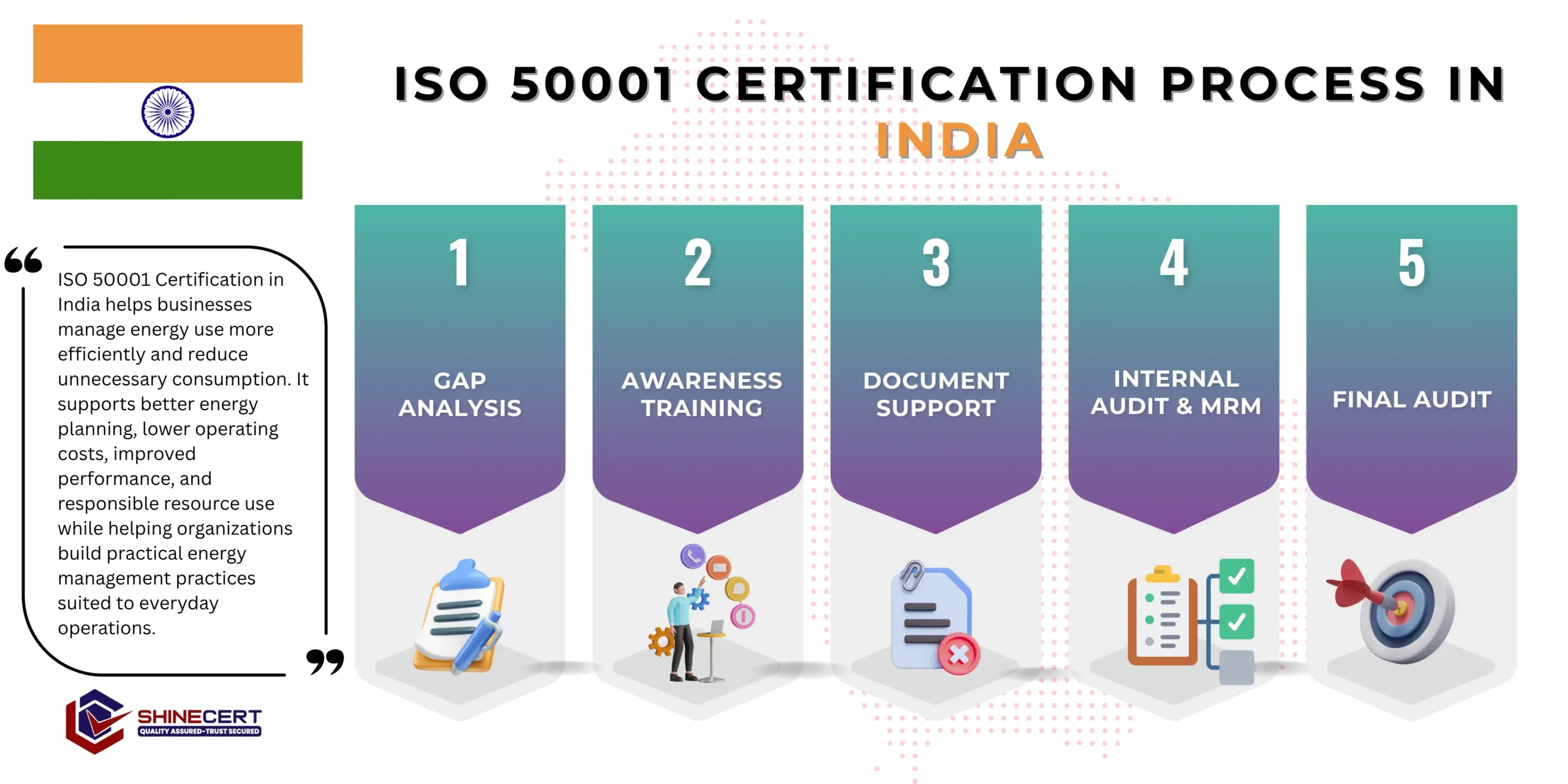
What are the steps to get ISO 50001 Certification in India?
our services
- ISO Certification India
- ISO 9001 Certification India
- ISO 14001 Certification India
- ISO 27001 Certification India
- ISO 22000 Certification India
- ISO 27701 Certification India
- ISO 45001 Certification India
- ISO 20000-1 Certification India
- ISO 13485 Certification India
- ISO 17025 Certification India
- ISO 31000 Certification India
- ISO 42001 Certification India
- ISO 37001 Certification India
- ISO 22301 Certification India
- ISO 50001 Certification India
- CE Mark Certification India
- GDPR Certification India
- GMP Certification India
- Halal Certification India
The Certification Process
Gap Assessment
We review your existing energy monitoring, any PAT-related audits and returns already on file, and compare current practices against the standard's requirements, identifying where existing documentation already meets the bar and where genuine gaps remain.
Documentation Development
Depending on complexity, we build the energy policy, energy baseline, and energy performance indicators, aligned with your existing BEE reporting so the two systems reinforce rather than duplicate each other.
Implementation and Training
The system goes live and staff, particularly your appointed energy manager and production supervisors, are trained on ongoing monitoring and data collection, since consistent, accurate energy data is the foundation the entire system depends on.
Internal Audit and Management Review
We run a structured internal audit against the same criteria the certification auditor will use, and complete a formal management review with leadership.
Certification Audit
An accredited certification body audits your actual energy monitoring and improvement processes, and issues the certificate once satisfied you genuinely meet the standard's requirements.
How Long Does Certification Take?
- Small businesses with a single facility (2 to 3 months) : Fewer significant energy uses mean a simpler baseline and performance indicator set, and existing utility billing data often provides a workable starting point.
- Medium businesses with multiple production lines (3 to 4 months) : More energy-intensive processes mean more individual baselines to establish and more staff across different lines to train on consistent monitoring.
- Large or multi-site Designated Consumers (4 to 5 months) : Extensive facilities and existing PAT reporting obligations across multiple sites typically require more coordination to build one coherent energy management system.
- The variable that matters most: whether you already have sub-metering or facility-wide billing only : A business with existing sub-metered data by process or department can establish a meaningful baseline quickly; one relying on facility-wide utility billing alone needs sub-metering installed before a genuine baseline is even possible.
A real example : A manufacturing facility near Pune had only facility-wide utility billing with no sub-metering by production line; installing basic sub-metering before a meaningful energy baseline could even be established added roughly five weeks beyond a comparable facility that already tracked energy use by line.
Why It Matters in India?
The Bureau of Energy Efficiency’s Perform, Achieve and Trade scheme is a regulatory mechanism under the Energy Conservation Act, 2001, targeting Specific Energy Consumption reduction in energy-intensive industries. Designated Consumers, businesses in specific high energy-intensive sectors identified by BEE, are legally required to appoint an energy manager, file annual energy consumption returns, and conduct mandatory energy audits, with a market-based mechanism allowing excess energy savings to be certified and traded. ISO 50001 certification supports PAT compliance directly, giving Designated Consumers a structured management system behind their mandatory reporting, rather than treating audits and returns as standalone annual exercises.
- What not being certified actually costs you : As a Designated Consumer, you’re managing PAT obligations, energy audits, consumption returns, target tracking, without the structured management system that makes meeting Specific Energy Consumption targets considerably more systematic and less last-minute. You’re also missing genuine cost savings, since a working energy management system frequently surfaces efficiency opportunities beyond what compliance-driven audits alone identify. And without continuous monitoring, energy performance tends to drift between audit cycles rather than improving consistently.
- Why is this happening in India right now? As industrial energy costs continue rising and BEE’s PAT scheme cycles bring tighter Specific Energy Consumption targets to more Designated Consumer sectors over time, businesses are finding that a genuine energy management system, rather than treating each PAT cycle as a fresh compliance exercise, produces both better regulatory outcomes and real cost savings that compound year over year.
What Affects the Cost?
- Number of significant energy uses : More distinct processes or equipment consuming significant energy mean more individual baselines and performance indicators.
- Existing metering infrastructure : A facility with sub-metering by process starts from a stronger position than one with only facility-wide billing.
- PAT Scheme designation status : Designated Consumers typically need documentation that explicitly aligns with existing BEE reporting obligations.
- Certification body fees : Separate from consulting fees, and worth confirming accreditation before comparing quotes.
Required Documentation
The scope statement defines exactly which facilities and processes the certification covers. The energy policy sets top management’s commitment.
The energy review identifies significant energy uses and improvement opportunities. The energy baseline and energy performance indicators establish the reference point against which improvement is measured.
Competence and training records prove staff responsible for energy management, including your PAT-designated energy manager, are genuinely qualified. The document control procedure governs how energy management records are maintained.
Operational control procedures describe how significant energy uses are actually managed day to day. Design and procurement procedures ensure new equipment and facilities consider energy performance from the outset.
Monitoring, measurement, and analysis records, internal audit reports, and management review minutes demonstrate ongoing oversight. Corrective action records show how you respond when energy performance deviates from targets.
Who Actually Needs This?
BEE-designated Designated Consumers under the PAT Scheme
Certification directly supports mandatory compliance obligations.
Read moreCement, textile, chemical, and other energy-intensive manufacturers
Whether or not currently designated, where energy costs represent a significant operating expense.
Read moreBusinesses seeking to generate tradable energy savings certificates
Systematic management supports genuinely exceeding PAT targets.
Read moreAny manufacturer facing rising industrial energy costs
Structured energy management delivers measurable savings beyond compliance value alone.
Read moreBenefits of ISO 50001 Certification
Certification builds exactly the energy monitoring, baseline, and performance indicator documentation that PAT reporting and target tracking require.
Systematic energy management frequently identifies efficiency opportunities beyond what compliance-driven annual audits alone surface.
Businesses that exceed their Specific Energy Consumption targets can generate tradable energy savings certificates; a working management system supports genuinely exceeding targets, not just meeting them.
Energy performance is monitored and improved year-round rather than reviewed only during BEE’s audit cycles.
ISO 50001 shares structural elements with ISO 14001 and ISO 9001, making combined certification efficient for many industrial businesses.
Common Mistakes We See
- Relying on facility-wide utility billing instead of genuine sub-metering : As our case study shows, a meaningful baseline requires visibility into significant energy uses individually, not just total consumption.
- Treating ISO 50001 as separate from PAT Scheme reporting : Building two disconnected systems doubles the documentation burden when they should reinforce each other.
- Underestimating the design and procurement clause : Businesses often manage existing operations well but skip considering energy performance when acquiring new equipment.
- Choosing a certification body without confirming accreditation : An unaccredited certificate carries no real recognition with BEE or industry stakeholders.
Standards and Clauses: What ISO 50001 Actually Requires
- Context of the Organization (Clause 4) : requires identifying energy-relevant conditions and interested parties’ expectations, including BEE and PAT Scheme obligations for Designated Consumers.
- Leadership (Clause 5) : requires top management to set an energy policy and take visible ownership, not delegate it entirely to the energy manager alone.
- Planning (Clause 6) : requires the energy review, baseline, and performance indicators, operationalizing measurable energy management rather than ad-hoc efficiency projects.
- Support (Clause 7) : covers competence, training, and documented information needed to run the system.
- Operation (Clause 8) : covers operational controls over significant energy uses and energy considerations in design and procurement.
- Performance Evaluation (Clause 9) : requires monitoring actual energy performance against the baseline, internal audits, and management review.
- Improvement (Clause 10) : requires acting on nonconformities and continually improving energy performance over time.
Case Study: A Manufacturing Facility Near Pune
- A manufacturing facility, a BEE-designated Consumer under the PAT Scheme, needed ISO 50001 certification to strengthen its energy management ahead of a tightening Specific Energy Consumption target in its next PAT cycle.
- Our gap assessment found the facility had only facility-wide utility billing, with no sub-metering by production line, making it impossible to establish a genuinely meaningful energy baseline or identify which specific processes drove consumption.
- We installed basic sub-metering across the facility’s three main production lines before building the baseline, adding roughly five weeks to the timeline but producing data granular enough to actually support meaningful energy performance indicators.
- The facility achieved certification and, using the new sub-metered visibility, identified and corrected an inefficient compressor cycling pattern that alone reduced consumption on one line by a measurable margin, a saving the facility’s previous facility-wide billing data had never revealed.
Answering the Objections Every Owner Has
“We already comply with PAT Scheme audits and reporting.”
Compliance and a management system are different things; ISO 50001 gives you the continuous, structured framework behind your PAT reporting, which tends to produce better audit outcomes and genuine year-round savings rather than annual scrambles.
“This seems like it’s only for the largest industrial consumers.”
Any organization with meaningful energy costs benefits from structured management; the standard scales its documentation to your actual energy footprint, and PAT designation isn’t a prerequisite for value.
“We’re worried this adds another layer of bureaucracy on top of PAT.”
A well-integrated system supports PAT reporting directly rather than duplicating it, turning what might otherwise feel like two separate compliance burdens into one coherent system.
“Can’t our energy manager handle this internally?”
Energy managers appointed under PAT requirements often handle technical energy audits well but rarely have experience structuring the full management-system documentation, baseline methodology, and performance indicators an ISO 50001 auditor specifically expects.
Choosing the Right Partner?
| DIY | Generic Consultant | ShineCert | |
|---|---|---|---|
| PAT Scheme integration | Often built as a separate, disconnected system | Sometimes overlooked entirely | Directly aligned with existing BEE reporting obligations |
| Baseline and metering assessment | Frequently based on facility-wide billing alone | Templated, rarely facility-specific | Built around your actual metering infrastructure |
| Accreditation verification | Often overlooked | Sometimes assumed rather than confirmed | Verified explicitly before you commit |
| Post-certification support | None | Often ends at the certificate | Built to support your ongoing surveillance audits |
Which Certification Body Should You Choose?
Confirm the certification body is accredited by NABCB or another IAF-member accreditation authority. Ask whether the consultant understands PAT Scheme reporting requirements, not just the generic standard. Confirm the certification audit includes a genuine review of your metering and baseline data.
Why Businesses Choose ShineCert in India?
We’ve spent 10 years helping more than 10,000 businesses worldwide get certified, coordinated through our Riyadh and India offices with work delivered remotely or on-site as needed. Our consultants build your ISO 50001 system to directly reinforce, not duplicate, your existing PAT Scheme reporting, and we assess your metering infrastructure honestly upfront rather than building a baseline on data that isn’t granular enough to support one, with ShineCert as the best ISO 50001 consultant in India. We only work with accredited certification bodies, never unaccredited shortcuts.
Frequently Asked Questions
No, but Designated Consumers under BEE’s PAT Scheme face mandatory energy audits and reporting under the Energy Conservation Act, 2001, and ISO 50001 directly supports meeting those obligations systematically.
It depends on your number of significant energy uses, existing metering infrastructure, and PAT status. We quote individually.
Usually two to five months depending on business size, with existing metering infrastructure mattering more than headcount alone.
No, it doesn’t replace mandatory BEE reporting for Designated Consumers; it gives you a structured system that directly supports and strengthens that reporting.
Confirm accreditation by NABCB or another IAF-member authority, and confirm the audit includes a genuine review of your metering and baseline data.