
ISO 31000 Certification in India
Quick Answer
ISO 31000 is an internationally recognized risk management framework, not a certifiable standard, giving organizations principles and guidelines for identifying, assessing, and managing risk at every level, from board strategy down to operational decisions. In India, boards of banks, NBFCs, and listed companies increasingly need a demonstrable risk framework to satisfy RBI risk governance expectations and SEBI disclosure requirements, and ISO 31000 gives them a globally recognized structure to build one. Implementation typically takes two to five months, delivered as an Independent Conformity Review rather than a certification audit.
About ISO 31000
ISO 31000 is the world’s leading international guidance standard for risk management, published by the International Organization for Standardization. Unlike most ISO management-system standards, it is explicitly not certifiable; there’s no accredited “ISO 31000 certificate” to earn. Instead, it provides principles, a framework, and a process that organizations adopt and adapt to embed risk management into governance, strategy, planning, and operations, treating risk consideration as integral to decision-making rather than a separate compliance exercise.
Because it isn’t certifiable, ShineCert delivers ISO 31000 work as an Independent Conformity Review, our consultants assess your risk framework against the standard’s principles and provide a formal report confirming genuine alignment, useful for board reporting, regulator conversations, and investor due diligence, without claiming a certification that doesn’t exist for this standard.
A brief history of the standard : ISO 31000 was first published in 2009, consolidating earlier national risk management standards, most notably Australia and New Zealand’s AS/NZS 4360, into a single internationally recognized framework. It was revised in 2018, the current edition, placing considerably greater emphasis on leadership and genuine integration of risk management into organizational governance and decision-making, rather than treating it as a standalone technical function.
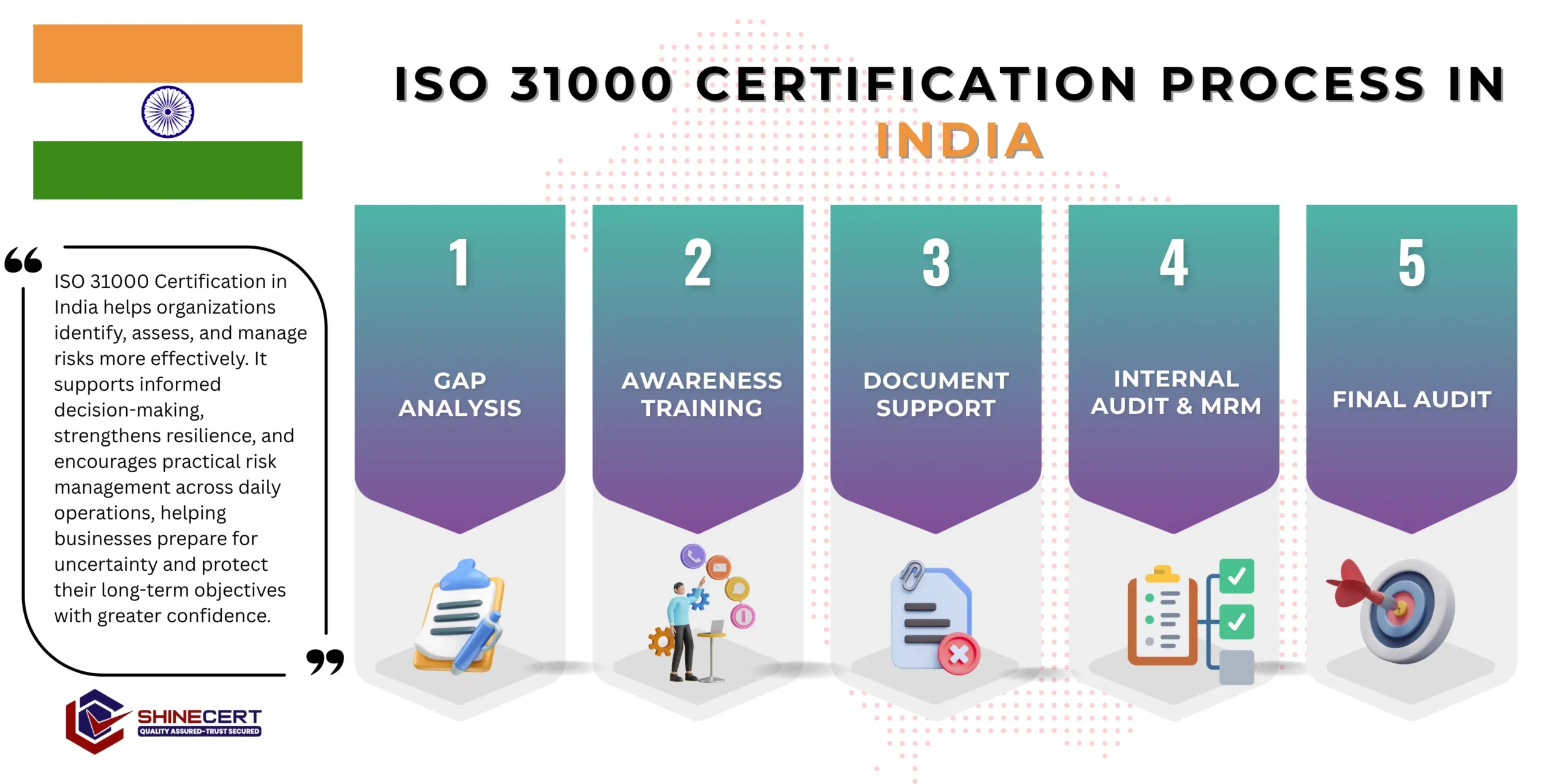
What are the steps to get ISO 31000 Certification in India?
our services
- ISO Certification India
- ISO 9001 Certification India
- ISO 14001 Certification India
- ISO 27001 Certification India
- ISO 22000 Certification India
- ISO 27701 Certification India
- ISO 45001 Certification India
- ISO 20000-1 Certification India
- ISO 13485 Certification India
- ISO 17025 Certification India
- ISO 31000 Certification India
- ISO 42001 Certification India
- ISO 37001 Certification India
- ISO 22301 Certification India
- ISO 50001 Certification India
- CE Mark Certification India
- GDPR Certification India
- GMP Certification India
- Halal Certification India
The Certification Process
Gap Assessment
We review your board's current risk oversight practices, any existing risk registers or committees, and compare them against ISO 31000's principles and process, identifying where genuine integration already exists and where it's currently more form than substance.
Documentation Development
We build the risk management policy, framework, and process documentation, written around how your board and leadership actually make decisions rather than a generic governance template.
Implementation and Training
The framework goes live, and board members and senior leadership are trained specifically on integrating risk consideration into their existing decision processes, not adding a separate compliance step alongside them.
Internal Review and Management Sign-Off
We run a structured internal review against the framework and secure formal management and, where appropriate, board sign-off.
Independent Conformity Review
ShineCert conducts an independent review of your framework in practice and issues a formal conformity report, suitable for board records, regulator conversations, and investor due diligence.
How Long Does Certification Take?
| Organization Size | Typical Timeline | Why |
|---|---|---|
| Small, single board committee | 2–3 months | Fewer stakeholders and simpler existing risk practices |
| Medium, multiple departments or subsidiaries | 3–4 months | More departments and risk categories to integrate |
| Large regulated entity or listed company | 4–5 months | Extensive board, committee, and regulatory coordination |
- Small organizations with a single board committee (2 to 3 months) : Fewer stakeholders and a more concentrated decision structure mean the framework can be built and embedded considerably faster.
- Medium organizations with multiple departments or subsidiaries (3 to 4 months) : More departments and risk categories mean more coordination to build one coherent, organization-wide framework rather than disconnected departmental approaches.
- Large regulated entities or listed companies (4 to 5 months) : Extensive board committee structures, multiple risk categories, and direct RBI or SEBI regulatory expectations typically require more documentation review and stakeholder alignment.
- The variable that matters most: whether your board is genuinely engaged from the outset, not just informed after the framework is built : A board that participates directly in shaping the framework embeds it into real decision-making far faster than one that reviews a finished document after the fact.
A real example : A trading company in Mumbai had a finance director genuinely engaged with risk management, but the broader board had never been formally briefed on risk governance expectations; once we secured direct board engagement early in the process, the framework was built and embedded in roughly six weeks, while a comparable organization that delayed board briefing needed an additional five weeks to secure the same level of genuine buy-in.
Why It Matters in India?
The Reserve Bank of India’s risk governance expectations for banks and NBFCs, alongside SEBI’s listing obligations and disclosure requirements for publicly traded companies, both increasingly expect boards to demonstrate a structured, board-level risk management framework, not just a risk register maintained by a mid-level compliance function. ISO 31000’s emphasis on integrating risk management into governance and strategic decision-making maps directly onto what RBI and SEBI examiners and reviewers are looking for: evidence that risk consideration genuinely shapes board and executive decisions, not a document produced only for audit season.
- What not being certified actually costs you : Your board risk oversight is harder to evidence convincingly during RBI supervisory reviews or SEBI disclosure scrutiny, since without a structured framework, risk management often looks reactive rather than genuinely embedded. You’re also weaker positioned with institutional investors and rating agencies, who increasingly factor governance and risk framework maturity into their own assessments. And without a systematic process, emerging risks tend to surface as incidents rather than being identified and addressed proactively at the board level.
- Why is this happening in India right now? As RBI continues tightening governance expectations for regulated entities and SEBI’s disclosure regime keeps expanding for listed companies, boards are under growing pressure to demonstrate genuine risk governance rather than compliance theater, and ISO 31000 gives them internationally recognized language and structure to do this credibly, rather than building a bespoke framework from scratch that examiners have no reference point for.
What Affects the Cost?
- Organizational complexity : More departments, subsidiaries, and risk categories mean more coordination to build one coherent framework.
- Existing risk governance maturity : An organization with genuinely engaged leadership starts from a stronger position than one relying on informal discussion alone.
- Regulatory context : Banks, NBFCs, and listed companies typically need more detailed documentation aligned to RBI or SEBI expectations than a private, unlisted business.
- Independent Conformity Review scope : More extensive organizations require more review time to confirm genuine conformity in practice.
Required Documentation
The risk management policy sets board-level commitment and defines risk appetite. The risk management framework documents how risk consideration is integrated into governance, strategy, and operations.
The risk identification and assessment methodology documents how risks are identified, analyzed, and evaluated consistently across the organization. The risk treatment plan documents how identified risks are addressed.
Board and committee terms of reference clarify risk oversight responsibilities at each governance level. Risk appetite statements define the boundaries within which the organization operates.
Risk register and monitoring records track identified risks and their status over time. Board reporting templates structure how risk information reaches leadership consistently.
Internal review reports and management sign-off records demonstrate the framework is genuinely operating, not just documented. The Independent Conformity Review report provides external validation.
Who Actually Needs This?
Banks and NBFCs
Banks and NBFCs, where RBI’s risk governance expectations for boards are direct and increasingly detailed.
Read moreListed companies
Listed companies, where SEBI’s disclosure requirements increasingly expect demonstrable risk governance, not just a risk register.
Read moreLarge enterprises with complex operations
Large enterprises with complex operations, where board-level risk oversight benefits from a structured, common framework across departments.
Read moreOrganizations preparing for institutional investment or a public listing
Organizations preparing for institutional investment or a public listing, where investor due diligence increasingly probes risk governance maturity directly.
Read moreBenefits of ISO 31000 Implementation
An Independent Conformity Review report gives your board evidence-backed language for supervisory reviews and disclosure requirements.
The framework’s emphasis on leadership integration means risk consideration shapes decisions upfront, not just retrospective compliance sign-off.
A structured, internationally recognized framework supports their own governance and risk assessments of your organization.
Systematic identification and monitoring catches emerging risks before they become board-level surprises.
Departments assessing risk consistently, using the same framework, produce more comparable and useful risk information for leadership.
Common Mistakes We See
- Building a risk register without a genuine governance framework around it : A list of risks isn’t the same as embedded risk governance, and RBI or SEBI reviewers increasingly distinguish between the two.
- Treating board training as a one-time briefing rather than ongoing engagement : Risk governance that isn’t revisited regularly tends to drift back into a compliance afterthought.
- Copying a framework from a different industry or regulatory context : Banking risk categories differ substantially from those of a manufacturing or technology business; genuine customization matters.
- Skipping the Independent Conformity Review : Without external validation, it’s harder to demonstrate genuine conformity credibly to regulators or investors.
Standards and Framework Elements: What ISO 31000 Actually Covers
- Principles : establish that risk management should be integrated, structured, customized, inclusive, dynamic, and based on the best available information, rather than a rigid, one-size-fits-all checklist.
- Framework : covers leadership and commitment, integration into governance, design of the risk management approach, implementation, evaluation, and continual improvement, the structural elements that keep risk management genuinely embedded rather than a one-time project.
- The process : covers communication and consultation, establishing context, risk assessment (identification, analysis, evaluation), risk treatment, monitoring and review, and recording and reporting, the operational cycle applied to specific risks as they’re identified.
Case Study: A Trading Company in Mumbai
- A trading company needed a demonstrable risk governance framework ahead of an institutional investment round where due diligence specifically probed board-level risk oversight maturity.
- Our assessment found the company’s finance director was genuinely engaged with risk management, but the broader board had never been formally briefed on what structured risk governance actually required.
- Once we secured direct board engagement early in the process, rather than presenting a finished framework after the fact, the framework was built and embedded in roughly six weeks, considerably faster than a comparable organization that delayed board involvement.
- The investment round closed, with the investor’s due diligence team specifically citing the Independent Conformity Review report as satisfying their governance maturity assessment.
Answering the Objections Every Owner Has
“We already have a risk register, isn’t that enough?”
A risk register is a tool, not a framework; ISO 31000 is about how risk consideration is genuinely integrated into governance and decision-making, which a register alone doesn’t demonstrate.
“There’s no certificate, so what are we actually paying for?”
You’re paying for a structured framework build and an independent, credible report confirming genuine alignment, valuable for board reporting, regulator conversations, and investor due diligence, even without a certification badge.
“Our board already discusses risk informally.”
Informal discussion doesn’t produce the auditable evidence RBI examiners or SEBI disclosure reviews increasingly expect; formalizing what the board already does well is usually faster than owners expect.
“Isn’t this something only large banks need?”
Any organization with meaningful strategic or operational complexity benefits from structured risk governance; the framework scales its depth to your organization’s actual risk profile and board maturity.
Choosing the Right Partner?
| DIY | Generic Consultant | ShineCert | |
|---|---|---|---|
| RBI/SEBI alignment | Rarely considered explicitly | Sometimes mentioned, rarely integrated | Directly reconciled with regulatory governance expectations |
| Board engagement | Often limited to a final sign-off | Templated, rarely genuine engagement | Built around direct board participation from the outset |
| Independent validation | Not available | Sometimes offered, variable rigor | Independent Conformity Review with a formal report |
| Post-implementation support | None | Often ends at the framework document | Built to support ongoing board reporting cycles |
Which Certification Body Should You Choose?
Ask whether the consultant understands RBI risk governance expectations or SEBI disclosure requirements specifically, not just the generic framework. Confirm the engagement includes genuine board-level participation, not just a document handed to leadership. Confirm an independent review is included, not just a self-assessment.
Why Businesses Choose ShineCert in India?
We’ve spent 10 years helping more than 10,000 businesses worldwide with governance and risk management support, coordinated through our Riyadh and India offices with work delivered remotely or on-site as needed. Our consultants build genuine board engagement into every implementation from the outset, and our Independent Conformity Review gives you a credible, external report for regulator conversations and investor due diligence, with ShineCert as the best ISO 31000 consultant in India.
Frequently Asked Questions
No, it’s a guidance framework, not a certifiable standard; ShineCert delivers implementation support and an Independent Conformity Review rather than a certification audit.
It depends on organizational complexity, existing risk governance maturity, and regulatory context. We quote individually.
Usually two to five months depending on organizational size, with genuine board engagement mattering more than headcount alone.
No, it doesn’t replace specific regulatory requirements; it gives you an internationally recognized structure to demonstrate genuine risk governance to regulators and investors.
Since ISO 31000 isn’t certifiable, ShineCert’s consultants assess your framework against the standard’s principles and issue a formal report confirming genuine alignment, useful for board and regulatory purposes.