
ISO 27701 Certification in India
Quick Answer
ISO 27701 certification is an internationally recognized Privacy Information Management System credential that extends an existing ISO 27001 information security system with privacy-specific requirements, covering how personal data is collected, processed, and protected as either a data controller or data processor. In India, the Digital Personal Data Protection Rules, 2025, notified 14 November 2025, are phasing in data-fiduciary obligations, including new Consent Manager provisions, over roughly 18 months, giving ISO 27701 direct practical relevance for organizations needing to demonstrate structured privacy governance. Certification typically takes two to five months and requires an existing or simultaneously built ISO 27001 foundation.
About ISO 27701
ISO 27701 is a Privacy Information Management System extension standard, published by the International Organization for Standardization, built directly on top of an ISO 27001 Information Security Management System. It adds privacy-specific controls covering consent management, data subject rights, cross-border data transfer, and the distinct obligations of controllers versus processors, requirements ISO 27001 alone doesn’t cover in this depth.
Certification means an independent, accredited certification body has audited both your underlying ISO 27001 security controls and the additional privacy-specific requirements, confirming genuine governance over how personal data moves through your organization, not just how it’s technically secured. It runs on the same three-year cycle as ISO 27001, with annual surveillance audits covering both layers together.
A brief history of the standard : ISO 27701 was published in August 2019, developed specifically in response to the European Union’s General Data Protection Regulation, which had come into force the previous year and created global demand for a structured, certifiable way to demonstrate privacy governance rather than security controls alone. It remains one of the newer standards in the ISO 27000 family, reflecting how recently privacy has been treated as a distinct management discipline from security.
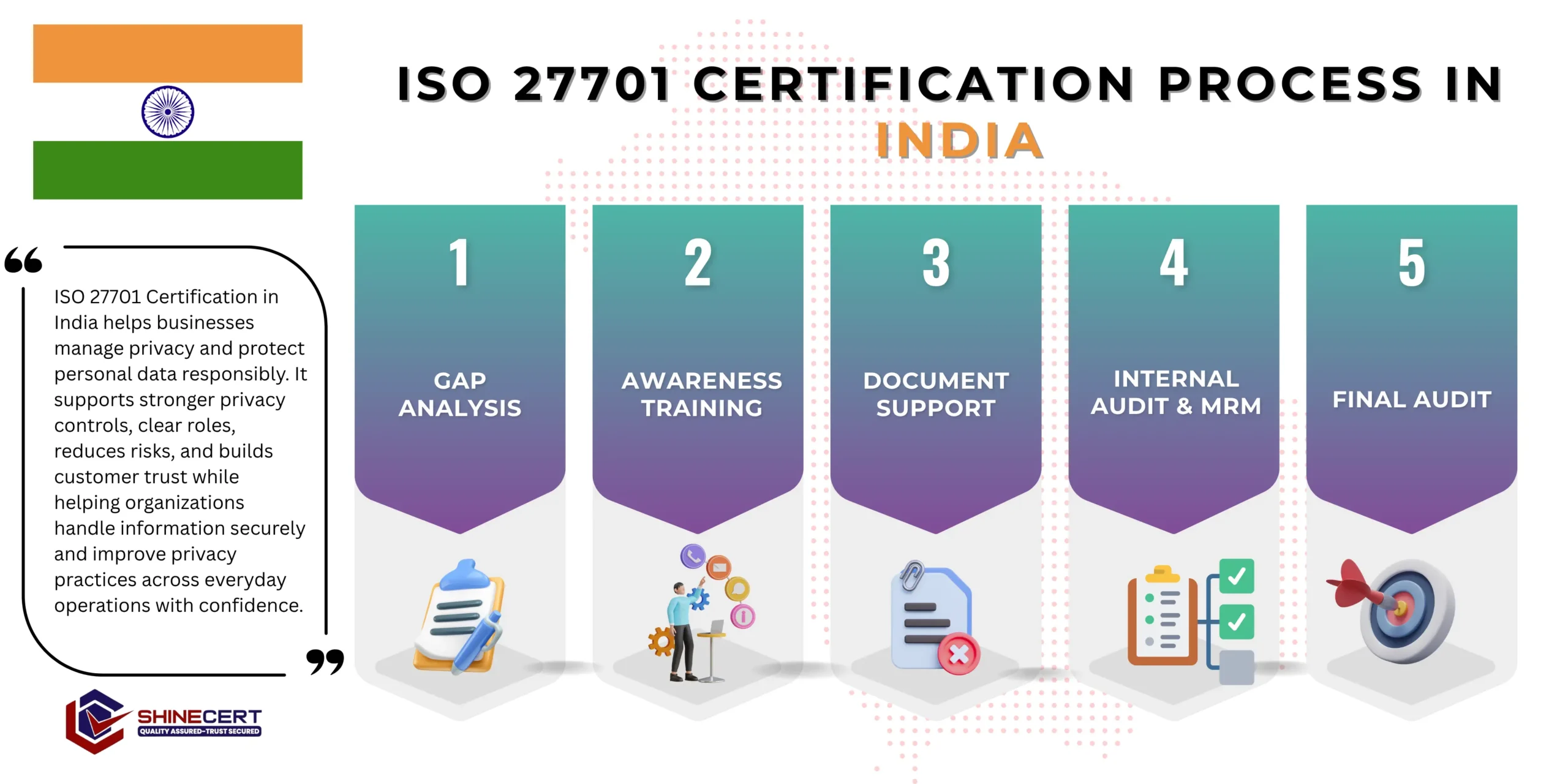
What are the steps to get ISO 27701 Certification in India?
our services
- ISO Certification India
- ISO 9001 Certification India
- ISO 14001 Certification India
- ISO 27001 Certification India
- ISO 22000 Certification India
- ISO 27701 Certification India
- ISO 45001 Certification India
- ISO 20000-1 Certification India
- ISO 13485 Certification India
- ISO 17025 Certification India
- ISO 31000 Certification India
- ISO 42001 Certification India
- ISO 37001 Certification India
- ISO 22301 Certification India
- ISO 50001 Certification India
- CE Mark Certification India
- GDPR Certification India
- GMP Certification India
- Halal Certification India
The Certification Process
Gap Assessment
We review your existing ISO 27001 system, or build the assessment for both standards simultaneously if you're not yet certified, and map every place personal data enters, moves through, and leaves your organization, comparing this against ISO 27701's privacy-specific requirements.
Documentation Development
We build the privacy policy, consent management procedures, and critically, the formal controller-processor determination for each client relationship, since this single document resolves ambiguity many businesses have never actually addressed.
Implementation and Training
Privacy-specific controls go live, and staff handling personal data are trained on consent handling, data subject request procedures, and their role's specific controller or processor obligations.
Internal Audit and Management Review
We run a structured internal audit against both ISO 27001 and ISO 27701 requirements together, and complete a formal management review with leadership.
Certification Audit
An accredited certification body audits your combined security and privacy system, and issues the certificate once satisfied you genuinely meet both standards' requirements.
How Long Does Certification Take?
| Business Size | Typical Timeline | Why |
|---|---|---|
| Small, already ISO 27001 certified | 2–3 months | Building only privacy-specific layer on an existing foundation |
| Medium, multiple client data relationships | 3–4 months | More controller-processor determinations and consent flows to document |
| Large or building both standards simultaneously | 4–5 months | Full security and privacy system build together |
- Small businesses are already ISO 27001 certified (2 to 3 months) : With the security foundation already in place, the privacy-specific extension is considerably faster to build and test.
- Medium businesses with multiple client data relationships (3 to 4 months) : More clients mean more individual controller-processor determinations and more distinct consent and data flow documentation to build correctly.
- Large businesses or those building both standards simultaneously (4 to 5 months) : Building the full ISO 27001 security foundation and ISO 27701 privacy extension together takes longer than extending an existing certified system.
- The variable that matters most: how clearly you already understand your controller-versus-processor role for each client relationship : A business that has genuinely mapped this already moves through documentation considerably faster than one discovering the ambiguity for the first time during the assessment.
A real example : A bank’s technology vendor assumed extending to ISO 27701 would take a few weeks on top of its existing ISO 27001 certification; the controller-processor determination alone took roughly five weeks, once we discovered the vendor was acting as both a processor for the bank’s core data and, for a separate analytics service, effectively a joint controller, a distinction nobody had previously documented.
Why It Matters in India?
The Digital Personal Data Protection Rules, 2025 completed the operationalization of the DPDP Act 2023, with obligations phasing in over roughly 18 months, including new Consent Manager provisions taking effect from 14 November 2026 and core obligations around consent, data security, breach reporting, and vendor governance following from May 2027. The Rules place compliance responsibility squarely on Data Fiduciaries, distinct from GDPR’s more direct obligations on processors, and organizations increasingly need to demonstrate structured consent handling, breach reporting discipline, and vendor governance well before enforcement fully activates.
- What not being certified actually costs you. You’re less prepared for the DPDP Rules’ phased obligations, particularly around consent management and breach reporting, since building genuine privacy governance takes considerably longer than the notice period between phases suggests. You’re also a weaker vendor for international clients, particularly those with EU exposure, where GDPR-aligned privacy governance is often already expected and organizations with existing GDPR investment find themselves considerably further along toward DPDP readiness. And without a formal controller-processor determination, businesses handling data on behalf of multiple clients often discover confusion about who’s actually responsible for what.
- Why is this happening in India right now? As the DPDP Rules’ phased timeline moves through 2026 into 2027, and as India’s IT and BPO sectors continue handling growing volumes of both domestic and international personal data, businesses that already hold ISO 27001 are finding the incremental step to ISO 27701 considerably more efficient than building privacy governance from scratch once enforcement fully activates.
What Affects the Cost?
- Existing ISO 27001 certification status : Already-certified businesses face a considerably smaller, faster scope of work than those building both standards together.
- Number of distinct client data relationships : More clients mean more individual controller-processor determinations to document correctly.
- Data sensitivity and cross-border transfer complexity : More sensitive data categories and international data flows require more detailed documentation.
- Certification body fees : Separate from consulting fees, and worth confirming accreditation before comparing quotes.
Required Documentation
The privacy policy extends your existing information security policy with privacy-specific commitments. The controller-processor determination formally documents your role for each client or data relationship.
The privacy risk assessment extends your ISO 27001 risk register with privacy-specific risks, such as unauthorized secondary use of data. The data flow mapping documents where personal data comes from, moves through, and goes.
Consent management procedures document how consent is captured, recorded, and withdrawn. Data subject request handling procedures document how access, correction, and deletion requests are processed.
Cross-border data transfer procedures document safeguards for data leaving India. Vendor and sub-processor agreements extend privacy obligations to third parties handling data on your behalf.
Breach notification procedures and records, internal audit reports, and management review minutes demonstrate ongoing oversight specific to privacy obligations.
Who Actually Needs This?
IT services and BPO companies processing personal data for international clients
IT services and BPO companies processing personal data for international clients, particularly those with EU or GDPR-exposed customer bases.
Read moreSaaS providers handling customer personal data at scale
SaaS providers handle customer personal data at scale, where privacy governance is increasingly a contractual requirement.
Read moreBusinesses already ISO 27001 certified
Businesses already ISO 27001 certified looking to extend into formal privacy governance efficiently.
Read moreOrganizations functioning as both a data controller and a data processor
Any organization functioning as both a data controller and a data processor for different clients, where the standard’s controller-processor determination requirement brings essential clarity.
Read moreFintech and healthcare technology companies
Fintech and healthcare technology companies, where sensitive personal data handling carries both regulatory and reputational stakes.
Read moreBenefits of ISO 27701 Certification
Certification builds exactly the consent management, breach reporting, and vendor governance documentation the Rules increasingly expect.
Businesses already certified to ISO 27001 build on that foundation rather than starting privacy governance separately.
GDPR-aligned privacy governance is often already expected, and certified organizations demonstrate this credibly.
The standard forces a formal determination that many businesses handling client data have never actually documented.
Building genuine governance now, rather than scrambling once Consent Manager and core obligations activate, avoids rushed, weaker implementation later.
Common Mistakes We See
- Skipping or rushing the controller-processor determination : As our case study shows, this single document resolves ambiguity many businesses discover only during the assessment itself.
- Treating ISO 27701 as identical to existing ISO 27001 documentation with a new cover page : The privacy-specific requirements need genuine, dedicated documentation, not a relabeled security policy.
- Underestimating cross-border transfer documentation : Businesses handling data for international clients often skip formal transfer safeguard documentation until an auditor specifically asks for it.
- Choosing a certification body without confirming ISO 27701 experience specifically : Not every ISO 27001-accredited body has deep practical experience with the privacy-specific extension.
Standards and Clauses: What ISO 27701 Actually Requires
- PIMS-specific requirements related to ISO 27001 (Clause 5) : extends the existing security management system with privacy-specific context, leadership commitment, and risk assessment.
- Additional guidance for ISO 27001 controls (Clause 6) : clarifies how existing Annex A security controls apply specifically to personal data protection.
- Additional guidance for PII controllers (Clause 7) : covers requirements specific to organizations determining the purposes of personal data processing, including consent, data subject rights, and privacy by design.
- Additional guidance for PII processors (Clause 8) : covers requirements specific to organizations processing personal data on behalf of another organization, including contractual obligations and limits on data use.
Case Study: A Bank’s Technology Vendor
- A technology vendor supplying core banking software needed ISO 27701 certification to satisfy the bank’s evolving privacy governance requirements, building on the vendor’s existing ISO 27001 certification.
- The vendor assumed the extension would take a few weeks given its existing security certification. Our assessment found it was acting as a data processor for the bank’s core banking data, but effectively a joint controller for a separate analytics service it operated using the same underlying data, a distinction nobody had previously documented.
- Resolving this controller-processor ambiguity alone took roughly five weeks, longer than the vendor expected but essential to get right before certification, since an unresolved determination would have left genuine compliance gaps in both directions.
- The vendor secured certification and the bank’s continued engagement, with the bank specifically citing the clarity of the controller-processor documentation as addressing a governance question its own compliance team had been unable to resolve internally.
Answering the Objections Every Owner Has
“We’re already ISO 27001 certified, isn’t our data secure?”
Security and privacy governance are related but distinct; ISO 27001 covers protecting data from unauthorized access, while ISO 27701 covers the broader question of whether you’re collecting, using, and sharing personal data appropriately in the first place.
“DPDP enforcement doesn’t fully activate until 2027, why act now?”
Building genuine privacy governance, consent flows, breach reporting, vendor agreements, takes considerably longer than the gap between phases suggests; starting now means readiness, not a rushed scramble later.
“We’re not sure if we’re a controller or a processor for some of our clients.”
This uncertainty is exactly what the standard’s determination process resolves, and it’s more common than most businesses expect, worth surfacing and documenting properly rather than leaving ambiguous.
“Can’t our existing ISO 27001 documentation cover this?”
It provides a foundation, but privacy-specific requirements, consent records, data subject request handling, cross-border transfer documentation, need their own dedicated build.
Choosing the Right Partner?
| DIY | Generic Consultant | ShineCert | |
|---|---|---|---|
| Controller-processor determination | Often skipped or assumed | Templated, rarely client-specific | Documented individually for every client relationship |
| DPDP Rules alignment | Rarely considered explicitly | Sometimes mentioned, rarely integrated | Directly reconciled with phased obligations |
| Accreditation verification | Often overlooked | Sometimes assumed rather than confirmed | Verified explicitly before you commit |
| Post-certification support | None | Often ends at the certificate | Built to support your ongoing surveillance audits |
Which Certification Body Should You Choose?
Confirm the certification body is accredited for ISO 27701 specifically, not just ISO 27001, since the extension requires distinct audit competence. Ask whether the consultant understands the DPDP Rules’ phased timeline, not just the generic standard. Confirm the certification audit reviews your controller-processor determinations individually.
Why Businesses Choose ShineCert in India?
We’ve spent 10 years helping more than 10,000 businesses worldwide get certified, coordinated through our Riyadh and India offices with work delivered remotely or on-site as needed. Our consultants build a genuine, individually documented controller-processor determination for every client relationship, rather than a generic privacy policy, and track the DPDP Rules’ phased timeline closely so your governance stays ahead of enforcement, with ShineCert as the best ISO 27701 consultant in India. We only work with accredited certification bodies with genuine ISO 27701 experience.
Frequently Asked Questions
No, but it directly supports demonstrating the privacy governance the DPDP Rules, 2025 increasingly expect, and it’s often expected by clients with EU or GDPR exposure.
Yes, ISO 27701 is an extension of ISO 27001, either an existing certification or a system built simultaneously with it.
It depends on your existing ISO 27001 status, number of client data relationships, and data sensitivity. We quote individually.
Usually two to five months, considerably faster if you’re already ISO 27001 certified, with clarity on your controller-versus-processor role mattering more than headcount alone.
Confirm accreditation for ISO 27701 specifically, not just ISO 27001, and confirm genuine experience with controller-processor determinations.