
ISO 13485 Certification in India
Quick Answer
ISO 13485 certification is an internationally recognized Quality Management System credential specifically for medical device manufacturers, confirming rigorous, auditable control over design, production, and post-market surveillance. In India, the Medical Devices Rules, 2017 require manufacturers and importers to maintain a quality management system aligned with ISO 13485:2016, though CDSCO does not universally mandate third-party certification for every device class; certification from an accredited body is, however, accepted as strong evidence of a compliant system and is often expected for higher-risk device categories and export markets. Certification typically takes two to six months.
About ISO 13485
ISO 13485 is the world’s dedicated Quality Management System standard for medical device manufacturers, published by the International Organization for Standardization. It requires organizations to control design, development, production, and post-market surveillance with a rigor calibrated to the risk medical devices carry, treating patient safety as the standard’s central organizing principle rather than one consideration among several.
Certification means an independent, accredited certification body has audited your actual design controls, production processes, and complaint-handling systems, and confirmed they genuinely meet the standard’s requirements. It runs on a three-year cycle with annual surveillance audits, appropriate for an industry where consistency and traceability matter continuously, not just at initial approval.
A brief history of the standard : ISO 13485 was first published in 1996 and revised in 2003, but its most significant revision came in 2016, the current edition, which was deliberately not restructured onto ISO’s High-Level Structure shared by ISO 9001 and other management standards. This was a conscious choice by the standards committee to keep the medical device standard stable for the many global regulators, including CDSCO, that reference specific clause numbering directly in their own regulatory frameworks.
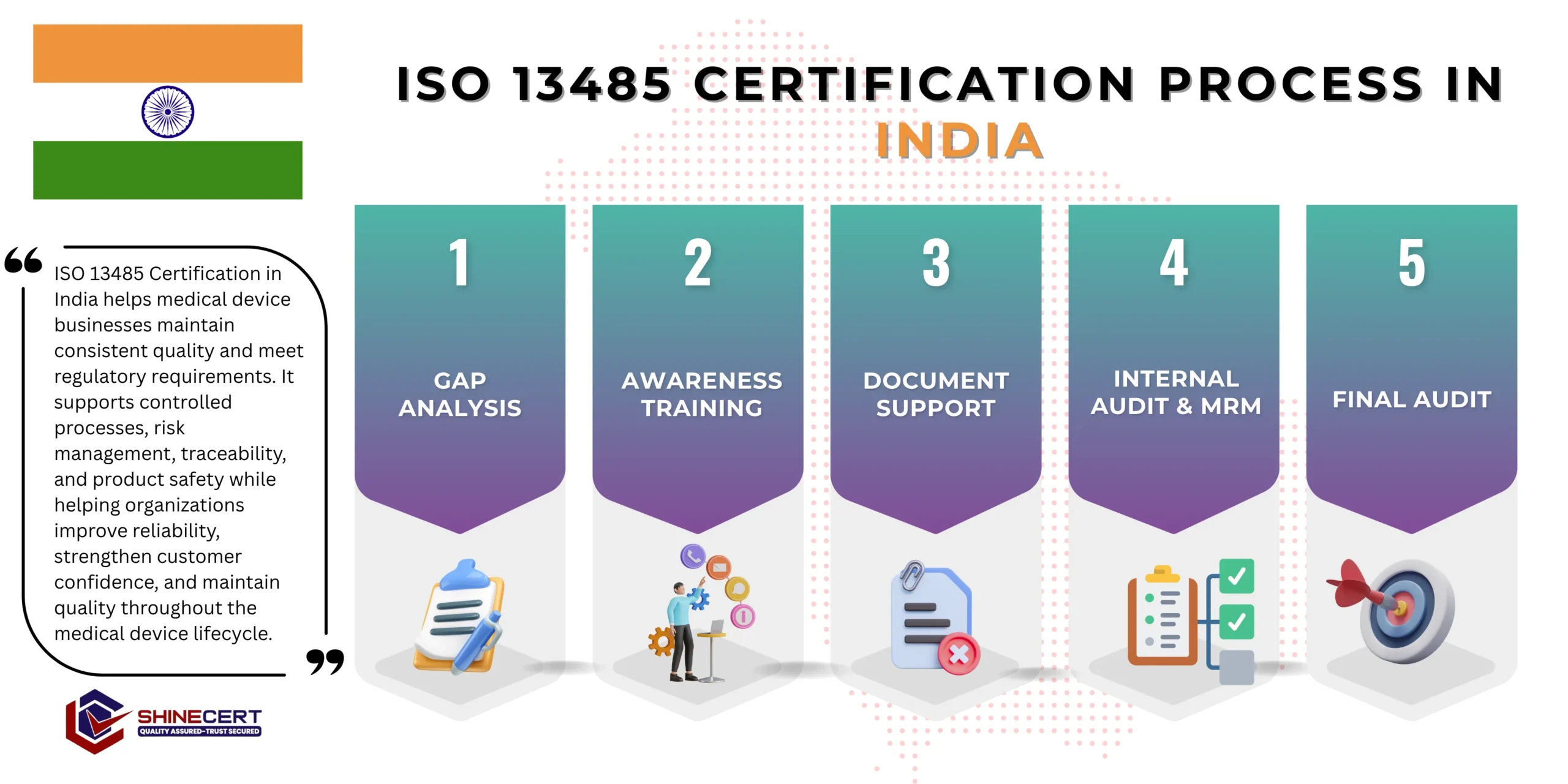
What are the steps to get ISO 13485 Certification in India?
our services
- ISO Certification India
- ISO 9001 Certification India
- ISO 14001 Certification India
- ISO 27001 Certification India
- ISO 22000 Certification India
- ISO 27701 Certification India
- ISO 45001 Certification India
- ISO 20000-1 Certification India
- ISO 13485 Certification India
- ISO 17025 Certification India
- ISO 31000 Certification India
- ISO 42001 Certification India
- ISO 37001 Certification India
- ISO 22301 Certification India
- ISO 50001 Certification India
- CE Mark Certification India
- GDPR Certification India
- GMP Certification India
- Halal Certification India
The Certification Process
Gap Assessment
We walk your actual design, manufacturing, and complaint-handling processes, comparing them against both the standard's requirements and CDSCO's expectations under the Medical Devices Rules 2017, identifying where existing practices already meet the bar and where genuine gaps remain.
Documentation Development
We build the quality manual, design and development control procedures, and risk management documentation, written around your actual device and process rather than generic language.
Implementation and Training
The system goes live and staff across design, production, and quality functions are trained on their specific responsibilities, since design control failures are among the most common and consequential findings in this industry.
Internal Audit and Management Review
We run a structured internal audit against the same criteria the certification auditor will use, and complete a formal management review with leadership.
Certification Audit
An accredited certification body audits your actual design, production, and post-market surveillance processes, and issues the certificate once satisfied you genuinely meet the standard's requirements.
How Long Does Certification Take?
| Business Size | Typical Timeline | Why |
|---|---|---|
| Small, single low-risk device | 2–3 months | Fewer design controls and simpler risk documentation |
| Medium, multiple devices or moderate risk class | 3–5 months | More design controls and risk documentation across devices |
| Large or high-risk multi-device manufacturers | 5–6 months | Extensive design history files and post-market surveillance coordination |
- Small manufacturers with a single low-risk device (2 to 3 months) : Fewer design controls and simpler risk documentation mean the quality system can be built and tested more quickly.
- Medium manufacturers with multiple devices or a moderate risk class (3 to 5 months) : More devices mean more individual design history files and risk management documentation, and more staff across functions to train consistently.
- Large or high-risk multi-device manufacturers (5 to 6 months) : Extensive design history files, more rigorous post-market surveillance obligations, and coordination across multiple product lines typically require more documentation review and audit time.
- The variable that matters most: how complete your existing design history files already are : A manufacturer with organized, complete design documentation from prior CDSCO submissions moves through certification considerably faster than one that has to reconstruct design rationale after the fact.
A real example : A medical device distributor in Ahmedabad handled two very different device risk profiles, a low-risk diagnostic accessory and a higher-risk implantable component, under one registration; building distinct, appropriately rigorous risk management approaches for each rather than treating them identically added roughly five weeks but produced a genuinely defensible system for both.
Why It Matters in India?
The Medical Devices Rules, 2017, effective from 1 January 2018, created a dedicated regulatory framework for medical devices in India, requiring manufacturers and importers to maintain a quality management system aligned with ISO 13485:2016. Importantly, the Rules do not explicitly mandate third-party ISO 13485 certification as a universal requirement for every manufacturer and device class; however, CDSCO accepts ISO 13485 certification from an accredited body as strong evidence of a compliant quality system, and it forms part of the readiness expected during device registration, particularly for higher-risk classifications.
- What not being certified actually costs you. You’re at a disadvantage during CDSCO registration for higher-risk device classes, where a documented, third-party-verified quality system speeds review rather than requiring CDSCO to evaluate your internal processes from scratch. You’re also effectively excluded from most export markets, since international regulators and distributors routinely require ISO 13485 certification as a baseline expectation regardless of India’s own domestic requirements. And without structured design controls and post-market surveillance, quality issues in medical devices carry consequences, patient harm, recalls, regulatory action, considerably more severe than in most other industries.
- Why is this happening in India right now? As India’s medical device manufacturing sector continues expanding under government push for domestic production and reduced import dependence, more manufacturers are pursuing both CDSCO registration and export market access simultaneously, making a single ISO 13485-aligned quality system, built once and leveraged for both purposes, considerably more efficient than treating domestic and export compliance as separate tracks.
What Affects the Cost?
- Device risk classification : Higher-risk devices require more rigorous design controls and post-market surveillance documentation.
- Number of devices under one quality system : More products mean more individual design history files to build and maintain.
- Existing documentation maturity : A manufacturer with organized CDSCO submission records starts from a stronger position than one relying on informal knowledge.
- Certification body fees : Separate from consulting fees, and worth confirming accreditation before comparing quotes.
Required Documentation
The scope statement defines exactly which devices and processes the certification covers. The quality policy sets top management’s commitment.
The risk management file documents hazards specific to each device and how they’re controlled, aligned with ISO 14971 risk management principles. The design and development plan documents how each device moves from concept to production.
Competence and training records prove staff across design, production, and quality functions are genuinely qualified. The document and record control procedure governs how design history files and other records are maintained.
Design history files consolidate design inputs, outputs, verification, and validation for each device. Production and process control procedures describe how consistency is maintained at manufacturing scale. Supplier evaluation records extend quality control to component and material suppliers.
Post-market surveillance records, complaint handling logs, and internal audit reports demonstrate ongoing oversight. Corrective and preventive action records show how you respond when something goes wrong.
Who Actually Needs This?
Medical device manufacturers
Medical device manufacturers, particularly those in higher-risk device classes where CDSCO registration benefits from accredited certification evidence.
Read moreMedical device importers and distributors
Medical device importers and distributors, where quality system evidence supports both registration and ongoing market surveillance obligations.
Read moreBusinesses targeting export markets
Businesses targeting export markets, where ISO 13485 is close to a universal baseline requirement internationally.
Read moreContract manufacturers producing devices for multiple brands
Contract manufacturers producing devices for multiple brands, where a certified quality system reassures every client simultaneously rather than requiring separate audits.
Read moreMedical device businesses seeking scalable quality systems
Medical device businesses seeking a structured quality system that can support regulatory expectations, customer confidence, and expansion into new markets.
Read moreBenefits of ISO 13485 Certification
Certification from an accredited body gives CDSCO strong, ready-made evidence of a compliant quality system.
Most international medical device markets treat ISO 13485 as a baseline expectation, not a differentiator.
Formal design and development controls reduce the risk of quality issues reaching the market at all.
Systematic tracking of field issues supports faster corrective action and regulatory reporting.
One well-built quality system serves both CDSCO registration and international market access.
Common Mistakes We See
- Treating design controls as a one-time approval step rather than an ongoing file : Auditors expect a complete design history file maintained throughout the device’s lifecycle, not just at initial CDSCO submission.
- Underestimating post-market surveillance requirements : Businesses often build strong pre-market controls but treat post-market complaint handling as an afterthought, which is a common and serious finding.
- Applying one risk management approach across genuinely different device risk profiles : As our own case study illustrates, treating a low-risk and higher-risk device identically under one system creates real gaps.
- Choosing a certification body without confirming accreditation : An unaccredited certificate carries no real recognition with CDSCO or export market regulators.
Standards and Clauses: What ISO 13485 Actually Requires
- Quality Management System (Clause 4) : requires establishing the overall system and documentation structure, including device-specific regulatory requirements like CDSCO’s.
- Management Responsibility (Clause 5) : requires top management to set quality objectives and take visible ownership, particularly around regulatory compliance.
- Resource Management (Clause 6) : covers competence, infrastructure, and work environment control appropriate to medical device production.
- Product Realization (Clause 7) : is the standard’s most detailed section, covering design and development controls, purchasing, production, and traceability, where design history files and most day-to-day documentation live.
- Measurement, Analysis, and Improvement (Clause 8) : requires monitoring product and process performance, complaint handling, post-market surveillance, internal audits, and corrective action.
Case Study: A Medical Device Distributor in Ahmedabad
- A medical device distributor needed ISO 13485 certification to satisfy both CDSCO registration requirements for a higher-risk implantable component and an international distributor agreement for a separate lower-risk diagnostic accessory.
- Our gap assessment found the distributor had been managing both devices under one undifferentiated quality approach, appropriate for neither device’s actual risk profile.
- Over roughly five and a half months, we built distinct risk management files and design controls appropriately calibrated to each device’s risk classification. The certification audit confirmed both systems were genuinely fit for purpose, with only minor documentation nonconformities.
- The distributor secured both the CDSCO registration and the international distribution agreement, with the international partner specifically citing the certification’s device-specific risk rigor as a deciding factor.
Answering the Objections Every Owner Has
“CDSCO doesn’t explicitly require third-party certification for our device class, why bother?”
Even where not mandated, accredited certification measurably speeds registration review and is often expected in practice for higher-risk classes; it’s also a near-universal requirement the moment you consider exporting.
“We already follow the Medical Devices Rules 2017.”
Following the Rules and holding third-party-verified certification are different things; certification gives CDSCO and any export buyer independent, auditable proof rather than your own self-assessment.
“This seems disproportionate for a smaller manufacturer.”
The standard scales its documentation expectations to your device’s risk classification and complexity; a lower-risk device typically has a lighter, faster certification path.
“Can’t our regulatory affairs team handle this internally?”
Regulatory affairs teams often manage CDSCO submissions well but rarely have deep experience structuring the design control and post-market surveillance documentation an ISO 13485 auditor specifically expects.
Choosing the Right Partner?
| DIY | Generic Consultant | ShineCert | |
|---|---|---|---|
| CDSCO alignment | Often built as a separate, disconnected system | Sometimes overlooked entirely | Directly reconciled with Medical Devices Rules 2017 expectations |
| Design history files | Frequently incomplete or reconstructed after the fact | Templated, often generic | Built and maintained as a living record from the outset |
| Accreditation verification | Often overlooked | Sometimes assumed rather than confirmed | Verified explicitly before you commit |
| Post-certification support | None | Often ends at the certificate | Built to support your ongoing surveillance audits |
Which Certification Body Should You Choose?
Confirm the certification body is accredited by NABCB or another IAF-member accreditation authority, and specifically ask whether they have genuine medical device sector experience relevant to your device class. Confirm the certification audit includes an actual production facility visit.
Why Businesses Choose ShineCert in India?
We’ve spent 10 years helping more than 10,000 businesses worldwide get certified, coordinated through our Riyadh and India offices with work delivered remotely or on-site as needed. Our consultants build design history files as living records from the outset, not reconstructed documents assembled after the fact, and reconcile your system directly with CDSCO’s Medical Devices Rules 2017 expectations, with ShineCert as the best ISO 13485 consultant in India. We only work with accredited certification bodies with genuine medical device sector experience.
Frequently Asked Questions
Not universal for every device class, but the Medical Devices Rules 2017 require a quality management system aligned with ISO 13485:2016, and CDSCO accepts accredited certification as strong compliance evidence, particularly for higher-risk devices.
It depends on device risk classification, number of products, and current documentation maturity. We quote individually.
Usually two to six months depending on device complexity, with existing design history file completeness mattering more than headcount alone.
Not universally required, but it strengthens CDSCO registration for higher-risk devices and is essential the moment you consider export markets.
Confirm accreditation by NABCB or another IAF-member authority, and confirm genuine medical device sector audit experience.