
GMP Certification in India
Quick Answer
GMP, Good Manufacturing Practice, certification confirms a pharmaceutical manufacturing facility maintains the systems, documentation, and quality controls required to produce safe, effective, consistent medicines. In India, Revised Schedule M under the Drugs and Cosmetics Act, 1940 substantially raised domestic GMP requirements, bringing them considerably closer to WHO-GMP, EU-GMP, and USFDA expectations, with the Drugs Controller General of India instructing state regulators to enforce the revised norms by January 2026. Of India’s roughly 10,500 pharmaceutical manufacturing units, only around 2,000 currently hold WHO-GMP certification, leaving a substantial compliance gap across the remaining units. Certification typically takes three to six months.
Why It Matters in India?
Revised Schedule M, under the Drugs and Cosmetics Act, 1940 and Rules 1945, represents a substantial overhaul of India’s domestic GMP framework, introducing structured Pharmaceutical Quality Systems, Product Quality Review, Quality Risk Management, formal validation requirements, computerized systems compliance, and data integrity discipline aligned to ALCOA+ principles, attributable, legible, contemporaneous, original, and accurate, among other requirements. The Drugs Controller General of India has directed state drug regulators to enforce these revised norms, with large manufacturers, turnover above Rs 250 crore, required to comply by June 2024, and MSME manufacturers, turnover up to Rs 250 crore, facing an original December 2024 deadline subsequently extended to December 2025 for those that formally applied through Form A within the stipulated time. Enforcement is now being pushed toward full effect by January 2026.
- What not being certified actually costs you : You risk losing your manufacturing license or facing enforcement action from state drug regulators now actively enforcing Revised Schedule M, particularly if you missed the MSME extension deadline or never formally applied for it. You’re also excluded from most export markets, since of India’s roughly 10,500 pharmaceutical manufacturing units, only around 2,000 currently hold WHO-GMP certification, meaning the vast majority face a genuine, urgent compliance gap if they intend to export. And without structured data integrity and validation practices, quality issues are harder to detect before products reach patients, carrying consequences considerably more severe than in most other industries.
- Why is this happening in India right now? With enforcement of Revised Schedule M being pushed toward full effect by January 2026, and with over 8,000 of India’s pharmaceutical manufacturing units still at varying stages of a genuine compliance gap relative to WHO-GMP recognition, this is one of the most time-sensitive regulatory shifts facing Indian pharmaceutical manufacturers of any size right now, not a distant future consideration.
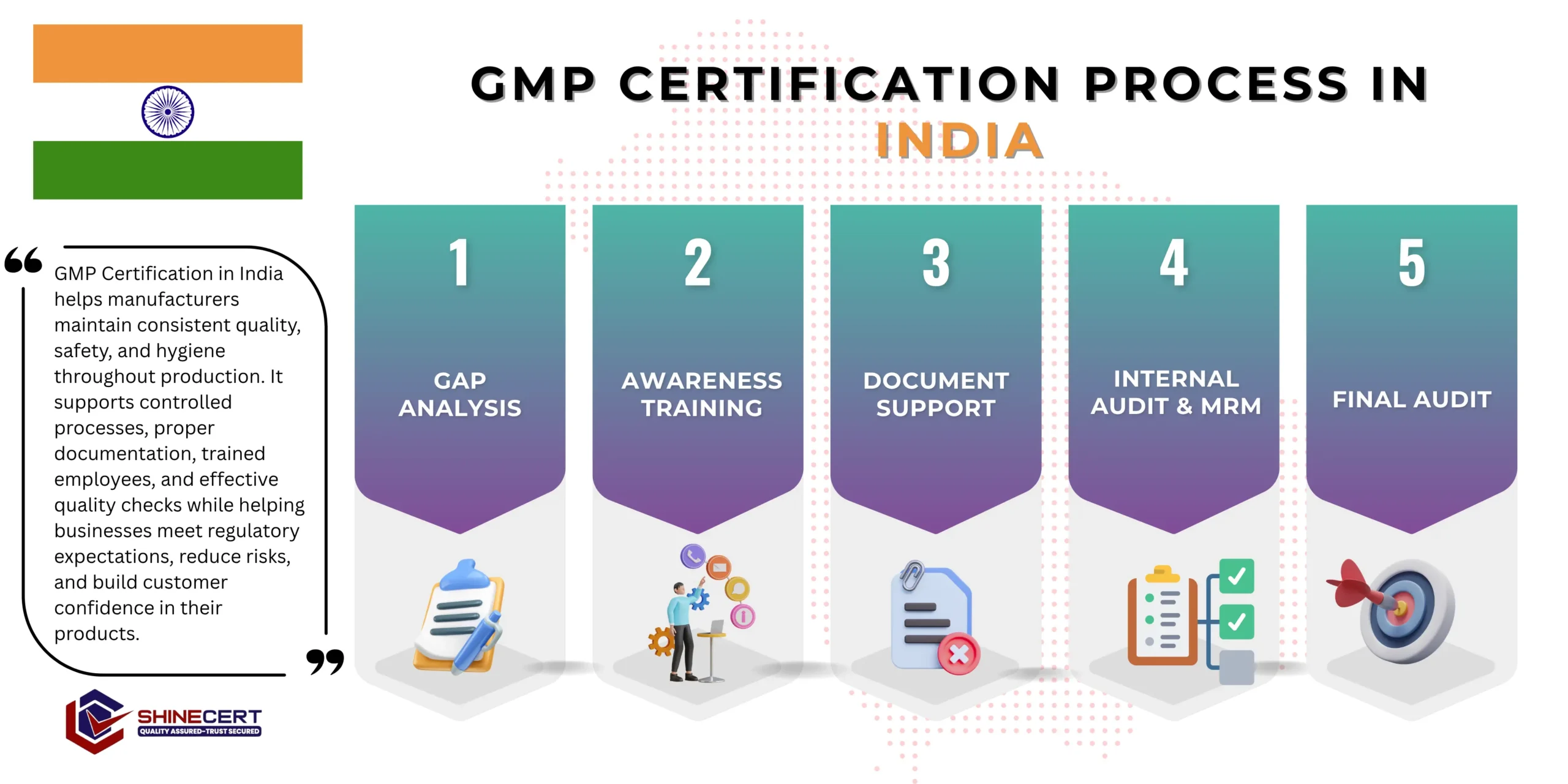
What are the steps to get GMP Certification in India?
our services
- ISO Certification India
- ISO 9001 Certification India
- ISO 14001 Certification India
- ISO 27001 Certification India
- ISO 22000 Certification India
- ISO 27701 Certification India
- ISO 45001 Certification India
- ISO 20000-1 Certification India
- ISO 13485 Certification India
- ISO 17025 Certification India
- ISO 31000 Certification India
- ISO 42001 Certification India
- ISO 37001 Certification India
- ISO 22301 Certification India
- ISO 50001 Certification India
- CE Mark Certification India
- GDPR Certification India
- GMP Certification India
- Halal Certification India
The Certification Process
Gap Assessment
We walk your actual facility, documentation practices, and validation status, comparing them against Revised Schedule M's specific requirements, and against WHO-GMP if export is also a goal, identifying the genuine size of your compliance gap.
Documentation Development
Depending on facility complexity, we build the Pharmaceutical Quality System documentation, Product Quality Review process, and Quality Risk Management framework, structured around ALCOA+ data integrity principles from the outset.
Implementation and Validation
Systems go live and formal validation studies, equipment qualification, process validation, computerized systems validation, are conducted, since this is where genuine gaps between old and new documentation practices most often surface.
Internal Audit and Management Review
We run a structured internal audit against the same criteria a regulatory inspection or certification audit will use.
Regulatory or Certification Audit
CDSCO or state drug regulators confirm Revised Schedule M compliance, or, for export-focused manufacturers, an international body audits for WHO-GMP or equivalent recognition.
How Long Does Certification Take?
| Facility Size | Typical Timeline | Why |
|---|---|---|
| Small facility, single product category | 3–4 months | Fewer validation studies and simpler documentation |
| Medium facility, multiple product lines | 4–5 months | More validation work and cross-departmental coordination |
| Large facility or one also pursuing WHO-GMP | 5–6 months | Extensive validation and dual-framework documentation |
- Small facilities with a single product category (3 to 4 months) : Fewer production lines mean fewer validation studies and a more contained documentation build.
- Medium facilities with multiple product lines (4 to 5 months) : More products mean more individual validation studies and more departments, production, quality control, quality assurance, to coordinate consistently.
- Large facilities or those also pursuing WHO-GMP (5 to 6 months) : Building documentation that satisfies both Revised Schedule M and international WHO-GMP expectations simultaneously typically requires more validation depth and review time.
- The variable that matters most: whether validation has genuinely been performed and documented previously, or exists only as an assumption : A facility with real prior validation records moves through the process considerably faster than one that has been operating on informal process knowledge without formal validation studies behind it.
A real example : A manufacturer had detailed standard operating procedures for its sterilization process but had never conducted or documented a formal validation study proving the process actually achieved its intended sterility assurance level; running and properly documenting genuine validation runs added roughly six weeks but was essential, since a validated process is fundamentally different from a well-described but unverified one.
About GMP Certification
- Good Manufacturing Practice certification confirms a pharmaceutical manufacturing facility’s quality systems genuinely control the risks inherent in drug production, contamination, mix-ups, deviations, and quality failures that other testing methods can’t fully catch after the fact. It covers facility design, equipment qualification, process validation, quality control testing, and documentation practices calibrated to protect patient safety at every production step.
- Certification means an independent audit, whether by CDSCO/state regulators under Revised Schedule M, or by an international body for WHO-GMP or other export-market recognition, has verified your actual production processes, documentation, and quality systems meet the applicable requirements, not just that you have a quality manual on file.
What Affects the Cost?
- Facility size and number of product lines : More production lines mean more individual validation studies and documentation.
- Current documentation and validation maturity : A facility with real, existing validation records starts from a considerably stronger position than one relying on informal process knowledge.
- Whether WHO-GMP or another export-market recognition is also a goal : Pursuing international recognition alongside domestic compliance adds documentation depth but is often more efficient done together than sequentially.
- Regulatory or certification body fees : Separate from consulting fees, and dependent on whether you’re pursuing domestic Revised Schedule M compliance alone or international recognition as well.
Required Documentation
The site master file describes your facility and its quality system comprehensively. The quality manual sets management’s commitment to the Pharmaceutical Quality System.
The Quality Risk Management framework documents how risks to product quality are identified and controlled. The validation master plan documents which equipment, processes, and computerized systems require validation and on what schedule.
Training records prove staff are genuinely qualified for their specific roles. Standard operating procedures covering every significant production and quality control activity.
Batch manufacturing and packaging records document each production run in ALCOA+-compliant detail. Equipment qualification and process validation reports provide documented proof, not just description, that processes achieve their intended results.
Product Quality Review reports, conducted periodically for each product, and internal audit reports demonstrate ongoing oversight. Deviation and corrective action records show how quality issues are genuinely investigated and resolved.
Who Actually Needs This?
All pharmaceutical manufacturers operating in India
Since Revised Schedule M compliance is a legal requirement for continued manufacturing authorization, not an optional certification.
Read moreMSME manufacturers who applied for the extended December 2025 deadline
Where compliance work needs to be genuinely complete, not just formally requested.
Read moreManufacturers targeting export markets
Where WHO-GMP or equivalent certification remains essential given how few Indian units currently hold it.
Read moreContract manufacturers producing for multiple pharmaceutical brands
Where a single compliant quality system serves every client relationship simultaneously.
Read moreBenefits of GMP Certification
Compliance protects your license to operate as state regulators actively enforce the revised framework.
With only around 2,000 of India’s roughly 10,500 units currently WHO-GMP certified, certification is a genuine competitive differentiator, not a baseline everyone already has.
This protects against regulatory findings that increasingly focus on data integrity, not just physical facility conditions.
Formal validation and Quality Risk Management catch problems before they affect product safety or efficacy.
A properly built Revised Schedule M-compliant system considerably eases the path to WHO-GMP or other export-market recognition.
Common Mistakes We See
- Assuming informal process knowledge is equivalent to documented validation : As our case study shows, a well-understood process and a formally validated one are genuinely different things under Revised Schedule M.
- Treating the MSME extension deadline as an indefinite exemption : The extension provided more time, not a permanent pass, and state regulators are actively enforcing toward full compliance.
- Underestimating computerized systems validation : Facilities often validate physical equipment and processes well but overlook formal validation of the software systems managing records and production data.
- Building documentation that describes intended practice rather than actual practice : Inspectors interview staff and review real records, and mismatches between documentation and actual practice are a common and serious finding.
What GMP Certification Actually Covers?
- Pharmaceutical Quality System : establishes the overarching structure connecting quality policy, risk management, and continuous improvement across the facility.
- Product Quality Review : requires periodic, formal review of each product’s quality trends, not just individual batch release decisions.
- Quality Risk Management : requires systematic risk assessment applied to manufacturing and quality decisions, rather than purely reactive problem-solving.
- Validation and computerized systems compliance : requires documented proof that equipment, processes, and any computer systems used in production or quality control genuinely perform as intended.
- Data integrity (ALCOA+) : requires that records be attributable, legible, contemporaneous, original, and accurate, among other principles, reflecting how heavily modern GMP inspections focus on data integrity specifically.
Case Study: A Pharmaceutical Manufacturer’s Sterilization Process
- A pharmaceutical manufacturer needed to demonstrate Revised Schedule M compliance ahead of a state regulator’s scheduled inspection, with WHO-GMP certification as a secondary goal for an emerging export opportunity.
- Our gap assessment found the manufacturer had detailed, well-written standard operating procedures for its sterilization process, but no formal validation study had ever been conducted proving the process actually achieved its intended sterility assurance level in practice.
- We designed and ran genuine validation studies, adding roughly six weeks to the timeline, but producing documented proof rather than a well-described assumption. The regulatory inspection found the facility genuinely compliant, and the subsequent WHO-GMP audit, built on the same validation foundation, proceeded smoothly.
- The manufacturer passed both the state inspection and the WHO-GMP audit, securing the export opportunity that had originally motivated pursuing international recognition.
Answering the Objections Every Owner Has
“We already meet the old Schedule M requirements.”
The revised framework introduces materially new expectations, structured Pharmaceutical Quality Systems, formal Product Quality Review, computerized systems compliance, that the previous version didn’t require in the same depth; meeting the old standard doesn’t automatically satisfy the new one.
“We applied for the MSME extension, so we’re covered until the deadline.”
The extension gave more time to complete compliance work, not an exemption from doing it; state regulators are actively enforcing toward the January 2026 target, and the extension period is not indefinite.
“WHO-GMP seems like it’s only for large exporters.”
With only around 2,000 of India’s roughly 10,500 units currently certified, it’s a genuine differentiator even for mid-sized manufacturers considering any international market, not an exclusive club requiring enormous scale.
“Can’t our existing quality team handle Revised Schedule M internally?”
Quality teams often understand pharmaceutical production well but may not have specific experience structuring documentation to the ALCOA+ data integrity standard or building a formal Product Quality Review process from scratch.
Choosing the Right Partner?
| DIY | Generic Consultant | ShineCert | |
|---|---|---|---|
| ALCOA+ data integrity build | Often generic, not genuinely embedded | Templated, rarely deeply integrated | Built into documentation from the outset |
| Validation rigor | Frequently assumed rather than performed | Templated, sometimes superficial | Genuine studies performed and properly documented |
| Revised Schedule M and WHO-GMP alignment | Rarely coordinated | Sometimes handled as separate efforts | Coordinated together when both are goals |
| Post-certification support | None | Often ends at the audit | Built to support ongoing Product Quality Reviews and audits |
Which Certification Body Should You Choose?
For domestic Revised Schedule M compliance, this is confirmed through CDSCO and state drug regulator inspection, not a separate certifying body. For WHO-GMP or other export-market recognition, confirm the certifying body’s international recognition matches your specific target export markets.
Why Businesses Choose ShineCert in India?
We’ve spent 10 years helping more than 10,000 businesses worldwide get certified, coordinated through our Riyadh and India offices with work delivered remotely or on-site as needed. Our consultants build genuine, properly documented validation studies rather than assuming informal process knowledge is sufficient, and we coordinate Revised Schedule M compliance with WHO-GMP or other export-market ambitions together when both are relevant, rather than treating them as separate projects, with ShineCert as the best GMP consultant in India.
Frequently Asked Questions
Yes, Revised Schedule M compliance under the Drugs and Cosmetics Act, 1940 is a legal requirement for pharmaceutical manufacturing authorization, with enforcement being pushed toward full effect by January 2026.
Revised Schedule M is India’s domestic legal requirement, now substantially closer to international standards; WHO-GMP is a separate, internationally recognized certification often required specifically for export markets.
It depends on facility size, current validation maturity, and whether WHO-GMP or another export recognition is also a goal. We quote individually.
Usually three to six months depending on facility size, with genuine prior validation work mattering more than headcount alone.
Yes, MSME manufacturers who formally applied through Form A received an extension to December 2025, but this was additional time to complete compliance work, not an exemption from it.