
Halal Certification in India
Quick Answer
Halal certification confirms food, pharmaceutical, or cosmetic products meet Islamic dietary and production requirements, verified by an accredited certification body. Unlike many countries where halal certification exists purely for export enablement, India has a genuinely large domestic halal certification market, served by established bodies including Jamiat Ulama-i-Hind Halal Trust and Halal India, alongside strong export relevance given India’s position as one of the world’s largest meat and food exporters. Certification typically takes six to twelve weeks depending on product complexity.
Why It Matters in India?
India presents a genuinely distinctive halal certification landscape compared to many other markets. The country has an established, active domestic halal certification industry, led by bodies including the Jamiat Ulama-i-Hind Halal Trust, founded through India’s oldest and largest Muslim organization, operating through seven regional offices across the country and maintaining a comprehensive verification framework spanning processed food manufacturing, dairy plants, chemical additive suppliers, and pharmaceutical formulations, and Halal India, whose certification is recognized in over 120 countries. All Halal certification bodies operating in India are required to be registered by the National Accreditation Board for Certification Bodies under the Quality Council of India, a requirement Jamiat Ulama-i-Hind Halal Trust has itself achieved.
This matters because India serves two genuinely distinct halal markets simultaneously: a substantial domestic market, given India’s large Muslim population and correspondingly significant halal food retail and food service sector, and a major export market, since India is one of the world’s largest exporters of buffalo meat and other halal-sensitive food products to markets across the Middle East, Southeast Asia, and beyond.
- What not being certified actually costs you : You’re excluded from domestic halal retail and food service channels that specifically stock or serve certified products, a genuinely large market segment in India, not a niche one. You’re also excluded from export markets that require halal certification as a condition of import, particularly across Gulf and Southeast Asian markets that are major destinations for Indian meat and food exports. And without NABCB-registered certification specifically, your certificate may not carry recognition in either domestic retail chains or the specific export markets you’re targeting.
- Why is this happening in India right now? As India’s food processing and export sectors both continue growing, and as domestic consumer awareness of halal certification standards has increased alongside growing organized retail, both markets are becoming more discerning about certification credibility, making NABCB-registered certification an increasingly important differentiator over informal or unrecognized certification claims.
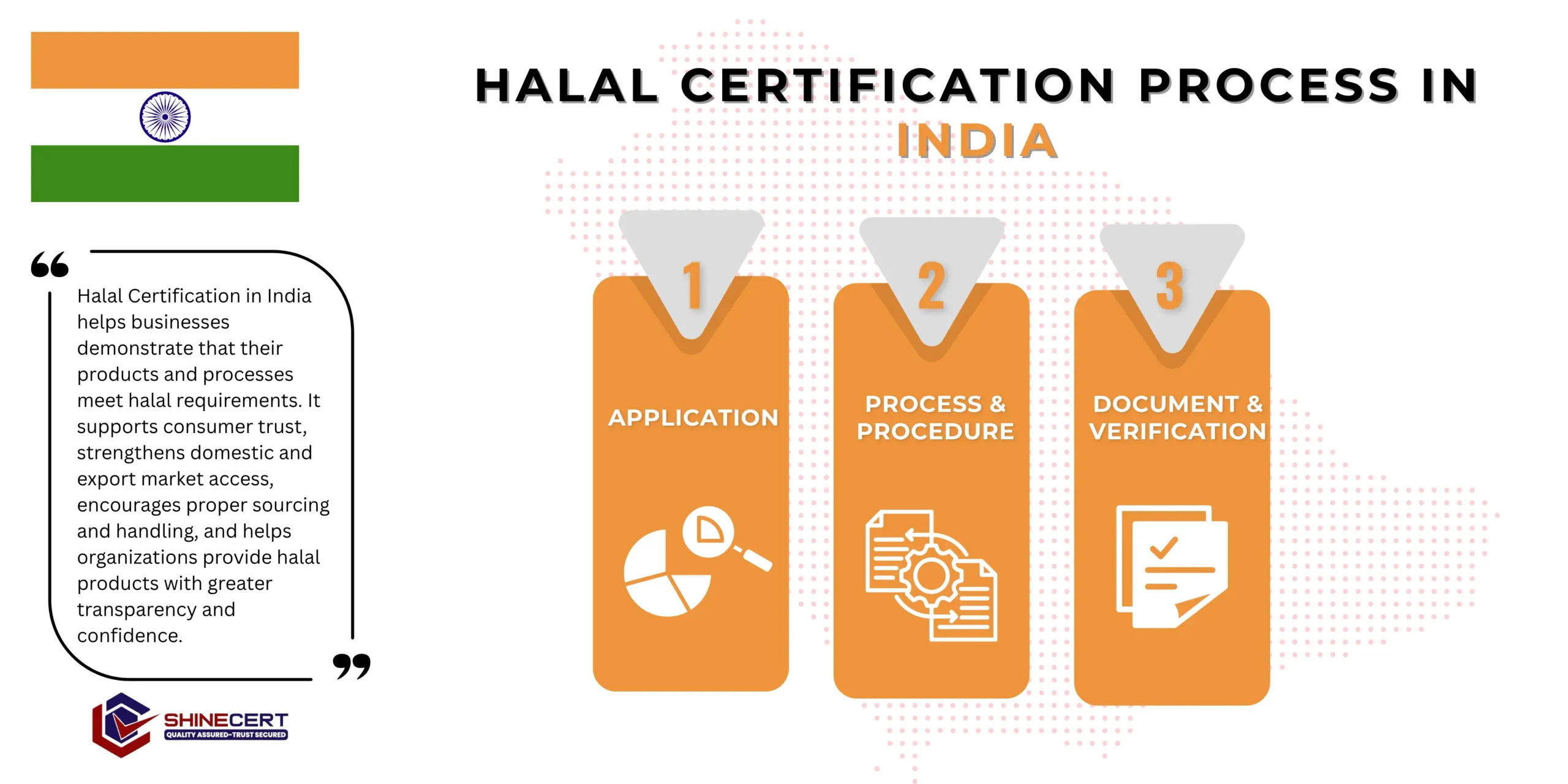
What are the steps to get Halal Certification in India?
our services
- ISO Certification India
- ISO 9001 Certification India
- ISO 14001 Certification India
- ISO 27001 Certification India
- ISO 22000 Certification India
- ISO 27701 Certification India
- ISO 45001 Certification India
- ISO 20000-1 Certification India
- ISO 13485 Certification India
- ISO 17025 Certification India
- ISO 31000 Certification India
- ISO 42001 Certification India
- ISO 37001 Certification India
- ISO 22301 Certification India
- ISO 50001 Certification India
- CE Mark Certification India
- GDPR Certification India
- GMP Certification India
- Halal Certification India
The Certification Process
Gap Assessment
We review your ingredients, suppliers, and production process, including equipment segregation from any non-halal products, and identify what's already compliant versus what needs attention.
Documentation Development
We build the halal management procedures and, critically, the ingredient traceability system that lets you demonstrate every input's halal status back to its source.
Implementation and Training
Controls go live and staff, particularly those handling ingredient receiving and production, are trained on maintaining segregation and traceability.
Internal Review
We verify the system is ready before the certification body's own audit.
Certification Audit
The certifying body audits your actual production process and traceability records, and issues the certificate once satisfied.
How Long Does Certification Take?
| Business Size | Typical Timeline | Why |
|---|---|---|
| Small, single product line | 6–8 weeks | Simpler ingredient list and traceability |
| Medium, multiple products | 8–10 weeks | More ingredients and suppliers to trace |
| Large exporter or multi-product manufacturer | 10–12 weeks | Extensive supply chain and multi-market certification needs |
- Small businesses with a single product line (6 to 8 weeks) : Fewer ingredients and suppliers mean traceability documentation builds considerably faster.
- Medium businesses with multiple products (8 to 10 weeks) : More ingredients and supplier relationships across different products mean more individual traceability chains to establish.
- Large exporters or multi-product manufacturers (10 to 12 weeks) : Extensive supply chains, and often the need to satisfy multiple export markets’ specific halal requirements simultaneously, typically take longer to document fully.
- The variable that matters most: how many suppliers are already able to provide halal-status documentation for their own ingredients : A business with suppliers who already maintain this documentation moves through the traceability-building phase considerably faster than one that has to request it fresh from every supplier.
A real example : A food processor with a dozen ingredient suppliers found only half could readily provide halal-status documentation for their own inputs; securing this from the remaining suppliers, some of whom had never been asked before, added roughly three weeks to the timeline.
About Halal Certification
- Halal certification verifies that a product, most commonly food, but also pharmaceuticals and cosmetics, meets Islamic dietary and production requirements, covering ingredient sourcing, processing methods, equipment segregation from non-halal products, and slaughter methods for meat products. Certification is issued by a recognized halal certification body following an audit of your actual production process, not just a declaration of compliant ingredients.
- Unlike ISO management-system standards, halal certification is typically product- or facility-specific and renewed periodically, often annually, rather than on a fixed three-year cycle, reflecting the certifying body’s need to continually verify that ingredient sourcing and production practices remain compliant as suppliers and processes change over time.
What Affects the Cost?
- Number of ingredients and suppliers : More inputs mean more individual traceability chains to establish and verify.
- Target market scope : Certification aimed at both domestic retail and specific export markets may require satisfying more than one certifying body’s requirements.
- Production complexity and equipment segregation needs : Facilities also producing non-halal products need more rigorous segregation controls and documentation.
- Certifying body fees : Vary by body and market recognition scope; we help you select based on your actual target markets.
Required Documentation
The halal policy sets management’s commitment. The product and ingredient list documents every input requiring halal-status verification.
Supplier halal-status certificates or declarations for every ingredient. The traceability system documents how each ingredient’s halal status is tracked from receipt through to the finished product.
Equipment segregation procedures, where relevant, document how halal and non-halal production are kept genuinely separate. Cleaning and changeover procedures prevent cross-contamination between production runs.
Internal review records and corrective action records demonstrate ongoing oversight between certification renewal cycles.
Who Actually Needs This?
Meat processors and exporters
Where halal certification is often a condition of both export market access and domestic premium retail channels.
Read moreFood manufacturers and processors targeting domestic halal retail
A substantial and growing organized retail segment within India.
Read moreDairy and processed food companies
Where ingredient sourcing and cross-contamination controls are central to certification.
Read morePharmaceutical and cosmetic manufacturers
Where halal-conscious consumers and export markets increasingly expect certification for relevant product categories.
Read moreHospitality and food service businesses
Particularly those serving halal-conscious domestic consumers or international travelers from Gulf and Southeast Asian markets.
Read moreBenefits of Halal Certification
Unlike many countries, this is a genuine, sizable domestic opportunity, not just an export enabler.
India’s position as a leading meat and food exporter makes halal certification essential for a large share of international buyers.
As consumer and buyer awareness grows, certification from a properly accredited body increasingly matters more than a generic halal claim.
The certification process typically surfaces supply chain visibility benefits beyond halal compliance alone.
Certified products can access shelf space and distribution channels that specifically prioritize certified halal options.
Common Mistakes We See
- Assuming halal-sourced ingredients alone satisfy certification : As noted above, certification requires audited process controls and traceability beyond ingredient sourcing.
- Choosing a certifying body without checking NABCB registration : Not every body claiming halal certification authority carries this recognition, and it matters considerably for both domestic retail credibility and export market acceptance.
- Overlooking processing aids and minor additives during ingredient review : These are often missed during an initial self-assessment but are exactly what a certifying body’s audit will scrutinize closely.
- Certifying for the wrong target market’s specific body : Different export destinations sometimes have preferences or requirements around which certifying body’s mark they recognize; we help you match this correctly upfront.
What Halal Certification Actually Covers?
- Ingredient sourcing requires every input, including additives, flavorings, and processing aids, to have verified halal status, not just the primary raw material.
- Production process control requires equipment and facility segregation sufficient to prevent cross-contamination with non-halal products, where relevant to your operation.
- Slaughter methods, for meat processors specifically, require adherence to Islamic slaughter requirements, verified directly by the certifying body.
- Traceability requires the ability to demonstrate, on request, exactly how any given product’s ingredients maintained halal status from source to finished product.
Case Study: A Food Processor with a Dozen Ingredient Suppliers
- A food processor needed halal certification to access both domestic organized retail shelf space and a Gulf export opportunity for the same product line.
- Our gap assessment found the processor sourced from a dozen ingredient suppliers, but only half could readily provide halal-status documentation for their own inputs, several had simply never been asked before.
- Over roughly ten weeks, we worked directly with the remaining suppliers to secure proper documentation and built a complete traceability system connecting every ingredient back to its verified source.
- The processor achieved certification from an NABCB-registered body recognized both by the domestic retail chain and the target Gulf market, securing both the retail listing and the export opportunity from a single certification process.
Answering the Objections Every Owner Has
“We assumed halal certification was only relevant for export.”
In India specifically, this isn’t the case; the domestic halal retail and food service market is genuinely substantial, not a niche export-only consideration.
“There seem to be many halal certification bodies, how do we know which is credible?”
Confirm the body is registered by NABCB under the Quality Council of India; this is the single most important credibility check, since not every certifier claiming halal authority carries this recognition.
“This seems complicated given how many bodies exist.”
We help you choose the certifying body whose recognition matches your specific target markets, domestic retail, particular export destinations, or both, rather than navigating this alone.
“Can’t we just source halal-certified ingredients and call our product halal?”
Ingredient sourcing is necessary but not sufficient; certification requires audited production process controls, equipment segregation, and traceability that ingredient sourcing alone doesn’t establish.
Choosing the Right Partner?
| DIY | Generic Consultant | ShineCert | |
|---|---|---|---|
| NABCB registration verification | Often overlooked | Sometimes assumed rather than confirmed | Verified explicitly for every certifying body considered |
| Target market matching | Rarely considered | Templated, generic | Matched to your specific domestic and export goals |
| Supplier traceability | Frequently incomplete | Templated, rarely thorough | Built through direct supplier engagement |
| Post-certification support | None | Often ends at the certificate | Built to support your annual renewal cycles |
Which Certification Body Should You Choose?
Confirm the body is registered by NABCB under the Quality Council of India. If exporting, confirm the specific certifying body’s mark is recognized in your target destination markets, since recognition can vary. Confirm the audit includes an actual production facility visit, not a documentation-only review.
Why Businesses Choose ShineCert in India?
We’ve spent 10 years helping more than 10,000 businesses worldwide get certified, coordinated through our Riyadh and India offices with work delivered remotely or on-site as needed. Our consultants help you navigate India’s genuinely distinctive dual domestic-and-export halal market, matching you to the right NABCB-registered certifying body for your specific goals, and build genuine supplier traceability rather than a superficial ingredient list, with ShineCert as the best Halal consultant in India.
Frequently Asked Questions
No, it’s voluntary, but it’s required by many domestic organized retail chains and virtually all halal-sensitive export markets.
No, unlike many other countries, India has a genuine, substantial domestic halal retail and food service market alongside strong export relevance.
It depends on your ingredients, suppliers, production complexity, and target markets. We quote individually.
Usually six to twelve weeks depending on business size, with supplier documentation readiness mattering more than headcount alone.
Confirm registration by NABCB under the Quality Council of India, and confirm recognition in your specific target markets if exporting.