
ISO 10002 Certification
Customer Complaint Management System
Quick Answer
ISO 10002:2018 is a guidance standard, not intended for certification purposes, providing guidelines for planning, designing, operating, maintaining, and improving an effective complaints-handling process within any organization. Unlike ISO 9001 or ISO 27001, there is no accredited third-party certification scheme for ISO 10002 recognized under the IAF’s multilateral recognition arrangement, and the standard itself explicitly states this. Organizations implement ISO 10002 to build a genuinely functioning complaints-handling process and can pursue an independent gap assessment or conformity review to demonstrate alignment to customers and stakeholders, typically completing implementation in two to four months.
Why ISO 10002 Matters for Customer-Facing Organizations?
How an organization handles a complaint often matters more to customer retention than whether something went wrong in the first place, since customers who have a complaint resolved well frequently become more loyal than customers who never had an issue at all, while a poorly handled complaint reliably becomes a lost customer and, increasingly, a public review or social media post that costs far more in reputation than the original issue. This pressure shows up differently across sectors: a retail or e-commerce business faces it through public review platforms where an unresolved complaint is visible to every future customer, a financial services firm faces it through regulatory expectations around fair complaint resolution, and a B2B service provider faces it through the direct commercial cost of a dissatisfied client simply not renewing a contract rather than escalating a complaint at all.
The honest picture: ISO 10002 is explicitly a guidance document, not a certifiable management system standard, and any provider claiming to offer accredited “ISO 10002 certification” in the same sense as ISO 9001 should be evaluated skeptically, the genuine value here is in building a complaints-handling process that actually works, not in a certificate.
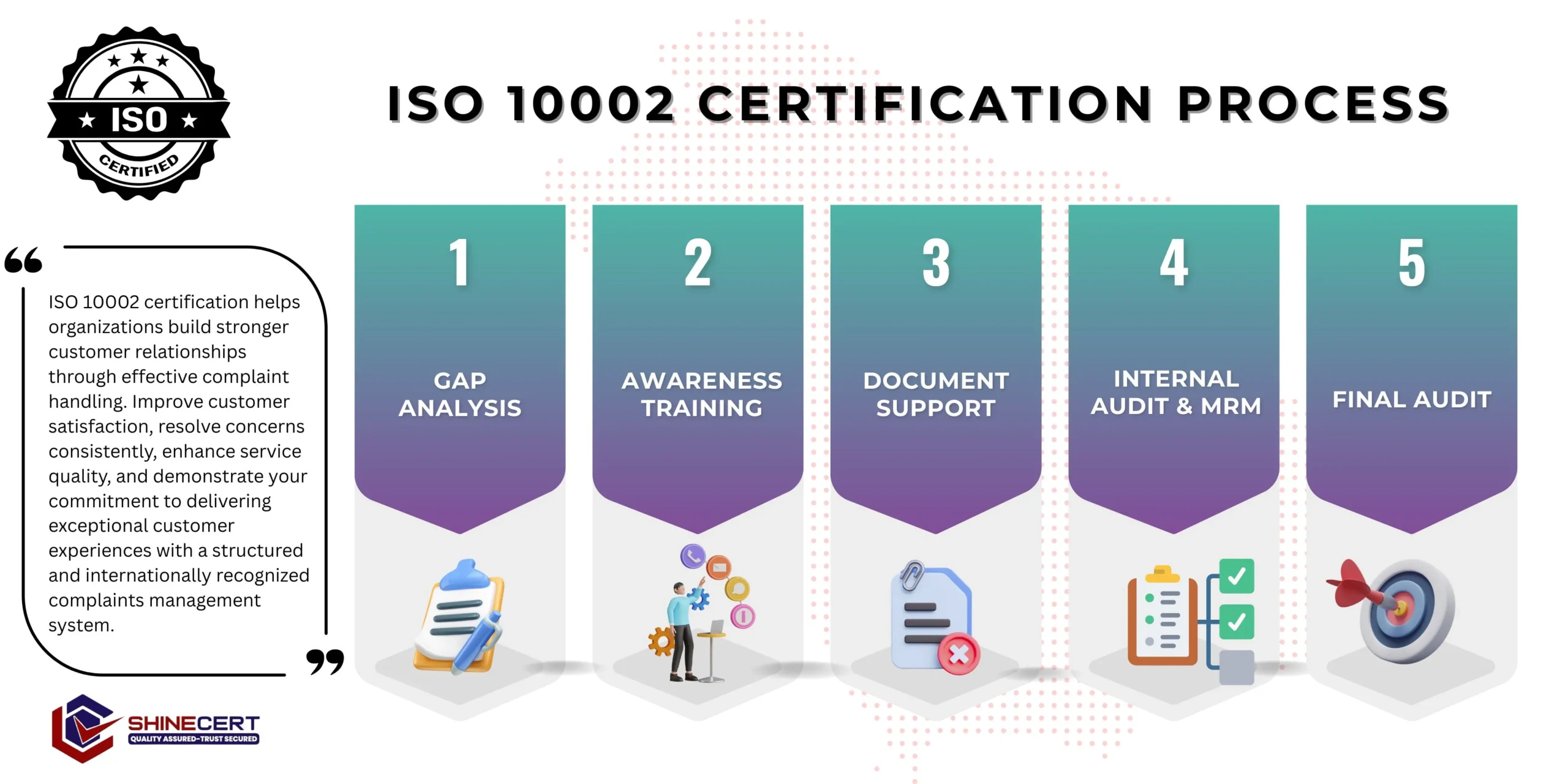
What are the steps to get 10002 Certification?
our services
- ISO 9001 Certification
- ISO 14001 Certification
- ISO 27001 Certification
- ISO 22000 Certification
- ISO 45001 Certification
- ISO 13485 Certification
- ISO 20000 Certification
- ISO 17025 Certification
- CE Mark Certification
- GMP Certification
- Halal Certification
- SOC Certification
ShineCert’s 5-Step ISO 10002 Implementation Process
A complaints policy framed on the wall of a customer service office doesn’t change what actually happens when a frustrated customer calls in. Here’s how we build a complaints-handling process that functions under real pressure.
Gap Analysis and Current State Review
ShineCert reviews current complaint handling practices, channels, and outcomes against ISO 10002's guidance.
Gap assessment report and current-state complaint handling review.
Process Design and Policy Development
The complaints-handling policy, escalation pathways, and investigation and resolution procedures are developed.
Complete complaints-handling process documentation.
Implementation and Staff Training
Complaint reception channels, tracking systems, and resolution procedures are rolled out, and customer-facing staff are trained on the new process.
Training records and process implementation evidence.
Internal Review and Trend Analysis
An internal review evaluates whether the process is functioning as designed, alongside complaint trend analysis to identify systemic issues.
Internal review report and complaint trend analysis.
Independent Gap Assessment or Conformity Review
Since ISO 10002 isn't intended for certification, ShineCert supports an independent gap assessment or documented conformity review where organizations want third-party validation to communicate to stakeholders.
Independent conformity assessment report and improvement recommendations.
Gap Analysis and Current State Review
ShineCert reviews current complaint handling practices, channels, and outcomes against ISO 10002's guidance.
Gap assessment report and current-state complaint handling review.
Process Design and Policy Development
The complaints-handling policy, escalation pathways, and investigation and resolution procedures are developed.
Complete complaints-handling process documentation.
Implementation and Staff Training
Complaint reception channels, tracking systems, and resolution procedures are rolled out, and customer-facing staff are trained on the new process.
Training records and process implementation evidence.
Internal Review and Trend Analysis
An internal review evaluates whether the process is functioning as designed, alongside complaint trend analysis to identify systemic issues.
Internal review report and complaint trend analysis.
Independent Gap Assessment or Conformity Review
Since ISO 10002 isn't intended for certification, ShineCert supports an independent gap assessment or documented conformity review where organizations want third-party validation to communicate to stakeholders.
Independent conformity assessment report and improvement recommendations.
What Is ISO 10002? Understanding the Guidance Standard
ISO 10002:2018 provides guidance on the process of complaints handling related to products and services within an organization, including planning, design, operation, maintenance, and improvement. Its scope explicitly states the guidelines are not intended for certification purposes, distinguishing it clearly from Annex SL management system standards like ISO 9001 or ISO 27001 that are specifically designed for third-party accredited certification. ISO 10002 is often used alongside ISO 9001 as a practical, detailed guide to satisfying that standard’s customer complaint and satisfaction-related clauses.
Handling Complaints Across Multiple Channels Consistently
Modern customers raise complaints across many channels, phone, email, chat, social media, in-person, and review platforms, and mature complaint handling should give roughly the same quality of resolution regardless of channel. Public social media complaints create pressure for fast response, but letting them jump the queue teaches customers that public escalation is the only way to get real attention. ShineCert helps organizations route every complaint into the same tracking system with the same standards, since inconsistent handling reflects reputation management rather than genuinely fixing issues.
Documented Information Supporting ISO 10002 Implementation
At minimum: complaints-handling policy, complaint tracking records, investigation and resolution documentation, complaint trend analysis reports, and evidence of process improvements driven by complaint data.
ISO 10002 and ISO 9001 — How They Connect
ISO 10002 provides detailed, practical guidance for satisfying the customer complaint and customer satisfaction elements embedded within ISO 9001’s broader quality management system requirements. Organizations pursuing ISO 9001 certification often use ISO 10002 specifically to build out the complaints-handling component of their QMS in genuine operational detail, since ISO 9001 itself references customer satisfaction and complaint handling only at a general principle level without the practical process design ISO 10002 provides.
The Service Recovery Paradox: Why Complaint Handling Quality Matters More Than Avoiding Complaints Entirely
- A recurring finding across customer experience research is that customers whose complaints are resolved quickly, fairly, and with genuine acknowledgment often report higher subsequent loyalty than customers who never experienced a problem at all, a phenomenon commonly called the service recovery paradox. This doesn’t mean organizations should welcome complaints, but it does mean that investment in genuinely excellent complaint resolution delivers a return that pure defect-prevention spending alone doesn’t capture, since some level of customer dissatisfaction is close to inevitable in any sufficiently large or complex service operation.
- ShineCert designs complaint-handling processes with this dynamic explicitly in mind, training staff not just to resolve complaints procedurally but to treat the moment of complaint as a genuine opportunity to strengthen the customer relationship rather than merely close a ticket.
The Structure of ISO 10002: Core Guidance Explained
- Complaints-Handling Policy : Guidance on establishing visible, accessible commitment to fair and effective complaint resolution.
- Responsibility and Authority : Guidance on assigning clear ownership for complaint handling, including escalation pathways for complex or serious complaints.
- Complaint Reception and Tracking : Guidance on making it easy for customers to lodge a complaint through accessible channels, and tracking every complaint to resolution.
- Assessment and Investigation : Guidance on fairly and objectively assessing each complaint’s validity and root cause before determining a resolution.
- Response and Resolution : Guidance on timely, appropriate resolution and clear communication with the complainant throughout the process.
- Data Analysis and Continual Improvement : Guidance on analyzing complaint trends to identify systemic issues and drive genuine process or product improvement, not just resolving individual cases in isolation.
Each of these areas focuses on practical process design rather than prescriptive, auditable requirements, reflecting the standard’s guidance nature.
Turning Complaint Data into Organizational Learning
- The continual improvement element of ISO 10002 guidance is often the most underdeveloped part of an organization’s complaint handling, since resolving individual complaints tends to consume all the available attention, leaving little organizational energy for the harder work of asking what the aggregate complaint data actually reveals about systemic product, service, or process issues. A genuinely mature complaints-handling process routes trend analysis findings to the specific teams, product development, operations, training, that can actually act on them, and tracks whether those teams genuinely implement changes in response, rather than letting complaint trend reports become a static document reviewed once and then filed away.
- ShineCert helps organizations build this feedback loop explicitly into their complaints-handling governance, since the ultimate measure of a complaints process’s success isn’t how quickly individual complaints are closed, but whether the same category of complaint becomes measurably less frequent over time as a direct result of organizational learning driven by the complaint data itself.
Benefits of Implementing ISO 10002 Guidance
A well-handled complaint frequently produces a more loyal customer than one who never had an issue, a well-documented phenomenon often called “service recovery paradox.”
Structured, consistent complaint handling reduces the risk of a poorly handled individual complaint escalating into public reputational damage.
Systematic complaint trend analysis surfaces recurring issues that individual complaint resolution alone never would.
For regulated sectors like financial services, ISO 10002-aligned processes provide a credible foundation for demonstrating fair complaint handling to regulators.
ISO 10002 Implementation Cost: What Actually Drives It
- Company size and complaint volume : A high-volume consumer business handling thousands of complaints monthly faces a more complex process and system design challenge than a low-volume B2B provider.
- Nature of the business and complaint complexity : A financial services firm facing regulatory complaint handling expectations faces more complex requirements than a straightforward retail return and complaint process.
- Number of departments and channels in scope : Implementation covering phone, email, social media, and in-person complaint channels as distinct touchpoints costs more than a single-channel process.
- Existing complaint tracking maturity : Organizations with an existing CRM or ticketing system adaptable to structured complaint tracking move faster and at lower cost than those building tracking infrastructure from scratch.
- Verification route chosen : Pursuing an independent gap assessment or conformity review adds a distinct cost beyond internal implementation alone.
ISO 10002 Implementation Timeline
Phase | Typical Duration |
Gap analysis and current state review | 1–2 weeks |
Process design and policy development | 3–5 weeks |
Implementation and staff training | 3–5 weeks |
Internal review and trend analysis | 1–2 weeks |
Independent gap assessment or conformity review (if pursued) | 2–3 weeks |
Total for a typical implementation | 2–4 months |
Who Needs ISO 10002 Guidance? Industries and Reverse Suitability
Sector | Why ISO 10002 Guidance Is Relevant |
Retail & E-commerce | Public review visibility makes complaint resolution quality directly commercially consequential |
Financial Services & Insurance | Regulatory expectations around fair, timely complaint resolution are increasingly explicit |
Telecommunications & Utilities | High complaint volume businesses need structured, consistent handling processes at scale |
Healthcare & Patient Services | Complaint handling intersects directly with patient trust and safety learning |
B2B Service Providers | Structured complaint handling surfaces client dissatisfaction before it becomes silent churn |
Hospitality & Travel Services | Service recovery quality directly affects repeat business and public reputation |
The reverse question: organizations with minimal direct customer interaction or complaint volume, highly specialized B2B suppliers with only a handful of long-term relationships managed through dedicated account managers, for instance, may find a lighter-touch, informal complaints process proportionate, though even these organizations often benefit from reviewing ISO 10002’s principles to confirm nothing structural is being missed.
Ready to scope your 10002 certification project? Book your free consultation or contact ShineCert directly.
Book Free ConsultationReady to scope your 10002 certification project? Book your free consultation or contact ShineCert directly.
Book Free ConsultationWhy Choose ShineCert for ISO 10002 Implementation?
ShineCert has guided more than 10,000 organizations through international standards implementation and certification from genuine operating offices in Riyadh, Lebanon, and India, and we are explicit with clients about which standards, like ISO 10002, are guidance documents rather than certifiable management systems, so budget and expectations are set accurately from the outset.
Choosing an Implementation or Review Partner?
What to Check | Why It Matters |
Explicit acknowledgment ISO 10002 isn’t a certifiable standard | A credible partner won’t market a nonexistent accredited certificate |
Depth of complaint trend analysis methodology | Genuine value comes from systemic issue identification, not just individual complaint resolution |
Sector experience with your complaint complexity | Regulated sectors and high-volume consumer businesses face distinct process design challenges |
Practical, operational focus over documentation volume | The standard’s value is in genuinely functioning process, not paperwork thickness |
Common Implementation Challenges
- Treating “ISO 10002 certified” as an available credential : Since the standard explicitly isn’t intended for certification, any marketed “certificate” claiming otherwise should be evaluated with real skepticism.
- Complaint channels that exist but aren’t genuinely accessible : A complaints email address buried on a website’s contact page doesn’t reflect genuine accessibility.
- Complaint data collected but never analyzed for trends : Individual complaints resolved in isolation without systemic trend analysis miss the standard’s continual improvement intent.
- Escalation pathways that exist on paper but aren’t followed under pressure : Frontline staff empowered on paper to escalate complex complaints, but organizational culture that discourages doing so in practice.
Training Frontline Staff to Handle Complaints Well
- The written complaints-handling procedure matters far less than how a frontline employee actually behaves in the moment a frustrated customer raises an issue, and this is where many otherwise well-documented complaint processes quietly fail in practice. Staff need genuine training in de-escalation, active listening, and the judgment to know when a complaint requires escalation versus when it can be resolved directly at the frontline, and this training needs to be practiced through realistic scenarios rather than delivered as a one-time policy briefing that’s quickly forgotten under real pressure.
- Organizations that invest genuinely in this frontline training consistently see better complaint resolution outcomes than those relying purely on well-designed backend processes and escalation software, since the customer’s actual experience of the complaint process is shaped overwhelmingly by that first human interaction, not by the sophistication of the systems operating behind it. ShineCert builds practical, scenario-based training into every ISO 10002 implementation specifically because policy documentation alone consistently underperforms relative to genuinely skilled frontline handling.
Start Your ISO 10002 Implementation Journey
ShineCert provides end-to-end ISO 10002 implementation support, from gap analysis through process design and independent conformity review, for customer-facing organizations across every sector. Book your free consultation or contact ShineCert directly, and our team will review your current complaint handling, channels, and target outcome before proposing a fixed-scope engagement plan.
Frequently Asked Questions
ISO 10002 is explicitly not intended for certification. Organizations implement its guidance to build genuine complaints-handling processes, optionally supported by an independent gap assessment.
The standard’s own scope states it isn’t intended for certification purposes, distinguishing it from Annex SL management system standards designed for third-party audit.
It depends on complaint volume, channel complexity, and existing tracking infrastructure. ShineCert provides a fixed quote after gap analysis.
Typically two to four months.
ISO 10002 provides detailed practical guidance for the customer complaint and satisfaction elements within ISO 9001’s broader quality management requirements.
Retail and e-commerce, financial services, telecommunications, healthcare, and any high-volume customer-facing business.
Yes, the guidance scales to organizations of any size, and even a small business handling a modest complaint volume benefits from the structured escalation and trend-analysis thinking the standard encourages.