
ISO 17025 Certification
Testing and Calibration Laboratories
Quick Answer
ISO/IEC 17025 is the international standard for the competence of testing and calibration laboratories. It is technically an accreditation, not a certification, laboratories are assessed by national accreditation bodies (such as UKAS, ANAB, or DAkkS) under the International Laboratory Accreditation Cooperation (ILAC) Mutual Recognition Arrangement, rather than by certification bodies. Accreditation is granted for specific, defined test or calibration methods, not as a blanket organizational certificate. Most laboratories complete accreditation in four to eight months.
Introduction
Laboratories researching ISO 17025 need to understand one distinction most consultancy content skips entirely: this is an accreditation, assessed differently from ISO 9001-style certification, and it’s granted method by method, not as a single blanket certificate. This page explains the standard’s actual clause structure, the technical requirements that make it harder than a typical management-system audit, benefits, cost, and the real accreditation process. ShineCert has supported testing and calibration laboratories through this process from our operating offices in Riyadh, Lebanon, and India.
What Is ISO 17025? Understanding the Standard
ISO/IEC 17025:2017 specifies general requirements for the competence, impartiality, and consistent operation of laboratories, covering both testing and calibration activities. Laboratories are assessed by national accreditation bodies, the same bodies that accredit certification bodies for standards like ISO 9001, operating under the ILAC Mutual Recognition Arrangement, the laboratory-sector equivalent of the IAF framework. ILAC-accredited results are internationally recognized across the many countries whose accreditation bodies are ILAC signatories. Critically, accreditation is granted for specific, defined scopes of testing or calibration, meaning a lab can hold accreditation for some methods while others remain unaccredited.
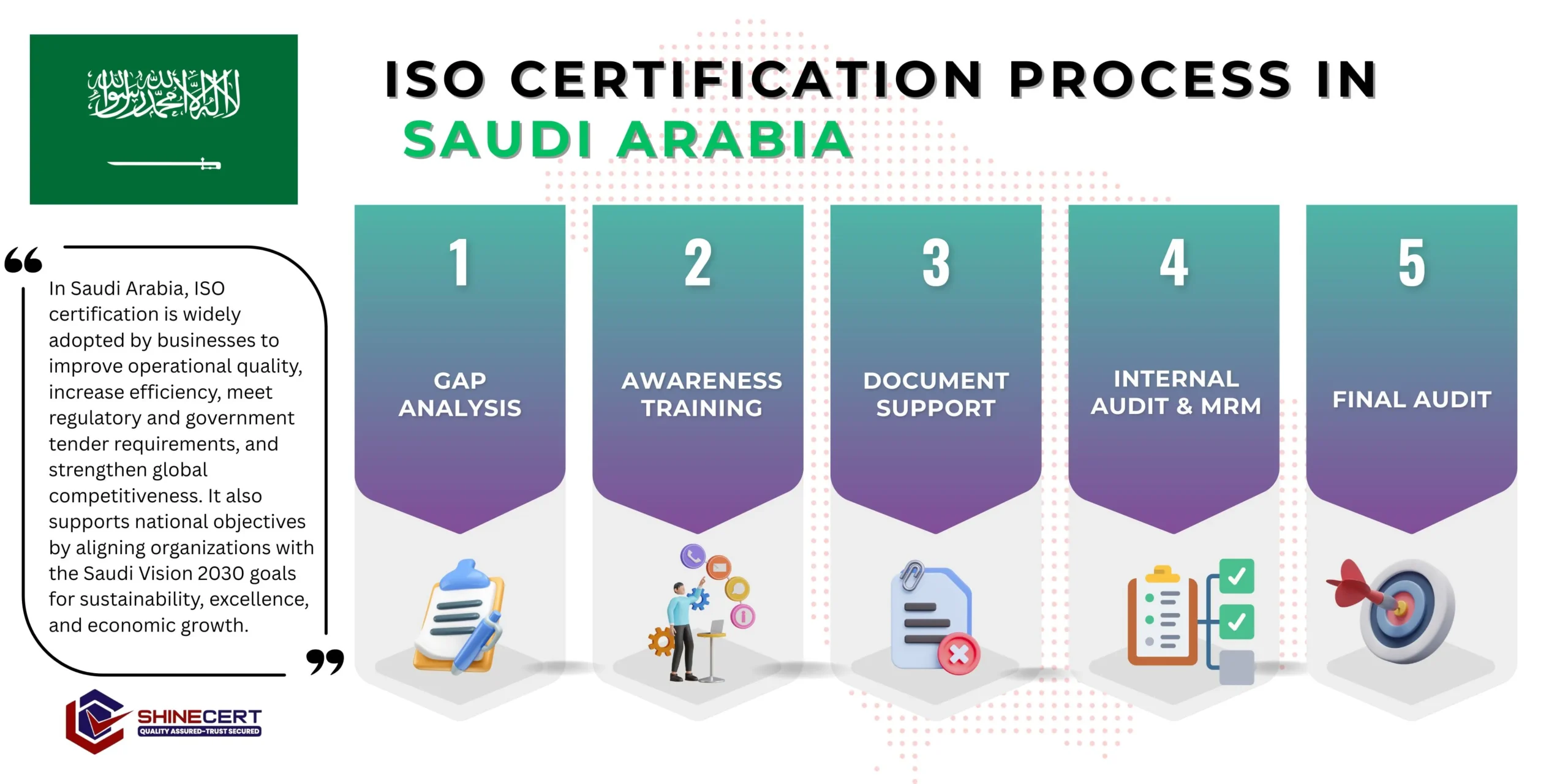
What are the steps to get ISO Certification?
our services
- ISO 9001 Certification
- ISO 14001 Certification
- ISO 27001 Certification
- ISO 22000 Certification
- ISO 45001 Certification
- ISO 13485 Certification
- ISO 17025 Certification
- CE Mark Certification
- GMP Certification
- Halal Certification
- SOC Certification
The ISO 17025 Implementation Process
Scope Definition
Define the precise scope of testing or calibration methods to be accredited, since accreditation applies to specific methods, not the whole laboratory.
Defined scope of accreditation document.
Technical Competence Development
Build validated methods, measurement uncertainty budgets, and equipment calibration and traceability records for each method in scope.
Validated methods with uncertainty budgets and calibration records.
Proficiency Testing Participation
Participate in proficiency testing schemes or inter-laboratory comparisons relevant to the accredited scope.
Proficiency testing and inter-laboratory comparison results.
Quality Control and Environmental Conditions
Implement method-specific quality control procedures and control of environmental conditions affecting result validity.
QC records and environmental monitoring data.
Internal Audit and Management Review
Complete an internal audit covering both management system and technical requirements before the accreditation body's technical assessment.
Internal audit report and management review minutes.
Scope Definition
Define the precise scope of testing or calibration methods to be accredited, since accreditation applies to specific methods, not the whole laboratory.
Defined scope of accreditation document.
Technical Competence Development
Build validated methods, measurement uncertainty budgets, and equipment calibration and traceability records for each method in scope.
Validated methods with uncertainty budgets and calibration records.
Proficiency Testing Participation
Participate in proficiency testing schemes or inter-laboratory comparisons relevant to the accredited scope.
Proficiency testing and inter-laboratory comparison results.
Quality Control and Environmental Conditions
Implement method-specific quality control procedures and control of environmental conditions affecting result validity.
QC records and environmental monitoring data.
Internal Audit and Management Review
Complete an internal audit covering both management system and technical requirements before the accreditation body's technical assessment.
Internal audit report and management review minutes.
The ISO 17025 Accreditation Process
Unlike certification, accreditation is granted directly by a national accreditation body, not a certification body operating under one. The accreditation body conducts a technical assessment, more detailed than a typical ISO 9001-style audit, reviewing method validation, measurement uncertainty budgets, and equipment traceability for each method in the requested scope. Once findings are resolved, accreditation is issued for the approved scope, followed by annual surveillance assessments and a full reaccreditation cycle every few years.
Why ISO 17025 Accreditation Matters?
Test and calibration results only matter if they can be trusted, and unaccredited results carry no independent verification that the laboratory’s methods are valid, its equipment properly calibrated, or its measurement uncertainty honestly stated. Regulators, export markets, and customers increasingly require ILAC-accredited results specifically because an unaccredited lab’s self-reported competence claims can’t be independently verified.
ISO 17025 Certification Cost Explained
Cost depends heavily on the number and complexity of test/calibration methods in the accreditation scope, since method validation and uncertainty budget development is genuinely technical, method-specific work.
Mandatory Documented Information for ISO 17025
At minimum: a defined accreditation scope; method validation records; measurement uncertainty budgets; equipment calibration and traceability records; staff competence records per method; proficiency testing participation evidence; quality control procedures; internal audit records; and management review records.
The Structure of ISO 17025: Clauses Explained
- Clause 4 — General Requirements : Covers impartiality (the lab’s activities must be free from commercial or other pressures that could compromise judgment) and confidentiality of client information and results.
- Clause 5 — Structural Requirements : Covers the lab’s legal identity, organizational structure, and defined responsibilities and authorities for personnel involved in testing or calibration activities.
- Clause 6 — Resource Requirements : The most technically demanding clause: personnel competence for each accredited method, appropriate facilities and environmental conditions, equipment calibration and traceability to national or international measurement standards, and externally provided products and services (subcontracted testing, reference materials).
- Clause 7 — Process Requirements : Covers review of requests and contracts, method selection and validation, sampling, handling of test or calibration items, technical records, evaluation of measurement uncertainty, ensuring validity of results (including proficiency testing), and reporting of results.
- Clause 8 — Management System Requirements : Covers document control, management review, internal audit, and corrective action, the general management system disciplines shared with other ISO standards, applied specifically to a laboratory’s technical operations.
Clauses 6 and 7 are where ISO 17025 diverges most from a typical management-system-only standard, and where ShineCert sees the most technical assessment findings, particularly around measurement uncertainty and equipment traceability.
The Difference Between ISO 9001 and ISO 17025 for a Laboratory
- Laboratories already familiar with ISO 9001 sometimes ask whether ISO 17025 is simply “ISO 9001 for labs,” and the honest answer is no, the overlap is real but partial. ISO 17025’s Clause 8 management system requirements are deliberately lighter than a full ISO 9001 implementation, on the assumption that a laboratory’s real rigor sits in Clauses 6 and 7’s technical competence requirements, not in general quality management documentation.
- A laboratory that already holds ISO 9001 certification will find some structural familiarity, document control, internal audit, management review, but should not assume its existing QMS satisfies ISO 17025’s method validation, measurement uncertainty, or proficiency testing requirements, which have no real ISO 9001 equivalent. Conversely, a laboratory pursuing ISO 17025 alone, without ISO 9001, is not missing anything essential, Clause 8 already covers the management system disciplines a laboratory specifically needs.
Benefits of ISO 17025 Accreditation
Many export markets require ILAC-accredited test results rather than accepting unaccredited lab reports, making accreditation a genuine trade enabler.
Accreditation gives customers and regulators independent, external evidence that results are valid, particularly important where the lab’s own claims can’t easily be verified by a non-technical buyer.
The measurement uncertainty and proficiency testing requirements force a level of technical discipline that improves actual result quality, not just documentation.
In-house quality control labs increasingly need accreditation to satisfy customers seeking assurance that internal QC testing meets an independently verified standard.
Choosing the Right Accreditation Scope for Your Business
- One of the most consequential early decisions in an ISO 17025 project is deciding exactly which methods to include in the accreditation scope, and it’s a decision worth making deliberately rather than defaulting to “everything we do.” Laboratories sometimes request accreditation for every method in their portfolio, only to discover during scoping that some methods lack sufficient validation data or proficiency testing availability to support a smooth first assessment, delaying the entire project for methods that weren’t commercially critical in the first place.
- A more effective approach starts with the methods customers, regulators, or export markets actually require accredited results for, achieves accreditation for that core scope first, and expands the scope in subsequent surveillance or reaccreditation cycles as additional methods reach full validation maturity, a phased approach that gets accredited results to market faster without compromising the technical rigor of what’s actually assessed.
Preparing Staff for a Technical Assessment
Unlike a general management-system audit, an ISO 17025 technical assessment often involves assessors directly questioning bench-level staff about method rationale, uncertainty calculations, and equipment handling, not just reviewing documents with the lab’s quality manager. Laboratories that prepare their technical staff specifically for this kind of direct questioning, not by rehearsing scripted answers, but by ensuring staff genuinely understand the reasoning behind their own procedures, tend to have noticeably smoother assessments than those that treat preparation purely as a documentation exercise handled by quality personnel alone.
Who Needs ISO 17025? Lab Types and Reverse Suitability
- Materials testing laboratories, environmental testing laboratories, food testing laboratories, and calibration laboratories are the core adopters, each facing somewhat different technical challenges within the same standard. Materials labs build scope around specific test standards and face measurement uncertainty tied to sample variability. Environmental labs face sample integrity challenges between collection and analysis. Food testing labs often need scope aligned with food safety regulatory requirements, frequently working alongside organizations pursuing ISO 22000 certification. Calibration labs face the most mathematically involved uncertainty budgets, since their calibration values determine the achievable uncertainty of every downstream measurement relying on their equipment.
- The reverse question: medical and clinical testing laboratories are often better served by the related ISO 15189 standard, specifically designed for medical laboratories, even though the underlying competence principles carry across both standards in similar form.
Types of Laboratories and How Accreditation Scope Differs
- ISO 17025 applies across a genuinely broad range of laboratory types, and “getting accredited” means something quite different depending on which kind of laboratory is pursuing it. Materials testing laboratories assessing mechanical, chemical, or physical properties typically build scope around specific test standards like tensile strength or hardness testing, facing uncertainty challenges tied to sample variability. Environmental testing laboratories testing water, soil, or air samples face a distinct challenge around sample integrity between collection and analysis, meaning their scope typically includes explicit sampling and chain-of-custody procedures alongside analytical methods.
- Calibration laboratories occupy a different position entirely: rather than testing a sample against a specification, they establish and maintain the traceability chain that gives meaning to every other laboratory’s measurements, facing the most mathematically involved uncertainty budgets of any laboratory type since their calibration values directly determine the achievable uncertainty of every downstream measurement relying on their equipment.
Reaccreditation and Maintaining Scope Over Time
Accreditation is maintained through periodic surveillance assessments and a full reaccreditation cycle, and laboratories that treat the period between assessments as a compliance holiday tend to accumulate drift, uncertainty budgets not revisited despite equipment changes, or lapsed proficiency testing participation, that surfaces as findings later.
Measurement Uncertainty in Practice
A defensible uncertainty budget identifies every contributing source specific to a method as performed in that laboratory, equipment resolution, environmental conditions, operator technique, reference standard accuracy and combines them using accepted statistical methods, typically following the GUM approach. A copied or generic uncertainty budget that doesn’t reflect the lab’s actual equipment is one of the most common reasons an assessment identifies significant findings.
Ready to scope your ISO 17025 certification project? Book your free consultation or contact ShineCert directly.
Book Free ConsultationReady to scope your ISO 17025 certification project? Book your free consultation or contact ShineCert directly.
Book Free ConsultationChoosing an Accreditation Body
Confirm the accreditation body’s ILAC MRA signatory status, and specifically its technical assessor expertise in your requested test/calibration methods, this is more consequential here than in management-system-only certification.
ISO 17025 Accreditation Timeline
Phase | Typical Duration |
Gap assessment and scope definition | 2–3 weeks |
Method validation and uncertainty budget development | 6–12 weeks |
Quality system documentation | 4–8 weeks |
Internal audit and management review | 2–3 weeks |
Technical assessment | 2–4 days |
Accreditation issuance | 4–10 weeks after assessment |
Why Choose ShineCert for ISO 17025 Accreditation?
ShineCert has guided more than 10,000 organizations through ISO and accreditation projects from genuine operating offices in Riyadh, Lebanon, and India, with direct experience navigating the technical rigor ISO 17025 assessment demands.
Common Implementation Challenges
- Underestimating measurement uncertainty complexity : Genuinely technical statistical work, often requiring specialist metrology support.
- Scope requested beyond demonstrated capability : Delays assessment and risks a negative outcome.
- Proficiency testing gaps for niche methods : Requires alternative inter-laboratory comparison arrangements.
- Equipment traceability chains that break down : Needs to be demonstrable back to national or international measurement standards.
Frequently Asked Questions
ISO/IEC 17025 is technically an accreditation confirming a laboratory’s technical competence for specific test or calibration methods. It’s typically essential for labs whose results need international recognition or regulatory acceptance.
It’s an accreditation, granted directly by national accreditation bodies under the ILAC Mutual Recognition Arrangement.
It depends heavily on the number and technical complexity of methods in scope. ShineCert provides a fixed quote after scoping.
Most laboratories move from kickoff to accreditation in four to eight months.
Accreditation scope, method validation records, uncertainty budgets, equipment traceability records, proficiency testing evidence, and internal audit records.
Materials, environmental, food, and calibration laboratories. Medical and clinical labs often use the related ISO 15189 standard instead.