
ISO 29001 Certification
Petroleum, Petrochemical, and Natural Gas Sector QMS
Quick Answer
ISO 29001:2020 (also referenced as API Spec Q1’s parallel international standard framework in some regions) is the sector-specific quality management system standard for organizations supplying products and services to the petroleum, petrochemical, and natural gas industries. It builds directly on ISO 9001’s core requirements while adding sector-specific technical and risk requirements addressing the safety-critical, high-consequence-failure nature of oil and gas supply chains. Certification is issued by an accredited certification body after an audit, and most suppliers complete implementation and certification in five to eight months given the additional technical documentation typically required.
Why ISO 29001 Matters for Oil and Gas Suppliers?
Suppliers to the petroleum, petrochemical, and natural gas sector operate in an environment where a quality failure isn’t just a customer complaint, it can mean equipment failure in a safety-critical process, environmental incident, or catastrophic loss of containment, which is why major operators and EPC contractors increasingly restrict their approved vendor lists to organizations holding sector-specific quality certification rather than generic ISO 9001 alone. This pressure shows up differently across the supply chain: an equipment manufacturer faces it through product traceability and failure mode analysis requirements, a specialty chemical supplier faces it through batch consistency and contamination control, and an engineering services firm faces it through documented competence requirements for personnel working on safety-critical designs.
The honest picture: ISO 29001 is increasingly a genuine prerequisite, not just a differentiator, for suppliers wanting access to major national oil company and international operator approved vendor programs, since procurement teams in this sector treat sector-specific quality certification as a baseline qualifying criterion rather than an optional enhancement.
What are the steps to get ISO Certification?
our services
- ISO 9001 Certification
- ISO 14001 Certification
- ISO 27001 Certification
- ISO 22000 Certification
- ISO 45001 Certification
- ISO 13485 Certification
- ISO 20000 Certification
- ISO 17025 Certification
- CE Mark Certification
- GMP Certification
- Halal Certification
- SOC Certification
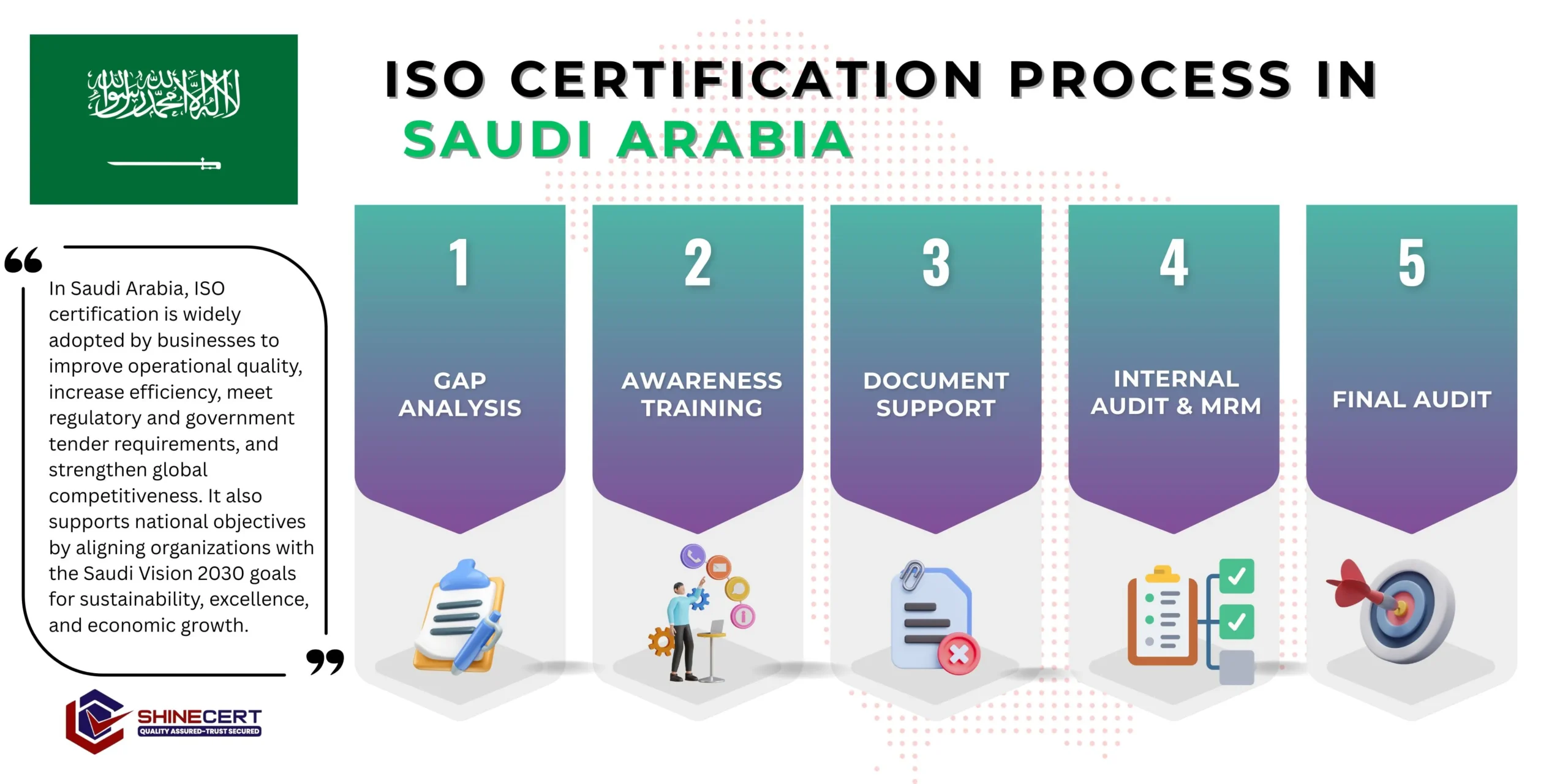
ShineCert’s 5-Step ISO 29001 Certification Process
A quality manual borrowed from a generic ISO 9001 template and lightly modified doesn’t satisfy the sector-specific traceability and risk requirements this standard actually demands. Here’s how we build a system that reflects genuine oil and gas supply chain quality discipline.
Gap Analysis and Sector Requirements Review
ShineCert reviews current quality practices against ISO 29001's sector-specific requirements, including traceability and failure mode analysis expectations.
Gap assessment report and sector-specific requirements mapping.
Documentation and Traceability System Design
The quality manual, product traceability procedures, and risk-based design and development controls are developed.
Complete QMS documentation and product traceability system design.
Implementation and Personnel Competence Verification
Traceability systems, nonconformance control processes, and competence verification for personnel in safety-critical roles are rolled out.
Training and competence records, and traceability implementation evidence.
Internal Audit and Management Review
An internal audit against ISO 29001 requirements is conducted, followed by a formal Management Review evaluating quality performance against sector-specific metrics.
Internal audit report and management review minutes.
Certification Audit Support
ShineCert supports Stage 1 and Stage 2 audits with your chosen accredited certification body, including review of traceability records and design control documentation.
ISO 29001:2020 certificate and surveillance audit schedule.
Gap Analysis and Sector Requirements Review
ShineCert reviews current quality practices against ISO 29001's sector-specific requirements, including traceability and failure mode analysis expectations.
Gap assessment report and sector-specific requirements mapping.
Documentation and Traceability System Design
The quality manual, product traceability procedures, and risk-based design and development controls are developed.
Complete QMS documentation and product traceability system design.
Implementation and Personnel Competence Verification
Traceability systems, nonconformance control processes, and competence verification for personnel in safety-critical roles are rolled out.
Training and competence records, and traceability implementation evidence.
Internal Audit and Management Review
An internal audit against ISO 29001 requirements is conducted, followed by a formal Management Review evaluating quality performance against sector-specific metrics.
Internal audit report and management review minutes.
Certification Audit Support
ShineCert supports Stage 1 and Stage 2 audits with your chosen accredited certification body, including review of traceability records and design control documentation.
ISO 29001:2020 certificate and surveillance audit schedule.
What Is ISO 29001?
ISO 29001:2020 specifies quality management system requirements for the design, development, production, installation, and service of products, and the development, production, installation, and service of related products for the petroleum, petrochemical, and natural gas industries. It’s built on the ISO 9001 framework but adds industry-specific requirements addressing product identification and traceability, risk management specific to safety-critical applications, and control of documented information under the demanding record-retention expectations typical of this sector.
Mandatory Documented Information for ISO 29001
At minimum: quality manual and QMS scope, product traceability records, risk and failure mode analysis documentation, personnel competence records for safety-critical roles, and internal audit and management review records.
Vendor Qualification Programs: Where ISO 29001 Certification Gets Tested
- Certification is only the first step, the practical test comes when a supplier applies to a major operator’s approved vendor program, where procurement and technical teams frequently conduct their own supplementary review beyond the certificate itself, examining actual traceability records, failure history, and quality performance data directly.
- Suppliers who treat ISO 29001 certification as the finish line, rather than the foundation for an ongoing vendor relationship, often find their approved vendor status doesn’t survive the first significant quality incident if the underlying system was built to pass an audit rather than to genuinely function day to day.ShineCert builds certification programs with this reality in mind, focusing on systems robust enough to survive both the certification audit and the more searching scrutiny of a major operator’s own vendor qualification and ongoing performance review process.
The Structure of ISO 29001: Clauses Explained
- Clause 4 — Context of the Organization : Requires defining QMS scope in the context of sector-specific customer and regulatory requirements.
- Clause 5 — Leadership : Requires top management commitment to quality objectives that reflect the safety-critical nature of sector supply.
- Clause 6 — Planning : Requires risk-based thinking specifically addressing failure modes relevant to petroleum, petrochemical, and gas applications.
- Clause 7 — Support : Covers competence requirements, often more stringent than generic ISO 9001 given the safety-critical nature of the work.
- Clause 8 — Operation : The technical core, covering product traceability, control of nonconforming outputs, and sector-specific design and development controls.
- Clause 9 — Performance Evaluation : Requires monitoring quality performance against sector-specific metrics, internal audit, and management review.
- Clause 10 — Improvement : Requires corrective action for quality failures with particular attention to root cause analysis given the potential consequences of recurrence.
ISO 29001 and ISO 9001 — How They Connect
ISO 29001 is built directly on ISO 9001’s core structure and requirements, meaning organizations already certified to ISO 9001 have a substantial head start, but the sector-specific additions, product traceability rigor, failure mode analysis, and enhanced documented information control, represent genuine additional work, not a simple rebadging exercise. Suppliers sometimes assume ISO 9001 certification alone satisfies sector customer expectations, only to discover during a major operator’s vendor qualification review that ISO 29001’s additional requirements are specifically what’s being evaluated, making the distinction commercially significant, not just technical.
Benefits of ISO 29001 Certification
Certification is increasingly a prerequisite for major national oil company and international operator approved vendor programs.
Sector-specific traceability and failure mode analysis requirements catch quality issues before they become field failures in safety-critical applications.
Certified suppliers frequently gain preferred vendor status and reduced pre-qualification friction with repeat customers across the sector.
Certification signals genuine understanding of the sector’s safety-critical quality expectations, beyond what generic ISO 9001 demonstrates.
ISO 29001 Certification Cost Explained
- Company size and product complexity. A manufacturer producing complex, safety-critical equipment faces more extensive traceability and failure mode analysis requirements than a supplier of simpler components.
- Nature of the business and customer base. Suppliers serving multiple major operators simultaneously often need to satisfy overlapping but distinct vendor qualification expectations.
- Number of departments and product lines in scope. Certification covering multiple product lines as distinct categories costs more than a narrowly scoped certification.
- Existing traceability system maturity. Organizations with established product traceability and record-keeping systems move faster and at lower cost than those building traceability from scratch.
- Existing ISO 9001 certification status. Organizations already certified to ISO 9001 typically transition to ISO 29001 faster given the shared foundational structure.
ISO 29001 Certification Timeline
Phase | Typical Duration |
Gap analysis and sector requirements review | 2–4 weeks |
Documentation and traceability system design | 6–9 weeks |
Implementation and personnel competence verification | 6–9 weeks |
Internal audit and management review | 1–2 weeks |
Certification body Stage 1 + Stage 2 audit | 3–5 weeks |
Total for a typical implementation | 5–8 months |
Root Cause Analysis: Why This Sector Demands More Than Corrective Action Alone
- In most industrial contexts, a corrective action addressing an immediate quality issue is often considered sufficient, but the petroleum, petrochemical, and natural gas sector’s safety-critical consequences mean ISO 29001 implementation typically demands genuine root cause analysis extending well beyond the immediate defect to the underlying systemic cause.
- A batch of components that fails specification testing raises an obvious immediate question about that specific batch, but the more important question is whether the same underlying process, supplier, or design issue affects other batches already delivered to customers, potentially already installed in operating equipment. ShineCert builds root cause analysis methodology into ISO 29001 implementations specifically to address this broader question, since a supplier whose corrective action process stops at fixing the immediately identified defect without investigating broader exposure leaves both the supplier and its customers exposed to a failure that may already be present elsewhere in the field.
Managing Design Changes Without Compromising Traceability
- Engineering changes are a normal, necessary part of product development in this sector, but each change creates a traceability challenge: which units in the field reflect the old design, which reflect the new one, and does a customer’s specific unit need to be tracked against the design revision that was actually in effect when it was manufactured. Suppliers without disciplined design change control often find their traceability records become unreliable exactly at the moments they matter most, during a field failure investigation involving a product that may have gone through several design iterations since initial production.
- A well-designed ISO 29001 implementation ties design change records directly into the product traceability system, so that any unit can be traced not just to a batch or production date but to the specific design revision and any subsequent field modifications, giving both the supplier and the customer genuine confidence in failure investigation and recall scoping if either is ever needed.
Supplier and Sub-Tier Quality Management Across the Supply Chain
- Most ISO 29001-certified organizations don’t manufacture every component themselves, they rely on a network of sub-tier suppliers for raw materials, castings, machined parts, and specialized processes, and the certified organization remains accountable for quality performance across that entire supply chain, not just its own direct operations. This means extending meaningful quality oversight to sub-tier suppliers: verifying their process controls, requiring their own traceability records to flow through to the certified organization’s systems, and building contingency plans for the genuine possibility that a critical sub-tier supplier experiences a quality event affecting multiple customers simultaneously.
- Organizations that treat sub-tier supplier quality as someone else’s problem, addressed only through a signed quality agreement without ongoing verification, often discover the gap during a field failure investigation that traces back several supply tiers to a process control weakness nobody was actively monitoring. ShineCert helps suppliers build genuinely proportionate sub-tier oversight into their ISO 29001 systems, focusing the most rigorous scrutiny on the sub-tier relationships supplying the most safety-critical or failure-consequential components rather than spreading limited oversight resources evenly across a supply base with very different risk profiles.
Who Needs ISO 29001? Industries and Reverse Suitability
Sector | Why ISO 29001 Is Relevant |
Oilfield Equipment Manufacturers | Product traceability and failure mode analysis are core supplier qualification requirements |
Specialty Chemical & Additive Suppliers | Batch consistency and contamination control are safety-critical in upstream and downstream processes |
Engineering, Procurement & Construction (EPC) Contractors | Documented personnel competence for safety-critical design work is increasingly mandatory |
Pipeline and Midstream Component Suppliers | Material traceability directly affects pipeline integrity management |
Instrumentation and Control Systems Suppliers | Process safety depends on documented reliability of control and monitoring equipment |
Drilling and Well Services Contractors | Approved vendor programs at major operators increasingly require sector-specific certification |
Ready to scope your ISO 29001 certification project? Book your free consultation or contact ShineCert directly.
Book Free ConsultationReady to scope your ISO 29001 certification project? Book your free consultation or contact ShineCert directly.
Book Free ConsultationChoosing an Accredited Certification Body
What to Check | Why It Matters |
Current IAF-recognized accreditation for ISO 29001 | Confirms the certificate carries genuine international recognition |
Oil and gas sector audit experience | Auditors familiar with sector-specific traceability and safety-critical requirements assess QMS more effectively |
Recognition by target major operators | Confirms certification will carry practical weight with the specific vendor programs you’re targeting |
API Spec Q1 familiarity where relevant | Relevant in regions or customer relationships referencing the parallel API framework |
Why Choose ShineCert for ISO 29001 Certification?
ShineCert has guided more than 10,000 organizations through international certification from genuine operating offices in Riyadh, Lebanon, and India, with practical experience supporting suppliers across the petroleum, petrochemical, and natural gas supply chain.
Common Implementation Challenges
- Traceability systems that don’t reach every component : Partial traceability covering finished products but not sub-components or raw materials fails to satisfy sector expectations.
- Failure mode analysis treated as a paperwork exercise : Generic risk categories applied without genuine engineering analysis specific to the product’s actual failure modes in service.
- Competence records incomplete for safety-critical roles : Personnel qualifications for design and quality functions are often tracked less rigorously than the standard expects.
- Design control documentation disconnected from actual engineering practice : Documented design review processes that don’t match how design changes are genuinely managed in practice.
Start Your ISO 29001 Certification Journey
ShineCert provides end-to-end ISO 29001 certification support, from gap analysis through certification audit, for suppliers to the petroleum, petrochemical, and natural gas industries. Book your free consultation or contact ShineCert directly, and our team will review your product range, customer base, and existing quality systems before proposing a fixed-scope engagement plan.
Frequently Asked Questions
It certifies a sector-specific quality management system for petroleum, petrochemical, and natural gas suppliers. It’s increasingly a prerequisite for major operator vendor programs.
They address similar sector-specific quality requirements and are often referenced together, though they are formally distinct standards maintained by different bodies.
It depends on product complexity, customer base, and existing traceability maturity. ShineCert provides a fixed quote after gap analysis.
Typically, five to eight months, often longer than generic ISO 9001 given sector-specific traceability requirements.
Not strictly required, though ISO 29001 builds on ISO 9001’s core structure, and organizations already certified to ISO 9001 typically transition faster.
Equipment manufacturers, specialty chemical suppliers, EPC contractors, and any organization on or pursuing a major operator’s approved vendor list.
Suppliers relying on subcontracted manufacturing or fabrication need to extend traceability and quality control requirements to those subcontractors, since the certified organization remains accountable for the full supply chain behind its delivered product.