
ISO 55001 Certification
Asset Management Systems
Quick Answer
ISO 55001:2014 is the international standard for asset management systems, certifying that an organization manages physical assets, infrastructure, equipment, plant, through a structured, risk-based approach that balances cost, risk, and performance across the asset lifecycle. It is most relevant to asset-intensive sectors like utilities, transportation infrastructure, and manufacturing plant operators, where poor asset management directly threatens service continuity and safety. Certification is issued by an accredited certification body after an audit, and most organizations complete implementation and certification in five to eight months given the data and asset inventory work typically required.
Why ISO 55001 Matters for Asset-Intensive Organizations?
Organizations managing significant physical infrastructure, power grids, water networks, rail systems, industrial plant, face a distinct version of operational risk that service-based businesses don’t: an asset failure isn’t just a service disruption, it can be a safety incident, an environmental event, or a multi-year capital replacement decision made under pressure rather than through planned lifecycle management. This pressure shows up differently across sectors: a utility company faces it through regulatory reporting requirements on asset condition, a transportation authority faces it through public safety accountability for aging infrastructure, and a manufacturing plant faces it through the direct cost of unplanned equipment failure against planned maintenance investment.
The honest picture: ISO 55001 is voluntary, but regulators in several infrastructure sectors increasingly reference it as good practice, and it’s become a genuine differentiator in asset-intensive tender evaluations where a bidder’s asset management maturity is a legitimate evaluation criterion in its own right.
What are the steps to get ISO 55001 Certification?
our services
- ISO 9001 Certification
- ISO 14001 Certification
- ISO 27001 Certification
- ISO 22000 Certification
- ISO 45001 Certification
- ISO 13485 Certification
- ISO 20000 Certification
- ISO 17025 Certification
- CE Mark Certification
- GMP Certification
- Halal Certification
- SOC Certification
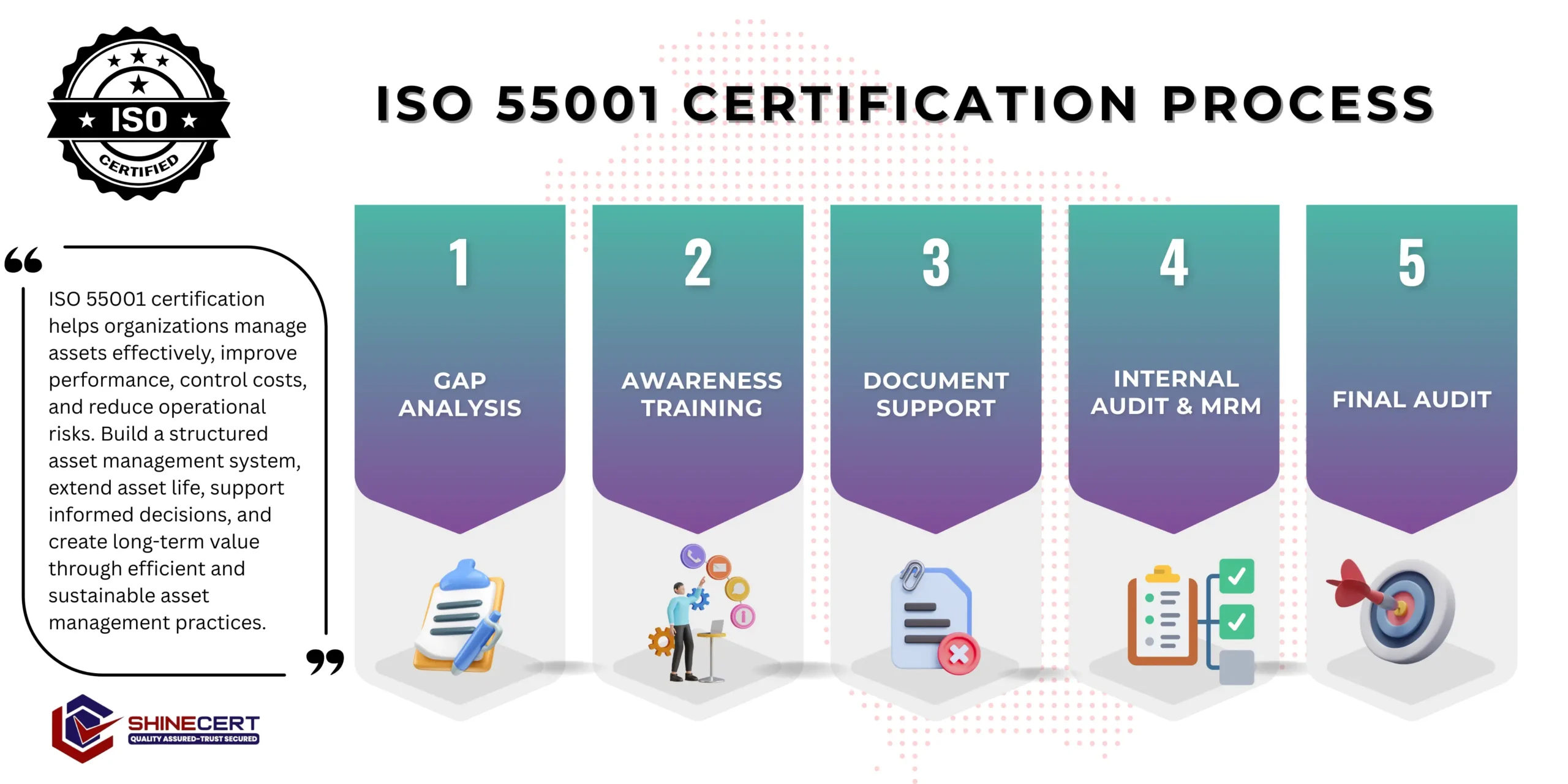
ShineCert’s 5-Step ISO 55001 Certification Process
An asset register that exists in a spreadsheet nobody updates doesn’t manage risk, it creates a false sense of control. Here’s how we build an asset management system that reflects genuine, current asset reality.
Gap Analysis and Asset Inventory Review
ShineCert reviews current asset management practices and the existing asset inventory against ISO 55001 requirements, identifying data gaps and missing lifecycle information.
Gap assessment report and asset data quality findings.
SAMP Development and Risk Assessment
The Strategic Asset Management Plan, asset management policy, and risk assessments covering asset failure modes are developed.
Complete SAMP, asset management policy, and asset risk register.
Implementation and Lifecycle Process Rollout
Lifecycle management processes — acquisition, maintenance planning, renewal decision criteria — are implemented, and relevant staff are trained.
Training records and lifecycle process implementation evidence.
Internal Audit and Management Review
An internal audit against ISO 55001 requirements is conducted, followed by a formal Management Review evaluating asset performance against the SAMP.
Internal audit report and management review minutes.
Certification Audit Support
ShineCert supports Stage 1 and Stage 2 audits with your chosen accredited certification body, including review of asset data systems and field verification.
ISO 55001:2014 certificate and surveillance audit schedule.
Gap Analysis and Asset Inventory Review
ShineCert reviews current asset management practices and the existing asset inventory against ISO 55001 requirements, identifying data gaps and missing lifecycle information.
Gap assessment report and asset data quality findings.
SAMP Development and Risk Assessment
The Strategic Asset Management Plan, asset management policy, and risk assessments covering asset failure modes are developed.
Complete SAMP, asset management policy, and asset risk register.
Implementation and Lifecycle Process Rollout
Lifecycle management processes — acquisition, maintenance planning, renewal decision criteria — are implemented, and relevant staff are trained.
Training records and lifecycle process implementation evidence.
Internal Audit and Management Review
An internal audit against ISO 55001 requirements is conducted, followed by a formal Management Review evaluating asset performance against the SAMP.
Internal audit report and management review minutes.
Certification Audit Support
ShineCert supports Stage 1 and Stage 2 audits with your chosen accredited certification body, including review of asset data systems and field verification.
ISO 55001:2014 certificate and surveillance audit schedule.
What Is ISO 55001?
ISO 55001:2014 specifies requirements for establishing, implementing, maintaining, and improving an asset management system, defined as the coordinated activity of an organization to realize value from assets. It works alongside ISO 55000 (which provides overview and terminology) and ISO 55002 (which provides implementation guidance), together forming the ISO 55000 family. The standard follows a lifecycle approach, covering asset acquisition, utilization, maintenance, and eventual renewal or disposal, rather than treating maintenance as an isolated activity disconnected from broader organizational objectives.
Renewal and Replacement Decision-Making
One of the most valuable, and most commonly underdeveloped, outputs of a mature asset management system is a genuinely data-driven approach to renewal and replacement decisions, replacing the common default of replacing an asset only after failure or basing timing purely on age. A well-designed SAMP builds in condition monitoring and performance trending that feeds directly into capital planning, so renewal decisions reflect actual asset health and criticality, helping organizations defer unnecessary spending, catch degrading assets earlier, and achieve better safety outcomes and more efficient capital allocation across the full portfolio.
Mandatory Documented Information for ISO 55001
At minimum: the Strategic Asset Management Plan, asset management policy and objectives, asset risk register, asset information requirements and data quality standards, and internal audit and management review records.
The Structure of ISO 55001: Clauses Explained
- Clause 4 — Context of the Organization : Requires defining the Strategic Asset Management Plan (SAMP) scope and understanding stakeholder requirements for asset performance.
- Clause 5 — Leadership : Requires top management commitment to asset management objectives aligned with overall organizational strategy.
- Clause 6 — Planning : Requires asset management objectives and a documented SAMP translating organizational objectives into asset management activities.
- Clause 7 — Support : Covers competence of asset management personnel, and critically, asset information requirements — the data underpinning every asset decision.
- Clause 8 — Operation : The technical core, covering lifecycle activities, contractors and outsourced asset management activities, and management of change affecting assets.
- Clause 9 — Performance Evaluation : Requires monitoring asset performance against the SAMP, internal audit, and management review.
- Clause 10 — Improvement : Requires corrective action for asset management failures and continual improvement of the system.
ISO 55001 and Risk Management — How They Connect
ISO 55001’s risk-based approach to asset failure overlaps substantially with ISO 31000 risk management guidance, though the two serve different purposes, ISO 31000 provides general risk management principles applicable across any organizational risk, while ISO 55001 applies risk thinking specifically to physical asset lifecycle decisions and is itself certifiable, unlike ISO 31000. Organizations already using ISO 31000-aligned risk frameworks typically find integrating asset-specific risk criteria into that existing framework faster than building asset risk management from scratch.
Benefits of ISO 55001 Certification
A structured asset management system typically shifts spending from reactive emergency repair toward planned, lower-cost maintenance investment over time.
Systematic asset condition monitoring catches degradation before it becomes a safety incident or unplanned failure.
Utilities and infrastructure operators increasingly find regulators expect documented asset management maturity as part of rate-setting or licensing processes.
A SAMP gives leadership a genuine long-term capital planning tool rather than reactive, year-to-year budget requests.
ISO 55001 Certification Cost Explained
- Company size and asset portfolio scale. An organization managing thousands of geographically distributed assets faces a larger data and inventory challenge than one managing a concentrated, smaller asset base.
- Nature of the business and asset criticality. Safety-critical infrastructure assets (rail, power transmission) require more rigorous risk assessment than lower-criticality equipment.
- Number of departments and asset classes in scope. Certification covering multiple asset classes, buildings, equipment, vehicles, IT infrastructure, as distinct categories costs more than a single asset class scope.
- Existing asset data quality. Organizations with poor historical asset records face substantially more data remediation work before a genuine SAMP can be built.
- Existing management system maturity. Organizations already certified to ISO 9001 or ISO 14001 typically integrate ISO 55001 faster given the shared Harmonised Structure.
Building the Asset Data Foundation Before Certification
- Most ISO 55001 implementation timelines are actually driven by asset data readiness rather than management system documentation itself, since a Strategic Asset Management Plan built on incomplete or contradictory asset records doesn’t hold up under audit scrutiny regardless of how well the surrounding policy is written. Organizations frequently discover during gap analysis that asset information is split across a maintenance management system, a finance department’s fixed asset register, and informal engineering records that don’t agree with each other on basic facts like installation date or current condition.
- ShineCert treats asset data reconciliation as its own distinct early-phase workstream precisely because rushing past this step to get to policy documentation produces an SAMP built on a foundation that won’t survive a genuine field verification during Stage 2.
Asset Criticality Classification: Prioritizing a Large Portfolio
- Organizations managing thousands of assets can’t apply identical scrutiny to every single one, and ISO 55001 implementation typically starts with a criticality classification exercise that ranks assets by the consequence of failure, safety impact, service disruption scale, replacement cost, and regulatory exposure, rather than treating a minor equipment item and a critical transmission asset with the same level of monitoring and planning rigor.
- Getting this classification wrong in either direction creates real problems: under-classifying a genuinely critical asset leaves a significant failure risk under-monitored, while over-classifying large portions of a low-criticality asset base spreads limited maintenance and monitoring resources too thin to be genuinely effective anywhere. ShineCert works with asset-intensive clients to build a criticality framework that reflects their actual risk profile and available resources, since a theoretically perfect classification system that the organization can’t realistically resource and maintain provides less real protection than a simpler, well-resourced system focused on the assets that matter most.
Integrating Asset Management with Broader Risk and Financial Planning
- A genuinely mature ISO 55001 system doesn’t operate as a standalone maintenance function off in its own corner, it feeds directly into enterprise risk registers, capital budgeting cycles, and, in regulated utility contexts, the rate case or tariff submissions that justify infrastructure investment to a regulator. Finance teams that treat asset management data as a credible input rather than an engineering-department curiosity gain a much stronger basis for long-term capital forecasting, because a SAMP built on real condition data and documented failure consequence analysis is a far more defensible planning tool than a rolling average of historical replacement spending.
- This integration also changes how organizations respond when budget pressure hits: rather than making an across-the-board cut that ignores relative asset criticality, a mature system lets leadership defer spending on genuinely low-risk assets while protecting investment in the assets whose failure would carry the greatest safety, financial, or regulatory consequence. ShineCert encourages clients to involve finance and risk stakeholders early in SAMP development rather than treating it as a purely technical exercise, since the standard’s long-term value depends heavily on asset management data being trusted and used well beyond the maintenance department itself, feeding into board-level risk reporting, insurance renewal discussions, and multi-year capital plans that used to rely on far less rigorous inputs.
Who Needs ISO 55001? Industries and Reverse Suitability
Sector | Why ISO 55001 Is Relevant |
Utilities (Power, Water, Gas) | Regulatory reporting on asset condition and long-term infrastructure investment planning |
Transportation Infrastructure Operators | Public safety accountability for aging rail, road, and airport infrastructure |
Manufacturing & Industrial Plant Operators | Balancing planned maintenance investment against unplanned failure cost |
Oil & Gas Midstream and Downstream Operators | Pipeline and processing plant integrity management |
Telecommunications Infrastructure Providers | Network asset lifecycle management across large geographic footprints |
Facilities and Real Estate Portfolio Managers | Long-term capital planning across large property or equipment portfolios |
The reverse question: organizations with limited physical asset exposure, professional services firms, most software companies, retail operations without significant owned infrastructure, generally don’t need ISO 55001, since the standard’s value depends specifically on managing a substantial base of physical assets with real lifecycle and failure-risk implications.
Ready to scope your ISO 55001 certification project? Book your free consultation or contact ShineCert directly.
Book Free ConsultationReady to scope your ISO 55001 certification project? Book your free consultation or contact ShineCert directly.
Book Free ConsultationChoosing an Accredited Certification Body
What to Check | Why It Matters |
Current IAF-recognized accreditation for ISO 55001 | Confirms the certificate carries genuine international recognition |
Asset-intensive sector experience | Auditors familiar with utility, transport, or industrial asset management assess SAMPs more effectively |
Data systems review capability | Asset management audits increasingly examine underlying asset data systems, not just policy documents |
Regulatory context familiarity | Relevant for utilities and infrastructure operators facing sector-specific regulatory asset reporting |
Why Choose ShineCert for ISO 55001 Certification?
ShineCert has guided more than 10,000 organizations through international certification from genuine operating offices in Riyadh, Lebanon, and India, with practical experience in asset-intensive sectors including utilities, transportation, and industrial operations.
Common Implementation Challenges
- Asset data quality gaps : Historical asset records are often incomplete, inconsistent, or scattered across multiple legacy systems, and this is consistently the single biggest implementation bottleneck.
- SAMP disconnected from actual organizational strategy : A Strategic Asset Management Plan built in isolation from broader business objectives fails to satisfy Clause 6’s intent.
- Risk assessments that don’t reflect real failure modes : Generic risk categories applied without asset-specific failure mode analysis.
- Contractor and outsourced asset management left outside scope : Organizations that outsource significant maintenance activity often fail to extend asset management system requirements to those contractor relationships.
Frequently Asked Questions
It certifies a structured system for managing physical assets across their lifecycle. It’s most valuable for organizations managing significant infrastructure or equipment portfolios.
No, though those sectors face the strongest pressure. Any organization with a substantial physical asset base can benefit.
It depends on asset portfolio size, data quality, and asset classes in scope. ShineCert provides a fixed quote after gap analysis.
Typically five to eight months, often longer than other management standards due to asset data remediation work.
ISO 55000 provides overview and terminology, ISO 55001 is the certifiable requirements standard, and ISO 55002 provides implementation guidance.
Yes, its Harmonised Structure supports integration with other ISO management standards.
Not strictly, though most organizations beyond a small asset base find dedicated asset management or CMMS software makes maintaining accurate, current asset data significantly more practical than manual tracking, particularly as portfolio size grows.