
ISO 37001 Certification
Anti-Bribery Management Systems
Quick Answer
ISO 37001:2016 is the international standard for anti-bribery management systems, certifying that an organization has implemented reasonable and proportionate measures to prevent, detect, and address bribery risk across its own operations, employees, and business relationships. It’s especially relevant for organizations bidding on government contracts, operating in higher-corruption-risk markets, or facing due diligence expectations from international partners and lenders. Certification is issued by an accredited certification body after an audit, and most organizations complete implementation and certification in four to seven months.
Why ISO 37001 Matters for Internationally Exposed Organizations?
Bribery exposure isn’t evenly distributed, it concentrates around specific business activities: government tendering, use of third-party agents and intermediaries, operations in higher-risk jurisdictions, and gift and hospitality practices around client relationships. This pressure shows up differently across sectors: a construction firm bidding on public infrastructure tenders faces it through procurement official interactions, an oil and gas company faces it through third-party agent relationships in resource-rich but higher-corruption-risk jurisdictions, and an export-oriented manufacturer faces it through customs and import facilitation payment pressure at multiple international borders.
The honest picture: ISO 37001 doesn’t guarantee bribery will never occur within a certified organization, and no credible anti-bribery program can make that promise, what it demonstrates is that reasonable, documented, and tested controls are genuinely in place, which matters enormously both for regulatory defense purposes (in jurisdictions like the UK, where “adequate procedures” is a statutory defense) and for satisfying international partners and lenders conducting their own due diligence.
What are the steps to get ISO 37001 Certification?
our services
- ISO 9001 Certification
- ISO 14001 Certification
- ISO 27001 Certification
- ISO 22000 Certification
- ISO 45001 Certification
- ISO 13485 Certification
- ISO 20000 Certification
- ISO 17025 Certification
- CE Mark Certification
- GMP Certification
- Halal Certification
- SOC Certification
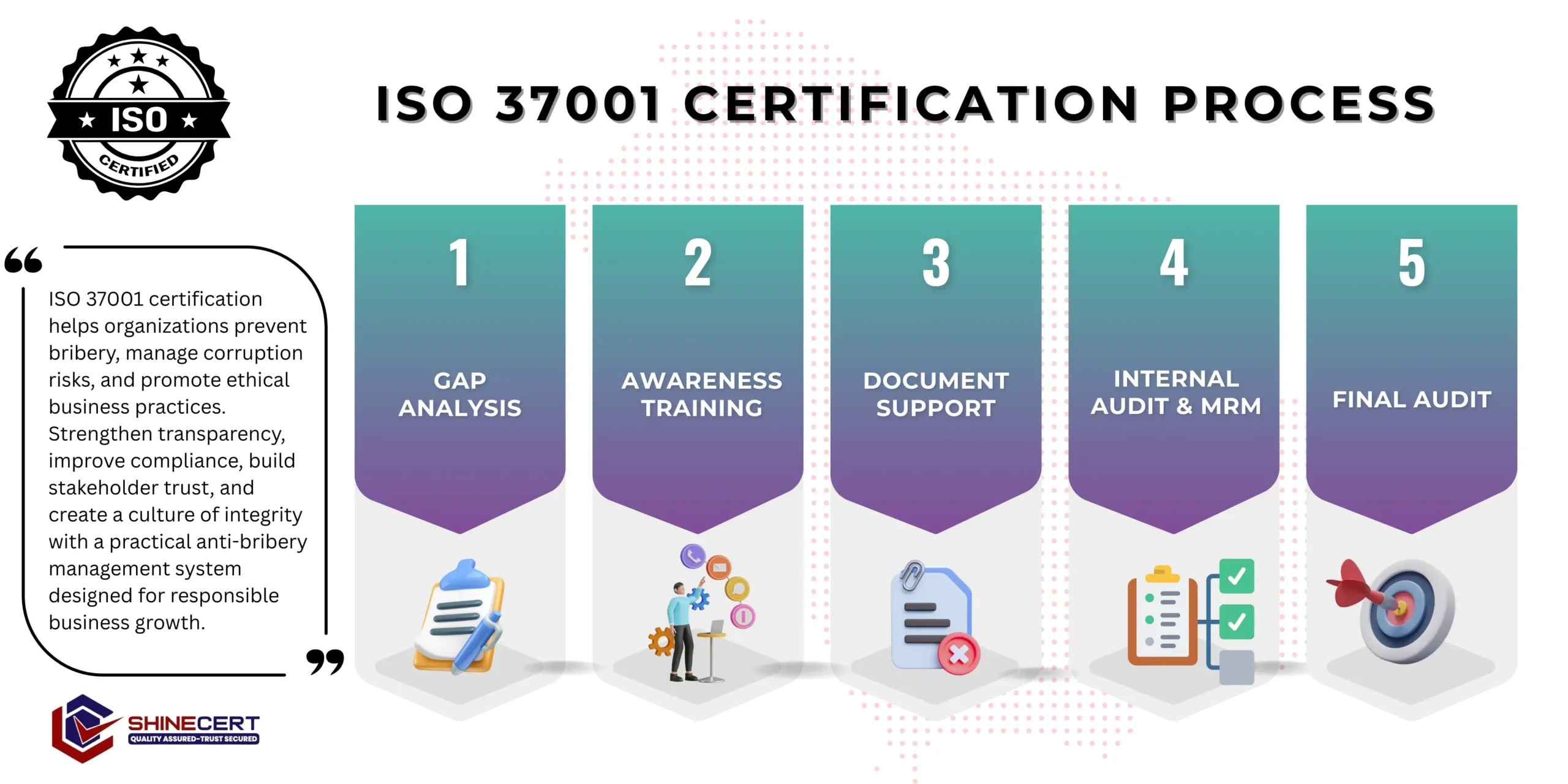
ShineCert’s 5-Step ISO 37001 Certification Process
An anti-bribery policy that sits in an employee handbook nobody reads doesn’t prevent bribery, it creates a false sense of protection that can actually worsen legal exposure if a real incident occurs despite it. Here’s how we build a system that functions as genuine, tested protection.
Bribery Risk Assessment
ShineCert conducts a bribery risk assessment specific to your operations, geographic footprint, and business relationships, identifying where genuine exposure concentrates.
Bribery risk assessment report and prioritized risk register.
Policy, Due Diligence Framework, and Documentation
The anti-bribery policy, business associate due diligence procedures, and financial control procedures (gifts, hospitality, facilitation payments) are developed.
Complete anti-bribery management system documentation and due diligence procedures.
Implementation and Staff Training
Due diligence processes are rolled out for existing and new business associates, and staff across relevant functions are trained on anti-bribery policy and raising concerns mechanisms.
Training records and due diligence implementation evidence.
Internal Audit and Compliance Function Review
An internal audit against ISO 37001 requirements is conducted, alongside the distinct review required from the anti-bribery compliance function.
Internal audit report and compliance function review records.
Certification Audit Support
ShineCert supports Stage 1 and Stage 2 audits with your chosen accredited certification body, including review of due diligence records and raising concerns mechanism testing.
ISO 37001:2016 certificate and surveillance audit schedule.
Bribery Risk Assessment
ShineCert conducts a bribery risk assessment specific to your operations, geographic footprint, and business relationships, identifying where genuine exposure concentrates.
Bribery risk assessment report and prioritized risk register.
Policy, Due Diligence Framework, and Documentation
The anti-bribery policy, business associate due diligence procedures, and financial control procedures (gifts, hospitality, facilitation payments) are developed.
Complete anti-bribery management system documentation and due diligence procedures.
Implementation and Staff Training
Due diligence processes are rolled out for existing and new business associates, and staff across relevant functions are trained on anti-bribery policy and raising concerns mechanisms.
Training records and due diligence implementation evidence.
Internal Audit and Compliance Function Review
An internal audit against ISO 37001 requirements is conducted, alongside the distinct review required from the anti-bribery compliance function.
Internal audit report and compliance function review records.
Certification Audit Support
ShineCert supports Stage 1 and Stage 2 audits with your chosen accredited certification body, including review of due diligence records and raising concerns mechanism testing.
ISO 37001:2016 certificate and surveillance audit schedule.
What Is ISO 37001?
ISO 37001:2016 specifies requirements for establishing, implementing, maintaining, reviewing, and improving an anti-bribery management system, applicable to bribery by the organization, its personnel, and business associates acting on its behalf, in both the public and private sectors. It’s designed to be proportionate to the size and bribery risk profile of the organization rather than imposing identical requirements regardless of actual exposure, and it can be implemented as a standalone system or integrated into a broader compliance or management system framework.
Third-Party Due Diligence in ISO 37001
Most real-world bribery exposure in certified organizations traces back to third-party relationships rather than direct employee conduct, which is why ISO 37001’s due diligence requirements for business associates carry disproportionate practical weight. A rigorous process needs to go beyond a signed anti-bribery certification and actually investigate beneficial ownership, litigation or sanctions history, and the commercial rationale for the relationship, an unusually high distributor commission is a classic red flag checkbox reviews miss. ShineCert helps build genuinely risk-tiered due diligence, applying deeper scrutiny to higher-risk relationships rather than uniform, shallow review.
Mandatory Documented Information for ISO 37001
At minimum: bribery risk assessment, anti-bribery policy, business associate due diligence records, financial control procedures for gifts and hospitality, raising concerns mechanism records, and internal audit and management review records.
The Structure of ISO 37001: Clauses Explained
- Clause 4 — Context of the Organization : Requires a bribery risk assessment specific to the organization’s operations, geography, and business relationships.
- Clause 5 — Leadership : Requires top management and, distinctively, the governing body’s commitment to anti-bribery objectives, plus appointment of an anti-bribery compliance function with sufficient authority and independence.
- Clause 6 — Planning : Requires setting anti-bribery objectives based on the risk assessment findings.
- Clause 7 — Support : Covers competence, anti-bribery training, and communication requirements across the organization and relevant business associates.
- Clause 8 — Operation : The technical core, covering due diligence on business associates and personnel, financial and non-financial controls (gifts, hospitality, donations, facilitation payments), and raising concerns mechanisms.
- Clause 9 — Performance Evaluation : Requires monitoring, internal audit, and management review, including a distinct requirement for review by the anti-bribery compliance function.
- Clause 10 — Improvement : Requires corrective action for identified bribery risk gaps and continual improvement of the system.
ISO 37001 and Anti-Money Laundering Compliance — How They Connect
ISO 37001 addresses bribery specifically, while anti-money laundering (AML) compliance addresses the broader movement of illicit funds, the two overlap substantially in practice since bribery proceeds often need to be laundered, and financial institutions in particular need both frameworks working together rather than as separate, disconnected compliance programs. Organizations with existing AML compliance infrastructure typically find the due diligence and record-keeping discipline already in place accelerates ISO 37001 implementation, since much of the underlying business associate due diligence rigor transfers directly.
Benefits of ISO 37001 Certification
In jurisdictions recognizing an “adequate procedures” defense, a certified anti-bribery management system provides meaningful documented evidence of genuine compliance effort.
International partners, lenders, and government procurement bodies increasingly treat certification as a credible due diligence signal, reducing friction in partnership and financing discussions.
Structured due diligence on third-party agents and business associates catches high-risk relationships before they become active liabilities.
Certification demonstrates a credible commitment beyond a policy document, particularly valuable for organizations operating in markets where corruption perception affects broader business reputation.
ISO 37001 Certification Cost Explained
- Company size and geographic footprint. Organizations operating across multiple higher-risk jurisdictions face a larger, more complex risk assessment than a single-country operation.
- Nature of the business and third-party exposure. Organizations relying heavily on agents, intermediaries, and joint venture partners face materially more due diligence work than those transacting directly with customers.
- Number of departments and business units in scope. Certification covering procurement, sales, and international operations as distinct functions costs more than a narrowly scoped certification.
- Existing compliance infrastructure. Organizations with established AML or broader compliance functions typically integrate anti-bribery requirements faster and at lower incremental cost.
- Volume of business associate relationships. The number of third-party agents, distributors, and intermediaries requiring due diligence directly affects implementation effort and cost.
Whistleblower Protection and Raising Concerns in Practice
- A raising concerns mechanism only works if employees genuinely believe reporting a concern won’t result in retaliation, and this trust has to be actively built and demonstrated over time, not simply asserted in a policy document. Organizations that have experienced a genuine, well-handled whistleblower case, where a concern was raised, investigated fairly, and acted upon without retaliation against the reporter, tend to see reporting rates increase afterward, since employees observe the system actually working as promised. Conversely, organizations where a whistleblower faced any negative consequence, even something as subtle as being excluded from future opportunities, tend to see reporting rates collapse regardless of how strongly the written policy protects reporters.
- ShineCert helps organizations design not just the mechanical reporting channel itself but the surrounding cultural and management practices that determine whether employees actually trust and use it, since a technically compliant but practically distrusted mechanism satisfies an auditor’s checklist without delivering the genuine risk detection the standard is designed to achieve.
Investigating and Remediating a Confirmed Bribery Incident
- Even a well-designed anti-bribery management system will occasionally surface a genuine incident, and how an organization responds in that moment often matters as much to regulators, certification bodies, and business partners as the preventive controls themselves. A credible response requires a genuinely independent investigation, not one run by the same management chain implicated in the concern, proportionate disciplinary or contractual consequences for those involved, and honest root cause analysis asking whether the control environment itself allowed the incident to occur, rather than treating it as an isolated bad actor problem unrelated to systemic gaps.
- Organizations that respond to a confirmed incident by quietly resolving it internally without genuine investigation or corrective action often find this becomes far more damaging than the original incident if it later surfaces during a certification surveillance audit or, worse, a regulatory investigation, since it then reads as active concealment rather than an isolated lapse. ShineCert helps organizations build incident response protocols into their ISO 37001 system before they’re ever needed, since building this process reactively in the middle of an actual incident rarely produces the calm, defensible response a genuine crisis demands, and pre-built protocols also reassure certification bodies and business partners that the organization takes detected incidents seriously rather than treating certification as a purely reputational exercise.
Gifts, Hospitality, and the Gray Areas That Cause Real Problems
- Most bribery risk doesn’t arrive as an obvious cash payment in an envelope, it arrives as an ambiguous gift, an expensive dinner, or a “consulting fee” that’s disproportionate to any genuine service rendered, and ISO 37001’s financial and non-financial control requirements exist specifically because these gray areas are where real organizations actually get into trouble.
- A clear, well-communicated policy needs specific monetary thresholds and approval requirements for gifts and hospitality, not vague language about using “good judgment,” since good judgment varies enormously between individuals and cultural contexts, and a policy that relies on it alone will be applied inconsistently across a global organization. ShineCert works with clients to set thresholds that are genuinely enforceable and culturally realistic for their specific operating markets, since a policy imported wholesale from a head office in one country without adaptation to local business customs elsewhere either gets ignored in practice or creates genuine friction with legitimate local business relationship norms that aren’t actually bribery risk.
Who Needs ISO 37001? Industries and Reverse Suitability
Sector | Why ISO 37001 Is Relevant |
Construction & Government Contractors | Direct interaction with public procurement officials and tender processes |
Oil, Gas & Extractive Industries | Third-party agent relationships in higher-corruption-risk resource jurisdictions |
Export & International Trading Companies | Customs facilitation payment exposure across multiple border jurisdictions |
Defense & Aerospace Contractors | High-value government contracts with intensive due diligence expectations |
Financial Institutions & Lenders | Due diligence expectations extend to borrower and counterparty anti-bribery controls |
Multinational Corporations with Third-Party Agents | Agent and intermediary relationships are consistently the highest-risk bribery exposure point |
The reverse question: small, purely domestic businesses with no government contracting, no international operations, and no third-party agent relationships face materially lower bribery exposure, and a simpler internal anti-bribery policy without full certification may be proportionate, though many still pursue certification specifically to satisfy a larger client’s or lender’s due diligence requirement.
Ready to scope your ISO 37001 certification project? Book your free consultation or contact ShineCert directly.
Book Free ConsultationReady to scope your ISO 37001 certification project? Book your free consultation or contact ShineCert directly.
Book Free ConsultationChoosing an Accredited Certification Body
What to Check | Why It Matters |
Current IAF-recognized accreditation for ISO 37001 | Confirms the certificate carries genuine international recognition |
Sector and jurisdictional risk experience | Auditors familiar with your specific corruption risk profile assess due diligence adequacy more effectively |
Independence and confidentiality protocols | Relevant given the sensitivity of raising concerns mechanism review during audit |
Track record with multinational or government-facing clients | Indicates practical experience with the complexity your organization actually faces |
Why Choose ShineCert for ISO 37001 Certification
ShineCert has guided more than 10,000 organizations through international certification from genuine operating offices in Riyadh, Lebanon, and India, with practical experience supporting internationally exposed organizations across construction, extractive industries, and export trading.
Common Implementation Challenges
- Superficial third-party due diligence : A due diligence checklist completed without genuine investigation into agent relationships or beneficial ownership.
- Facilitation payment ambiguity : Organizations operating in jurisdictions where facilitation payments are common culturally often struggle to draw a clear, enforceable internal line.
- Raising concerns mechanisms that exist but aren’t trusted : A whistleblowing channel that employees don’t actually believe is confidential or safe to use undermines the entire detection function.
- Compliance function without genuine independence : An anti-bribery compliance role that reports through a conflicted management chain fails to satisfy Clause 5’s independence intent.
Frequently Asked Questions
It certifies a structured system for preventing, detecting, and addressing bribery risk. It’s most valuable for organizations with government contracting, international operations, or third-party agent relationships.
No credible anti-bribery program can guarantee this. Certification demonstrates reasonable, documented, and tested controls are in place.
It depends on geographic footprint, third-party relationship volume, and business unit scope. ShineCert provides a fixed quote after risk assessment.
Typically four to seven months, depending on due diligence workload.
It provides strong, credible evidence toward that defense, though the defense itself is ultimately assessed by courts on the specific facts of a case, not by certification status alone.
Yes, it integrates well with AML compliance and broader ISO management systems given overlapping due diligence and governance requirements.
It requires an anti-bribery compliance function with sufficient authority and independence, which for smaller organizations may be a designated role rather than a full-time dedicated position, scaled proportionately to actual bribery risk exposure.