
ISO 20000 Certification
IT Service Management Systems
Quick Answer
ISO 20000 is the international standard for IT service management systems (SMS), certifying that an organization delivers managed IT services through a structured, auditable system. It is frequently confused with ITIL, ITIL is a best-practice framework describing how service management can be done, while ISO 20000 is the certifiable standard defining what a service management system must achieve. Certification is issued by an accredited certification body after an audit, and most organizations complete implementation and certification in three to six months.
Introduction
Managed service providers and enterprise IT departments researching ISO 20000 usually need the ITIL confusion cleared up first, then a clear picture of what the standard actually requires, what it costs, and whether it’s worth pursuing alongside ISO 27001. This page covers all of that, plus the clause structure and the real difference between building the system internally and getting it certified externally. ShineCert has implemented IT service management systems for managed service providers and enterprise IT departments from our operating offices in Riyadh, Lebanon, and India.
What Is ISO 20000? Understanding the Standard
ISO/IEC 20000-1:2018 specifies requirements for establishing, implementing, maintaining, and continually improving a service management system for organizations that deliver IT services, whether to external customers (managed service providers) or internal ones (enterprise IT departments). It follows the Harmonised Structure shared with ISO 9001 and ISO 27001. Many organizations use ITIL practices as the practical “how” to satisfy ISO 20000’s certifiable “what,” but ITIL adoption alone isn’t a certification, and ISO 20000 doesn’t require ITIL specifically, even though the two are commonly paired.
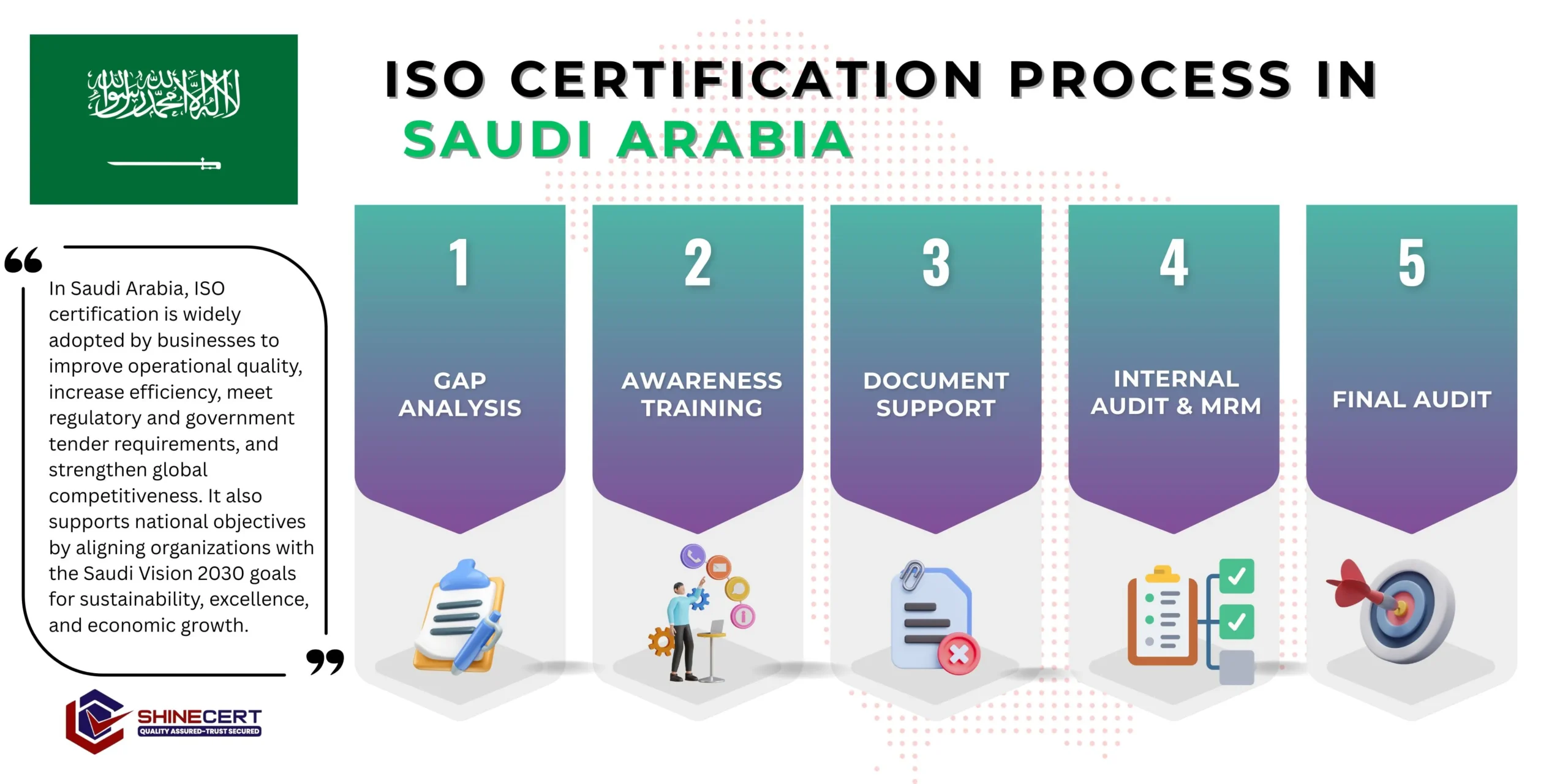
What are the steps to get ISO Certification?
our services
- ISO 9001 Certification
- ISO 14001 Certification
- ISO 27001 Certification
- ISO 22000 Certification
- ISO 45001 Certification
- ISO 13485 Certification
- ISO 20000 Certification
- ISO 17025 Certification
- CE Mark Certification
- GMP Certification
- Halal Certification
- SOC Certification
The ISO 20000 Implementation Process
Context, Leadership, and Service Scope
Define SMS scope and secure top management commitment to service quality.
SMS scope statement and service quality policy.
Service Design and Transition Planning
Establish planning and design processes for new or changed services, including service level requirements and capacity planning.
Service design plans and capacity management records.
Service Delivery Processes
Implement incident, problem, change, configuration, and service level management processes.
Documented incident, problem, change, and SLA management procedures.
Relationship and Supplier Management
Establish business relationship management and supplier management processes.
Business relationship and supplier management procedures.
Performance Evaluation
Establish monitoring against service levels, complete an internal audit cycle, and conduct management review before the certification audit.
SLA performance reports, internal audit report, and management review minutes.
Context, Leadership, and Service Scope
Define SMS scope and secure top management commitment to service quality.
SMS scope statement and service quality policy.
Service Design and Transition Planning
Establish planning and design processes for new or changed services, including service level requirements and capacity planning.
Service design plans and capacity management records.
Service Delivery Processes
Implement incident, problem, change, configuration, and service level management processes.
Documented incident, problem, change, and SLA management procedures.
Relationship and Supplier Management
Establish business relationship management and supplier management processes.
Business relationship and supplier management procedures.
Performance Evaluation
Establish monitoring against service levels, complete an internal audit cycle, and conduct management review before the certification audit.
SLA performance reports, internal audit report, and management review minutes.
The ISO 20000 Certification Process
Stage 1 Audit
Reviews SMS documentation, scope, and readiness for Stage 2.
DocumentationStage 2 Audit
An on-site audit assessing whether the SMS is genuinely implemented, reviewing incident and change records, service level performance data, and supplier management evidence.
Evidence sampledCertification Decision
Certification is issued once nonconformities are resolved, typically valid three years subject to surveillance.
Certificate issuedSurveillance and Recertification
Annual surveillance audits, with full recertification every three years.
Ongoing / every 3 yearsWhy ISO 20000 Certification Matters?
IT services fail in ways that are entirely preventable with structured management: changes deployed without proper assessment, incidents resolved inconsistently depending on which technician handles them, and capacity problems that surface only once customers are already affected. ISO 20000 certification demonstrates that incidents, changes, and service levels are managed through a structured, continually improving system, not that a service desk never experiences an incident, which no standard can promise.
ISO 20000 Certification Cost Explained
Cost depends on the number of services in scope, organizational complexity, and existing process maturity, organizations with established ITIL practices typically move faster and at lower cost, since much of the groundwork around service management and documentation is already in place, reducing the additional effort, time, and resources needed to close remaining gaps and bring the organization fully in line with certification requirements.
Mandatory Documented Information for ISO 20000
At minimum: SMS scope and service management policy; service level agreements; incident, problem, change, and configuration management procedures; business and supplier relationship management procedures; internal audit records; and management review records.
The Structure of ISO 20000: Clauses and Processes Explained
- Clause 4 — Context of the Organization : Requires defining SMS scope (services, teams, locations covered) and identifying interested parties’ service requirements.
- Clause 5 — Leadership : Requires top management commitment to service quality and continual improvement, with a service management policy.
- Clause 6 — Planning : Requires identifying risks to service delivery and setting service management objectives.
- Clause 7 — Support of the SMS : Covers resources, competence, awareness, communication, and documented information.
- Clause 8 — Operation of the SMS : The technical core, covering service planning, design, and transition of new or changed services; the core service delivery processes — incident management, problem management, change management, configuration management, and service level management; and business relationship and supplier management.
- Clause 9 — Performance Evaluation : Requires monitoring service performance against agreed service levels, internal audit, and management review.
- Clause 10 — Improvement : Requires corrective action addressing service gaps and continual improvement of the SMS.
Clause 8’s process requirements are where the real technical substance lives and where ShineCert most often finds gaps in organizations that have adopted ITIL terminology without building the underlying auditable system.
Configuration Management: The Foundation Most Skip
Configuration management means maintaining accurate, current information about the configuration items making up in-scope services, so incident diagnosis and change impact assessment rely on documented data rather than institutional memory. Starting with the configuration items that matter most and expanding coverage over time is a pragmatic, auditor-accepted approach.
Who Needs ISO 20000? Industries and Reverse Suitability?
- Managed service providers face the strongest commercial pressure to certify, since enterprise clients increasingly require it in vendor evaluation. Internal IT departments serving large organizations benefit from the service management maturity and accountability it demonstrates internally. IT outsourcing providers frequently face it as a contractual requirement.
- The reverse question: organizations whose primary IT risk is information security rather than service delivery consistency should prioritize ISO 27001 first, though the two pair naturally for organizations addressing both angles of IT risk together.
Benefits of ISO 20000 Certification
Enterprise clients increasingly require ISO 20000 certification when evaluating managed service provider vendors, often alongside ISO 27001.
Structured incident, problem, and change management processes reduce recurring outages and the operational chaos of inconsistent, technician-dependent service delivery.
Certification is frequently a stated requirement in IT outsourcing and managed services agreements.
Formal service level management gives both provider and customer a shared, measurable basis for service quality conversations, replacing informal or disputed service expectations.
Service Level Management and the Service Catalog
Service level management starts with a genuine service catalog describing services in terms the business understands, then sets SLA metrics that are both meaningful and realistically measurable, a common mistake is setting targets that sound impressive without the infrastructure maturity to reliably achieve them.
Capacity Planning and Avoiding Service Degradation
Capacity management requires understanding current and projected demand and planning upgrades proactively. Organizations that skip formal capacity planning discover the gap during peak demand or unexpected growth, precisely when service degradation is most damaging.
Multi-Supplier Environments: A Growing Certification Challenge
- Modern IT service delivery rarely involves a single provider anymore, cloud infrastructure providers, software vendors, network carriers, and specialist subcontractors typically all sit somewhere in the service chain, and ISO 20000’s business relationship and supplier management requirements become genuinely harder to satisfy as the number of parties involved grows.
- A managed service provider certifying its SMS needs to demonstrate that it manages its own suppliers’ service levels with the same discipline it applies internally, meaning supplier contracts need measurable service commitments, not vague best-effort language, and the provider needs a genuine process for escalating and remediating supplier service failures that affect the end customer. Organizations that certify without adequately addressing multi-supplier complexity frequently see this surface as an audit finding once an auditor asks how a specific customer-facing SLA is actually supported by the underlying supplier chain.
Service Reporting: Turning Data Into Customer Trust
Beyond the internal service level review meetings covered under service level management, regular service reporting to customers is what actually builds the ongoing commercial trust ISO 20000 certification is partly meant to support. Good service reporting goes beyond a raw uptime percentage, it contextualizes performance against agreed targets, explains any misses honestly rather than burying them in aggregate statistics, and surfaces upcoming changes or risks the customer should be aware of. Organizations that build genuinely transparent service reporting into their SMS from the start tend to have measurably easier commercial conversations at contract renewal, since the customer relationship isn’t starting from a position of having to dig for information the provider should have proactively shared.
Staff Adoption: Why Technical Process Documentation Alone Isn’t Enough
- A well-documented incident, change, or configuration management process only delivers value once frontline staff actually follow it consistently, and ShineCert consistently finds this adoption gap is a bigger risk to certification success than any single technical requirement. Technicians who have handled incidents informally for years, relying on personal judgment and institutional shortcuts, don’t automatically adopt a new formal process just because it’s been documented and approved by management, genuine adoption requires clear communication of why the process exists, hands-on training using real scenarios rather than abstract policy walkthroughs, and, critically, visible management reinforcement when the new process is followed even if it takes longer initially than the old informal approach.
- Organizations that skip this change-management dimension of implementation often find that documented processes and actual day-to-day practice diverge within weeks of going live, which surfaces as a serious conformity gap the moment a certification body auditor compares written procedure against actual staff interview responses and system records.
Continual Service Improvement: Making Clause 10 Real
- Clause 10’s improvement requirement is often satisfied on paper through a generic “lessons learned” log that nobody actually reviews or acts on, and ShineCert consistently finds this is where genuine SMS maturity is easiest to distinguish from a merely certified one. A functioning continual improvement process captures improvement opportunities from multiple real sources, customer feedback, incident and problem trends, internal audit findings, and staff suggestions, prioritizes them against genuine business impact rather than ease of implementation, and tracks them to actual completion with assigned ownership.
- Organizations that build this discipline into regular management review cycles, rather than treating improvement as a once-a-year audit preparation exercise, see their service management system’s real-world performance continue improving well after the initial certification project ends, which is ultimately the outcome the standard is designed to produce.
ISO 20000 vs. ISO 27001: Overlap and Divergence
Both standards share general management system disciplines and both touch incident management, but from different angles, ISO 27001 focuses on security incidents, ISO 20000 on restoring normal service operation regardless of cause. Organizations implementing both well typically build one shared change advisory process satisfying both perspectives, reducing total process overhead.
Problem Management: Learning From Incidents
Problem management investigates root cause once an incident is resolved, so the same disruption doesn’t recur, distinct from incident management’s focus on restoring service quickly. Organizations that skip formal problem management resolve the same recurring incident repeatedly without ever addressing why.
Ready to scope your ISO 20000 certification project? Book your free consultation or contact ShineCert directly.
Book Free ConsultationReady to scope your ISO 20000 certification project? Book your free consultation or contact ShineCert directly.
Book Free ConsultationChoosing an Accredited Certification Body
Confirm current IAF-recognized ISO 20000 accreditation and sector experience relevant to your service delivery model, MSP-focused and internal-IT-focused auditors bring different, relevant perspectives.
ISO 20000 Certification Timeline
Phase | Typical Duration |
Gap assessment and scoping | 1–2 weeks |
Service management process documentation | 4–8 weeks |
Implementation and metric baseline | 4–8 weeks |
Internal audit and management review | 2–4 weeks |
Stage 1 and Stage 2 audits | 2–3 days combined |
Certificate issuance | 2–6 weeks after Stage 2 |
Why Choose ShineCert for ISO 20000 Certification?
ShineCert has guided more than 10,000 organizations through ISO certification from genuine operating offices in Riyadh, Lebanon, and India, with meaningful IT service management experience across managed service providers and enterprise IT departments.
Common Implementation Challenges
- SLAs documented but not consistently measured : Undermines the entire service management system’s credibility.
- Change management was bypassed under pressure : Emergency changes that skip formal processes create audit findings and real operational risk.
- Supplier dependencies under-documented : Many services depend on third-party infrastructure without adequate relationship management.
- Confusing ITIL adoption with certification : ITIL practices alone don’t satisfy ISO 20000’s management system and audit requirements.
Frequently Asked Questions
It certifies an IT service management system against an internationally recognized standard. It’s increasingly valuable for managed service providers and IT organizations facing enterprise client requirements.
No. ITIL is a best-practice framework; ISO 20000 is the certifiable standard defining what a service management system must achieve.
It depends on the number of services in scope, complexity, and process maturity. ShineCert provides a fixed quote after scoping.
Most organizations move from kickoff to certificate in three to six months.
SMS scope, service management policy, SLAs, incident/problem/change/configuration procedures, and management review records.
Managed service providers, IT outsourcing providers, and internal IT departments serving large organizations.