
ISO 31000 certification
Risk Management
Quick Answer
ISO 31000 is an international guidance standard for risk management, published by ISO. Unlike ISO 9001 or ISO 27001, it is not designed for third-party certification, there is no accredited, IAF-recognized “ISO 31000 certificate.” Instead, organizations implement it as a framework, and ShineCert delivers a documented conformity gap assessment alongside a genuinely functioning risk management framework. Most implementations take three to six months, with cost driven by organizational complexity and current risk maturity.
Introduction
Most consultancy websites sell “ISO 31000 certification” without mentioning that no such accredited certificate exists. This page explains what ISO 31000 actually is, its three-part structure, what genuine implementation involves, what it costs, and what ShineCert delivers instead of a misleading certificate. ShineCert believes this distinction is worth stating plainly, consistent with our commitment to accurate guidance rather than selling around an inconvenient fact.
What Is ISO 31000? Understanding the Standard
ISO 31000:2018 provides principles, a framework, and a process for managing risk, applicable to any organization regardless of size, activity, or sector. It was deliberately written as adaptable guidance rather than a checklist of auditable requirements, which is precisely why no accredited certification scheme exists against it. Some training providers offer “ISO 31000 certificates” that certify an individual’s completion of training, or an organization’s self-attestation, neither is an accredited third-party audit comparable to ISO 9001 or ISO 27001 certification.
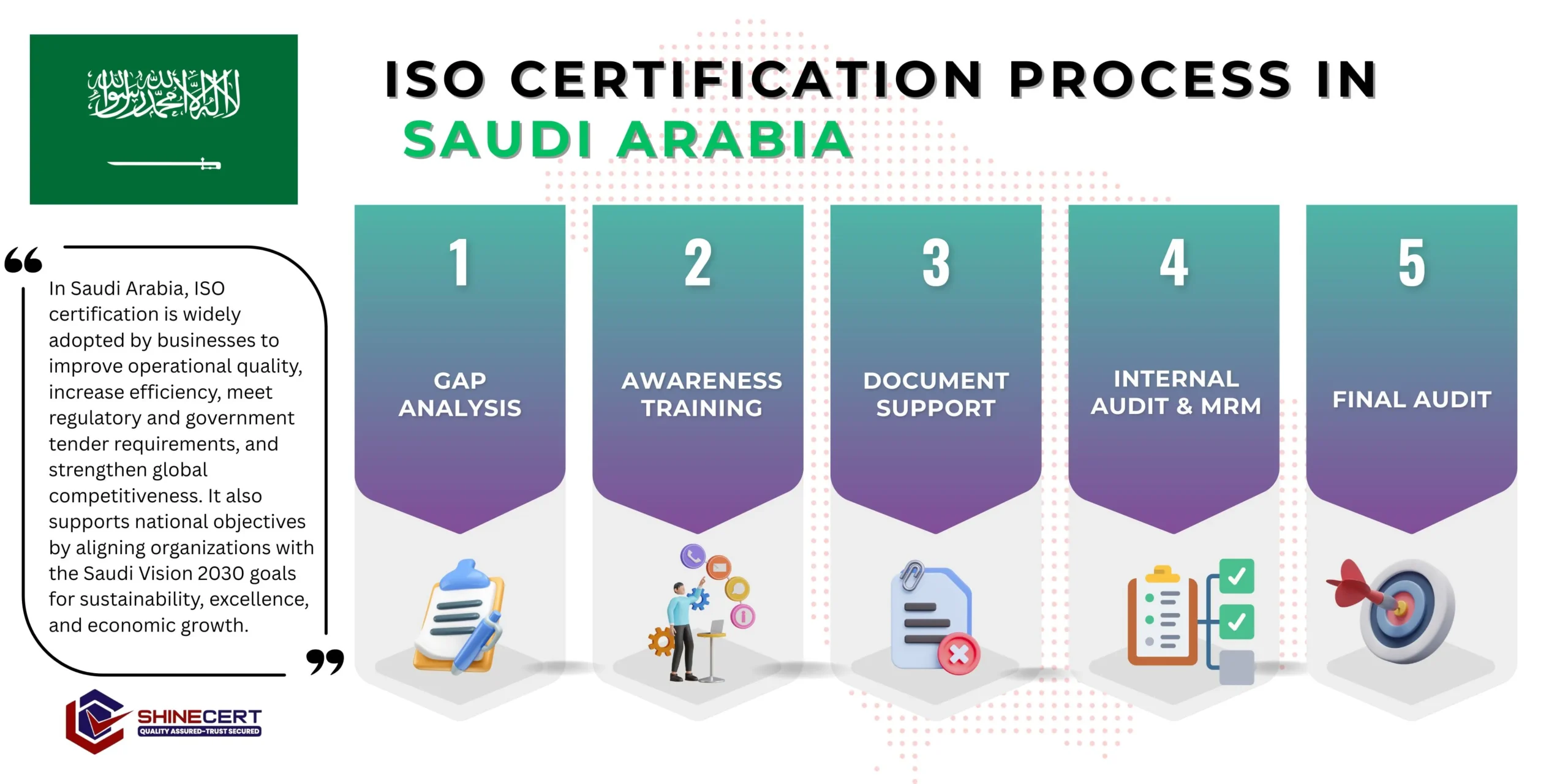
What are the steps to get ISO Certification?
our services
- ISO 9001 Certification
- ISO 14001 Certification
- ISO 27001 Certification
- ISO 22000 Certification
- ISO 45001 Certification
- ISO 13485 Certification
- ISO 17025 Certification
- CE Mark Certification
- GMP Certification
- Halal Certification
- SOC Certification
The ISO 31000 Implementation Process
Mandate and Commitment
Secure genuine leadership commitment to risk management as a governance priority, and establish a risk management policy and objectives.
Risk management policy and documented leadership mandate.
Framework Design
Design how risk is identified, assessed, treated, monitored, and reported, integrated with existing decision-making processes rather than running parallel to them.
Documented risk management framework.
Risk Assessment Methodology Rollout
Implement a consistent, organization-wide risk identification, analysis, and evaluation methodology, calibrated to the organization's actual risk appetite and tolerance.
Risk register and calibrated evaluation criteria.
Risk Treatment and Ownership
Establish risk treatment plans with clearly assigned ownership, integrated into actual operational and strategic planning.
Risk treatment plans with named owners.
Monitoring, Review, and Continual Improvement
Establish ongoing monitoring and periodic review, with genuine mechanisms for updating the framework as organizational context changes.
Monitoring schedule and framework review records.
Mandate and Commitment
Secure genuine leadership commitment to risk management as a governance priority, and establish a risk management policy and objectives.
Risk management policy and documented leadership mandate.
Framework Design
Design how risk is identified, assessed, treated, monitored, and reported, integrated with existing decision-making processes rather than running parallel to them.
Documented risk management framework.
Risk Assessment Methodology Rollout
Implement a consistent, organization-wide risk identification, analysis, and evaluation methodology, calibrated to the organization's actual risk appetite and tolerance.
Risk register and calibrated evaluation criteria.
Risk Treatment and Ownership
Establish risk treatment plans with clearly assigned ownership, integrated into actual operational and strategic planning.
Risk treatment plans with named owners.
Monitoring, Review, and Continual Improvement
Establish ongoing monitoring and periodic review, with genuine mechanisms for updating the framework as organizational context changes.
Monitoring schedule and framework review records.
The ISO 31000 Conformity Assessment Process
Because no accredited certification scheme exists, this process differs from a typical ISO audit. ShineCert conducts a documented gap assessment against the standard’s principles and framework requirements, evaluating whether the delivered framework genuinely reflects ISO 31000’s structure, not a pass/fail accredited audit, but a rigorous, honest conformity evaluation with a written report identifying strengths and remaining gaps. Some organizations also pursue independent training certification for key risk staff, which is a distinct, complementary exercise, not a substitute for the framework itself.
Why ISO 31000 Alignment Matters?
Ad hoc, department-siloed risk management breaks down as organizations grow: different teams score risk on different scales, nobody has a consistent basis for deciding which risks warrant board attention, and risk decisions become disconnected from actual strategic and operational planning. ISO 31000 alignment gives organizations one consistent risk language and methodology, and gives boards a recognized, internationally consistent framework for risk governance conversations.
ISO 31000 Certification Cost Explained
Cost depends on organizational complexity (number of business units, geographic spread), current risk management maturity, and how deeply the framework needs to integrate with existing governance and planning processes, all of which shape the overall time, effort, and resources required to implement the framework effectively across different departments, regions, and layers of organizational decision-making and long-term strategic planning.
Mandatory Documentation for ISO 31000 Alignment
At minimum, a genuine framework requires: a risk management policy and objectives; a documented framework describing roles, integration, and reporting lines; a risk assessment methodology; an enterprise risk register; risk treatment plans with assigned ownership; and monitoring and review records demonstrating the framework operates continually rather than once.
The Structure of ISO 31000: Principles, Framework, and Process Explained
- The Principles : Eight principles describe what effective risk management should achieve: it should be integrated into organizational activities, structured and comprehensive, customized to the organization’s context, inclusive of stakeholders, dynamic and responsive to change, based on the best available information, mindful of human and cultural factors, and subject to continual improvement.
- The Framework : The framework describes the organizational arrangements needed to design, implement, evaluate, and improve risk management across the organization: leadership and commitment, integration into governance, design of the approach, implementation, evaluation, and improvement. This is the structural layer that turns the principles into an operating system.
- The Process : The process is the practical, repeatable sequence applied to any specific risk: establishing scope and context, risk assessment (identification, analysis, and evaluation), risk treatment, and ongoing monitoring, review, recording, and reporting, with communication and consultation running throughout.
Understanding these three layers separately matters because organizations frequently build a risk register (the process output) without ever building the framework or embedding the principles, producing a document that looks like risk management without functioning as it.
Who Benefits From ISO 31000? Suitability and Reverse Fit
- Organizations implementing multiple ISO management system standards benefit most directly, since ISO 31000 principles underpin the risk-based thinking already required across those standards. Boards and executive teams seeking structured enterprise risk oversight, and organizations preparing for investor, insurer, or regulator risk scrutiny, are also strong fits.
- The reverse question: organizations seeking an accredited, auditable certificate to present to customers or regulators should look at a certifiable management system standard instead, ISO 27001 for information security risk, or a combination of certifiable standards with ISO 31000 as the connective framework underneath them, rather than expecting ISO 31000 alone to satisfy an accredited-certificate requirement.
Benefits of ISO 31000 Alignment
A documented, ISO 31000-aligned framework demonstrates structured risk maturity to investors, insurers, and regulators, even without a certificate to point to.
For organizations implementing ISO 9001, 27001, 45001, or 14001, ISO 31000 principles underpin the risk-based thinking those certifiable standards already require, implementing it as shared groundwork improves coherence and reduces duplicated risk methodology across multiple certifications.
A genuinely embedded framework, not just a risk register, gets risk considerations built into standard decision-making templates and business cases, rather than existing as a separate report nobody references when decisions are actually made.
Organizations that embed risk-aware thinking into how people actually make decisions, not just how a risk function reports upward, build lasting risk maturity that survives staff turnover and organizational change.
How ISO 31000 Relates to Sector-Specific Risk Frameworks
- Many industries already operate under sector-specific risk frameworks, Basel III capital adequacy risk frameworks in banking, COSO enterprise risk management frameworks in listed US companies, or national cybersecurity risk frameworks in critical infrastructure. A frequent and reasonable question is whether adopting ISO 31000 means replacing these existing frameworks.
- In practice, ISO 31000 is deliberately generic enough to sit alongside sector-specific frameworks rather than compete with them: it provides the overarching principles and process language, while the sector-specific framework provides the detailed technical methodology for that industry’s particular risk categories. Organizations already operating under a mature sector framework typically use ISO 31000 to fill genuine gaps, extending structured risk thinking into business areas the sector framework doesn’t cover, or providing a common vocabulary that helps risk conversations move between the specialized framework and the rest of the organization.
Integrating ISO 31000 With Certifiable Standards You Already Hold
- Organizations already certified to ISO 9001, ISO 27001, or ISO 45001 often find their existing risk-based thinking requirements, Clause 6 in each of those standards are satisfied more thoroughly and consistently once a genuine ISO 31000-aligned framework sits underneath them. Rather than each management system maintaining its own siloed risk register using its own methodology, a shared enterprise framework lets risk information flow between systems: a supply chain risk identified through quality management can inform business continuity planning, and a cybersecurity risk identified through information security management can inform overall enterprise risk reporting to the board.
- ShineCert frequently recommends implementing or formalizing ISO 31000 alongside a first or second certifiable standard specifically because the marginal cost of building one coherent framework is lower than maintaining multiple disconnected risk processes over time.
Risk Appetite and Tolerance: Getting the Calibration Right
Calibrating risk appetite (how much risk the organization will accept in pursuit of objectives) and risk tolerance (acceptable variation around specific risk levels) is a leadership and governance decision, not something a risk function can determine unilaterally. This typically requires structured board-level workshops addressing appetite by category, financial, operational, reputational, regulatory, strategic, since appetite genuinely varies by risk type even within one organization.
Risk Assessment Techniques ISO 31000 Actually Points To
ISO 31000 describes principles and a framework rather than prescribing specific techniques, but its companion standard, IEC 31010, catalogs the methods organizations commonly use in practice: structured brainstorming and scenario analysis for identifying risks, and qualitative risk matrices or quantitative methods like Monte Carlo simulation for analyzing them, with the choice driven by how much reliable data exists and how much precision a given decision genuinely requires.
Ready to scope your ISO 31000 certification project? Book your free consultation or contact ShineCert directly.
Book Free ConsultationReady to scope your ISO 31000 certification project? Book your free consultation or contact ShineCert directly.
Book Free ConsultationChoosing an Implementation Partner
Since no accredited certification body relationship applies here, the relevant choice is an implementation partner with genuine cross-sector risk management experience and, ideally, direct experience integrating ISO 31000 alongside certifiable standards you already hold or are pursuing.
ISO 31000 Implementation Timeline
Phase | Typical Duration |
Mandate, commitment, and initial scoping | 2–3 weeks |
Framework design | 3–6 weeks |
Risk assessment methodology rollout | 4–8 weeks |
Integration into planning and governance | Ongoing, typically 2–3 months to first full cycle |
Why Choose ShineCert for ISO 31000 Implementation?
ShineCert has guided more than 10,000 organizations through ISO-related consulting, and we’d rather tell you honestly that ISO 31000 isn’t an accredited certification than sell you a “certificate” that won’t hold up to scrutiny. What we deliver is a genuinely functioning risk management framework, built around your actual governance structure.
Common Implementation Challenges
- Building a risk register that never informs actual decisions : Disconnected from real planning, it delivers little value regardless of documentation quality.
- Inconsistent methodology across business units : Different departments scoring risk on different scales makes enterprise comparison meaningless.
- Treating the framework as a one-time project : ISO 31000 explicitly frames risk management as continual; a project with a defined end date tends to atrophy afterward.
- Overstating what an engagement delivers externally : Confusing ISO 31000 alignment with accredited certification when communicating to investors or regulators risks a credibility problem later.
Frequently Asked Questions
ISO 31000 is a risk management guidance standard, not an accredited certifiable standard — there is no IAF-recognized “ISO 31000 certificate.” Implementation is worth it for organizations seeking a coherent, recognized risk management framework, especially alongside other ISO certifications.
No. Some bodies offer training certificates or self-attestation documents, which are different from third-party accredited certification.
It depends on organizational complexity, current risk maturity, and integration depth. ShineCert provides a fixed quote after scoping.
Framework design and initial rollout typically take three to six months.
A risk management policy, a documented framework, a risk assessment methodology, an enterprise risk register, risk treatment plans, and monitoring and review records.
Those implementing multiple certifiable ISO standards, and boards seeking structured risk governance independent of any single certification.